
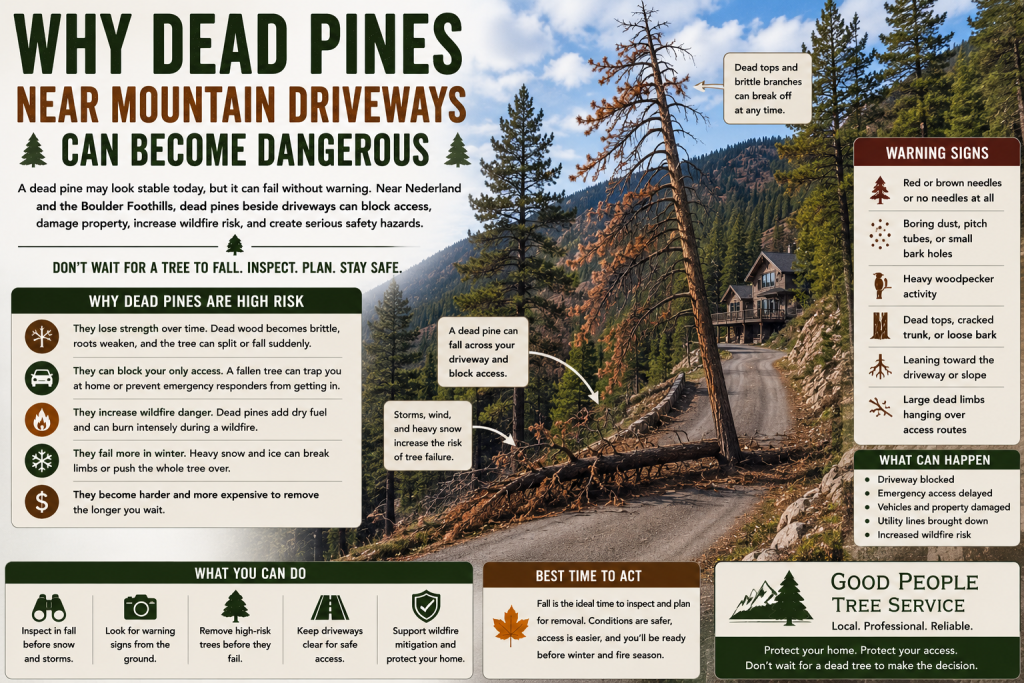
Why dead pines near mountain driveways can become dangerous is something many Colorado mountain homeowners do not think about until a tree falls, blocks access, drops limbs, or becomes too brittle to remove easily. A dead pine may stand quietly for months or even longer. It may look stable from the driveway. It may not move much in light wind. But once a pine dies, the tree starts losing strength.
Near Nederland, the Boulder Foothills, and other mountain communities, a dead pine beside a driveway creates more than a tree-care problem. It can become an access problem, a wildfire fuel problem, a winter storm problem, and a safety problem. Mountain driveways are often steep, narrow, winding, shaded, or the only route between a home and the main road. A dead tree that falls across that route can trap vehicles, block emergency responders, stop snowplows, or delay evacuation.
Dead pines also behave differently than healthy trees. Branches dry out. Tops can snap. Trunks can crack. Roots can weaken. Bark may loosen. Beetle damage may already exist. Wind, snow, slope, and gravity can turn a dead standing tree into a sudden hazard.
Understanding why dead pines near mountain driveways can become dangerous helps homeowners act before the tree becomes an emergency.
If you have dead, beetle-damaged, leaning, or red-needled pines near a mountain driveway, Good People Tree Service can inspect the property and help determine whether removal, monitoring, or mitigation makes the most sense.
Why dead pines near mountain driveways can become dangerous
Why dead pines near mountain driveways can become dangerous starts with location. A dead tree in the middle of a remote forested area may not create immediate risk if it cannot hit people, structures, roads, or access routes. A dead pine beside a driveway is different.
The driveway is a target. It may carry family vehicles, delivery trucks, contractors, fire crews, utility workers, and snow removal equipment. It may also serve as the only escape route during wildfire, wind events, or winter storms.
When a dead pine stands close enough to fall across that route, the risk becomes practical and immediate. The tree does not need to hit the house to create a serious problem. It only needs to block access at the wrong time.
A dead pine near a driveway should be judged by what it could hit, what it could block, and how difficult it would be to remove if it failed during bad weather.
Dead pines lose strength over time
A living pine has moisture, flexible tissues, and active defense systems. A dead pine does not. Once the tree dies, branches and trunk sections begin to dry. The wood can become brittle. Bark may loosen. Internal decay can start. Roots may lose anchoring strength.
This process does not follow a simple universal timeline. Species, weather exposure, insects, decay, soil conditions, slope, and tree size all affect how long a dead pine can stand.
That uncertainty is the problem. A homeowner may look at a dead pine and think, “It has stood this long, so it is probably fine.” But standing does not mean safe. A dead tree can remain upright until wind, snow, soil movement, or decay finally changes the balance.
The longer a dead pine stands near a driveway, the more attention it deserves.
Mountain driveways make the risk more serious
Mountain driveways near Nederland and the Boulder Foothills often have features that increase risk. They may be steep. They may have tight turns. They may run below slopes. They may pass through dense conifers. They may be difficult for large equipment to access.
A fallen pine can block a driveway completely. If snow, ice, darkness, or high wind arrives at the same time, removal becomes harder. A blocked driveway can prevent residents from leaving and prevent help from reaching the property.
This matters during medical emergencies, wildfire evacuation warnings, winter storms, utility outages, and snow removal. A dead pine near the driveway can become a safety issue even when it stands far from the house.
Homeowners should inspect trees along the entire driveway, not only the trees near the home.
Dead pines can fall without much warning
A dead pine can fail in several ways. A large branch may drop first. The top may break out. The trunk may snap at a weak point. The root system may give way. A tree on a slope may fall downhill across the driveway.
Failure does not always happen during an extreme storm. Dead branches can fall during calm weather. A brittle top can break during moderate wind. A tree with root decay can fall after soil moisture changes.
This unpredictability makes dead pines near driveways hard to ignore. Homeowners cannot control when the tree fails, but they can control whether they inspect and remove high-risk trees before failure occurs.
Wind exposure increases risk
Mountain properties often experience stronger and more variable wind than lower-elevation neighborhoods. A dead pine on a ridge, slope, open driveway edge, or gap in the forest may face repeated wind pressure.
Wind can move a dead pine differently than a flexible living tree. Dead limbs may snap. Cracks can widen. A trunk weakened by beetles or decay may break. If the tree leans toward the driveway, wind can push it farther in the failure direction.
Repeated wind events also matter. A tree may survive one storm but weaken during the process. The next storm may finish the job.
Fall and winter inspections help homeowners find dead pines before seasonal wind turns them into access hazards.
Snow load can break dead pine tops and limbs
Pines can hold snow on branches and needles. Dead pines may no longer have the same flexibility or strength to handle that load. Heavy, wet snow can break dead tops, snap large limbs, or pull a weakened tree toward the driveway.
In mountain areas, snow also complicates cleanup. A fallen tree across a driveway during winter can be frozen into snow, buried under additional accumulation, or difficult to cut safely on icy ground.
A dead pine that seems manageable in October can become a bigger problem after a November or December storm.
Removing high-risk dead pines before snow season often reduces emergency work later.
Slopes change fall direction and cleanup difficulty
Many mountain driveways cut across slopes. A dead pine above the driveway can fall downhill. A tree below the driveway can fall upward or sideways depending on lean, root condition, and wind direction, but downhill force often increases concern.
Slopes also make removal more difficult. Logs can roll. Branches can slide. Equipment setup can be limited. A dead pine may be harder to control if it stands on rocky, uneven, or steep ground.
Homeowners should not try to remove large dead pines on slopes without proper training and equipment. Dead trees can split, shift, or fall in unexpected ways.
A professional tree crew can assess the fall path, access, slope, rigging needs, and cleanup plan before cutting begins.
Beetle-killed pines can become especially brittle
Many dead pines near Nederland and the Boulder Foothills die from bark beetle activity, drought stress, or a combination of both. Mountain pine beetles, Ips beetles, and other bark beetles attack stressed conifers and damage tissue under the bark.
A beetle-killed pine may show boring dust, pitch tubes, small holes, fading needles, red or brown needles, woodpecker activity, and loose bark. By the time the crown turns red or brown, the tree may already be dead or close to it.
Beetle-killed pines near driveways create several concerns. They can become brittle. They can add dry fuel. They may indicate stress in nearby trees. They may become more difficult to remove if homeowners wait too long.
A red or dead pine near a driveway should be inspected early, not after the tree starts dropping large pieces.
Dead pines can increase wildfire concerns
Dead pines and dry branches can add fuel to a mountain property. A dead tree beside a driveway can also affect defensible space, access, and evacuation planning.
Wildfire mitigation focuses on reducing fuels near homes and along important access routes. A dead pine close to a driveway may create risk because it can burn, fall, block access, or contribute to debris near the road.
This does not mean every tree along a driveway should come down. Healthy, well-spaced trees can remain valuable. The concern is dead, dying, crowded, beetle-damaged, or unstable trees that create fuel or access problems.
Removing dead pines near mountain driveways can support both safety and wildfire readiness.
Driveway clearance matters for emergency response
A mountain driveway should allow emergency vehicles, fire crews, utility crews, and snowplows to access the property when needed. Dead pines close to the route can threaten that access.
A tree does not need to fall completely across the driveway to create a problem. Large limbs can hang low. A broken top can block part of the road. A leaning dead tree can reduce clearance for taller vehicles. Fallen debris can make a steep driveway unsafe.
When inspecting dead pines, look at the full width and height of the access corridor. Check both sides of the driveway, turns, slopes above the road, and areas near gates or turnarounds.
Access planning is one of the main reasons dead pines near mountain driveways become more urgent than dead trees in open woods.
Utility lines and dead pines are a dangerous combination
Some mountain driveways have overhead utility lines nearby. A dead pine near a line can become extremely dangerous if it falls, drops branches, or leans into the utility corridor.
Homeowners should never cut a tree that touches or may fall into power lines. Dead trees can break unpredictably. A branch can shift during cutting. A trunk can twist as it falls. If electricity is involved, the risk becomes severe.
If a dead pine stands near utility lines, contact the utility company or a qualified tree professional. Do not try to pull, rope, climb, or cut it yourself.
Power-line proximity can change the entire removal plan.
Dead pines can damage vehicles and property
Many mountain driveways also serve as parking areas, staging areas, or work zones. A dead pine near these areas can damage vehicles, trailers, equipment, fences, gates, retaining walls, and snowplow markers.
Large pine branches can be heavy. A dead top can cause serious damage if it lands on a parked car or plow route. A trunk failure can damage drainage features, culverts, or driveway surfaces.
Property damage risk increases when dead pines stand near tight access points. A tree that falls in the wrong direction may hit more than the driveway. It may damage the house, garage, retaining wall, or neighboring property.
Early removal helps homeowners control the timing and reduce surprise damage.
Dead trees can become harder and more expensive to remove
A dead pine often becomes more difficult to remove as it deteriorates. Branches may snap during climbing. The trunk may not support normal rigging. Bark may loosen. Wood may crack. The tree may become unsafe to climb.
When that happens, removal may require additional equipment, more setup time, or a different approach. Steep driveways, limited access, and nearby structures can add complexity.
Removing a dead pine while it still has enough structural integrity can be safer and more controlled than waiting until it becomes brittle.
Delay does not always save money. It can make the final job harder.
Not every dead pine needs immediate removal
Dead trees can provide wildlife habitat in some settings. A standing dead tree far from homes, roads, trails, driveways, power lines, and defensible space zones may not need immediate removal.
The difference is target risk. A dead pine beside a driveway has a target. A dead pine deep in the back of a large forested parcel may not.
Homeowners should prioritize based on location. Start with dead pines that could hit the home, driveway, road, deck, propane tank, garage, utility line, or neighbor’s property. Lower-risk trees farther away can be monitored or handled later.
This approach avoids unnecessary clearing while still addressing real hazards.
Warning signs homeowners should not ignore
Dead pines near mountain driveways deserve attention when you see:
- red or brown needles
- no needles on large sections
- boring dust near bark or roots
- pitch tubes
- small bark holes
- heavy woodpecker activity
- loose bark
- dead top
- trunk cracks
- lean toward the driveway
- root movement
- large dead limbs
- tree growing above a steep driveway
- branches hanging over access routes
- nearby trees showing similar symptoms
Several signs together increase concern. A red pine with boring dust above the driveway should be inspected quickly.
How to inspect safely from the ground
Homeowners can do a basic inspection without climbing or cutting.
Stand back and look at the whole tree. Notice whether it leans toward the driveway. Look at the crown color. Check whether branches overhang the travel path. Look at the trunk for holes, pitch, cracks, and missing bark.
Then look at the ground. Check for boring dust, lifted roots, soil cracks, erosion, and slope movement. Walk the driveway and notice whether the tree could block the route if it fell.
Do not stand under dead limbs. Do not pull on dead branches. Do not climb a dead pine. Do not cut near power lines.
A ground inspection can help you decide when to call a tree service.
What homeowners should not do
Do not wait for a dead pine to fall before taking action near a driveway. Emergency removal during snow, wind, or evacuation conditions is harder and riskier.
Do not stack beetle-killed pine slash or logs near healthy pines, under decks, or against the home. Fresh or infested material may create pest or fuel concerns.
Do not assume a red pine can recover. Once a pine has turned red or brown after successful beetle attack, it often has poor recovery potential.
Do not try to remove a large dead pine yourself on steep ground, near structures, or beside utility lines. Dead tree work is dangerous.
When removal usually makes sense
Removal usually makes sense when a dead pine can fall across a driveway, block a road, hit a vehicle, damage a structure, affect utility lines, or add fuel near a defensible space zone.
Removal also makes sense when the pine is beetle-killed, brittle, leaning, cracked, or standing above a steep access route.
A tree service can help determine whether the pine should be removed immediately or scheduled before winter, fire season, or the next major storm cycle.
The safest timing is usually before the tree creates an emergency.
Case example: the red pine above a steep driveway
A homeowner near Nederland notices a pine above the driveway turning red. Reddish dust sits in bark crevices. Woodpeckers have chipped pieces from the trunk. The tree leans slightly toward the driveway.
This pine creates a strong removal case. It may be beetle-killed. It stands above the access route. If it falls, it can block the driveway and create emergency access problems.
Waiting may allow the tree to become more brittle. A planned removal before winter or high winds may reduce risk and cost.
Case example: the dead pine near a turnaround
A dead pine stands near a mountain driveway turnaround. It cannot hit the house, but it can fall into the only place where fire trucks, snowplows, and delivery vehicles can turn around.
This tree matters because access matters. The homeowner may not think of the turnaround as a target, but emergency vehicles need space to maneuver.
Removing the dead pine can help preserve safe access.
Case example: the old dead pine far from access
A dead pine stands deep in the back of a forested lot. It cannot hit the home, driveway, road, utility line, or trail. It does not affect defensible space around the house.
This tree may be lower priority. It may be monitored, left for wildlife habitat, or removed later as part of broader forest management.
This example shows why the driveway location is so important. Dead does not always mean urgent. Dead near access often does.
Planning removal before winter
Fall is often a smart time to inspect dead pines near mountain driveways. Homeowners can still see the driveway, slopes, root zone, and access points before snow covers the ground. Tree crews may have better access before ice and snow make the site harder to work.
Removing dead pines before winter also reduces the chance of a blocked driveway during a storm. It can help prepare the property for snowplows, propane deliveries, utility access, and emergency response.
If a dead pine has stood through summer, fall is a good time to decide whether it should stay through winter.
Planning removal before fire season
Spring and early summer are also important planning windows. Dead pines near driveways can affect wildfire readiness and defensible space.
If a dead tree may block evacuation or add fuel near the access route, removal before peak fire conditions can make the property safer.
Slash cleanup matters too. Removal should include a plan for branches, logs, needles, and chips so the material does not create a new fuel issue.
A well-planned removal supports both driveway access and wildfire mitigation.
When to call a tree service
Call a tree service when a pine near your mountain driveway is dead, red, beetle-damaged, leaning, cracked, dropping limbs, or standing above the access route. Also call if the tree is near utility lines, structures, steep slopes, or defensible space zones.
Good People Tree Service can inspect the tree, evaluate visible risk factors, and help plan removal before the tree blocks access or becomes more difficult to remove safely.
Frequently asked questions
Are dead pines near mountain driveways dangerous?
They can be. A dead pine near a driveway can fall, drop limbs, block access, damage vehicles, affect emergency response, or add wildfire fuel.
How do I know if a pine is dead or beetle-killed?
Look for red or brown needles, boring dust, pitch tubes, small bark holes, loose bark, woodpecker activity, and dead tops. A professional inspection can confirm the likely cause.
Should I remove every dead pine on my property?
No. Start with dead pines near homes, driveways, roads, power lines, decks, propane tanks, and defensible space areas. Dead trees far from targets may be lower priority.
Can a red pine recover?
A pine that turns red or brown after beetle attack usually has poor recovery potential. Green stressed pines may have more options if beetles have not successfully colonized them.
When is the best time to remove a dead pine near a driveway?
Before it becomes an emergency. Fall can be a good time before snow. Spring can be important before fire season. The right timing depends on risk, access, and tree condition.
Final thoughts
Why dead pines near mountain driveways can become dangerous comes down to access, timing, and tree failure risk. A dead pine may not threaten the home directly, but it can still block the only driveway, damage vehicles, slow emergency response, affect snow removal, or add wildfire fuel.
Near Nederland and the Boulder Foothills, mountain driveways often run through steep, forested, windy, and fire-prone terrain. Dead pines in those areas deserve careful inspection, especially when they show beetle damage, lean toward the access route, or stand above steep slopes.
The best approach is selective. Remove dead pines that threaten access, structures, utilities, or defensible space. Monitor lower-risk dead trees away from targets when appropriate. Manage slash and logs properly after removal.
Good People Tree Service helps mountain homeowners inspect dead and beetle-damaged pines, plan safe removals, and protect access routes before storms or fire season make the problem urgent.
If you have a dead pine near your mountain driveway, schedule an inspection before it falls, blocks access, or becomes harder to remove safely.