
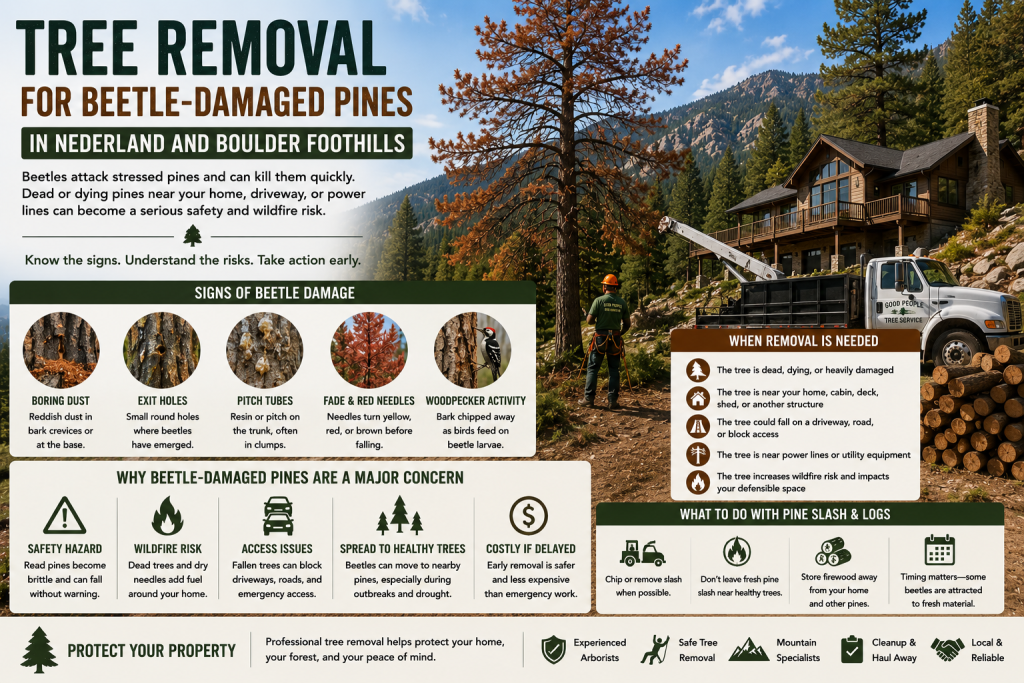
Tree removal for beetle-damaged pines in Nederland and Boulder Foothills often becomes necessary when bark beetles have already killed or seriously weakened a pine near a home, driveway, road, deck, power line, propane tank, or defensible space zone. A beetle-damaged pine may start as a forest-health concern, but on a mountain property, it can quickly become a safety, access, wildfire, and property-risk issue.
Nederland and the Boulder Foothills have many pine-covered properties where trees grow close to homes, cabins, roads, and steep slopes. These trees add privacy, shade, wildlife habitat, and mountain character. They also face drought stress, dense competition, strong winds, heavy snow, rocky soils, and bark beetle pressure.
When pine trees become stressed, bark beetles can take advantage. Mountain pine beetles, Ips beetles, and other bark beetles attack trees under the bark. They damage the living tissue that moves water and nutrients. Once beetles successfully colonize a pine, the tree may fade, turn red or brown, drop needles, attract woodpeckers, and eventually die.
Tree removal for beetle-damaged pines in Nederland and Boulder Foothills should not be treated as simple yard cleanup. The timing, location, slope, access, nearby structures, surrounding trees, and debris management all matter.
If you have a pine with boring dust, pitch, bark holes, fading needles, woodpecker activity, or sudden decline near Nederland or the Boulder Foothills, Good People Tree Service can inspect the tree and help determine whether removal, monitoring, or mitigation is the right next step.
Tree removal for beetle-damaged pines in Nederland and Boulder Foothills
Tree removal for beetle-damaged pines in Nederland and Boulder Foothills starts with one key question: is the tree still viable, or has beetle damage moved too far?
Some stressed pines can recover if beetles have not successfully attacked the tree and the main issue is drought, root stress, or poor site conditions. Other pines are already beyond saving by the time symptoms become visible.
A pine with widespread crown fade, boring dust, exit holes, heavy woodpecker activity, and red or brown needles may already be dead or in advanced decline. At that point, treatment may not make sense. Removal may protect nearby targets and reduce future hazards.
Location changes the urgency. A beetle-damaged pine deep in the woods creates a different concern than one leaning over a driveway, cabin, road, deck, or utility corridor.
Why pine beetle damage matters near Nederland
Nederland-area properties sit in a mountain environment where tree problems can affect much more than appearance. A beetle-damaged pine can threaten access, structures, wildfire planning, and surrounding trees.
Many properties have narrow driveways, steep slopes, forested lots, and limited equipment access. If a dead pine falls across a driveway during a windstorm, it can block homeowners, emergency vehicles, snowplows, or service providers. If a beetle-killed tree stands near a home, it can drop branches or fail as the wood dries and weakens.
The Boulder Foothills also sit in a wildfire-prone landscape. A dead standing tree, dry branches, red needles, or unmanaged slash can add fuel. Removal may become part of a larger defensible space or forest-health strategy.
This is why beetle-damaged pine removal near Nederland should be planned carefully instead of delayed until the tree falls.
Mountain pine beetle and Ips beetles are different
Homeowners often call every bark beetle problem “pine beetle.” That is understandable, but correct identification matters.
Mountain pine beetles often attack ponderosa, lodgepole, and other pines. Ips beetles also attack stressed pines and spruce. They can behave differently, use different host material, and require different management decisions.
Ips beetles often take advantage of drought-stressed trees and freshly cut pine or spruce material. Fresh green slash, logs, and firewood can attract them if left unmanaged during active periods.
Mountain pine beetle can create larger outbreak concerns in ponderosa pine forests. In a residential setting, both pests can matter when they attack trees near homes, roads, or defensible space areas.
A professional inspection can help determine whether the tree shows signs of active beetle attack, old beetle damage, drought stress, or another issue.
Signs a pine may have beetle damage
Beetle-damaged pines can show several warning signs. Homeowners should look at the trunk, lower bark, canopy, and surrounding ground.
Common signs include:
- boring dust in bark crevices
- reddish-brown dust near the tree base
- small round holes in the bark
- pitch tubes or resin masses
- fading green needles
- yellow, red, or brown crown color
- woodpecker activity
- bark flaking from bird feeding
- dead branches or top dieback
- loose bark
- nearby trees showing similar symptoms
The most important clue is pattern. One small spot may not tell the whole story. Multiple signs together usually raise concern.
Do not peel off large sections of bark to investigate. That can damage living trees and create safety issues around dead trees. A tree service can inspect symptoms without unnecessary harm.
Crown color can tell you the stage of decline
Pine needles often change color after successful bark beetle attack. A tree may look green for a while even after beetles have entered under the bark. Later, needles may fade, yellow, turn red, or become brown.
This delay matters. Homeowners may think the tree suddenly declined when the attack started earlier. By the time the entire crown turns red or brown, the tree may already be dead.
In some beetle-killed pines, red needles can remain in the crown for a period before they fall. After that, the tree moves into a gray phase with no needles and increasingly dry wood.
Removal timing matters because a dead pine can become more brittle and more difficult to remove safely as it deteriorates.
Fresh beetle attacks should be treated differently from older dead pines
The timing of beetle damage matters. If a pine has been freshly attacked by mountain pine beetle, removal should be treated as a higher priority because the tree may still contribute to beetle spread in the surrounding area. In that situation, prompt removal and proper handling of the wood can help reduce risk to nearby susceptible pines.
An older beetle-killed pine is different. If the tree was attacked, died, and at least a year has passed, the beetles may no longer be actively spreading from that tree. If that older dead pine is not threatening a home, driveway, road, power line, deck, or other structure, removal may be a lower priority compared with freshly attacked trees or hazardous trees near targets.
This is why timing, location, and risk all matter. A fresh beetle attack near healthy pines may call for faster action. An older dead tree far from structures may be monitored or scheduled later as part of broader property management.
Beetle-damaged pines can become hazardous
A beetle-damaged pine does not fail the moment beetles arrive. But once the tree dies, its structure begins to change.
Dead branches can break first. Later, the top may fail. Over time, the trunk can crack, decay, or lose strength. Wind, snow, slope, and gravity all add pressure.
Hazard depends on location. A dead pine in an open forest patch away from people and structures may not need immediate removal. A dead pine near a roof, deck, driveway, parking area, road, power line, or propane tank deserves faster attention.
Tree removal for beetle-damaged pines in Nederland and Boulder Foothills often focuses on those high-risk locations first.
Wildfire risk changes the removal decision
Beetle-killed pines can affect wildfire planning on mountain properties. Dead trees and dry needles may contribute to fuel concerns. Dense pine stands with dead material can also complicate defensible space work.
Tree removal does not eliminate wildfire risk by itself. Home hardening, defensible space, debris cleanup, spacing, ladder-fuel reduction, and maintenance all matter. But removing dead or beetle-killed pines near structures can support a safer property plan.
Nederland and the Boulder Foothills include many wildland-urban interface properties, where homes sit among forest fuels. In that setting, beetle-damaged pine removal should be viewed as part of broader risk reduction, not only as tree cleanup.
Dense pine stands increase stress
Dense pine stands can increase competition for limited moisture. Trees growing too close together compete for water, light, and nutrients. During drought, weaker trees may lose vigor faster.
Bark beetles often take advantage of stressed trees. A crowded stand with drought pressure can create more opportunity for beetle activity.
Selective removal can sometimes improve conditions for remaining trees. Removing beetle-killed trees, suppressed trees, or poorly placed trees may reduce competition and support healthier spacing.
This does not mean clearing the whole property. It means choosing which trees create risk and which trees have the best chance to remain healthy.
Drought makes beetle problems worse
Drought stress plays a major role in many bark beetle problems. Pines need moisture to maintain defenses. When soil dries out and trees lose vigor, they may not produce enough resin to resist beetle attacks effectively.
The Boulder Foothills often experience dry air, intense sun, shallow rocky soils, and wind exposure. Trees near driveways, rock outcrops, slopes, or dense stands may face even more stress.
A beetle-damaged pine may be only one visible symptom of a larger moisture and forest-health issue. If several nearby pines look stressed, removal of one dead tree may not be the only step. The property may also need watering guidance for high-value trees, spacing, slash cleanup, or mitigation planning.
Fresh slash can create new problems
Tree removal creates logs, branches, needles, and slash. On mountain properties, this material must be handled carefully.
Fresh pine material can attract some bark beetles, especially Ips beetles. Leaving green pine slash near living trees during active periods can create unnecessary risk. Firewood piles can also become a concern if they sit too close to homes or living pines.
The cleanup plan matters as much as cutting the tree. Beetle-damaged pine removal should include a plan for hauling, chipping when appropriate, debarking, timing, or proper disposal based on the situation.
Do not assume all material can go into a regular chipping program. Beetle-infested wood may require separate handling.
Tree removal near slopes requires planning
Nederland and Boulder Foothills properties often sit on steep or uneven terrain. Removing a beetle-damaged pine on a slope requires careful planning because logs, limbs, and tops can move downhill.
A tree that leans downhill toward a structure, driveway, or road creates extra concern. The fall path, root condition, access, equipment setup, and rigging options all matter.
Homeowners should not try to remove large beetle-damaged pines on slopes themselves. Dead pines can be brittle. Branches may break unexpectedly. Trunks can split or roll. Chainsaw work on uneven terrain is dangerous even for experienced property owners.
Professional removal helps control the tree’s movement and reduce damage to the property.
Driveway and road access matters
A beetle-damaged pine along a mountain driveway may not threaten the house, but it can still create a serious problem. If it falls across the only access route, it can trap vehicles, block emergency response, or stop snow removal.
This is especially important near Nederland, where private roads, steep driveways, and long access routes are common.
Inspect pines along driveways and roads at least once a season. Look for crown fading, boring dust, dead tops, leaning trunks, cracked stems, and branches over the travel path.
Removing high-risk trees before they fall can prevent emergency work during storms, snow, or high wind.
Pines near power lines need special caution
A beetle-damaged pine near utility lines requires extra caution. Homeowners should never attempt to cut or pull trees near energized lines.
Dead or dying pines can break unpredictably. A branch or trunk contacting a line can create serious danger. Trees near power lines may require utility coordination or specialized professionals.
If a beetle-damaged pine leans toward a line or has dead limbs near a line, keep people away and contact the utility or a qualified tree service.
Power-line proximity can turn a normal removal into a specialized job.
When removal is usually the right choice
Removal often makes sense when the pine is dead, heavily beetle-damaged, structurally weak, leaning toward a target, blocking defensible space goals, or standing near a home, driveway, road, deck, fence, power line, septic area, or propane tank.
Removal may also make sense when the pine has already shifted into red or gray phase and no longer has a realistic recovery path.
A tree service can help prioritize which trees need removal first. On properties with several damaged pines, the first priority should be trees near targets and trees that affect access or wildfire mitigation.
Not every dead tree in a forested area needs immediate removal, but every dead tree near a target needs attention.
When monitoring may be enough
Monitoring may make sense when the pine is still green, shows limited symptoms, stands far from targets, and does not create access or fire-risk concerns. Monitoring may also be appropriate when symptoms point more toward drought stress than successful beetle attack.
However, monitoring needs a schedule. A homeowner should not look once and forget. Recheck the tree for crown color, boring dust, pitch, woodpecker activity, and new decline.
If the tree worsens, removal may become more urgent.
Monitoring works best when the homeowner understands what signs would change the decision.
Can beetle-damaged pines be treated?
Treatment depends on timing, pest, tree health, and whether the tree has already been successfully attacked. Preventive treatments may protect high-value trees in some situations, but they do not usually save a tree that beetles have already colonized successfully and that has begun serious decline.
This is why early identification matters. A pine that still looks healthy but stands near active beetle pressure may have more options than a pine already turning red.
For homeowners, the key is not to wait until the crown fully browns. Once decline becomes obvious, removal may be the only realistic choice.
Case example: the red pine above a Nederland driveway
A homeowner near Nederland notices a pine above the driveway turning red. Boring dust appears in bark crevices. Woodpeckers have chipped bark from the trunk. The tree leans slightly downhill toward the access road.
This tree should be inspected quickly. It may already be dead or close to it. If it falls, it could block the driveway and create emergency access problems. Removal may be the safest choice.
Waiting could make the tree more brittle and the removal more complicated.
Case example: several stressed pines in the Boulder Foothills
A property in the Boulder Foothills has several ponderosa pines growing close together. One pine shows beetle signs. Two nearby trees look thin but still green. The stand sits within the defensible space area around the home.
The homeowner may need more than one-tree removal. A good plan may include removing the infested or dead tree, inspecting nearby pines, thinning crowded areas, managing slash, and improving defensible space.
This approach protects the home while preserving stronger trees with better long-term value.
Case example: fresh pine slash after mitigation work
A homeowner cuts several pine branches and small trees during wildfire mitigation work. The material stays in piles near living pines for weeks during warm weather.
That slash can create problems if it attracts bark beetles. The homeowner should have a plan before cutting begins. Depending on the timing and beetle risk, slash may need chipping, hauling, or other proper handling.
Mitigation work should reduce risk, not create a new pest issue.
What homeowners should not do
Do not ignore a beetle-damaged pine because it still stands upright. Dead trees can remain standing for a while before they fail.
Do not stack infested pine wood against the house, under decks, or beside healthy pines. Do not move beetle-infested wood casually to another property. Do not assume all chipping programs accept infested wood.
Do not climb or cut large dead pines yourself, especially on slopes or near structures. Dead pine limbs can snap, trunks can barber-chair, and logs can roll.
Do not treat every pine without identification. The right response depends on pest species, tree condition, and timing.
How to reduce future beetle risk
Homeowners can reduce beetle risk by keeping high-value pines healthier and reducing stress where possible.
Maintain better spacing in dense stands. Protect roots from construction and compaction. Water important landscape trees during prolonged drought when appropriate. Avoid unnecessary wounding. Remove or properly manage fresh pine slash. Keep firewood stored safely and away from structures. Inspect pines after drought, storms, and nearby beetle activity.
No homeowner can control every forest-health factor. But proactive care can reduce the chance that one beetle-damaged pine turns into a larger property problem.
When to call a tree service
Call a tree service if you see boring dust, pitch tubes, bark holes, crown fading, red or brown needles, woodpecker activity, dead tops, cracking trunks, leaning pines, or multiple nearby pines declining.
Also call if a damaged pine stands near your house, cabin, deck, driveway, road, fence, power line, propane tank, or defensible space zone.
Good People Tree Service can inspect the tree, evaluate visible risk, plan safe removal, and help you think through cleanup and next steps.
Frequently asked questions
Should beetle-damaged pines near Nederland be removed?
They often should be removed when they are dead, heavily damaged, leaning, near structures, near access routes, or part of a defensible space concern. Some trees may only need monitoring if symptoms are limited and risk is low.
How do I know if a pine has bark beetles?
Look for boring dust, pitch tubes, small holes, fading needles, red or brown crown color, and woodpecker activity. A professional can help identify whether beetles are active and what type may be involved.
Can a beetle-damaged pine recover?
A pine may recover from drought stress if beetles have not successfully colonized it. A pine that has been successfully attacked and is turning red or brown usually has poor recovery potential.
Is beetle-killed pine a wildfire risk?
Dead trees and dry needles can contribute to fuel concerns, especially near homes and defensible space zones. Removal may be one part of a larger wildfire mitigation plan.
What should I do with beetle-infested wood?
Handle it carefully. Do not store it near healthy pines or against structures. Infested wood may require separate disposal or management, depending on the situation and local guidance.
Final thoughts
Tree removal for beetle-damaged pines in Nederland and Boulder Foothills is about more than removing a dead tree. It is about protecting homes, access routes, defensible space, nearby trees, and mountain property safety.
Bark beetles often take advantage of stressed pines. Drought, dense stands, rocky soil, wind exposure, and fresh slash can all increase problems. Once a pine is successfully attacked and begins turning red or brown, removal may be the most practical option, especially near structures or driveways.
The smartest approach is selective. Remove high-risk beetle-damaged pines. Preserve healthy trees when they can remain safely. Manage slash correctly. Watch nearby pines for early symptoms. Build a property plan that supports both safety and forest health.
Good People Tree Service helps Nederland and Boulder Foothills homeowners evaluate beetle-damaged pines, remove hazardous trees, and protect mountain properties before dead trees create bigger problems.
If you see boring dust, pitch, red needles, bark holes, or a declining pine near your home or driveway, schedule an inspection before the tree becomes harder and riskier to remove.