
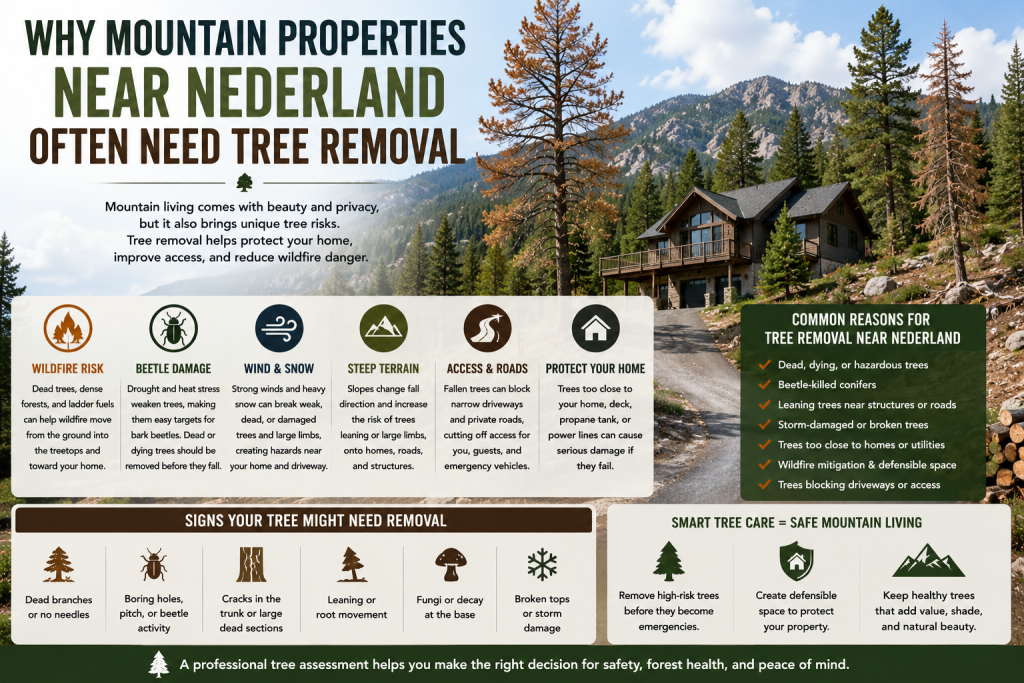
Why mountain properties near Nederland often need tree removal comes down to wildfire risk, steep terrain, dense forest, beetle pressure, winter damage, access issues, and the way mountain trees decline over time. A tree that might only be a minor concern in a flat suburban yard can become a serious safety problem when it stands near a mountain home, driveway, propane tank, power line, septic area, deck, or narrow access road.
Nederland sits in a different tree-care environment than lower-elevation neighborhoods near Boulder. Mountain properties often have more conifers, thinner soils, rockier slopes, stronger winds, heavier snow loads, colder winters, and more direct exposure to wildfire conditions. Trees grow close to structures because many homes were built into forested lots. That creates beauty, shade, privacy, and mountain character. It also creates risk.
Tree removal near Nederland does not always mean clearing a property or removing healthy trees without a reason. In many cases, removal focuses on dead trees, beetle-killed trees, fire-prone ladder fuels, trees leaning toward structures, trees blocking access, or trees that have become too weak to keep safely.
Understanding why mountain properties near Nederland often need tree removal helps homeowners make practical decisions before a dead pine falls, a windstorm breaks a weakened limb, or defensible space work becomes urgent.
If you own a mountain property near Nederland and have dead, leaning, beetle-damaged, storm-damaged, or crowded trees near your home, Good People Tree Service can inspect the site and help determine whether pruning, mitigation, monitoring, or removal makes the most sense.
Why mountain properties near Nederland often need tree removal
Why mountain properties near Nederland often need tree removal starts with the setting. Many properties sit in or near forested mountain terrain. Trees may grow close together, compete for limited moisture, and stand near homes, decks, driveways, and outbuildings.
In a mountain setting, tree risk often involves more than the tree itself. A dead standing tree can add wildfire fuel. A leaning tree may fall across the only driveway. A beetle-killed pine may threaten nearby trees. A tree with root damage on a slope may become unstable after heavy rain or snowmelt. A dense stand may create ladder fuels that help fire move from ground vegetation into crowns.
Homeowners should not look at tree removal as a last-minute emergency only. In Nederland-area mountain properties, removal often supports three goals: safety, access, and fire resilience.
Wildfire risk changes tree decisions
Wildfire risk is one of the biggest reasons mountain properties near Nederland often need tree removal. Forested lots in western Boulder County may need defensible space around homes, driveways, decks, and other structures.
Defensible space does not mean removing every tree. It means reducing continuous fuel, separating tree crowns where needed, removing dead material, limbing lower branches, and keeping flammable vegetation away from structures.
Dead or dying trees create special concern because they add dry fuel and may fall during wind, snow, or fire conditions. Dense clusters of conifers can also increase risk when branches overlap or when small trees and shrubs create ladder fuels.
A homeowner may love the natural forested look, but the safest property often balances trees with spacing, cleanup, and selective removal.
Dead trees become bigger hazards in mountain terrain
A dead tree near Nederland does not stay harmless for long. Once a tree dies, wood begins to dry, crack, decay, and lose strength. Branches can fall first. Later, the top, trunk, or whole tree may fail.
Mountain weather speeds up risk. Wind can shake brittle limbs loose. Snow can load dead branches. Freeze-thaw cycles can widen cracks. Slopes can change the way a tree falls. If the tree stands near a home, driveway, road, shed, fence, or utility line, the risk increases.
Dead trees in open forest areas may provide wildlife habitat, but dead trees near targets need a different decision. A target is anything the tree can hit, including people, structures, vehicles, access routes, and property improvements.
Tree removal often becomes the safest option when a dead tree stands close to daily use areas.
Beetle-killed trees are common mountain concerns
Bark beetles are part of Colorado forest ecology, but they become a property concern when they kill trees near homes. Mountain pine beetle, Ips beetles, and other bark beetles can attack stressed conifers. Drought, dense stands, heat, and competition can make trees more vulnerable.
A beetle-damaged tree may show boring dust, pitch, small bark holes, fading needles, woodpecker activity, or sections of the canopy turning yellow, red, or brown. By the time needles fully change color, the tree may already be dead or near death.
Mountain properties near Nederland often include pines, spruce, fir, and mixed conifer stands. When beetles move through stressed trees, homeowners may need to remove infested or dead trees to reduce hazards, manage fuels, and protect nearby high-value trees.
Tree removal does not solve every beetle problem by itself, but it can play an important role in a broader forest-health plan.
Dense tree stands compete for limited moisture
Many mountain lots have trees growing close together. Dense stands can look healthy from a distance, but each tree competes for water, sunlight, and nutrients.
During dry periods, crowded trees may become stressed faster than well-spaced trees. Stressed trees can become more vulnerable to beetles, branch dieback, and decline. Some trees may remain small and weak because they never get enough resources.
Selective tree removal can improve the health of the remaining trees when done thoughtfully. Removing suppressed, dead, damaged, or poorly placed trees can reduce competition and allow stronger trees to use available moisture more effectively.
This is not the same as clearing a property. It is a targeted approach that supports forest health, access, and fire resilience.
Slopes make unstable trees more dangerous
Mountain properties near Nederland often sit on slopes or uneven ground. Slope changes how homeowners should think about tree failure.
A leaning tree above a driveway, home, deck, or parking area can cause serious damage if it falls downhill. Roots may grow around rock, shallow soil, or drainage channels. Heavy rain, snowmelt, erosion, or excavation can reduce root support.
A tree that leans uphill may not create the same risk as a tree leaning downhill toward a structure. The fall direction, root condition, soil stability, and target area all matter.
Tree removal may become necessary when a slope tree has root movement, a new lean, cracked soil, exposed roots, trunk cracks, or dead canopy near a target.
Snow and wind damage add long-term stress
Nederland-area properties can experience strong winds and heavy snow. Winter storms can break limbs, bend young trees, split codominant stems, and weaken old branch unions.
Some storm damage looks obvious. A large branch breaks and hangs in the canopy. A tree splits down the trunk. A top snaps out of an evergreen. Other damage stays hidden until the next storm.
A cracked limb may hold through one season and fail later. A split union can expand slowly. A storm-bent tree may never regain safe structure. When storm-damaged trees stand near structures or access routes, removal may become the safer choice.
Pruning can solve some storm damage. Tree removal makes more sense when the trunk, roots, or main structure have failed.
Access roads and driveways matter
Mountain homes often depend on narrow driveways, private roads, and limited turnarounds. A fallen tree can block access for homeowners, emergency vehicles, contractors, propane delivery, snowplows, or utility crews.
This access issue makes tree removal more urgent near Nederland than in many flat neighborhoods. A tree leaning over a long mountain driveway may not threaten the house, but it can still create a major problem if it falls during a storm.
Homeowners should inspect trees along access routes, especially dead trees, beetle-killed pines, cracked trunks, and trees leaning toward the road.
Removing high-risk trees near driveways can prevent emergency access problems later.
Trees near power lines require extra caution
Mountain properties often have overhead utility lines running through forested areas. Trees near power lines create special risk during wind, snow, and wildfire conditions.
Homeowners should not prune or remove trees near energized lines themselves. Utility-related tree work can be dangerous and may require coordination with the utility provider or qualified professionals.
A tree that leans toward a line, has dead limbs over a line, or shows root instability near a line should be evaluated carefully. The tree may need professional removal or utility coordination.
Never assume a storm-damaged tree touching a line is safe. Stay away and call the appropriate utility or emergency contact.
Trees near roofs, decks, and propane tanks need closer attention
Mountain properties often place homes, decks, stairs, sheds, and propane tanks close to trees. These targets change the risk calculation.
A healthy tree may provide shade and privacy. A declining tree near a propane tank, roofline, or wood deck can become a serious concern. Branches that overhang a roof can drop needles, leaves, cones, and debris into gutters. Dead limbs can fall onto decks or walkways. Dense vegetation near structures can increase fuel continuity.
Tree removal may be appropriate when a tree is dead, structurally weak, leaning toward the structure, too close to critical equipment, or part of a dense fuel pathway.
Good tree care near mountain homes often combines pruning, spacing, cleanup, and selective removal.
Fire mitigation may require selective removal
Boulder County and Colorado wildfire guidance often focuses on the home ignition zone, the area around the home where vegetation and materials influence wildfire survival. For forested mountain properties, this can include removing dead trees, reducing ladder fuels, spacing trees, and clearing flammable debris.
In some cases, wildfire mitigation specialists may help identify which trees should be removed to meet defensible space goals. Homeowners should check local rules, property-specific requirements, HOA expectations, and county guidance before large mitigation projects.
The goal is not to strip the land bare. The goal is to reduce the chance that fire moves easily from ground fuels to trees, from tree crowns to structures, or from nearby vegetation to the home.
Tree removal becomes one tool in that larger mitigation plan.
Not every tree near a house should be removed
Selective removal matters. A mountain property with no trees can lose shade, privacy, wildlife value, soil stability, and natural character. Trees also help reduce erosion, frame views, and support a healthier landscape when they are well placed and structurally sound.
The question is not, “Should every tree near the house come down?” The better question is, “Which trees create unacceptable risk, and which trees can stay with pruning, spacing, or monitoring?”
Healthy trees with good structure, adequate spacing, and manageable fuel conditions may remain valuable. Dead, diseased, unstable, beetle-killed, or poorly located trees may need removal.
A professional inspection can help homeowners avoid both extremes: removing too much or keeping dangerous trees too long.
Tree removal can improve the remaining forest
Thoughtful tree removal can help the trees that remain. Removing dead trees, weak trees, suppressed trees, or trees competing heavily with stronger trees can improve spacing and reduce stress.
Better spacing can improve airflow, sunlight, and moisture availability. It can also reduce ladder fuels when paired with pruning and slash cleanup.
This matters near Nederland because many properties exist within a forested setting rather than a traditional landscaped yard. Tree care should consider the whole stand, not just one trunk.
A good removal plan asks which trees have the best long-term value and which trees reduce safety or forest health.
Slash and debris must be handled properly
Tree removal creates slash, logs, branches, and needles. On mountain properties, leftover debris can become a wildfire fuel problem if homeowners pile it near structures or leave it unmanaged.
Removal work should include a plan for hauling, chipping, stacking, or otherwise managing slash appropriately. Firewood should not be stacked against the home or under decks. Fresh conifer material may also attract some beetles if stored carelessly during active periods.
The cleanup plan matters as much as the cut. Removing a hazardous tree but leaving dry branches near the house does not fully solve the risk.
Permits, county rules, and property requirements matter
Tree removal near Nederland can involve different rules depending on whether the property sits inside town limits, in unincorporated Boulder County, within an HOA, near protected areas, or under conditions from past site plan review or mitigation requirements.
Homeowners should not assume every tree can be removed without checking. They should also not assume every tree requires a permit. The answer depends on location, property status, tree purpose, and local requirements.
Before major removal, especially for multiple trees, defensible space work, or trees tied to a land-use condition, check with the Town of Nederland, Boulder County, or the relevant HOA or property authority.
A local tree service can often help homeowners understand what questions to ask before work begins.
Case example: the beetle-killed pine above a driveway
A homeowner near Nederland notices a pine turning red above a steep driveway. The tree has boring dust at the base and woodpecker activity on the trunk. It leans slightly toward the driveway.
This tree creates several concerns. It may be beetle-killed or in advanced decline. It stands above an access route. It could block the driveway during wind or snow. It may also add dry fuel near the property.
In this case, tree removal may make more sense than waiting. The homeowner should schedule an inspection before the tree becomes more brittle and harder to remove safely.
Case example: the crowded conifer stand near the deck
A mountain home has a deck surrounded by dense small conifers. The trees create privacy, but their lower branches touch shrubs, needles collect under the deck, and several small trees grow close to larger trees.
This situation may not require removing every tree. It may need selective removal, limbing, spacing, and debris cleanup. Removing some small trees can reduce ladder fuels and help stronger trees remain healthier.
The best plan protects the home without destroying the mountain feel of the property.
Case example: the leaning aspen near a cabin
An aspen near a cabin leans more after a wet spring. The soil around the base looks lifted on one side. Several branches are dead, and the trunk has old wounds.
Aspens can be beautiful, but they can also decline quickly when roots, trunk wounds, or decay become significant. A leaning aspen near a structure needs inspection.
If the root plate has moved or decay affects the trunk, removal may be the safest option. If the lean is old and the tree remains stable, monitoring or pruning may be enough.
Warning signs mountain homeowners should not ignore
Mountain homeowners near Nederland should watch for dead standing trees, red or brown conifer needles, boring dust, pitch tubes, bark holes, woodpecker activity, cracked trunks, split stems, mushrooms near the base, root movement, exposed roots, sudden lean, large dead limbs, broken tops, and branches over access routes or structures.
One sign may not prove removal is necessary. Several signs together raise concern. The location also matters. A dead tree far from targets creates different risk than a dead tree beside a home.
Inspect trees after wind, heavy snow, hail, lightning, and long dry periods.
When tree removal becomes urgent
Tree removal becomes more urgent when a tree is dead, leaning toward a target, blocking access, touching utility lines, split through the trunk, severely beetle-damaged, or unstable at the roots.
Urgency also increases when the tree stands near a home, deck, driveway, road, power line, propane tank, septic area, or neighbor’s property.
Do not wait for a high-risk tree to fail during the next storm. Mountain removals can become more difficult once a tree dies fully, loses structural strength, or becomes tangled with nearby trees.
When pruning or monitoring may be enough
Not every concerning tree needs removal. A tree with a few dead branches may only need pruning. A healthy tree near a structure may need clearance pruning. A young leaning tree may need correction. A stand with dense branches may need limbing and spacing rather than full removal.
Monitoring can make sense when the tree is alive, structurally sound, away from targets, and not part of a high-risk fuel pathway.
A professional inspection can help homeowners choose the least aggressive option that still protects safety.
Frequently asked questions
Why do mountain properties near Nederland need more tree removal?
Mountain properties near Nederland often have dense forest, wildfire risk, steep slopes, winter storms, beetle pressure, and limited access routes. Those conditions make dead, leaning, or crowded trees more risky.
Does wildfire mitigation mean removing all trees?
No. Wildfire mitigation usually focuses on reducing fuel continuity, removing dead material, spacing trees, pruning ladder fuels, and protecting structures. Healthy trees can often remain when they fit the mitigation plan.
Are beetle-killed trees dangerous?
Yes, beetle-killed trees can become brittle and hazardous over time, especially near homes, driveways, roads, decks, or power lines. They can also add dry fuel.
Should I remove trees close to my mountain home?
It depends on tree health, structure, spacing, fire risk, and distance from targets. Some trees may need removal, while others may only need pruning, limbing, or monitoring.
Do I need to check rules before removing trees near Nederland?
Yes, especially for multiple trees, defensible space work, HOA properties, town-limit properties, or trees tied to land-use requirements. Check with the appropriate local authority before major work.
Final thoughts
Why mountain properties near Nederland often need tree removal comes down to the realities of living in a forested mountain environment. Trees provide beauty, shade, privacy, and habitat, but they can also create risk when they die, lean, crowd structures, block access, attract beetles, or add wildfire fuel.
The best approach is selective and practical. Remove trees that create safety, access, or wildfire concerns. Preserve healthy trees that add value and can remain safely. Use pruning, spacing, slash cleanup, and monitoring where removal is not necessary.
Good People Tree Service helps homeowners near Nederland evaluate dead, beetle-damaged, leaning, storm-damaged, and fire-risk trees. The right decision can protect the home while keeping the property’s mountain character intact.
If your Nederland-area property has dead trees, dense conifers, beetle signs, leaning trunks, or branches near structures, schedule an inspection before the next storm or dry season makes the problem more urgent.