
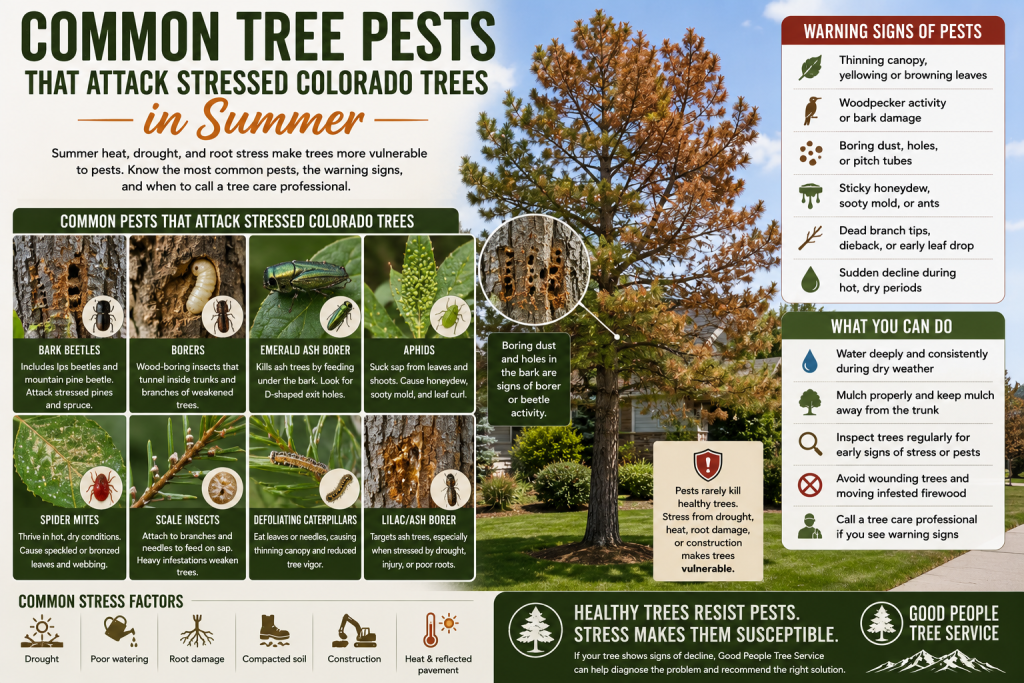
Common tree pests that attack stressed Colorado trees in summer often show up after heat, drought, root damage, poor watering, or construction stress has already weakened the tree. Homeowners may first notice brown leaves, thinning canopy, sticky residue, boring dust, holes in the bark, pitch on the trunk, or sudden branch dieback. The insect may look like the main problem, but the tree was often struggling before the pest became obvious.
Colorado summers create the perfect setup for pest problems. Hot, dry weather increases water loss from leaves. Low humidity dries soil faster. Clay soil can limit oxygen around roots. Pavement and rock mulch add reflected heat. Construction and trenching can damage roots. When these stresses overlap, trees lose some of their natural defenses.
A healthy tree can often tolerate minor insect activity. A stressed tree has fewer reserves. It may not produce enough resin, recover from feeding damage, or seal wounds as effectively. That is why common tree pests that attack stressed Colorado trees in summer can turn a small tree-health issue into a larger decline problem.
Understanding the difference between harmless seasonal insects and serious tree pests helps homeowners act earlier. Some pests only cause cosmetic damage. Others can kill weakened trees or signal that the tree needs inspection.
If a tree on your property has browning leaves, boring dust, bark holes, pitch, dead branches, or sudden decline, Good People Tree Service can inspect it and help determine whether pests, drought, roots, disease, or structural problems are involved.
Common tree pests that attack stressed Colorado trees in summer
Common tree pests that attack stressed Colorado trees in summer include bark beetles, borers, emerald ash borer, aphids, spider mites, scale insects, defoliating caterpillars, and pests that move into trees after drought or root damage.
The exact pest depends on the tree species. Ash trees face different risks than pines. Spruce, fir, cottonwood, maple, linden, apple, aspen, and ornamental trees all attract different insects.
The most important pattern is stress. Drought-stressed trees, construction-damaged trees, overwatered trees, recently planted trees, and trees with root problems often become easier targets.
A homeowner should not diagnose a tree only by seeing “bugs.” Many insects live around trees without harming them. The warning signs matter more:
- boring dust near the trunk
- pitch tubes or sap masses
- D-shaped exit holes on ash
- sudden canopy thinning
- dead branch tips
- sticky honeydew
- black sooty mold
- curled leaves
- browning needles
- woodpecker activity
- bark peeling
- rapid decline after heat waves
These signs help separate normal insect presence from a tree-health concern.
Why stressed trees attract more pests
Trees defend themselves with energy, moisture, resin, wound response, and healthy growth. Summer stress weakens those defenses.
Drought reduces water movement. Fine roots may die back. The canopy produces less energy. The tree may close leaf openings to conserve moisture, which reduces photosynthesis. With fewer resources, the tree has a harder time resisting insects.
Conifers rely partly on resin to push out attacking bark beetles. When drought limits moisture, that defense can weaken. Deciduous trees can also lose vigor and become more attractive to borers, aphids, mites, and canker-related pests.
Construction damage adds another layer. A tree with cut or compacted roots may leaf out normally in spring but struggle by July. Insects often move in after the tree loses vigor.
This is why common tree pests that attack stressed Colorado trees in summer often reveal a larger site problem. The pest may matter, but roots, water, soil, and tree condition usually matter too.
Ips beetles on stressed pines and spruce
Ips beetles, also called engraver beetles, commonly attack stressed pines and spruce. They develop under the bark and tunnel through the living tissue that helps move water and nutrients.
In Colorado, ips beetles often become more active when trees suffer from prolonged drought stress. Freshly cut green wood can also attract them, especially when homeowners leave branches, logs, or firewood near susceptible trees.
Signs may include reddish-brown boring dust, fading needles, small holes in bark, pitch, and sections of canopy that turn yellow, red, or brown. By the time the whole tree changes color, the damage may already be advanced.
Pines near homes, driveways, rock beds, slopes, or construction zones may face extra stress during summer. If those trees also lack deep watering during dry periods, ips beetles may find a better opportunity.
Homeowners should avoid stacking fresh pine or spruce material next to healthy trees during beetle season. They should also watch stressed conifers closely during hot, dry summers.
Mountain pine beetle and larger pine risks
Mountain pine beetle is one of Colorado’s best-known bark beetles. It attacks several pine species and can contribute to serious tree mortality in susceptible areas.
Homeowners should watch for popcorn-like pitch tubes, boring dust in bark crevices, woodpecker activity, and foliage that later turns yellowish or reddish across the crown. A pine may not show obvious crown color changes until months after a successful attack.
Mountain pine beetle concerns increase where many suitable host pines grow close together. Large pines, drought stress, and nearby outbreaks can raise concern.
This pest matters for residential properties near foothills, pine stands, mountain communities, and Front Range neighborhoods with mature pines. A single infested tree near a home can also create safety concerns if it dies and remains standing.
Good inspection timing matters. Once beetles successfully colonize a tree, saving that tree may not be realistic. Homeowners should focus on early signs, tree vigor, and professional evaluation.
Emerald ash borer on Colorado ash trees
Emerald ash borer, or EAB, threatens ash trees across affected Colorado communities. It is a serious pest because it attacks true ash trees and can kill them as larvae feed beneath the bark.
Many Colorado neighborhoods planted ash trees for decades. That means homeowners may have mature ash trees near streets, sidewalks, driveways, yards, and homes.
Signs of EAB may include upper canopy thinning, branch dieback, increased woodpecker activity, bark flecking, S-shaped galleries under bark, and small D-shaped exit holes. Homeowners often miss early symptoms because EAB activity can start high in the canopy.
Not every declining ash tree has EAB. Drought, lilac/ash borer, root damage, poor pruning, compaction, and age can also cause dieback. Still, homeowners with ash trees in or near known EAB areas should take symptoms seriously.
Treatment decisions can become complicated. A high-value ash with limited canopy decline may still have options, but a severely declining tree near a target may require removal. Homeowners should consult qualified tree-care professionals before making that call.
Lilac/ash borer and other wood borers
Wood borers often attack stressed trees. Many borers prefer trees weakened by drought, transplant shock, injuries, poor soil, root issues, or mechanical damage.
Lilac/ash borer commonly affects ash trees, especially when trees have stress from drought, injury, or recent transplanting. Other borers may target fruit trees, pines, pinyons, and ornamentals.
Borer signs can include holes in bark, sawdust-like frass, sap flow, branch dieback, bark cracking, and thinning canopy. Some borers attack trunks. Others attack branches or branch unions.
Borers deserve attention because they often indicate underlying stress. A homeowner may kill or remove one visible pest problem, but the tree may stay vulnerable if drought, wounds, or roots remain unresolved.
This is why common tree pests that attack stressed Colorado trees in summer often require a whole-tree approach rather than a quick insect-only response.
Aphids on shade trees and ornamentals
Aphids are common on many Colorado shade trees and ornamentals. They feed by sucking sap from plant tissue. Many aphid problems create more nuisance than danger, but heavy populations can stress young, weak, or already struggling trees.
Signs include curled leaves, sticky honeydew, ants moving on branches, shiny residue on cars or patios, and black sooty mold growing on the honeydew.
Linden trees often attract aphids in Colorado landscapes. Maples, willows, cottonwoods, elms, fruit trees, and ornamentals can also host aphid activity depending on species.
Aphids do not usually kill mature healthy trees by themselves. However, they can add stress when the tree already struggles with drought, heat, poor roots, or construction damage.
Homeowners should look at the full pattern. Sticky residue on a patio may be annoying, but canopy thinning, dieback, or major leaf distortion may point to a tree that needs closer evaluation.
Spider mites during hot, dry weather
Spider mites thrive in hot, dry conditions. Colorado summers can create ideal conditions for outbreaks, especially on drought-stressed plants.
Mites are tiny, so homeowners often notice symptoms first. Leaves or needles may look speckled, dull, bronzed, yellowed, or brown. Some infestations create fine webbing. Evergreens, ornamentals, shrubs, and many landscape plants can suffer during dry periods.
Drought-stressed plants can become more favorable to spider mites. Heat, dust, and water stress can make outbreaks worse.
Spider mites matter because their damage can look like drought stress or leaf scorch. A homeowner may water more without checking for mites, while the actual problem continues.
Trees near driveways, dusty areas, rock mulch, and hot walls may face more mite pressure. Good tree care starts with moisture management, but accurate diagnosis matters.
Scale insects on conifers and ornamentals
Scale insects attach to twigs, needles, branches, or stems and feed from the plant. Some scales look like small bumps, crusts, or shells. Others produce sticky honeydew.
In Colorado, scale insects can affect conifers and ornamental trees. Heavy scale infestations can cause yellowing, needle drop, branch dieback, slow growth, and overall decline.
Scale problems often become worse when trees already struggle. Drought, poor planting, root stress, and hot sites can reduce the tree’s ability to tolerate feeding damage.
Homeowners should inspect browning evergreens, thinning conifers, or ornamentals with sticky residue. Scale can hide in plain sight because it does not look like a typical crawling insect.
Western spruce budworm and defoliating insects
Defoliating insects eat needles or leaves. Western spruce budworm has been one of the most widespread forest pests in Colorado in recent years, especially in Douglas-fir and mixed-conifer forests.
Residential homeowners may notice defoliation, brown tips, webbing, thin crowns, or reduced growth on susceptible conifers in areas where the pest occurs.
Defoliation does not always kill a tree quickly. Repeated defoliation weakens growth and can make trees more vulnerable to bark beetles and other pests later.
This pattern matters because homeowners often focus only on pests that bore into bark. Leaf- and needle-feeding insects can also reduce a tree’s energy and push a stressed tree closer to decline.
Pests on fruit and ornamental trees
Colorado yards often include crabapples, apples, plums, pears, cherries, hawthorns, and other ornamental or fruiting trees. Summer pests may include aphids, mites, borers, leafrollers, scale insects, and other chewing or sucking insects.
These pests can curl leaves, skeletonize foliage, scar fruit, weaken shoots, or cause branch dieback. On a healthy ornamental tree, damage may stay mostly cosmetic. On a newly planted or drought-stressed tree, the same damage can slow establishment.
Homeowners should watch young ornamentals carefully. A small tree has fewer reserves than a mature shade tree. Heat stress plus pests can set it back quickly.
How summer stress changes pest risk
Summer does not create every pest problem, but it can push a tree into vulnerability.
A tree near a driveway may face reflected heat. A tree in rock mulch may experience hotter soil. A tree with shallow lawn watering may lack deep moisture. A tree near recent construction may have damaged roots. Add aphids, mites, or borers, and the tree may decline faster.
This is why common tree pests that attack stressed Colorado trees in summer often appear together with other symptoms:
- brown leaf edges
- early leaf drop
- thinning canopy
- dead branch tips
- dry soil
- poor growth
- root damage
- bark wounds
- trunk cracks
- recent pruning or construction
The pest is part of the story, not always the whole story.
Case example: the ash tree with several problems
A homeowner has a mature ash tree near the street. The upper canopy begins thinning in summer. Woodpeckers become more active. A few branches die back. The lawn still looks green, but the soil near the tree feels dry below the surface.
This tree could have EAB, lilac/ash borer, drought stress, root damage, or a combination of issues.
A quick guess could lead to the wrong decision. The homeowner needs identification, canopy assessment, and a realistic discussion about treatment value or removal risk.
Ash trees near streets and homes deserve careful evaluation because decline can create falling-branch hazards as well as long-term canopy loss.
Case example: the pine that faded after drought
A pine near a Colorado home looks fine in spring. During a hot, dry summer, the needles start fading in sections. The homeowner later notices boring dust near the trunk and pitch marks on the bark.
Drought likely weakened the tree before bark beetles became visible. The pine may have lacked enough moisture to defend itself well.
At this point, timing matters. A tree service can inspect whether the infestation is active, whether nearby trees need attention, and whether the damaged tree creates a removal risk near the home.
What homeowners should inspect during summer
Homeowners can check trees safely from the ground.
Look at the canopy first. Notice thinning, browning, curled leaves, dead tips, early leaf drop, or uneven decline. Then look at the trunk and branches. Search for boring dust, bark holes, pitch tubes, sap flow, woodpecker activity, sticky residue, and fungal growth.
Check the soil too. Dry soil, soggy soil, compacted areas, rock mulch, trenching, and cut roots can all explain why pests have an opening.
Do not climb the tree or peel large sections of bark. That can create damage or put you at risk under weak branches.
What homeowners should not do
Do not assume every insect needs treatment. Many insects do little harm, and some beneficial insects help control pests.
Avoid applying insecticides without correct identification and proper guidance. The wrong treatment can waste money, miss the real issue, or harm beneficial insects. Some treatments require licensed applicators.
Do not ignore the root cause. If drought, compaction, rock mulch heat, or root damage caused the stress, the tree may remain vulnerable even after pest pressure drops.
Avoid moving infested firewood or fresh logs from one area to another. Wood movement can spread certain pests.
How to reduce pest problems before they start
The best pest strategy starts with tree health.
Water deeply during prolonged dry periods. Mulch the root zone with organic mulch where appropriate. Keep mulch away from the trunk. Protect roots from construction and compaction. Avoid wounding trunks with mowers or string trimmers. Remove hazardous deadwood. Do not leave fresh pine or spruce material near susceptible trees.
Tree diversity also helps. A neighborhood with too many of one species can suffer more when a pest targets that species.
Regular inspections matter most during summer because heat reveals stress quickly. Homeowners who notice problems early often have more options.
When to call a tree service
Call a tree service when you see boring dust, pitch tubes, D-shaped exit holes, rapid canopy thinning, large dead branches, sudden evergreen browning, bark peeling, major woodpecker activity, sticky honeydew plus decline, or pests on a tree near your home, driveway, sidewalk, or fence.
Good People Tree Service can inspect the tree, identify visible symptoms, evaluate risk, and explain whether the issue likely comes from pests, drought, root stress, disease, or structural decline.
Frequently asked questions
What pests attack stressed Colorado trees in summer?
Common pests include bark beetles, ips beetles, mountain pine beetle, emerald ash borer, wood borers, aphids, spider mites, scale insects, and defoliating insects.
Do pests only attack unhealthy trees?
No. Some pests can attack healthy trees, but many pests become more successful when drought, root damage, wounds, or poor soil conditions weaken the tree.
How do I know if my tree has borers?
Look for holes, boring dust, sap or pitch, bark cracking, branch dieback, woodpecker activity, and rapid decline. A professional inspection can help identify the specific pest.
Are aphids dangerous to mature trees?
Aphids usually create nuisance issues like honeydew and sooty mold. Heavy infestations can add stress, especially when the tree already struggles.
Should I treat a tree for pests myself?
Do not treat before identifying the pest and tree condition. Some treatments require licensed professionals, and the tree may need watering, pruning, or removal instead.
Final thoughts
Common tree pests that attack stressed Colorado trees in summer often appear when heat, drought, root damage, compacted soil, or poor watering has already weakened the tree. Bark beetles, borers, EAB, aphids, mites, scales, and defoliators all affect trees differently, but stress makes many problems worse.
Homeowners should look beyond the insect. The better question is why the tree became vulnerable. Dry soil, rock mulch heat, construction damage, overwatering, poor drainage, trunk wounds, and old storm damage can all open the door to pests.
Good People Tree Service helps Colorado homeowners inspect stressed trees, identify visible pest symptoms, remove hazardous deadwood, and decide whether a tree can recover or should be removed.
If your tree shows boring dust, holes, pitch, sticky residue, browning leaves, thinning canopy, or sudden branch dieback this summer, schedule an inspection before pest pressure turns into serious decline.