
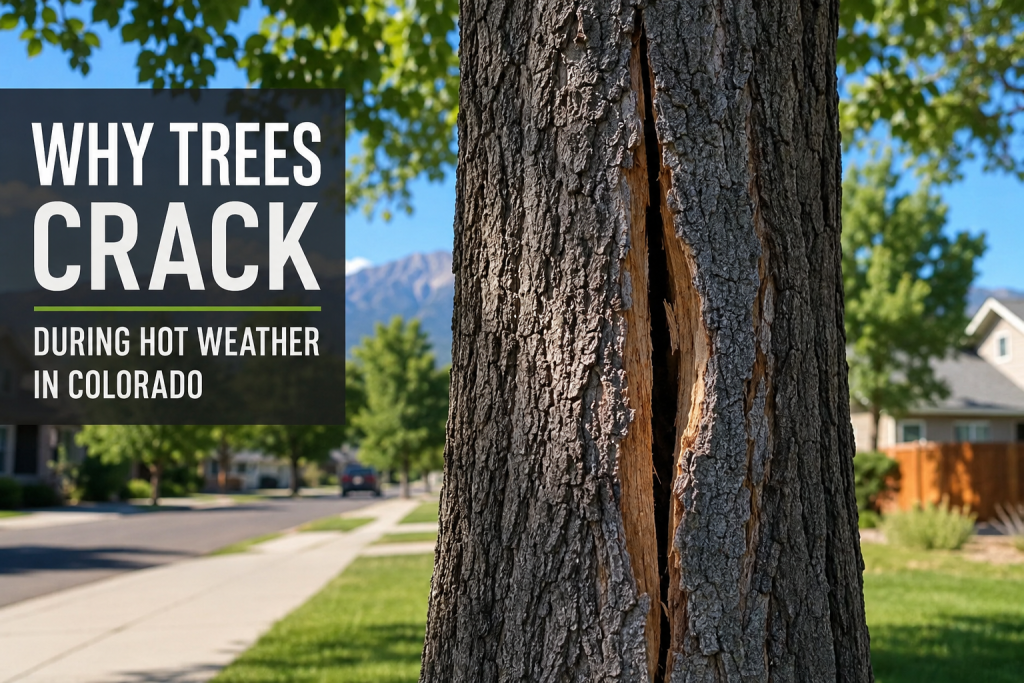
Trees crack during hot weather in Colorado for reasons that are usually deeper than heat alone. A homeowner may walk outside after several hot days and notice a long vertical split in the trunk, peeling bark, or a fresh crack near a large branch union. The damage can look sudden, but the stress behind it often develops slowly.
Colorado trees deal with a difficult mix of intense sunlight, low humidity, dry soil, sudden temperature swings, and urban heat from concrete or asphalt. During hot weather, those factors can combine with drought stress, root damage, poor watering, or old wounds. When the tree can no longer balance moisture loss with water uptake, bark and wood may split under pressure.
Understanding why trees crack during hot weather in Colorado helps homeowners decide whether a crack is a minor bark issue or a possible structural warning sign. Some cracks only need monitoring. Others may point to decay, root problems, or a higher chance of limb or trunk failure.
If a tree on your property develops a new crack during a heat wave, Good People Tree Service can inspect it and help determine whether pruning, monitoring, or removal is the safest next step.
Why trees crack during hot weather in Colorado
Trees crack during hot weather in Colorado because heat changes how water, bark, and wood behave inside the tree. The outer bark heats up first. Inner wood reacts more slowly. At the same time, leaves may be losing moisture faster than the roots can replace it.
That difference creates tension.
Bark protects the trunk, but it is not flexible without limits. When heat, drought, and internal stress build together, the bark may split vertically. In some cases, the crack stays shallow. In others, the split extends into the wood and becomes more serious.
The crack is usually not the beginning of the problem. It is the visible result of stress that may have been building for weeks, months, or even several seasons.
Common contributing factors include:
- prolonged drought stress
- sudden heat waves
- sunscald on exposed bark
- compacted or dry soil
- inconsistent watering
- damaged roots
- previous pruning wounds
- internal decay
- reflected heat from pavement
- rapid day-to-night temperature shifts
Colorado heat is different from ordinary summer heat
Hot weather in Colorado affects trees differently than hot weather in more humid regions. Dry air pulls moisture from leaves and bark more quickly. Higher elevation also means stronger sun exposure, especially in open yards and along streets.
A tree planted near a driveway, sidewalk, patio, or south-facing wall may experience more heat than the temperature forecast suggests. Concrete and asphalt absorb heat during the day, then radiate it back toward the trunk and root zone. Soil near these surfaces can dry faster than soil in a shaded landscape bed.
This is why trees in Colorado suburbs can develop heat symptoms even when nearby trees in parks or natural areas look healthier. The microclimate around the tree matters.
A mature tree in a lawn may also have another hidden problem. Turf irrigation often wets the top few inches of soil but does not always provide deep moisture for large roots. During a heat wave, shallow watering may not support the canopy enough.
Sunscald can split bark during hot weather
Sunscald is one of the most common reasons trees crack during hot weather in Colorado. It happens when direct sun heats the bark faster than the tree can tolerate.
Damage often appears on the south or southwest side of the trunk. That side receives strong afternoon sun, especially in open Colorado yards. Young trees are more vulnerable because their bark is thinner, but mature trees can also develop sunscald after pruning, construction, or canopy loss exposes bark that used to be shaded.
Sunscald can look like:
- a long vertical split
- sunken bark
- discolored bark
- peeling bark on one side
- a dry wound on exposed trunk tissue
Once bark is damaged, the area may become more vulnerable to insects, decay, and future cracking. A small sunscald injury can also become larger over time if the tree stays under heat and drought stress.
Drought stress is often the hidden cause
Drought stress is one of the biggest reasons trees crack during hot weather in Colorado. Heat may trigger the visible crack, but lack of moisture often sets up the problem first.
A drought-stressed tree struggles to move enough water from the roots to the canopy. Leaves keep losing moisture, especially during hot and windy days. When roots cannot keep up, the tree begins operating under internal tension.
Visible drought symptoms may include:
- leaf scorch
- smaller leaves
- early leaf drop
- thinning canopy
- dead branch tips
- browning needles
- dry soil near the root zone
These signs may appear before trunk cracking, but homeowners do not always connect them.
Colorado drought stress can also be delayed. A dry year may damage fine roots, reduce stored energy, and weaken the tree. The crack might not show until the next hot season.
Watering mistakes can make cracking worse
Watering seems simple, but many tree problems begin with the wrong watering pattern.
Shallow watering encourages roots near the surface. Frequent light irrigation may keep grass green while leaving deeper tree roots dry. Overwatering in heavy clay soil can also reduce oxygen and damage roots.
Both situations can make trees more vulnerable.
During hot weather, the goal is not to keep the surface constantly wet. A better approach is deep, slow watering that reaches the root zone without saturating the soil for too long. Mature trees usually need water spread across a wide area, not just near the trunk.
Watering should also match the site. Sandy soil drains quickly. Clay soil holds water longer. Trees near pavement may dry faster than trees in mulched beds.
When homeowners understand the soil, they can reduce the stress that leads to cracking.
Root damage can show up as trunk cracks
Tree roots are often damaged long before the trunk shows symptoms.
Construction, trenching, driveway repair, patio installation, fence posts, soil grading, and heavy equipment can all harm the root zone. Even if the trunk is never touched, root damage can reduce the tree’s ability to absorb water and stay stable.
After root damage, a tree may decline slowly. The canopy may thin. Leaves may scorch. Branches may die back. During a later heat wave, trunk cracks may appear because the tree cannot move water effectively.
This is one reason trees crack during hot weather in Colorado after a home renovation or landscaping project. The visible crack may seem unrelated, but root stress may be the real starting point.
A tree with new cracking after construction should be inspected carefully, especially if it is near a home, driveway, or sidewalk.
Soil compaction limits water and oxygen
Compacted soil is another hidden cause of tree stress.
Roots need both water and oxygen. When soil is compacted, pore space is reduced. Water may run off or sit in the wrong places, while oxygen becomes limited. Roots struggle to grow, absorb moisture, and support the canopy.
Compaction often happens when:
- vehicles park under trees
- construction equipment crosses the yard
- foot traffic is repeated in the same area
- soil is graded or packed during landscaping
- materials are stored near the root zone
A compacted root zone makes hot weather harder on the tree. Even if water is available, roots may not function well enough to use it.
Over time, this stress can lead to canopy thinning, leaf scorch, branch dieback, and bark cracking.
Case example: a maple near a driveway
Imagine a homeowner in a Colorado suburb with a mature maple next to the driveway. The tree has provided shade for years, but the driveway was replaced two summers ago. During the project, equipment parked under part of the canopy, and a few roots were cut near the concrete edge.
The tree looked normal the next spring. By late summer, leaves were smaller, and the top of the canopy looked thinner. After several hot days, a vertical crack appeared on the sun-facing side of the trunk.
This situation is common because tree stress can be delayed. The driveway project may have reduced root function. Summer heat then increased water demand. Drought and reflected pavement heat added more pressure.
The crack is not just a bark issue. It is a clue that the tree may be under root and moisture stress.
Case example: a young tree in an exposed yard
A newly planted ornamental tree in a sunny front yard can also crack during hot weather. The trunk may be thin, the root system may not be established, and the tree may sit in a lawn where sprinklers water shallowly.
On a hot afternoon, one side of the trunk heats quickly. Thin bark cannot buffer the temperature change well. If the root ball dries out, the young tree cannot replace moisture fast enough.
A vertical split may appear before the homeowner realizes the tree was stressed.
Young trees need consistent establishment care, mulch, and protection from mower or trimmer damage. A small crack early in a tree’s life can become a long-term weak point if the underlying problem continues.
Species differences matter, but site conditions matter more
Some trees are more prone to bark splitting than others. Thin-barked trees often show heat and sunscald damage sooner. Fast-growing species may also develop weak wood or branch attachments.
In Colorado landscapes, cracking may appear on maples, ash, lindens, fruit trees, ornamentals, and young shade trees. Conifers can also show heat and drought stress, although symptoms may look different.
A well-placed tree with healthy soil and consistent moisture may handle summer heat better than a drought-stressed tree of the same species near pavement. The wrong location can make even a hardy tree vulnerable.
Homeowners should look at the whole site, not only the tree name.
When a crack is not urgent
Not every trunk crack means the tree is dangerous.
Some cracks are shallow and limited to outer bark. These may come from normal growth, minor sun exposure, or seasonal expansion and contraction. If the canopy looks healthy, the crack is not widening, and there is no decay or lean, monitoring may be enough.
Less concerning cracks usually:
- stay shallow
- do not spread
- are not near major branch unions
- do not expose soft or dark wood
- are not paired with canopy decline
- appear on otherwise vigorous trees
Still, homeowners should take photos and watch the crack over time. A stable crack can become more concerning if it widens, deepens, or begins collecting moisture and decay.
When cracking becomes a safety concern
Some cracks deserve prompt attention.
A cracked tree should be evaluated if the split is deep, spreading, or connected to other warning signs. Cracks near large limbs or co-dominant stems are more serious because they may affect structural strength.
Call for an inspection when cracking appears with:
- new leaning
- dead branches
- fungal growth
- soft wood
- bark peeling in large sections
- canopy thinning
- root damage
- soil movement
- storm damage
- limbs over structures
Location also matters. A cracked tree in an open area may be monitored differently from a cracked tree over a roof, driveway, sidewalk, or play area.
A tree can be alive and still structurally unsafe.
Hidden decay behind cracks
Sometimes a crack reveals decay that was already inside the tree.
Decay can begin after old pruning wounds, storm breaks, trunk injuries, animal damage, or fungal infection. The tree may continue producing leaves even while internal wood loses strength.
Warning signs of decay include:
- mushrooms near the base
- cavities
- hollow sounds
- soft or crumbly wood
- bark loss
- repeated branch failure
- woodpecker activity
Heat may simply reveal the weakness.
Cracks with decay should be inspected because they can increase the risk of trunk or limb failure.
What homeowners should do when a crack appears
Start with safety and observation.
Do not cut into the crack. Avoid filling it with foam, cement, tar, paint, or sealant. These products usually do not fix the underlying problem and may trap moisture against damaged tissue.
Instead, document the issue.
Look for the crack’s location, length, width, and depth. Check whether the tree is leaning. Notice whether leaves are scorched, small, or dropping early. Examine the ground from a safe distance for root damage or soil movement.
Helpful questions include:
- Did the crack appear after a heat wave?
- Has construction happened nearby?
- Is the tree near pavement?
- Has the canopy thinned recently?
- Are there fungi or cavities?
- Is the crack growing?
These observations help a tree professional understand the likely cause.
How professionals evaluate cracked trees
A professional tree inspection looks beyond the crack.
The evaluator may consider tree species, age, size, structure, canopy condition, root zone, soil compaction, water history, exposure, decay signs, and nearby targets.
The main question is not only “Can the tree survive?” A better question is “Can the tree remain reasonably safe where it stands?”
A tree with a shallow crack and good vigor may need monitoring and improved care. Another tree with a deep crack, decay, and a lean toward a house may require removal.
Good inspections connect the visible symptom to the larger tree system.
Preventing heat-related cracking in Colorado
Prevention starts with reducing stress before the hottest part of summer.
Deep watering helps trees maintain internal moisture. Mulch protects soil from extreme temperature swings and reduces evaporation. Protecting roots during construction preserves the tree’s ability to absorb water.
Good prevention steps include:
- water deeply during dry periods
- avoid shallow daily watering
- mulch around the root zone
- keep mulch away from the trunk
- avoid parking under trees
- protect roots during construction
- prune correctly and avoid topping
- monitor young trees closely
- reduce lawn competition where possible
- inspect trees after heat waves
Frequently asked questions
Can a tree survive after the trunk cracks?
Yes, some trees survive after cracking. Survival depends on the crack’s depth, location, tree health, and whether decay is present. A shallow bark crack may stabilize, while a deep structural split may remain risky.
Should I seal a tree crack?
Usually, no. Sealants often do not solve the problem and may trap moisture. Proper pruning, stress reduction, watering, and inspection are usually more helpful.
Are cracks worse in young trees?
Young trees can be more vulnerable because their bark is thinner and their roots are not fully established. Good watering, mulch, and trunk protection can reduce risk.
Can heat alone crack a tree?
Heat can trigger cracking, but it is usually combined with drought stress, sunscald, root issues, or previous damage. A healthy tree in good soil is less likely to crack from heat alone.
When should a cracked tree be removed?
Removal may be needed when the crack is deep, widening, connected to decay, paired with a lean, or located on a tree near structures where failure would cause damage.
Final thoughts
Trees crack during hot weather in Colorado because heat, drought, sun exposure, root stress, and site conditions often work together. The crack may appear suddenly, but the underlying stress usually builds over time.
Some cracks are minor and can be monitored. Others reveal deeper problems such as decay, root damage, structural weakness, or severe drought stress.
Colorado homeowners should pay attention to new cracks, especially when they appear after heat waves or near homes, driveways, sidewalks, and outdoor living areas.
Good People Tree Service helps homeowners evaluate cracked trees, identify hidden stress, and decide whether pruning, monitoring, or removal is the safest option.
If your tree develops a crack during hot weather, schedule an evaluation before the next storm or heat wave adds more stress.