
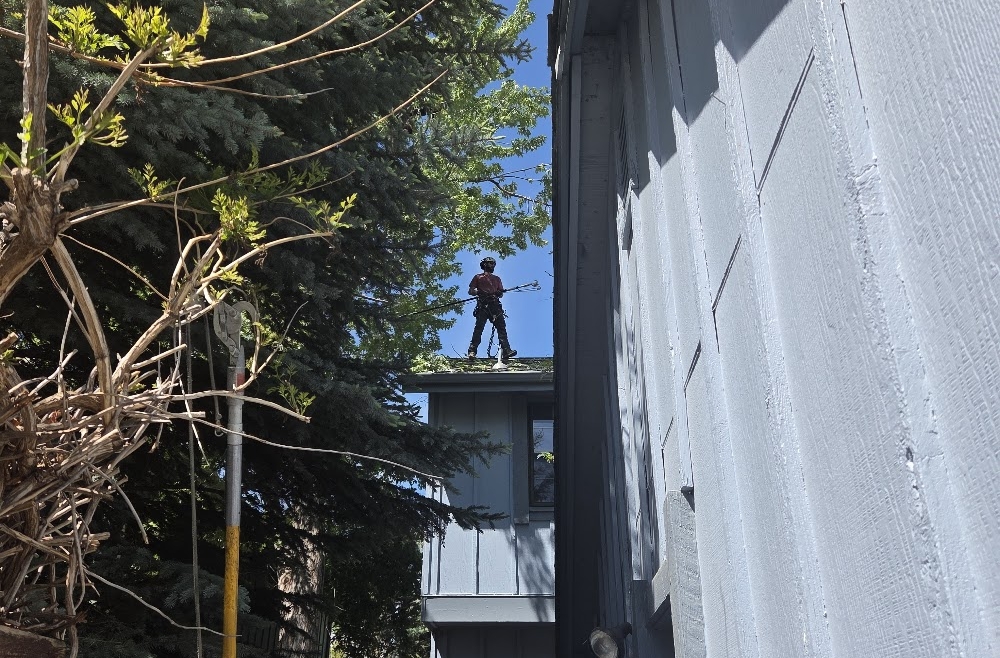
Why trees lean toward houses and what it means is a question many homeowners start asking after they notice a trunk tilting closer to the roof, garage, driveway, or fence. Sometimes the lean has been there for years. Other times, it appears after a storm, construction project, heavy snow, or soil movement.
A leaning tree is not automatically dangerous. Some trees naturally grow at an angle because of sunlight, wind exposure, or competition with nearby trees. But a tree leaning toward a house deserves attention because location changes the level of risk.
The real issue is not only whether the tree is leaning. The bigger question is why it is leaning, whether the lean is changing, and what would be damaged if the tree or a large limb failed.
In Colorado, leaning trees are especially important to evaluate. Front Range trees deal with strong winds, dry soils, wet spring snow, construction-disturbed root zones, and rapid weather changes. These conditions can turn a slow structural issue into a serious hazard.
If a tree on your property is leaning toward your home, garage, driveway, or outdoor living area, Good People Tree Service can evaluate whether pruning, monitoring, or removal is the safest next step.
Why Trees Lean Toward Houses in the First Place
Trees lean for several reasons. Some are natural. Others are signs of stress or structural instability.
A tree may lean because it is growing toward sunlight. This is common when a tree is shaded by buildings, fences, or other trees. Over time, the canopy may stretch toward open light. The trunk may follow that growth pattern.
A tree may also lean because of wind exposure. In open areas, repeated wind can shape growth over many years. This type of lean may develop slowly and may not be urgent if the root system is stable.
But not all leaning is harmless.
A tree may lean because roots are damaged. Soil may be shifting. The trunk may have internal decay. A storm may have pushed the tree off balance. Construction may have cut roots on one side. Heavy snow may have loaded the canopy unevenly.
This is why the cause matters. A long-standing lean is very different from a new lean after a storm.
Why Trees Lean Toward Houses and What It Means for Risk
Why trees lean toward houses and what it means for risk depends on three main factors: the cause of the lean, how fast the lean is changing, and what the tree could hit if it failed.
A tree leaning away from everything in an open yard may be lower risk. A tree leaning toward a roof, bedroom, driveway, sidewalk, or power line is different.
Location matters because tree risk includes consequences. A defect in a tree is more serious when there is a target nearby.
A leaning tree near a house should be evaluated if it shows:
- A new or increasing lean
- Soil lifting near the roots
- Exposed roots
- Cracks in the trunk
- Fungal growth near the base
- Dead branches
- Canopy imbalance
- Recent storm damage
- Construction activity near the roots
- Branches touching the roof
- Large limbs over living areas
One sign does not always mean removal is needed. But several signs together should be taken seriously.
A Natural Lean Is Different From a New Lean
Some trees have leaned for most of their lives. If the trunk grew that way gradually and the root system adapted over time, the tree may be stable.
A natural lean often has signs of long-term adaptation. The trunk may show reaction wood. The canopy may be balanced. The soil around the base may be firm. The lean may not be changing from year to year.
A new lean is different.
A tree that suddenly leans after wind, snow, saturated soil, or construction may have lost root support. That situation can become dangerous quickly.
Warning signs of recent movement include:
- Fresh cracks in the soil
- Raised ground on one side
- Torn roots
- New gaps around the trunk
- A trunk angle that changed after a storm
- Branches suddenly closer to the roof
- A tree that appears more tilted than last season
If the lean is new, the tree should be inspected as soon as possible.
Root Damage Is One of the Most Serious Causes
Roots are the main support system of the tree. When roots are damaged, the tree may begin leaning toward the side with less support.
Colorado State University Extension explains that most tree roots are in the top 6 to 24 inches of soil and often occupy an area two to four times the diameter of the tree crown. That means important roots can extend far beyond the trunk. They can also be damaged by work that does not seem close to the tree.
Root damage may happen because of:
- Driveway replacement
- Utility trenching
- Fence installation
- Sidewalk repair
- Patio construction
- Irrigation work
- Soil compaction
- Grade changes
- Poor drainage
- Drought stress
CSU Extension also notes that soil compaction, changes in soil depth, and improper watering can injure roots and increase stress and susceptibility to insects and disease.
This matters because root damage may not show immediately. A tree can look normal for months or years after roots are cut or compacted. Then the lean may appear later.
If a tree started leaning after construction or landscaping, the root zone should be evaluated.
Construction Near the Tree Can Create Delayed Problems
Many homeowners do not connect a leaning tree with work that happened months or years earlier.
A driveway project may cut roots. Heavy equipment may compact the soil. Soil may be added over roots. A trench may reduce support on one side. Irrigation changes may alter moisture patterns.
CSU Extension warns that soil compaction and grade changes can adversely affect root health and may lead to branch dieback and tree death. It also recommends evaluating trees before construction to decide whether preservation is feasible.
This is especially relevant in growing Colorado communities where homes are remodeled, patios are expanded, fences are replaced, and utilities are updated.
The tree may not lean immediately. But the support system may already be weaker.
A delayed lean after construction should not be dismissed.
Wind and Snow Can Push a Tree Past Its Limit
Colorado weather can expose a weak tree quickly.
Wind places force on the canopy. Snow adds weight. Wet soil can reduce root holding strength. If a tree already has root damage, internal decay, or poor structure, one weather event may change its position.
A tree may begin leaning after:
- High winds
- Heavy spring snow
- Saturated soil
- Freeze-thaw cycles
- Storm-related branch loss
- Uneven canopy loading
The Colorado State Forest Service advises homeowners to first assess storm-damaged trees before cutting, especially when branches are twisted, hanging, or under pressure.
The same caution applies to leaning trees. A tree that has shifted after a storm may still be unstable.
Do not try to pull a large leaning tree upright with ropes, vehicles, or chains. That can be dangerous and may cause more damage.
Internal Decay Can Cause Leaning Over Time
A tree may lean because the trunk or root flare is weakened by decay.
Decay can begin after wounds, old storm damage, pruning cuts, trunk injuries, or root damage. The tree may continue producing leaves while internal wood loses strength.
Visible signs of decay may include:
- Mushrooms near the base
- Cavities
- Soft or crumbling wood
- Bark loss
- Cracks in the trunk
- Hollow areas
- Old wounds that never closed
A tree with decay near the base is more concerning than a tree with minor dead twigs. The lower trunk and root flare are critical for stability.
Tree risk guidance often looks closely at roots, trunk defects, cavities, cracks, weak unions, and decay when evaluating whether a tree may fail.
If a tree is leaning toward a house and also has decay signs, it should be inspected quickly.
Can a Leaning Tree Be Saved?
Sometimes, yes.
A leaning tree does not always need removal. The right answer depends on the size of the tree, how long it has leaned, whether the roots are stable, and whether the lean is increasing.
A smaller young tree that shifted recently may sometimes be corrected with proper support and care. A large mature tree leaning toward a house is a different situation.
A tree may be manageable if:
- The lean is old and stable
- The root system is firm
- There are no cracks or soil movement
- The canopy can be balanced with pruning
- The tree is not close to major targets
- The tree is otherwise healthy
A tree may be more dangerous if:
- The lean is new
- The lean is getting worse
- Soil is lifting near the roots
- Roots are exposed or torn
- The trunk has cracks
- Decay is present
- The canopy is heavy on one side
- The tree leans toward a home or walkway
Good People Tree Service can evaluate the tree and explain whether pruning, monitoring, cabling, or removal should be considered.
Why Branches Leaning Toward the Roof Also Matter
Sometimes the entire trunk is not leaning, but large limbs are growing toward the house.
This can still create problems.
Branches that extend over a roof may scrape shingles, clog gutters, drop limbs, or add risk during storms. Long horizontal limbs may be more vulnerable to snow loading. Dense canopy growth near a roof can also reduce airflow and add maintenance concerns.
Pruning may help when the tree is structurally sound. The goal is not to over-prune. The goal is to reduce risk while preserving the tree’s natural form.
Branches should not be cut randomly. Poor cuts can create decay and weak regrowth.
A professional pruning plan can often reduce roof clearance issues while keeping the tree healthier.
What Homeowners Should Check From a Safe Distance
Homeowners can do a basic visual check without climbing or cutting.
Look for:
- Has the lean changed recently?
- Is soil lifting on one side?
- Are roots exposed?
- Are there cracks in the trunk?
- Are there mushrooms near the base?
- Are large limbs over the roof?
- Has the tree dropped branches recently?
- Did construction happen near the tree?
- Did the lean appear after wind or snow?
- Is the canopy heavier on one side?
Take photos from the same angle every few months. This makes it easier to see whether the lean is changing.
Do not stand under a leaning tree for long periods. Also please do not inspect it during high winds and don’t try to remove large limbs yourself.
When a Leaning Tree Becomes an Emergency
A leaning tree may require urgent attention if it is actively shifting or threatening people or structures.
Emergency warning signs include:
- Sudden lean after a storm
- Soil heaving around the roots
- Cracking sounds
- Fresh trunk cracks
- Roots lifting from the ground
- Tree touching the house
- Tree leaning into utility lines
- Large broken limbs hanging overhead
- Rapid change in angle
If utility lines are involved, stay away and contact the utility company or emergency services.
If the tree is leaning toward a structure, keep people and pets away from the fall zone until it can be evaluated.
How to Reduce the Risk of Trees Leaning Toward Houses
Not every lean can be prevented. But homeowners can reduce risk through better tree care and planning.
Helpful steps include:
- Plant trees far enough from structures
- Choose species with mature size in mind
- Protect roots during construction
- Avoid cutting major roots
- Avoid parking on root zones
- Water deeply during drought
- Prune young trees for structure
- Remove deadwood
- Inspect trees after storms
- Monitor leaning trees over time
Tree placement matters. A small tree planted close to the house may become a larger problem as it matures.
Good planning can reduce future removals, roof conflicts, and emergency tree situations.
Final Thoughts
Why trees lean toward houses and what it means depends on the cause, timing, and location of the lean. Some trees lean naturally and remain stable for years. Others lean because roots are damaged, soil has shifted, decay has developed, or storms have changed the tree’s structure.
A leaning tree near a house should not be ignored. The risk is not only the lean itself. The concern is what the tree could damage if it fails.
Colorado weather adds pressure. Wind, snow, drought, and construction-disturbed soils can all make leaning trees more serious.
Good People Tree Service helps Colorado homeowners evaluate leaning trees, identify root and structural problems, and decide whether pruning, monitoring, or removal is the safest option.
If a tree is leaning toward your house, schedule a professional evaluation before the next storm tests it.