
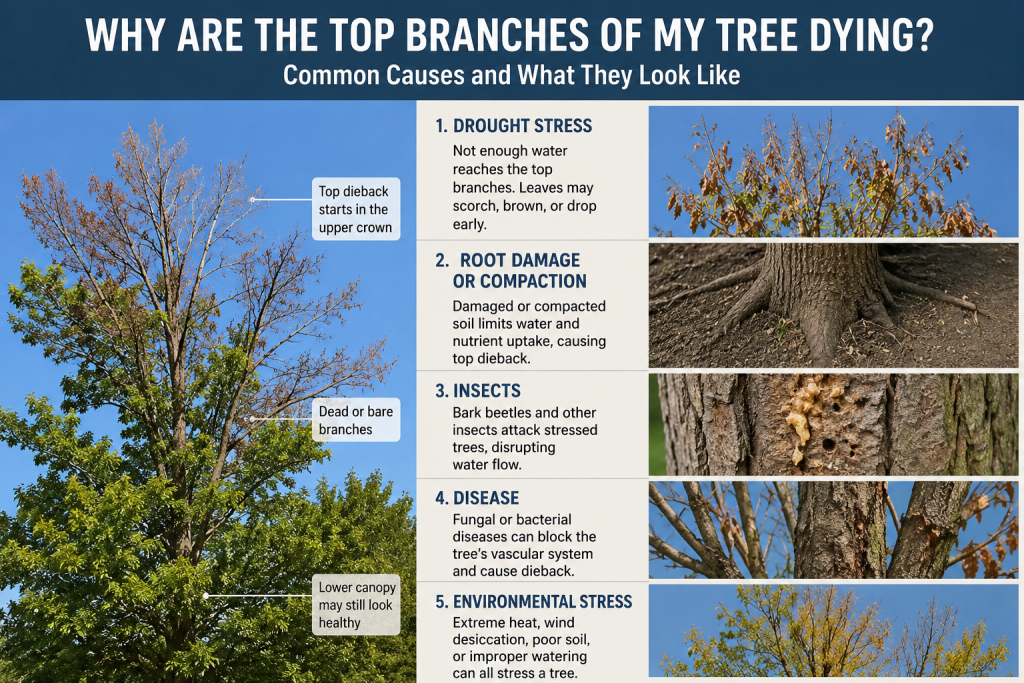
Why are the top branches of my tree dying? This is one of the most common questions homeowners ask when they notice dead twigs, bare limbs, thinning leaves, or browning needles near the top of a tree. The issue can look strange because the lower part of the tree may still seem healthy while the upper canopy slowly declines.
When the top branches of a tree start dying, the problem is often related to stress. The tree may not be getting enough water to the highest parts of the canopy. Roots may be damaged. Soil may be compacted. Drought may be affecting the tree. Insects or disease may also be involved.
For Colorado homeowners, this symptom deserves attention. Trees along the Front Range deal with dry air, drought stress, winter moisture loss, heavy clay soils, strong winds, and construction-disturbed root zones. These conditions can make upper-canopy dieback more common.
If you are asking, “Why are the top branches of my tree dying?” the answer depends on the tree species, site conditions, watering history, root health, and how quickly the dieback is spreading.
If the top of your tree is thinning, browning, or dropping dead branches, Good People Tree Service can inspect it and help determine whether the tree can recover or whether removal should be considered.
Why the Top Branches of My Tree Dying Is a Warning Sign
The phrase top branches of my tree dying usually points to a problem in the tree’s resource system. A tree has to move water and nutrients from the roots up through the trunk and into the canopy. The top of the tree is one of the hardest places to support because it is farthest from the root system.
When a tree is under stress, the upper canopy may show symptoms first.
That can happen when roots cannot absorb enough water. It can also happen when the trunk cannot move water efficiently. In other cases, insects, disease, or internal damage interrupt normal movement through the tree.
Common causes include:
- Drought stress
- Root damage
- Soil compaction
- Construction injury
- Poor watering
- Winter drying
- Vascular disease
- Insect activity
- Trunk damage
- Overwatering or poor drainage
- Old storm damage
- Natural decline in mature trees
Top dieback does not always mean the tree is dead. But it does mean the tree is struggling.
Top Branches of My Tree Dying After Drought
Drought is one of the biggest reasons Colorado homeowners notice upper-canopy dieback.
A tree may look stable for a while during dry conditions. Then the top branches begin to thin, brown, or die back. This happens because the tree cannot move enough moisture to the farthest parts of the canopy.
Drought stress can cause:
- Smaller leaves
- Leaf scorch
- Early leaf drop
- Browning needles
- Sparse canopy growth
- Dead branch tips
- Upper crown dieback
- Increased pest or disease pressure
This is especially common when a tree has shallow roots, compacted soil, or limited irrigation.
Drought damage can also be delayed. A dry season may weaken fine roots. The tree may survive that year but decline later. Homeowners may not connect the dying top branches with drought stress from previous months or years.
This is one reason the question “Why are the top branches of my tree dying?” often has more than one answer. Drought may be the trigger, but root health, soil condition, and tree species also matter.
Root Damage Can Show Up at the Top First
Root problems often appear in the canopy.
That may seem backwards. Homeowners look up and see dead branches, so they assume the problem is in the branches. But the real issue may be underground.
Roots absorb water and nutrients. They also anchor the tree. When roots are damaged, the top of the tree may stop receiving enough support.
Root damage may happen because of:
- Driveway work
- Utility trenching
- Fence installation
- Patio construction
- Heavy equipment
- Soil compaction
- Grade changes
- Root cutting
- Poor drainage
- Drought stress
A tree may not show symptoms immediately after root damage. The decline can take months or years.
This delayed response can make diagnosis difficult. A homeowner may notice the top branches dying long after construction or landscaping work was completed.
If the top branches of my tree dying started after a construction project, new patio, driveway repair, or irrigation change, root damage should be considered.
Soil Compaction Limits Water and Oxygen
Soil compaction is another common cause of top dieback.
Compacted soil has less space for air and water. Roots need both. When soil becomes compressed, roots may struggle to grow, absorb moisture, and support the canopy.
Soil compaction can happen when:
- Vehicles park near trees
- Construction equipment crosses the root zone
- Foot traffic is repeated under the canopy
- Materials are stored around trees
- Lawns are heavily used
- Soil is disturbed and then packed down
The tree may still look normal at first. Over time, the canopy may thin. Branch tips may die. The top may decline.
This is another reason top branches of my tree dying can be a root-zone problem rather than a branch problem.
The root zone often extends much farther than homeowners expect. Damage does not have to happen right next to the trunk to affect tree health.
Winter Dryness Can Damage Upper Branches
Colorado winter can be hard on trees, even when they are dormant.
Dry winter air, frozen soil, wind, and limited moisture can all stress trees. Evergreens are especially vulnerable because they continue losing moisture through needles during winter.
Winter injury may not be obvious right away. Damage may appear later as browning needles, delayed leaf-out, reduced growth, or branch dieback.
This is why some homeowners notice top dieback in spring and wonder what happened. The stress may have occurred months earlier.
Winter watering can help during dry periods, especially for newly planted trees, evergreens, and trees in exposed locations.
If you are asking “Why are the top branches of my tree dying?” after a dry winter, winter moisture stress may be part of the answer.
Leaf Scorch and Browning at the Top
Leaf scorch is a common symptom of water stress.
Leaves may develop brown edges, dry tips, or burned-looking patches. On some trees, scorch appears more heavily in the upper canopy or outer branches because those areas are exposed to sun and wind.
Leaf scorch can be caused by:
- Drought
- Improper watering
- Root damage
- Compacted soil
- Too much fertilizer
- Hot wind
- Poor site conditions
Scorch does not always mean a disease is present. It often means the tree cannot move enough water to meet leaf demand.
If scorch is followed by branch dieback, the tree may be under ongoing stress.
Insects Can Attack Stressed Upper Canopies
Insects may also cause top branches to die.
Some insects attack specific tree species. Others target trees that are already stressed by drought, root damage, or poor growing conditions.
In Colorado, bark beetles and borers can be important concerns for certain trees. A stressed tree may be less able to defend itself. Once insects enter, the upper canopy may decline more quickly.
Warning signs may include:
- Small holes in the bark
- Boring dust
- Pitch tubes on conifers
- Peeling bark
- Woodpecker activity
- Sudden needle browning
- Branch dieback
- Crown thinning
If the top branches of my tree dying are happening on a pine, spruce, fir, ash, or other susceptible tree, insect activity should be evaluated carefully.
Not every insect on a tree is the main cause. Sometimes insects are secondary. They attack after drought or root stress has already weakened the tree.
Disease Can Interrupt Water Movement
Some diseases affect a tree’s ability to move water through its vascular system. When that happens, parts of the canopy may decline.
The top branches may die first if water movement is limited or if the tree is already under stress.
Disease-related symptoms may include:
- Sudden wilting
- Branch flagging
- One-sided dieback
- Cankers
- Discolored leaves
- Bark cracking
- Fungal growth
- Progressive crown decline
The pattern matters. A single dead branch is different from the entire top thinning. One side dying is different from uniform crown dieback.
A professional inspection can help separate disease symptoms from drought, root damage, or insect pressure.
Overwatering and Poor Drainage Can Also Cause Dieback
It may seem strange, but too much water can also lead to branch dieback.
Roots need oxygen. If soil stays saturated, roots can decline. Poor drainage can reduce root function and make the tree more vulnerable to disease.
Overwatering is more likely in:
- Heavy clay soil
- Low spots
- Areas with poor drainage
- Over-irrigated lawns
- Sites where water pools near the trunk
- Newly planted trees in poorly draining holes
The symptoms can look similar to drought stress because damaged roots cannot move water properly.
This is why guessing can be risky. A homeowner may add more water when the real problem is poor drainage.
Mature Trees May Show Top Dieback First
Mature trees can be especially vulnerable to upper-canopy decline.
Older trees have larger canopies to support. They may also have old wounds, compacted root zones, limited soil space, or past construction damage.
The top of a mature tree may begin thinning when the root system cannot keep up with the canopy’s needs.
This does not always mean immediate removal is required. Some mature trees can be managed with pruning, watering adjustments, mulching, and monitoring.
But top dieback in a mature tree should not be ignored, especially if large dead branches are forming.
Dead branches high in the canopy can become a safety issue.
If the top branches of my tree dying are large, high, or located over a home, driveway, sidewalk, or play area, the tree should be inspected.
Storm Damage Can Create Delayed Dieback
Storm damage is not always obvious right after the storm.
Wind can crack branches. Heavy snow can bend limbs. Hail can damage leaves and bark. A branch may remain attached but slowly decline after internal damage.
Colorado storms can create delayed problems because trees may be stressed by several forces at once.
A tree may experience:
- Wind twisting
- Wet snow loading
- Broken branch attachments
- Torn bark
- Root movement
- Soil saturation
- Sudden temperature shifts
The top canopy is often exposed to the strongest wind and weather.
If upper branches begin dying after a major storm season, storm damage may be part of the cause.
Is the Tree Dying or Just Losing a Few Branches?
Not every dead branch means the whole tree is dying.
Trees naturally shed small twigs and shaded interior branches. That is different from visible top dieback.
The concern is greater when:
- The highest branches are dying
- The dieback is spreading downward
- Large limbs are dead
- The canopy is thinning each year
- Leaves are smaller than normal
- Bark is peeling
- Fungal growth is present
- The tree has insect signs
- The tree is leaning or cracking
- Dead branches are over structures
A few small dead twigs may be routine. A thinning crown with multiple dead upper branches is more serious.
What Homeowners Should Check From the Ground
You can make useful observations without climbing or cutting.
Look for:
- Is the top thinning or completely dead?
- Are the leaves smaller than usual?
- Are branch tips dying throughout the canopy?
- Is only one side affected?
- Are there holes, boring dust, or pitch tubes?
- Is the soil dry, compacted, or constantly wet?
- Did construction happen nearby?
- Did the symptoms appear after drought or winter?
- Are dead limbs large or high?
- Is the tree near a structure?
Take photos from the same spot every few weeks. This helps show whether the problem is spreading.
Do not climb the tree. Do not cut large high branches yourself. Dead upper limbs can break unpredictably.
Can a Tree Recover From Top Dieback?
Sometimes, yes.
Recovery depends on the cause, severity, species, and overall tree condition.
A tree may recover if:
- Dieback is limited
- Roots are still healthy
- The problem was temporary drought stress
- Watering can be corrected
- Soil conditions can be improved
- Deadwood can be pruned safely
- Insect or disease pressure is manageable
A tree may not recover if:
- The top is fully dead
- Dieback is spreading quickly
- The trunk has decay
- Root damage is severe
- Major limbs are dead
- The tree is structurally unsafe
- The canopy has lost too much live growth
- Insects have heavily infested the tree
Top dieback is not automatically a death sentence. But it is a sign that the tree needs attention.
Good People Tree Service can evaluate the tree and explain whether pruning, care, monitoring, or removal is the best option.
How to Reduce Future Top Dieback
Prevention starts with reducing stress.
Helpful steps include:
- Water deeply during dry periods
- Water during dry winter months when needed
- Mulch properly around the tree
- Keep mulch away from the trunk
- Avoid soil compaction
- Protect roots during construction
- Avoid cutting major roots
- Prune deadwood safely
- Watch for insect activity
- Improve drainage if soil stays wet
- Inspect mature trees regularly
The goal is to support the root system. Healthy roots are the foundation of a healthy canopy.
If roots cannot function, the top of the tree often shows the consequences.
When Removal May Be the Safest Option
Removal may be recommended when top dieback is advanced and the tree has become hazardous.
This is more likely when:
- The upper canopy is mostly dead
- Large dead branches are over structures
- The trunk has cracks or decay
- Insects have heavily attacked the tree
- Root damage is severe
- The tree is leaning
- The tree has lost too much live canopy
- The tree is declining quickly
- Pruning cannot reduce risk enough
A tree near a home, driveway, sidewalk, or fence carries more risk than a tree in an open area.
Location matters when deciding whether to keep, monitor, or remove a declining tree.
Final Thoughts
Why are the top branches of my tree dying? In most cases, the tree is showing signs of stress that may begin in the roots, trunk, soil, or environment.
The cause may be drought stress, root damage, soil compaction, winter dryness, insects, disease, storm damage, poor drainage, or age-related decline.
For Colorado homeowners, top dieback should be taken seriously because dry weather, wind, snow, and construction-disturbed soils can make tree stress worse.
A tree with a few small dead twigs may only need routine pruning. A tree with spreading top dieback, large dead limbs, or signs of pests may need professional evaluation.
Good People Tree Service helps homeowners identify why the top branches of a tree are dying, remove hazardous deadwood, and determine whether the tree can recover.
If the top branches of your tree are dying, schedule an inspection before the decline spreads or the dead limbs become a safety concern.