
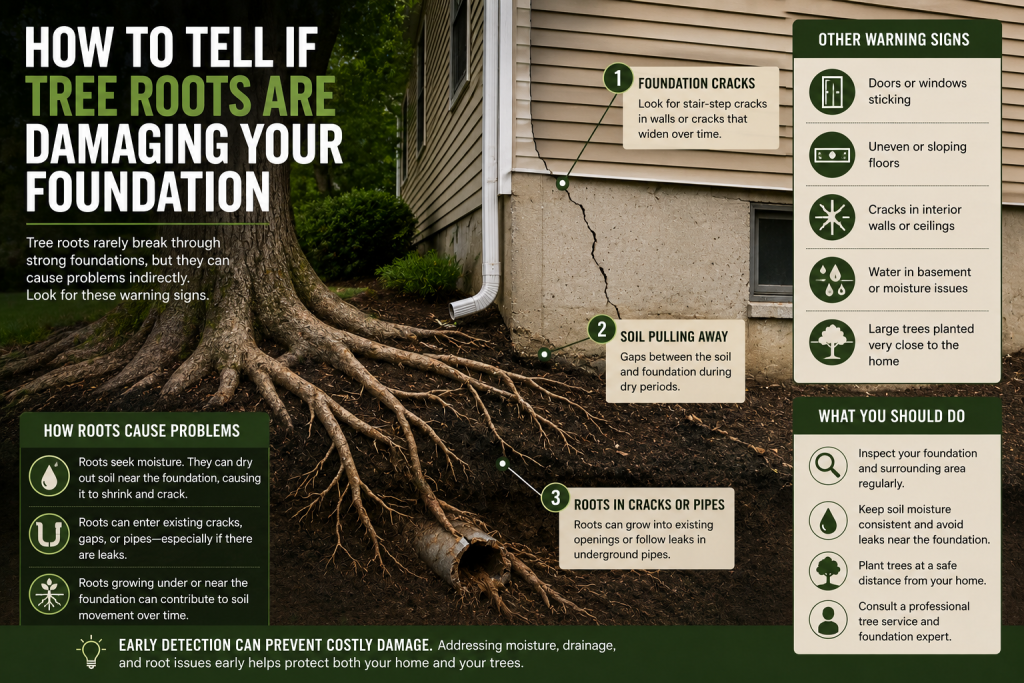
How to tell if tree roots are damaging your foundation is a question many homeowners ask after noticing cracks, uneven concrete, sticking doors, or large roots growing close to the house. It can be stressful because foundation problems feel expensive, and tree roots are easy to blame when a mature tree is nearby.
The truth is more nuanced. Tree roots do not usually break through strong, intact foundations on their own. More often, roots contribute to foundation problems indirectly by changing soil moisture, growing into existing cracks, following leaking pipes, or expanding in disturbed soil near the home.
In Colorado, this issue deserves extra attention because many homes are built on soils that expand and shrink as moisture levels change. Dry periods, irrigation habits, drainage problems, and large nearby trees can all affect soil movement around a foundation.
Understanding how to tell if tree roots are damaging your foundation helps homeowners avoid two costly mistakes: ignoring a real warning sign or removing a healthy tree without confirming the actual cause.
If a tree near your home is showing surface roots, canopy decline, or signs of stress, Good People Tree Service can evaluate the tree and help determine whether pruning, monitoring, or removal should be considered alongside foundation or drainage advice from the right professionals.
Why tree roots and foundations are often misunderstood
Many homeowners imagine tree roots pushing through concrete like a wedge. That can happen in weak spots, cracks, drains, or damaged masonry, but it is not the most common pattern.
Roots grow where conditions are favorable. They need oxygen, moisture, and space. If soil near a foundation has water from irrigation, a leaking pipe, poor drainage, or an existing crack, roots may grow toward that area. They are opportunistic, not intentionally destructive.
In many cases, the foundation problem starts with soil movement, poor drainage, settlement, expansive clay, construction issues, or moisture imbalance. Roots may worsen the problem after it begins, especially if they enter cracks or remove moisture from soil near the foundation.
This is why the question is not simply, “Are roots touching my house?” A better question is, “Are roots, soil, moisture, and foundation symptoms all pointing to the same problem?”
How to tell if tree roots are damaging your foundation
To tell if tree roots are damaging your foundation, look for patterns, not one isolated sign. A visible root near the house does not automatically mean structural damage. A foundation crack does not automatically mean roots caused it.
Concern increases when several clues appear together.
Warning signs may include:
- large trees growing very close to the foundation
- foundation cracks near the tree side of the house
- doors or windows sticking in the same area
- uneven floors or sloping interior surfaces
- cracks in basement walls or slabs
- roots visibly pressing against hardscape near the home
- plumbing or sewer issues near large roots
- soil pulling away from the foundation during dry periods
- repeated moisture problems along the same wall
- tree roots entering existing cracks, drains, or pipe openings
The pattern matters. A small hairline crack far from any tree may be unrelated. A widening crack on the same side as a large moisture-demanding tree deserves a closer look.
Colorado soil makes this issue more complicated
Colorado homeowners have to think about more than roots. Soil behavior is often a major part of the story.
Some Colorado soils contain expansive clay. These soils swell when wet and shrink when dry. That movement can place pressure on foundations, basement walls, slabs, sidewalks, and driveways.
A tree near the home may influence this process by drawing moisture from the soil. During dry periods, roots can contribute to uneven drying around the foundation. During wet periods, poor drainage or irrigation can cause the soil to expand again.
This cycle of shrinking and swelling may create movement that looks like root damage but is really a soil-moisture problem with trees as one contributing factor.
That distinction matters because removing the tree may not solve the foundation problem if drainage, irrigation, grading, or expansive soil remains unmanaged.
Soil pulling away from the foundation
One clue homeowners often notice is soil pulling away from the foundation during dry weather.
A gap between soil and the foundation can happen when soil dries and shrinks. Large trees and shrubs may accelerate drying in some areas because their roots remove water from the soil.
If the gap is larger near a tree or on one side of the home, moisture imbalance should be considered.
This does not prove roots are damaging the foundation. It does suggest that soil moisture is uneven, and that unevenness can contribute to foundation movement over time.
Homeowners should also check whether downspouts, gutters, sprinkler heads, or drainage patterns are adding water to one area while another side stays dry. Colorado foundation issues often come from moisture inconsistency, not just too much or too little water.
Cracks near the tree side of the house
Foundation cracks can have many causes. Settlement, expansive soil, poor drainage, construction defects, freeze-thaw stress, and plumbing leaks can all contribute.
Roots become more suspicious when cracks are concentrated near a large tree, especially if the tree is very close to the house and the cracks are changing over time.
Look for:
- stair-step cracks in masonry
- widening cracks in basement walls
- cracks that reopen after repair
- slab cracks near the tree side
- exterior cracks paired with interior drywall cracks
- cracks near plumbing lines or drainage areas
A crack alone is not enough to diagnose root damage. The cause should be evaluated by someone qualified to assess foundations. A tree service can inspect the tree and visible root concerns, but structural foundation diagnosis usually requires a foundation specialist or engineer.
Sticking doors and windows
Doors and windows can stick when a home shifts slightly. Seasonal humidity can also affect doors, so this symptom should be interpreted carefully.
Concern increases when sticking doors or windows appear with foundation cracks, uneven floors, wall separation, or visible soil movement near a large tree.
For example, a homeowner may notice that a basement door sticks every late summer, while soil pulls away from the foundation on the side of a large mature tree. That pattern may point to seasonal soil shrinkage influenced by moisture loss.
If the problem is getting worse each year, it should not be ignored.
Uneven floors or interior cracks
Interior signs can sometimes reveal foundation movement before the exterior looks dramatic.
Warning signs include:
- sloping floors
- cracks above doors or windows
- gaps between walls and trim
- drywall cracks that keep returning
- basement slab cracks
- separation where walls meet ceilings
These symptoms do not automatically mean tree roots are the cause. However, when they appear on the side of the home near a large tree, root-related soil moisture changes may be part of the investigation.
The safest approach is to avoid guessing. A combined evaluation of tree location, drainage, soil, and foundation symptoms gives a clearer picture.
Roots entering existing cracks or pipes
Tree roots are very good at finding moisture. If a foundation already has cracks, gaps, or openings, roots may grow into them.
The same is true for sewer lines, drains, and old pipes. Roots often enter through existing weaknesses where water or condensation is present. Once inside, they can expand and worsen the problem.
Signs may include:
- recurring sewer backups
- slow drains
- wet spots near the foundation
- roots visible in cracks
- moisture near basement walls
- cracks close to utility lines
In this situation, roots may not have caused the original defect, but they can make the damage worse. Tree removal alone may not fix the pipe or foundation opening.
Case example: the mature tree near a basement wall
A homeowner in a Colorado suburb has a mature shade tree about ten feet from the house. The tree has been there for decades. Recently, a basement wall crack started widening, and a door near that side of the home began sticking.
At first, the tree seems like the obvious cause.
A closer review shows several contributing factors. The downspout on that corner discharges near the foundation. The sprinkler system waters the lawn unevenly. During dry weeks, the soil pulls away from the wall. During storms, water collects near the same area.
The tree may be part of the moisture pattern, but it is not the only issue. Removing it without fixing drainage could leave the foundation problem unresolved.
This is why diagnosing root-related foundation concerns requires looking at the whole site.
Case example: roots following a leaking pipe
Another homeowner notices roots near a foundation crack and assumes the tree broke the wall. Later, a plumbing inspection finds a leaking sewer line near the foundation. Moisture from the leak created ideal conditions for root growth.
The roots were not the original cause. They followed water.
This situation is common enough that homeowners should be cautious before blaming the tree. Roots often reveal where moisture already exists. In some cases, they are a symptom of a plumbing or drainage issue rather than the first problem.
Tree species and distance from the home matter
Some trees create more concern near foundations because of mature size, water demand, root spread, and growth habit.
Large, fast-growing trees with broad root systems need more space. Trees planted too close to the home may create conflicts as they mature, even if they looked harmless when young.
Distance matters, but there is no single rule that fits every site. Soil type, foundation depth, tree species, irrigation, drainage, and mature size all influence risk.
In general, homeowners should be more cautious with large trees planted very close to a foundation, especially on expansive or moisture-sensitive soils.
A small ornamental tree in a well-drained site may be much less concerning than a large shade tree growing close to a basement wall in clay soil.
Surface roots near the house
Surface roots are common and do not always mean foundation damage.
Most tree roots grow in the upper soil layers because that is where oxygen and moisture are available. Large roots may become visible near sidewalks, lawns, and planting beds over time.
Surface roots become more concerning when they are pressing against foundation elements, lifting nearby hardscape, entering cracks, or growing near drainage lines.
Avoid cutting large surface roots without professional advice. Removing major roots can stress the tree, increase decline, or reduce stability. A root that looks inconvenient may also be structurally important.
If roots are close to the home and the tree is also declining, leaning, or showing stress, inspection becomes more important.
What homeowners should not do
When foundation concerns appear, it is tempting to act quickly. Unfortunately, fast decisions can create new problems.
Avoid:
- cutting large roots on your own
- removing a tree without diagnosis
- ignoring drainage problems
- piling soil or mulch against the foundation
- letting sprinklers spray the foundation
- assuming every crack is root damage
- assuming roots are harmless because the tree looks healthy
- delaying inspection when cracks are widening
Large root cuts can destabilize a tree. Tree removal can also change soil moisture patterns, especially in expansive soils. Foundation problems need careful planning, not panic.
When tree removal may be considered
Tree removal may be considered when a large tree is too close to the foundation, roots are entering cracks or pipes, the tree is declining, or foundation professionals identify the tree as a contributing factor.
Removal may also make sense when major root cutting would be required for repairs and the tree would become unstable afterward.
However, removal is not always the first or only solution. In some cases, drainage correction, irrigation changes, root barriers, selective pruning, or monitoring may be considered.
The right decision depends on tree health, structural risk, foundation symptoms, and long-term property goals.
How professionals evaluate the problem
A tree professional will look at the species, size, distance from the house, visible roots, canopy health, lean, trunk condition, and signs of root stress.
A foundation specialist may evaluate cracks, settlement, wall movement, drainage, soil behavior, and structural risk.
Sometimes both perspectives are needed.
Good evaluations consider:
- tree location and mature size
- root visibility
- soil type
- drainage patterns
- irrigation layout
- foundation crack pattern
- plumbing issues
- tree health and stability
- recent construction or grading
- whether symptoms are worsening
This combined approach helps avoid unnecessary tree removal and missed structural problems.
How to reduce future foundation risk
Prevention is easier than repair.
Homeowners can reduce risk by managing water and tree placement carefully. Around Colorado homes, consistent moisture management is especially important because dry and wet cycles can affect expansive soils.
Helpful steps include:
- plant large trees far enough from the home
- choose species based on mature size
- keep downspouts extended away from the foundation
- avoid sprinkler spray near the house
- maintain consistent soil moisture
- inspect plumbing leaks early
- avoid compacting tree root zones
- use mulch carefully, not against the foundation
- monitor foundation cracks over time
- check mature trees near the home regularly
Water management should protect both the foundation and the tree. Too much water can create swelling or drainage problems, while too little can increase soil shrinkage.
Can roots be managed without removing the tree?
Sometimes roots can be managed without removing the tree, but it depends on the site.
Possible approaches may include root barriers, drainage corrections, irrigation adjustments, walkway or hardscape redesign, pipe repair, or selective tree work. Each option has limits.
Root barriers are most effective when planned early and installed correctly. Around mature trees, cutting roots for a barrier can create stress or stability problems. Pruning may reduce canopy demand slightly, but it does not erase root-related soil movement.
A tree near a foundation should be managed with caution. The goal is to protect the house without making the tree hazardous.
Frequently asked questions
Can tree roots actually damage a foundation?
Yes, but not always in the way people imagine. Roots are more likely to exploit existing cracks, follow moisture, affect soil moisture, or enter weak points than break through strong concrete directly.
How close is too close for a tree near a house?
It depends on tree species, mature size, soil type, foundation design, and drainage. Large trees very close to the foundation deserve more caution, especially in expansive soils.
Should I cut roots near my foundation?
Do not cut large roots without professional guidance. Root cutting can harm the tree and may make it unstable.
Will removing the tree fix foundation cracks?
Not necessarily. If the real issue is expansive soil, drainage, settlement, or plumbing, removing the tree may not solve the problem.
Who should inspect the issue?
A tree service can evaluate tree health and root conflicts. A foundation professional or engineer should evaluate structural foundation movement.
Final thoughts
How to tell if tree roots are damaging your foundation comes down to patterns. A tree near the house is not automatic proof of damage. Foundation cracks are not automatic proof of root damage. The most important clues involve root location, soil moisture, drainage, foundation movement, plumbing issues, and whether symptoms are getting worse.
In Colorado, expansive soils and moisture swings make this issue more complex. Tree roots may contribute to foundation stress by changing soil moisture or entering existing cracks, but drainage and soil behavior are often part of the same story.
Good People Tree Service helps homeowners evaluate trees growing near foundations, identify root-related concerns, and decide whether pruning, monitoring, or removal should be considered.
If you suspect tree roots are affecting your foundation, schedule a tree inspection and consider a foundation evaluation before making major decisions.