
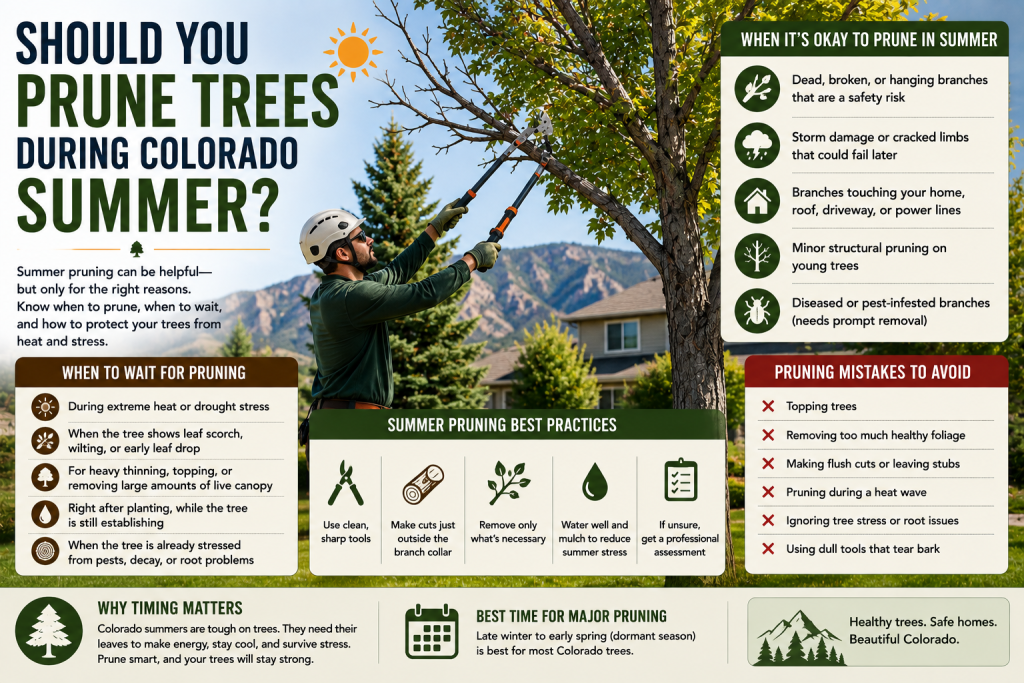
Should you prune trees during Colorado summer? The honest answer is: sometimes, but carefully. Summer is not automatically the wrong time to prune, but it is also not the best time for heavy, unnecessary, or cosmetic pruning on stressed trees. Colorado summers bring heat, drought, low humidity, wind, hail, pests, and sudden storms. Those conditions can make pruning decisions more important than they look.
Many homeowners notice tree problems in summer because symptoms become obvious. Leaves turn brown. Branches drop. Canopies thin. Deadwood shows up. A storm breaks limbs. An evergreen browns. A tree near a driveway looks scorched. The natural reaction is to grab tools and start cutting.
That can help in some cases. Removing a broken, dead, or hazardous branch can reduce risk. Light corrective pruning may help young trees. Pruning diseased wood may make sense when timing matters. But heavy pruning during hot, dry weather can add stress when the tree already needs every healthy leaf it has.
The key is understanding why you want to prune. Safety pruning and health-related pruning are different from appearance pruning. A broken branch over a roof should not wait because the calendar says summer. A major canopy reduction on a drought-stressed shade tree usually should wait.
Learning when to prune trees during Colorado summer helps homeowners protect tree health, avoid unnecessary stress, and address real hazards before they become bigger problems.
If a tree in your yard has dead limbs, storm damage, hanging branches, canopy thinning, or signs of summer stress, Good People Tree Service can inspect it and help determine whether pruning, monitoring, or removal makes sense.
Should you prune trees during Colorado summer?
Should you prune trees during Colorado summer? Yes, if the pruning has a clear reason and the tree can tolerate it. No, if the goal is heavy shaping, topping, major live-branch removal, or cosmetic thinning during heat and drought stress.
Summer pruning usually makes sense for:
- dead branches
- broken limbs
- hanging branches
- storm damage
- branches touching structures
- small corrective cuts on young trees
- diseased branches when prompt removal matters
- branches creating visibility or access problems
- minor clearance pruning when safety requires it
Summer pruning usually deserves caution when:
- the tree shows drought stress
- leaves are scorched or curling
- the canopy is already thin
- the tree was recently planted
- the tree recently lost branches in a storm
- you want to remove a large amount of live foliage
- the tree has pests, decay, or root problems
- the work is mainly cosmetic
Colorado summer pruning should be selective. The goal should be solving a specific problem, not forcing a tree into a perfect shape during the hardest part of the year.
Late winter is often better for major pruning
For many Colorado trees, late winter or early spring works better for major pruning. The tree is dormant. Branch structure is easier to see. The tree has stored energy. Wounds can begin closing as growth resumes.
Late-winter pruning also reduces some impacts on tree health compared with pruning during stressful summer conditions. Homeowners can see dead, crossing, cracked, or poorly attached branches more clearly when leaves are off deciduous trees.
This does not mean all summer pruning is wrong. It means summer pruning should have a reason.
If your goal is long-term structural pruning, major crown cleaning, or larger live-branch removal, the dormant season may give the tree a better chance to respond.
Colorado summer stress changes the pruning decision
Colorado trees face unique summer pressure. Low humidity pulls moisture from leaves. Hot sun increases water demand. Wind dries foliage and soil. Clay soil can limit water movement. Rock mulch and pavement can increase heat. Drought can reduce fine root function.
A tree under this kind of stress needs its leaves. Leaves produce energy through photosynthesis. When homeowners remove too much live canopy during summer, they reduce the tree’s ability to feed itself.
That matters most when the tree already shows stress. Brown leaf edges, early leaf drop, wilting, curling leaves, dead tips, or thinning canopy all suggest the tree may not handle extra pruning well.
Before summer pruning, ask: Is this branch dangerous, damaged, diseased, or truly necessary to remove now? If not, waiting may help the tree.
Dead, broken, or hanging branches can be removed in summer
Dead, broken, and hanging branches do not provide energy for the tree. They can also create safety risks. Removing them during summer often makes sense, especially near homes, patios, sidewalks, driveways, streets, fences, or play areas.
Storms can leave branches cracked, lodged, or partly attached. These limbs may fall later without much warning. A branch that looks stuck in the canopy can shift during the next wind event.
Summer removal of hazardous deadwood is different from heavy live pruning. Deadwood pruning focuses on safety and cleanup. It does not remove healthy leaves the tree needs for summer energy.
Large dead or hanging branches should be handled by a professional. Overhead limbs can carry more weight and tension than homeowners expect.
Storm damage should not always wait
Colorado summer storms can bring wind, hail, lightning, heavy rain, and sudden branch failure. After a storm, pruning may need to happen quickly.
Broken limbs can tear bark if they remain attached. Hanging branches can fall. Cracked limbs can fail later. Branches resting on roofs, fences, vehicles, or utility lines can create urgent hazards.
The first step is inspection. Look from the ground. Stay away from downed or hanging wires. Do not stand under broken branches. Do not cut large limbs under tension.
A tree service can remove storm-damaged branches safely and make proper pruning cuts. Good storm cleanup does not mean stripping the tree. It means removing damaged, dangerous, or poorly attached material while preserving enough healthy canopy for recovery.
Avoid topping trees in summer
Topping is never a good summer pruning strategy. It removes large parts of the canopy, creates big wounds, triggers weak sprouts, and increases long-term decay and failure risk.
Homeowners sometimes request topping because a tree feels “too tall” or “too messy.” That approach usually makes the tree more dangerous over time. The new sprouts that grow after topping often attach weakly. Large wounds may not close well. Sun can hit newly exposed bark and branches.
In Colorado summer, topping also removes shade from the tree’s own bark and root zone. That can add heat stress.
If a tree is too large for its location, a professional can discuss selective reduction, structural pruning, monitoring, or removal. Topping should not be the solution.
Do not remove too much live canopy
Even proper cuts can stress a tree if homeowners remove too much at once. This matters during Colorado summer because heat and dry air already push trees hard.
A tree needs leaves to produce energy. Removing too many healthy branches reduces food production and can expose inner branches and bark to sudden sun.
This is especially risky for stressed trees, young trees, drought-stressed trees, and trees that already lost canopy in a storm.
If the tree needs major pruning, consider phasing the work across seasons or waiting for a better dormant-season window. A professional can decide how much live canopy the tree can safely lose.
Summer pruning can help young trees when done lightly
Young trees often benefit from small structural corrections. Removing a small competing leader, a rubbing branch, or a poorly placed branch early can prevent bigger problems later.
Summer can reveal branch weight, leaf distribution, and growth patterns. That makes some structural issues easier to see. However, the cuts should stay small and purposeful.
Young trees in Colorado already face establishment stress. They have smaller root systems and may dry out quickly during hot weather. Heavy pruning can set them back.
Light summer pruning may help a young tree build better structure. Major reshaping should wait or be planned carefully.
Do not prune drought-stressed trees heavily
Drought-stressed trees need caution. If a tree has scorched leaves, early leaf drop, thinning canopy, dead tips, or wilting, heavy pruning may make things worse.
The tree may already have fewer working leaves and weakened fine roots. Removing additional live branches reduces its energy supply. Large wounds can also add another stress point.
For a drought-stressed tree, focus first on soil moisture, mulch, root-zone protection, and diagnosis. Remove dead or hazardous branches if needed. Avoid cosmetic thinning or major canopy reduction during extreme heat.
If the tree has both drought stress and safety issues, a tree service can prioritize the risky branches while preserving as much healthy canopy as possible.
Disease may change the timing
Some diseases require prompt pruning when symptoms appear. Fire blight is a common example for apple, crabapple, pear, and related ornamental trees. Diseased shoots may need removal during the growing season when symptoms develop.
That said, disease pruning requires careful cuts and tool sanitation. Poor pruning can spread problems or create unnecessary wounds. Homeowners should avoid random cutting when they do not know the disease.
If a tree has oozing cankers, blackened shoots, sudden branch dieback, or other unusual symptoms, get the issue identified before pruning heavily.
Timing depends on the disease, tree species, weather, and severity. Summer pruning can help in some disease cases, but only when done correctly.
Pest problems should be diagnosed before pruning
Summer pests can make trees look like they need pruning. Aphids, mites, scale insects, borers, bark beetles, and emerald ash borer can all cause visible symptoms.
Pruning may remove dead branches, but it does not always solve the pest problem. A thinning ash tree may need emerald ash borer evaluation. A browning pine may need inspection for bark beetles. A sticky linden may have aphids rather than a branch-structure problem.
Cutting without diagnosis can waste time and remove healthy tissue. It may also miss the real cause: drought, root damage, pests, or disease.
Prune hazardous deadwood when needed, but investigate the reason for decline before making large cuts.
Shade trees need special care in summer
Large shade trees provide cooling benefits during Colorado summer. They shade homes, patios, driveways, soil, and turf. Removing too much canopy during summer can reduce those benefits and expose the tree to more heat.
Maples, lindens, elms, oaks, cottonwoods, ash, honeylocusts, and other shade trees can all face summer stress. Mature trees also carry large limb weight, which makes pruning decisions more important.
For mature shade trees, summer pruning should focus on safety, broken branches, deadwood, and targeted clearance. Save major structural work for the dormant season when possible.
Evergreens need a different pruning approach
Evergreens do not respond like deciduous trees. Pines, spruce, firs, and junipers each have different growth habits. Some evergreens do not replace foliage well from old wood.
Summer pruning of evergreens should stay conservative. Remove dead, broken, diseased, or hazardous branches when needed. Avoid cutting into bare inner wood unless you understand how that species responds.
Evergreens stressed by drought, mites, bark beetles, winter injury, or root problems should be inspected before pruning. Browning branches may not always mean simple pruning will solve the issue.
A professional can help decide whether the tree needs pruning, pest evaluation, watering changes, or removal.
Fruit and ornamental trees need species-specific timing
Fruit and ornamental trees can need different pruning timing than large shade trees. Apple, crabapple, pear, plum, cherry, hawthorn, and similar trees may have disease, flowering, fruiting, or structural concerns that affect pruning decisions.
Light removal of dead, broken, or diseased wood can happen when needed. Larger shaping often works better during dormant periods, depending on the species and goal.
Flowering trees also have bloom timing to consider. Pruning at the wrong time can remove buds and reduce next season’s flowers.
Colorado homeowners should avoid treating every tree the same. Species matters.
Branches touching the house may need summer pruning
Branches that scrape siding, rub roofs, block walkways, or interfere with gutters may need attention during summer. Clearance pruning can reduce property damage and improve safety.
The key is restraint. Remove only what is necessary. Do not strip one side of the tree or create large imbalance just to clear a structure.
If a large limb touches the roof, a professional should evaluate it. Large limbs can shift when cut. Poor cuts can damage the tree and the home.
Clearance pruning is practical. Over-pruning is the problem.
Heat waves are a bad time for unnecessary pruning
Even if summer pruning can be appropriate, timing within summer matters. Avoid unnecessary pruning during extreme heat, drought, or wildfire-smoke stress periods when trees already struggle.
A tree pruned during a heat wave loses leaf area at the same time it needs energy and shade. Freshly exposed bark and branches may face sudden sunscald. Water demand may remain high while the tree has less foliage to regulate itself.
If the branch is hazardous, address it. If the work is cosmetic, wait for milder weather or the dormant season.
Proper pruning cuts matter
A good pruning cut respects the branch collar. The branch collar is the swollen area where the branch joins the trunk or a larger limb. Cutting just outside the branch collar helps the tree seal the wound more effectively.
Do not make flush cuts against the trunk. Do not leave long stubs. Do not tear bark. Do not paint wounds unless a specific pest or disease plan requires it.
Small branches require clean, sharp tools. Larger branches require proper technique and, often, professional equipment.
Bad cuts can create long-term decay, weak regrowth, and more future pruning problems.
Case example: the storm-broken maple
A Colorado homeowner finds a maple branch broken after a July storm. The branch hangs over a driveway and has torn bark near the trunk.
This is a reasonable summer pruning situation. The branch creates a safety issue. It may tear more bark if left in place. A tree service can remove the broken limb, make a proper cut, and evaluate whether nearby branches also cracked.
The homeowner should not use this moment to heavily thin the whole tree. The maple still needs healthy leaves for the rest of summer.
Case example: the drought-stressed ash
An ash tree has brown leaf edges, thinning canopy, and dead tips in August. The homeowner wants to prune it heavily to “help it breathe.”
That approach may hurt the tree. The ash may have drought stress, emerald ash borer, lilac/ash borer, root damage, or a combination of issues. Heavy pruning would remove live canopy and might not address the cause.
A better first step is inspection. The tree may need pest evaluation, soil moisture checks, watering adjustments, deadwood removal, or removal if decline is severe.
Case example: the young tree with crossing branches
A young tree planted two years ago has two small branches rubbing near the lower canopy. The tree otherwise looks healthy and receives proper water.
Light summer pruning may make sense. Removing one small rubbing branch now can prevent a larger wound later. The cut should be small, clean, and targeted.
This kind of pruning differs from large canopy reduction. Young tree structure improves through small, thoughtful cuts over time.
What homeowners can prune themselves
Homeowners can often handle small, low branches if they can make clean cuts from the ground and the branch is not heavy, overhead, or near wires.
Small dead twigs, low rubbing branches, or minor suckers may be manageable. Use sharp tools. Do not climb ladders with saws. Do not cut branches under tension. Do not work near power lines.
If the branch requires a ladder, chainsaw, rope, or overhead cutting, call a professional. Tree work becomes risky quickly when weight, height, and tension are involved.
When to call a tree service
Call a tree service if you see large dead limbs, hanging branches, storm damage, trunk cracks, a new lean, branches near power lines, heavy limbs over structures, pest activity, sudden canopy thinning, or large branches that need removal.
Also call when you are unsure whether pruning will help or hurt the tree. A professional can inspect the tree, identify stress factors, and decide whether summer pruning, dormant pruning, monitoring, or removal makes sense.
Good People Tree Service helps Colorado homeowners handle hazardous branches, storm-damaged trees, deadwood, and tree-health concerns safely.
Frequently asked questions
Is summer a bad time to prune trees in Colorado?
Summer is not always bad, but heavy pruning during heat or drought can stress trees. Remove dead, broken, diseased, or hazardous branches when needed. Save major pruning for late winter when possible.
Can I prune dead branches in summer?
Yes. Dead branches can usually be removed in summer, especially if they create safety risks near homes, driveways, sidewalks, or patios.
Should I prune a heat-stressed tree?
Avoid heavy pruning on heat-stressed trees. Focus on soil moisture, mulch, root-zone protection, and inspection. Remove only dead, broken, or hazardous branches if needed.
Can I prune after a summer storm?
Yes, storm-damaged branches may need prompt removal. Avoid risky cutting yourself when branches are large, hanging, cracked, or near structures.
What is the best time to prune most Colorado trees?
Late winter or early spring is often best for many trees because they are dormant and branch structure is easier to see. Summer pruning should be selective and purposeful.
Final thoughts
Should you prune trees during Colorado summer? Sometimes. Summer pruning makes sense for dead branches, broken limbs, storm damage, disease concerns, light young-tree corrections, and safety hazards. It does not make sense for heavy cosmetic pruning, topping, or major canopy removal on drought-stressed trees.
Colorado summer already challenges trees with heat, dry air, wind, drought, storms, pests, clay soil, pavement heat, and root stress. A tree needs healthy foliage to produce energy and recover. Removing too much live canopy at the wrong time can make stress worse.
The best approach is simple: prune with a reason. Remove hazards. Protect tree health. Avoid unnecessary heavy cuts. Save larger structural work for the dormant season when possible.
Good People Tree Service helps Colorado homeowners inspect summer tree problems, remove hazardous branches, clean up storm damage, and decide whether pruning or removal is the right next step.
If your tree has broken limbs, dead branches, storm damage, or signs of summer decline, schedule an inspection before a small issue becomes a bigger safety concern.