
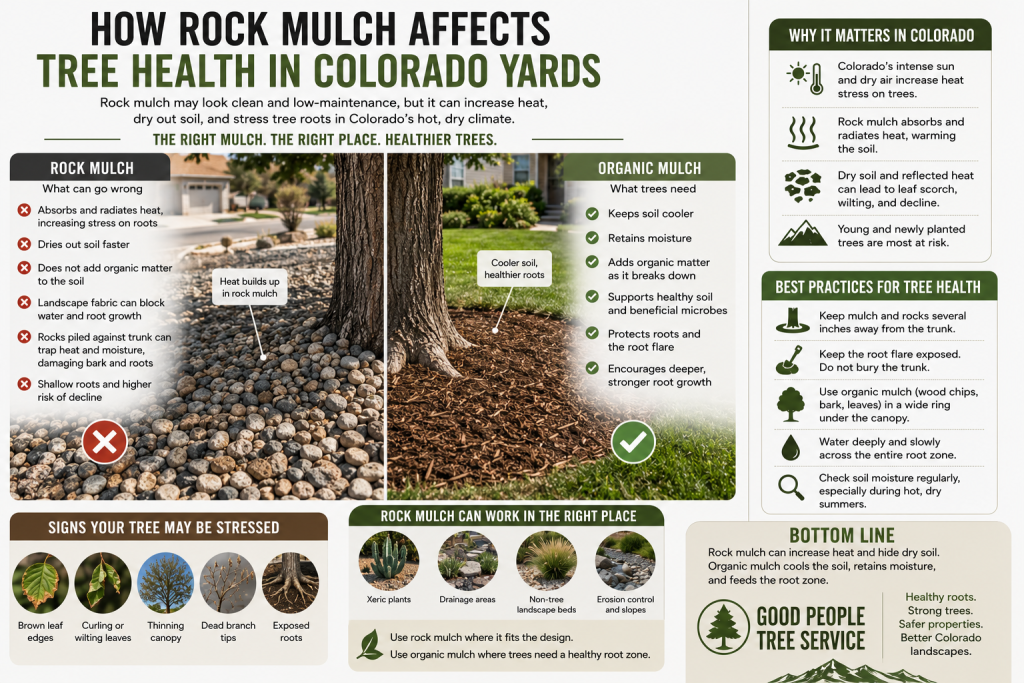
How rock mulch affects tree health in Colorado yards depends on placement, depth, soil type, irrigation, tree age, and summer heat exposure. Rock can look clean, reduce mud, and fit a low-water landscape style. It can also create problems when homeowners place it too close to trunks, spread it over shallow roots, combine it with landscape fabric, or use it around trees that already struggle with drought and heat stress.
Many Colorado homeowners choose rock mulch because it lasts longer than wood mulch and matches xeriscape designs. That choice makes sense in some parts of a yard. The problem starts when rock becomes the default material around every tree, shrub, and planting bed.
Trees need a healthy root zone. Roots need oxygen, moisture, moderated soil temperature, and room to grow. Rock mulch can change each of those conditions. In a hot Front Range yard, rock may absorb and release heat, dry the area around the tree faster, restrict organic matter, and make irrigation harder to judge.
Understanding how rock mulch affects tree health in Colorado yards helps homeowners avoid hidden stress before leaves turn brown, branches die back, or a young tree fails to establish.
If a tree in your rock bed shows leaf scorch, thinning canopy, dead tips, exposed roots, or slow growth, Good People Tree Service can inspect the tree and help identify whether heat, soil, watering, roots, or site conditions are part of the problem.
How rock mulch affects tree health in Colorado yards
How rock mulch affects tree health in Colorado yards starts with heat. Rock absorbs sunlight during the day and releases that heat into the surrounding air and soil. In Colorado’s dry summer climate, that extra heat can increase stress around tree roots, trunks, and lower branches.
Rock also changes moisture behavior. In some designs, small gravel can reduce surface evaporation. In other situations, rock can shed water, concentrate runoff, or make homeowners think the soil has enough moisture when the root zone remains dry.
Organic mulch behaves differently. Wood chips, bark, pine needles, and arborist chips break down slowly and add organic matter to the soil. They also help moderate soil temperature and create a root-zone environment closer to a natural forest floor.
Rock does not decompose into soil-building material. It stays in place, holds heat, and often sits on top of landscape fabric that can interfere with long-term soil health.
That does not mean rock mulch always harms trees. It means homeowners should use it carefully and avoid treating it as a universal tree-care solution.
Colorado yards make the rock mulch question more important
Colorado landscapes create special challenges for trees. The Front Range has dry air, intense sun, clay soil, compacted neighborhoods, drought cycles, rapid temperature swings, and hardscape-heavy yards.
Many trees already grow near driveways, sidewalks, patios, streets, and south-facing walls. Rock mulch can add another heat source to that stressful environment.
This is why how rock mulch affects tree health in Colorado yards depends so much on context. The same material can work in one bed and hurt another tree in a different spot.
Rock mulch can increase heat around trees
Heat is the biggest concern.
Rocks can absorb sun during the day and radiate warmth later. Around homes, this can create a hotter microclimate near plants. Add a south-facing wall, driveway, sidewalk, or street, and the heat load becomes even stronger.
Tree roots often grow in the upper soil layers. When rock increases surface heat, shallow roots may experience more stress. This matters during July and August when soil already dries quickly and leaves lose water faster through transpiration.
Heat stress may show up as brown leaf edges, curling leaves, scorched foliage, early leaf drop, dead branch tips, or slow growth.
A mature tree with a large root system may tolerate heat better than a young tree. Still, repeated summer stress can reduce vigor over time.
Rock mulch can hide dry soil
Rock can make a yard look finished and tidy. That tidy surface can mislead homeowners.
Soil beneath rock may dry out while the surface still looks stable. Unlike organic mulch, rock does not darken, soften, or visibly break down in ways that remind homeowners to check the soil. A tree may look surrounded by a “protected” bed, while the roots below need water.
The only reliable way to know is to check the soil. Use a screwdriver, soil probe, or small trowel several inches down. Test near the dripline and under the canopy, not just next to the trunk.
This step matters because rock mulch affects tree health in Colorado yards most during hot, dry stretches when homeowners rely on appearances instead of soil moisture.
Rock mulch and clay soil can create mixed results
Many Colorado yards contain clay or clay-like soil. Clay already creates a watering challenge. It absorbs water slowly, drains slowly, and compacts easily.
Rock over clay can make diagnosis harder. A homeowner may water quickly, watch water run through or away from the rock, and assume the tree received enough moisture. In reality, compacted clay may not absorb water evenly.
Another homeowner may overwater because the tree shows leaf scorch. If clay soil stays wet below the surface, roots may lack oxygen. The leaves may brown because damaged roots cannot move water well.
Rock mulch does not fix clay soil problems. It may cover them.
A tree in clay soil needs slow watering, oxygen, mulch management, and root-zone protection. If rock makes those tasks harder, the tree can decline even when the landscape looks neat.
Landscape fabric often makes the problem worse
Many rock beds include landscape fabric underneath. Homeowners use it to reduce weeds and keep stones from mixing into soil. In the short term, it may look practical. Over time, it can create problems around trees.
Fabric can collect dust, organic debris, and weed seeds on top. Roots may grow into or along the fabric. Water may move unevenly. Soil biology may decline because organic matter no longer cycles into the root zone.
When homeowners combine fabric and rock near trees, the bed can trap heat and separate the soil from natural organic inputs.
Tree roots benefit from living soil. A rock-and-fabric layer often treats the root zone like a finished construction surface rather than a biological system.
Organic mulch supports roots differently
Organic mulch helps trees in ways rock cannot.
Wood chips, shredded bark, pine needles, leaves, and arborist chips break down over time. As they decompose, they add organic matter and support soil organisms. They also moderate soil temperature, reduce evaporation, reduce mower damage, and reduce competition from grass near the trunk.
Healthy tree roots often develop better under organic mulch than under turf or harsh surface conditions. That matters because fine roots absorb much of the water and nutrients a tree needs.
Rock may reduce maintenance in one sense, but organic mulch usually supports tree biology better.
Rock near the trunk can create bark problems
Tree trunks should not sit buried in any mulch material. That includes rock.
When rock piles against the trunk, it can trap heat, hold moisture in pockets, scrape bark, hide girdling roots, and cover the root flare. The root flare is the area where the trunk widens into the main structural roots. It should remain visible.
A buried root flare can hide decay, pest activity, circling roots, and planting-depth problems. Rock can make the base look clean while the trunk slowly develops stress.
Keep any mulch away from direct trunk contact. A small open space around the trunk helps bark stay visible and reduces the chance of hidden damage.
Case example: the young tree in a hot rock bed
Imagine a homeowner plants a young shade tree in a new Colorado front yard. The landscaper installs decorative rock across the whole bed and places fabric underneath. The tree looks sharp against the stone.
By the second summer, the leaves curl in the afternoon. Brown edges appear by August. The homeowner waters the bed but does not know whether moisture reaches the root ball. The rock stays hot around the small root system, and the fabric makes soil checks harder.
The tree has not had time to grow roots into the wider yard. It needs consistent moisture and moderate soil conditions. Instead, it sits in a hot, low-organic, hard-to-monitor root zone.
This is a common example of how rock mulch affects tree health in Colorado yards when homeowners use it around newly planted trees.
Case example: the mature tree surrounded by rock
A mature tree grows near a driveway. Years ago, the homeowner replaced turf with rock to reduce watering and maintenance. The tree looked fine at first.
Over time, the canopy thinned. Leaves scorched on the driveway side. Surface roots appeared. The soil under the rock became compacted, and irrigation only reached parts of the root zone.
The rock did not cause every problem alone. The driveway added heat. Clay soil slowed water movement. Years of drought reduced root health. Still, the rock bed made the site hotter and made soil management less natural.
This tree may need root-zone improvements, deadwood pruning, watering adjustments, or risk evaluation depending on its condition.
Rock mulch can work in the right place
A balanced article should not say rock is always bad.
Rock can work well in dry creek beds, drainage channels, cactus or succulent areas, non-tree xeric beds, narrow decorative zones, and places where fire mitigation or erosion control matters. Some native or drought-adapted plants tolerate gravelly conditions better than moisture-loving trees.
Rock can also reduce weeds and hold up under wind better than lightweight mulch.
The issue is placement. A rock bed that works for ornamental grasses or xeric perennials may not support a young shade tree or a stressed evergreen.
Use rock where it matches the plant community and the site. Use organic mulch where the priority is tree root health.
Rock around evergreens can be risky in hot sites
Evergreens can struggle in hot rock beds, especially near walls, streets, or south-facing exposures. Pines, spruce, and firs may show browning needles, tip dieback, or slow decline when heat, drought, and root stress combine.
Evergreens also lose moisture during winter. Rock does not solve winter drought. A dry evergreen in a rock bed may enter spring already stressed, then face summer heat with limited reserves.
Some evergreen species tolerate dry, rocky conditions better than others. Still, residential rock beds often add reflected heat and reduce organic soil improvement.
A tree service can help determine whether browning comes from drought, heat, mites, beetles, needle disease, planting issues, or root stress.
Signs rock mulch may be stressing a tree
Homeowners should look for patterns.
Warning signs include leaf scorch, curling leaves, early leaf drop, thinning canopy, dead branch tips, browning needles, bark cracks near the lower trunk, dry soil under the rock, surface roots, poor growth, repeated summer stress, and decline near pavement or hot walls.
These signs do not prove rock mulch is the only cause. Colorado trees often face several stress factors at once. The rock bed may contribute to heat, moisture, and soil limitations.
Pay attention when symptoms appear on the hottest side of the tree or in beds with rock, fabric, pavement, and limited irrigation.
What homeowners should do if rock already surrounds a tree
Start with inspection, not panic.
Pull a few stones back carefully and check the soil. Look for fabric. Find the root flare. Check whether rock touches the trunk. Test moisture in several spots. Notice whether irrigation reaches the whole root zone.
If the tree looks healthy and the soil stays cool and moist enough, you may not need major changes. If the tree shows stress, consider removing rock from the critical root zone and replacing it with organic mulch.
A good compromise uses rock in decorative areas while leaving a wide organic mulch ring around trees. This preserves the design while giving roots a better environment.
How to convert rock around a tree to organic mulch
Work carefully.
Do not scrape roots aggressively. Remove rock by hand or with light tools near the trunk and exposed roots. Cut and remove fabric if it exists. Keep the root flare visible. Add organic mulch in a flat layer, usually about 2 to 4 inches deep, for the site.
Keep mulch away from the trunk. Spread it wide rather than deep. A larger ring helps more roots than a small donut.
Water slowly after conversion so moisture reaches the soil. Then monitor the tree through the next hot season.
Avoid burying surface roots under soil. A thin organic mulch layer usually works better than adding heavy soil over roots.
What to use instead of rock near trees
Organic mulch usually works best around trees.
Good options include arborist wood chips, shredded bark, pine needles, leaf mulch, and partially composted wood material. Arborist chips often work well because they contain a mix of wood, bark, and leaves.
The best mulch choice depends on site, slope, fire considerations, appearance goals, and irrigation. In some wildfire-prone areas, homeowners may need defensible-space guidance near structures. Even then, they can often design tree root zones thoughtfully instead of placing hot rock directly around every trunk.
When to call a tree service
Call a tree service if a tree in rock mulch shows severe leaf scorch, canopy thinning, dead branches, browning needles, trunk cracks, mushrooms near the base, pest activity, new lean, root damage, or sudden decline.
The urgency increases when the tree stands near a home, driveway, sidewalk, patio, fence, or utility line.
Good People Tree Service can inspect the tree, look at the site, identify visible stress factors, and explain whether root-zone changes, pruning, monitoring, or removal makes sense.
Frequently asked questions
Is rock mulch bad for trees in Colorado?
Rock mulch is not always bad, but it can stress trees when it increases heat, hides dry soil, covers roots with fabric, or sits too close to the trunk. Trees usually benefit more from organic mulch around the root zone.
Can I keep rock in my yard and still protect trees?
Yes. Keep rock in areas where it fits the design, but consider organic mulch around trees. A wide mulch ring can protect roots while the rest of the landscape keeps a low-water style.
Should I remove landscape fabric under rock near trees?
Often, yes. Fabric can interfere with water movement, root growth, soil biology, and future tree care. Remove it carefully to avoid damaging roots.
How far should organic mulch extend around a tree?
Wider is usually better. Mulch under the canopy and toward the dripline when possible. Keep it flat and away from the trunk.
Final thoughts
How rock mulch affects tree health in Colorado yards depends on how homeowners use it. Rock can fit certain xeric designs, drainage features, and low-water plantings. Around trees, it can also increase heat, hide dry soil, reduce organic matter, complicate watering, and worsen stress in hot sites.
Colorado trees already face dry air, intense sun, clay soil, drought, compacted yards, and hardscape heat. A rock bed may add pressure when trees need moisture, oxygen, and moderated soil conditions.
The best solution is not always removing every stone. The smarter solution is matching mulch to the plant. Trees usually need a living root zone with organic mulch, careful watering, visible root flare, and protection from heat and compaction.
Good People Tree Service helps Colorado homeowners evaluate tree stress, root-zone problems, deadwood, and site conditions.
If a tree in your rock landscape looks scorched, thin, dry, or unhealthy, schedule an inspection before root-zone stress turns into long-term decline.