
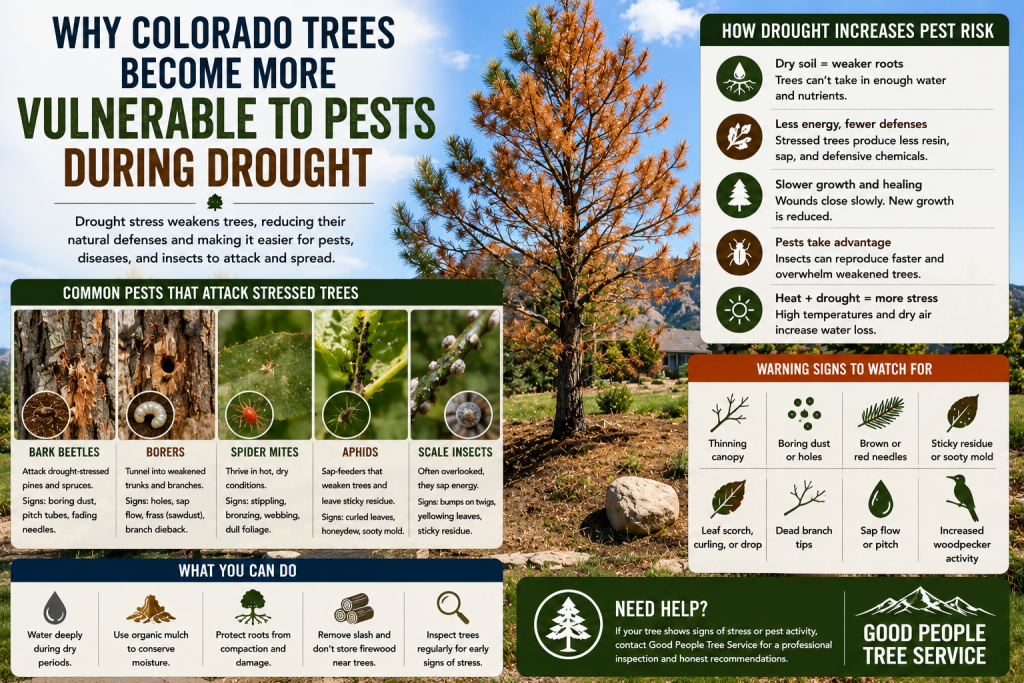
Why Colorado trees become more vulnerable to pests during drought comes down to stress, water movement, and weakened defenses. A healthy tree can often tolerate small insect populations. A drought-stressed tree has fewer resources, weaker roots, less moisture, and less energy to fight back. That is when pests can move from a minor issue to a serious tree-health problem.
Colorado homeowners often notice the pattern in summer. A tree looks fine in spring. Then heat, dry wind, low rainfall, compacted soil, rock mulch, and shallow watering start to add pressure. By late summer, leaves scorch, needles fade, branches thin, bark beetles appear, aphids leave sticky residue, mites cause bronzing, or borers start attacking weak limbs.
Drought does not create every pest problem. Some pests attack healthy trees too. But drought often gives insects an opening. It can reduce the tree’s ability to seal wounds, produce resin, move water, grow new tissue, and recover from feeding damage.
Understanding why Colorado trees become more vulnerable to pests during drought helps homeowners act earlier. The goal is not only to identify insects after damage appears. The better goal is to reduce stress before pests take advantage.
If your tree shows boring dust, pitch, sticky residue, thinning canopy, browning needles, leaf scorch, or dead branch tips during dry weather, Good People Tree Service can inspect it and help determine whether drought, pests, roots, disease, or structure are part of the problem.
Why Colorado trees become more vulnerable to pests during drought
Why Colorado trees become more vulnerable to pests during drought starts with water. Trees need water to move nutrients, cool leaves, maintain living tissues, produce energy, and defend themselves.
When soil dries out, fine absorbing roots can decline. Those fine roots collect much of the water and nutrients the tree needs. As they weaken, the tree loses capacity. It may still stand tall and look alive, but it has less ability to respond to insects, heat, and disease.
Drought also reduces growth. A tree that grows slowly produces less new tissue, less energy, and fewer reserves. That matters because pest resistance takes resources. Trees do not defend themselves for free. They need moisture and energy to do it.
In Colorado, drought often combines with other stress factors. Clay soil may limit root oxygen. Rock mulch may raise heat around roots. Pavement may reflect heat. Lawn sprinklers may water turf but miss deeper tree roots. Construction may cut or compact roots.
Once these factors stack up, pests have a better chance.
Drought weakens tree defenses
Trees defend themselves in several ways. They compartmentalize wounds, produce chemicals, grow callus tissue, shed damaged parts, and push back against some pests with sap or resin.
Conifers such as pines and spruce rely partly on resin to resist bark beetles. A vigorous tree can sometimes pitch out attacking beetles. A drought-stressed tree may not have enough moisture and pressure to produce a strong resin response.
Deciduous trees also lose defensive strength during drought. Ash, maple, linden, cottonwood, elm, fruit trees, and ornamentals may have less energy to tolerate borers, aphids, mites, scale insects, and leaf-feeding pests.
The insect may look like the cause, but the stress often came first. Drought makes the tree easier to attack and harder to recover.
Colorado drought stress often builds slowly
Drought stress rarely begins on the day leaves turn brown. It often builds over weeks, months, or seasons.
A tree may experience dry winter soil, limited spring moisture, hot summer weather, and inconsistent irrigation. By the time pests appear, the tree may already have weakened roots and reduced canopy energy.
This slow buildup explains why some trees decline even after one good rainstorm. A quick storm may wet the surface but not restore deep root moisture. Roots that died during drought do not regrow instantly. A tree may need several seasons of better conditions to regain strength.
Homeowners sometimes say, “But it rained last week.” The better question is whether the root zone recovered from months of moisture deficit.
Heat and drought work together
Colorado drought often comes with heat. Hot air increases water demand. Low humidity pulls moisture from leaves. Wind dries soil and foliage. Strong sun adds pressure to exposed branches and young bark.
During hot drought periods, trees close tiny leaf openings to conserve water. That helps reduce moisture loss, but it also limits photosynthesis. Less photosynthesis means less energy. Less energy means fewer reserves for growth and defense.
This creates a cycle. The tree conserves water to survive, but that survival mode reduces its ability to fight pests. If drought continues, pests may take advantage of the weakened condition.
Bark beetles often target stressed conifers
Bark beetles are one of the biggest drought-related concerns for Colorado conifers. Ips beetles, mountain pine beetles, Douglas-fir beetles, and other bark beetles attack trees under the bark, where they damage the tissues that move water and nutrients.
Drought-stressed pines and spruce may become more vulnerable because they cannot produce enough defensive resin. Beetles may also breed in fresh cut wood, storm debris, slash piles, or firewood left near susceptible trees.
Signs of bark beetle activity can include boring dust, small holes, pitch tubes, fading needles, woodpecker activity, and sections of canopy turning yellow, red, or brown.
A conifer can decline quickly after a successful beetle attack. By the time needles turn fully brown, the damage may already be advanced.
Ips beetles and drought-stressed pines or spruce
Ips beetles, also called engraver beetles, commonly attack stressed pines and spruce in Colorado. They can become a problem during prolonged drought, especially when fresh green wood sits nearby.
Homeowners should watch trees after pruning, thinning, storm cleanup, or fire-mitigation work. Fresh pine or spruce material can attract beetles if it stays near living trees during active periods.
Drought-stressed conifers may show top dieback, fading needles, boring dust, and bark holes. A tree near rock mulch, pavement, slopes, or poor irrigation may face higher stress during summer.
The best approach combines prevention and early detection. Keep trees watered during dry periods when appropriate, avoid unnecessary wounding, manage fresh cut material, and inspect conifers when drought persists.
Mountain pine beetle risk increases when trees are stressed
Mountain pine beetle can attack pines and cause major mortality during outbreaks. Large host trees, dense stands, drought stress, and nearby beetle populations can increase concern.
In residential settings, homeowners may notice pitch tubes, boring dust, woodpecker feeding, and later crown color change. A pine may not show obvious canopy symptoms right away.
A strong pine may resist some attacks with resin. A drought-stressed pine has fewer defenses. Once beetles successfully colonize the tree, saving it may not be realistic.
Homeowners with mature pines near homes, driveways, patios, or mountain properties should take drought stress seriously. A dead pine can become a property hazard, especially when it stands near targets.
Borers often move into weakened trees
Many wood borers prefer trees weakened by drought, injury, poor roots, transplant stress, or mechanical damage. They tunnel into trunks, limbs, or branches and disrupt the tree’s living tissue.
Common signs include holes in bark, sawdust-like material, sap flow, branch dieback, bark cracking, and thinning canopy.
Borers often tell a larger story. The tree may have drought stress, lawn-equipment wounds, compacted soil, construction root damage, or poor planting depth. Killing or removing one visible pest problem will not help much if the tree stays weak.
This is why homeowners should ask why the borer arrived. Drought may be the opening. The pest is the symptom that made the problem visible.
Spider mites thrive in hot, dry conditions
Spider mites are not insects, but homeowners often group them with tree pests. They can become worse during hot, dry weather, especially on stressed plants.
Mite damage may appear as stippled leaves, bronzing, dull color, yellowing, browning, or fine webbing. On evergreens, mites can contribute to needle discoloration and thinning. Dusty, dry conditions can make problems worse.
Drought-stressed plants may become more favorable to mite outbreaks. A homeowner may think the tree only needs more water, but mites may already be feeding.
Watering the root zone helps reduce drought stress, but mite identification still matters. Some mite problems require targeted care, and some symptoms look similar to heat scorch.
Aphids can add stress to already weak trees
Aphids are common on Colorado shade trees and ornamentals. They feed on plant sap and often leave sticky honeydew on leaves, cars, patios, sidewalks, and outdoor furniture. Sooty mold may grow on that honeydew.
Aphids rarely kill mature, healthy trees by themselves. But they can add stress to trees already weakened by drought, poor soil, or root problems. Heavy aphid populations may cause curled leaves, distorted growth, sticky messes, and general decline in smaller or stressed trees.
Lindens, maples, willows, cottonwoods, fruit trees, and ornamentals can all host aphids depending on species and conditions.
The key is context. Sticky residue alone may be mostly a nuisance. Sticky residue plus canopy thinning, drought stress, and dead branch tips deserves a closer look.
Scale insects can hide on stressed branches
Scale insects often look like small bumps or crusty growths on stems, twigs, needles, or leaves. Many homeowners do not recognize them as pests.
Scale can cause yellowing, weak growth, branch decline, and honeydew in some species. Trees under drought stress may tolerate scale feeding less effectively.
Because scale insects often sit still and blend into bark or twigs, infestations can go unnoticed until the tree shows visible decline.
Inspect branches closely if a tree looks weak after drought. Scale may be part of the problem, especially on ornamentals, conifers, and smaller landscape trees.
Emerald ash borer and drought-stressed ash trees
Emerald ash borer attacks ash trees specifically. Drought does not cause emerald ash borer, but drought can complicate ash tree decisions.
Ash trees in Colorado already face heat, compacted soil, street exposure, root restriction, old pruning wounds, and inconsistent watering. Drought can thin the canopy and weaken the tree. Emerald ash borer can then become harder to detect early because drought symptoms and pest symptoms may overlap.
Warning signs include upper canopy thinning, branch dieback, woodpecker activity, bark flecking, sprouts from the trunk or lower branches, S-shaped galleries under bark, and D-shaped exit holes.
A declining ash needs proper identification and inspection. Homeowners should not assume drought explains everything, especially in communities where emerald ash borer has been detected nearby.
Drought can make pest symptoms look confusing
Drought and pests often create similar symptoms. Brown leaves, thinning canopy, dead tips, and early leaf drop can come from dry soil, root damage, pests, disease, or a combination.
This makes guessing risky. Watering more may help drought stress, but it will not stop bark beetles in a successfully attacked pine. Pruning dead branches may reduce risk, but it will not fix a dry root zone. Treating insects may fail if compaction, rock mulch, and poor watering continue to weaken the tree.
Look for patterns. Drought stress often affects exposed sides, upper canopy, leaf edges, or the whole tree. Pest activity may leave boring dust, pitch, holes, honeydew, webbing, scale bumps, bark flecking, or woodpecker activity.
A good diagnosis considers both the tree and the site.
Root damage increases pest vulnerability during drought
Drought becomes more serious when roots are already damaged. Construction, trenching, grading, patio installation, driveway work, utility lines, and compacted soil can reduce root function.
A tree with damaged roots may still leaf out in spring. Then summer heat arrives, and the tree cannot move enough water. Pests may attack during or after that stress period.
Homeowners often blame the insect because that is what they can see. But root damage may have weakened the tree months earlier.
Protecting roots is one of the best ways to reduce pest vulnerability. Keep heavy equipment, soil piles, digging, and repeated foot traffic away from the root zone when possible.
Rock mulch and pavement can add stress
Many Colorado yards use rock mulch, concrete, asphalt, patios, and south-facing walls. These surfaces can increase heat around trees.
Rock mulch may absorb and radiate heat. Pavement can reflect sun and warm the root zone. Landscape fabric under rock can complicate water movement and reduce organic matter.
A tree in this environment may face drought stress even when the homeowner waters occasionally. The site dries faster and stays hotter.
Pests often take advantage of trees in hot, dry, restricted root zones. If a tree near rock mulch or pavement shows scorch, thinning, or pest signs, check the soil and consider root-zone improvements.
Young trees are especially vulnerable
Young trees have smaller root systems and fewer stored reserves. A dry summer can stress them quickly. If they sit in compacted soil, rock beds, or windy exposures, the risk increases.
Pests may not always be the first issue. A young tree may first show wilting, curling leaves, leaf scorch, or early leaf drop. Then aphids, mites, borers, or disease may follow.
New trees need consistent soil moisture during establishment. They also need proper mulch, visible root flare, and protection from trunk wounds.
A young tree that struggles through drought may never establish well unless homeowners correct the root-zone problem.
Mature trees can decline slowly
Mature trees often hide drought stress longer than young trees. They have larger trunks, bigger root systems, and more stored energy. That can make them look stable even while stress builds.
After repeated dry seasons, a mature tree may produce smaller leaves, thinner canopy, dead branch tips, or early fall color. Pests may then attack weakened branches or the main trunk.
Large trees near homes can become safety concerns when drought and pests combine. Dead limbs, bark beetle-killed conifers, or declining ash trees near targets need inspection.
Mature trees deserve proactive care because replacement takes decades.
Warning signs homeowners should watch for
During drought, inspect trees from the ground every few weeks.
Watch for boring dust, small bark holes, pitch tubes, sap flow, woodpecker activity, sticky honeydew, sooty mold, webbing, curled leaves, bronzed foliage, browning needles, thinning canopy, dead branch tips, early leaf drop, bark cracks, exposed roots, and sudden color change.
Also check the soil. Dry soil several inches down means the tree may need slow watering. Soggy soil may point to drainage or oxygen problems. Compacted soil may prevent water from reaching roots.
Tree symptoms and soil conditions should be read together.
How homeowners can reduce drought-related pest risk
The best pest prevention starts with tree health.
Water deeply during prolonged dry periods. Focus on the root zone, not the trunk. Use organic mulch to conserve moisture and moderate soil temperature. Keep mulch away from the trunk. Protect roots from construction and compaction. Avoid unnecessary pruning during severe heat. Remove fresh conifer material that can attract bark beetles. Do not move firewood from unknown sources.
Choose tree species that fit Colorado conditions. Maintain diversity in the landscape. A yard with several species usually handles pest pressure better than a yard dominated by one vulnerable tree type.
Schedule inspections when a high-value tree shows drought stress. Early attention gives homeowners more options.
When watering is not enough
Water helps many drought-stressed trees, but it cannot fix every pest problem.
A pine with successful bark beetle attack may not recover. An ash with advanced emerald ash borer symptoms may need removal. A tree with severe root damage, trunk decay, or large dead limbs may remain hazardous even if watered.
Watering supports living tissue. It does not reverse structural failure, advanced infestation, or major decay.
Call a tree service when pest signs appear with rapid decline, large dead branches, trunk cracks, mushrooms near the base, a new lean, or branches over a roof, driveway, sidewalk, fence, or patio.
Frequently asked questions
Why do pests attack drought-stressed trees?
Drought-stressed trees have weaker roots, less energy, lower moisture, and reduced defenses. That makes it easier for pests to feed, reproduce, or overwhelm the tree.
Which pests attack Colorado trees during drought?
Common drought-related concerns include bark beetles, ips beetles, mountain pine beetles, wood borers, spider mites, aphids, scale insects, and pests that take advantage of weakened trees.
Can watering prevent tree pests?
Watering can reduce drought stress and improve tree vigor, but it cannot prevent every pest. It works best as part of a larger plan that includes mulch, root protection, inspection, and correct pest identification.
How do I know if my tree has pests or drought stress?
Look for both symptoms and clues. Drought often causes scorch, wilting, thinning, or early leaf drop. Pests may leave boring dust, holes, pitch, honeydew, webbing, scale bumps, or woodpecker activity.
Should I treat pests myself?
Do not treat before identifying the pest and tree condition. The wrong product or timing can waste money and miss the real problem. Some treatments require licensed professionals.
Final thoughts
Why Colorado trees become more vulnerable to pests during drought comes down to weakened defenses. Dry soil, heat, wind, low humidity, compacted roots, rock mulch, pavement, and poor watering all reduce tree strength. Once a tree loses vigor, pests can move in more easily.
Bark beetles, borers, spider mites, aphids, scale insects, and emerald ash borer concerns all require accurate diagnosis. Some problems mostly create nuisance damage. Others can kill trees or create safety risks near homes and walkways.
Homeowners should focus on prevention first. Check soil moisture. Water deeply during dry periods. Use organic mulch. Protect roots. Avoid unnecessary wounds. Watch for pest signs before the canopy collapses.
Good People Tree Service helps Colorado homeowners inspect drought-stressed trees, identify visible pest symptoms, evaluate branch hazards, and decide whether a tree needs care, monitoring, or removal.
If your tree looks dry, thin, sticky, bored into, or suddenly brown during drought, schedule an inspection before pest pressure turns into long-term decline.