
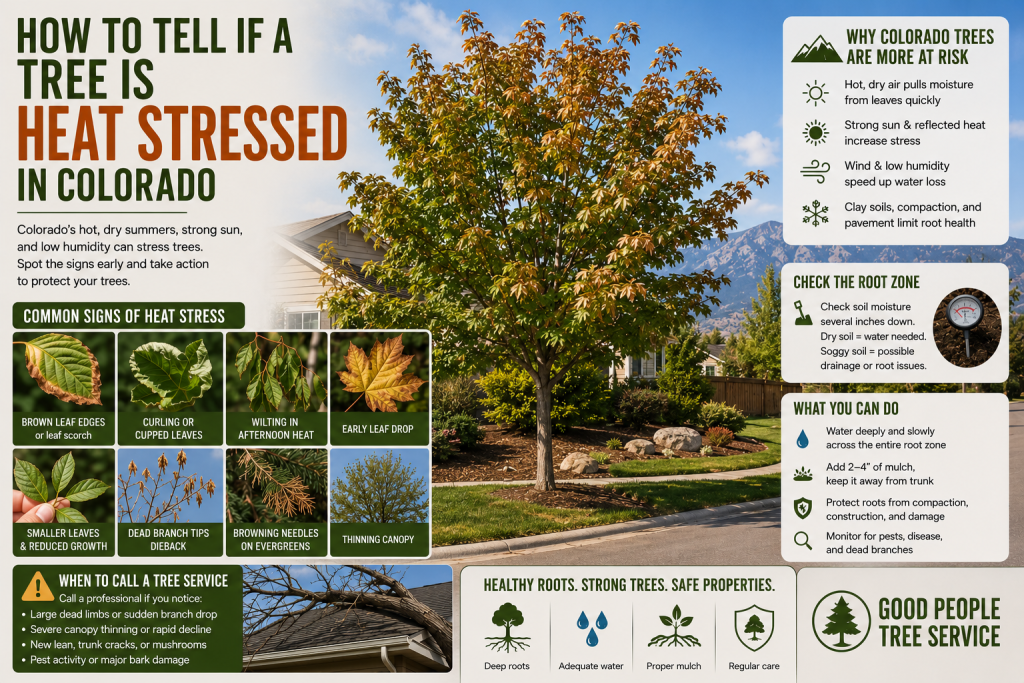
How to tell if a tree is heat stressed in Colorado starts with the leaves, but the real story often begins in the roots. A tree may look healthy in spring, then begin curling, browning, thinning, or dropping leaves after several weeks of hot, dry summer weather. Homeowners notice the canopy first, yet heat stress usually reflects a deeper water and root-zone problem.
The Front Range has dry air, strong sun, low humidity, compacted soil, clay-heavy yards, reflected heat from pavement, and long stretches without meaningful rain. A tree must move water from roots to leaves fast enough to replace what it loses through the canopy.
Heat stress does not always mean the tree is dying. Some trees recover after a short stressful period. Others decline over several seasons because heat, drought, root damage, pests, or poor watering keep adding pressure.
Understanding how to tell if a tree is heat stressed in Colorado helps homeowners act early. The sooner you spot the pattern, the better chance you have to reduce damage before leaf scorch turns into branch dieback or a safety issue.
If a tree on your property shows brown leaf edges, curling leaves, thinning canopy, or sudden summer decline, Good People Tree Service can inspect the tree and help determine whether watering, pruning, monitoring, or removal makes the most sense.
How to tell if a tree is heat stressed in Colorado
How to tell if a tree is heat stressed in Colorado depends on pattern, timing, and site conditions. Heat-stressed trees often show symptoms during long hot stretches, especially when wind, low humidity, and dry soil arrive together.
Look for:
- brown or crispy leaf edges
- leaves curling inward
- wilting during hot afternoons
- early leaf drop
- smaller leaves than normal
- thinning canopy
- dead branch tips
- early fall color
- dull or faded foliage
- browning needles on evergreens
- branch drop after heat waves
- dry soil several inches down
One symptom does not tell the whole story. A few brown leaves may only reflect temporary stress. A tree with scorch, canopy thinning, dead tips, and dry soil needs more attention.
The best diagnosis compares the tree to the season, the site, and its past condition.
Leaf scorch is the most obvious sign
Leaf scorch is one of the clearest signs of summer heat stress. It usually appears as brown margins, dry tips, crispy patches, yellowing between veins, or leaves that curl and feel brittle.
The edges often brown first because water must travel farther to reach those areas. When heat and dry air pull water from the leaf faster than roots can replace it, the leaf tissue dries out.
Colorado homeowners often see scorch on maples, lindens, ash, cottonwoods, aspens, oaks, ornamentals, spruce, pine, and other landscape trees.
Leaf scorch tells you the tree cannot keep up with water demand. It does not always prove the soil lacks water. Compacted soil, root damage, poor drainage, trunk injury, winter drought, overwatering, and pavement restriction can also interrupt water movement.
Curling leaves can mean the tree is conserving moisture
When a tree loses water too quickly, leaves may curl, cup, fold, or droop. Curling reduces exposed leaf surface and helps the tree slow moisture loss.
This symptom often appears during hot afternoons and may improve overnight if the tree still has enough root function. If leaves stay curled through the morning, the tree may have more serious stress.
Curling matters because it often appears before major browning. A homeowner who catches curling early may still have time to adjust watering, check soil, mulch the root zone, and reduce additional stress.
Repeated curling week after week deserves attention. It shows the tree keeps operating near its limit. This is one practical part of how to tell if a tree is heat stressed in Colorado before larger canopy damage appears.
Wilting in afternoon heat
Some heat-stressed trees wilt during the hottest part of the day. Leaves may hang limp, lose firmness, or look dull. The tree may recover slightly by morning, then wilt again the next afternoon.
That daily cycle shows the root system can still move some water, but it cannot keep pace during peak demand.
Afternoon wilting becomes more concerning when it appears with dry soil, leaf scorch, early leaf drop, dead tips, or thinning canopy. It may also point to root damage if the soil seems moist but the tree still wilts.
Check soil moisture before adding water. Dry soil needs slow soaking. Wet soil may indicate poor oxygen or drainage problems.
Early leaf drop during summer
Trees sometimes drop leaves early to reduce water demand. This can happen during severe heat, drought, or root stress.
A few scattered leaves may not create a major concern. Heavy summer leaf drop deserves a closer look, especially if it happens before normal fall timing. Heat-stressed trees may drop yellow, brown, curled, or scorched leaves.
Early leaf drop helps the tree survive in the short term, but it reduces the leaf area that produces energy. If the tree loses leaves every summer, it may weaken over time.
Smaller leaves and reduced growth
Heat stress can affect more than the current season. A tree that struggled in previous years may produce smaller leaves, shorter shoots, and less dense foliage the next year.
Smaller leaves often show that the tree has limited energy or root capacity. The tree may have lost fine roots during drought or suffered construction damage near the root zone.
Homeowners sometimes miss this symptom because it develops slowly. Compare the tree to older photos. If the canopy looks thinner each year, heat stress may be part of a longer decline.
Dead branch tips after hot weather
Dead tips or small dead branches often appear after repeated summer stress. When roots cannot support the full canopy, the tree may sacrifice outer branches.
Branch tip dieback often appears near the top or outer canopy. Those areas face more sun and wind. They also sit farthest from the roots and trunk water supply.
Dead tips matter because they show stress has moved beyond temporary leaf symptoms. The tree has started losing living branch tissue.
A tree with expanding deadwood near a house, driveway, sidewalk, or patio needs inspection. Dead branches can fail during wind, storms, snow, or calm weather as they dry and weaken.
Evergreens show heat stress differently
Evergreens can suffer heat stress too, but they show it in different ways. Pines, spruce, firs, and junipers may develop brown needles, dull color, tip dieback, thinning sections, or branch decline.
A spruce may brown after hot weather because of drought stress, root damage, mites, needle disease, winter injury, or a combination of problems. A pine may fade quickly if bark beetles or Ips beetles attack a tree already weakened by drought.
Homeowners should pay attention to rapid browning, scattered dead branches, pitch, boring dust, holes in the bark, or woodpecker activity. Those signs may point to pests or deeper decline, not only heat.
Colorado’s dry air makes heat stress worse
Colorado heat stresses trees differently than humid heat. Low humidity pulls moisture from leaves quickly. Wind makes that moisture loss faster. Strong sun adds more demand, especially at high elevation.
A tree in Colorado may struggle on a day that does not seem extreme compared with hotter states. A 90-degree afternoon with dry air and wind can create intense water loss. The weather app temperature does not show the whole picture.
This is why how to tell if a tree is heat stressed in Colorado requires local context. The tree experiences heat, wind, soil conditions, root limitations, and reflected sun from nearby surfaces at the same time.
Heat reflected from homes and hardscape
Trees near houses, driveways, sidewalks, patios, walls, and rock mulch often face extra heat. Hard surfaces absorb sunlight and radiate heat back toward leaves, bark, and soil.
A tree beside pavement may live in a hotter microclimate than a tree in an open mulched bed. Roots may also have less soil volume, less oxygen, and less water access.
Watch trees near south-facing walls, light-colored siding, asphalt, concrete, and rock beds. They may scorch or thin sooner than trees in cooler parts of the yard.
If one side of the tree turns brown near a driveway or wall, reflected heat and root restriction may contribute.
Soil moisture tells the truth
Do not guess from the leaf symptoms alone. Check the soil.
Use a screwdriver, soil probe, or small trowel to test moisture several inches down in multiple spots around the tree. Check near the dripline and under the canopy, not only near the trunk.
Dry soil several inches down suggests the tree needs slow, deep watering. Wet soil with stressed leaves may point to poor drainage, compaction, or low oxygen around roots.
This step matters because both drought and overwatering can produce similar canopy symptoms. Roots need water, but they also need oxygen. A tree in wet clay soil can still show scorch because damaged roots cannot move water properly.
A soil check often answers how to tell if a tree is heat stressed in Colorado better than leaf color alone.
Shallow lawn watering often fails trees
A green lawn does not prove the tree has enough water.
Lawn sprinklers often run short cycles that moisten the surface. Grass roots use much of that water quickly. A mature tree needs slow water spread across a much wider root zone.
The active tree roots often extend under the canopy and beyond it. Watering only near the trunk misses much of the absorbing root system.
The lawn may look fine while the tree shows scorch and thinning because turf irrigation does not reach the tree’s broader needs.
Clay soil complicates heat stress
Many Colorado yards contain clay or clay-like soil. Clay can hold water and nutrients, but it absorbs water slowly and compacts easily.
Dry clay can become hard and resist water. Fast irrigation may run off instead of soaking in. Wet clay can stay saturated too long and reduce oxygen. Compacted clay makes both problems worse.
A tree in clay soil may show heat stress because the soil is too dry, too wet, or too compacted. The only way to know is to check moisture and site conditions.
Slow watering, mulch, and root-zone protection help trees in clay soil handle summer heat better.
Construction damage can show up during heat waves
Construction often damages roots months or years before homeowners see symptoms. Driveway work, patio installation, fence posts, utility trenches, grading, and heavy equipment can cut or compact roots.
A tree may look normal after the project. Then summer heat arrives, and the reduced root system cannot support the canopy. Leaves scorch. Branch tips die. One side thins near the construction area.
This delayed pattern makes heat stress confusing. The heat may reveal the problem, but root damage may have started earlier.
Trees near recent construction need close monitoring during hot weather.
Pests often attack stressed trees
Heat stress can weaken a tree’s defenses. Once that happens, pests and diseases may move in more easily.
Colorado trees under drought and heat stress may face borers, bark beetles, mites, aphids, cankers, and fungal problems. Some insects cause minor seasonal damage. Others attack trees that already struggle.
Watch for boring dust, small holes, pitch tubes, sap flow, sticky residue, webbing, woodpecker activity, bark peeling, and sudden branch dieback.
Pest symptoms combined with leaf scorch or canopy thinning deserve inspection. The tree may need more than water.
Case example: the maple near a driveway
A mature maple grows beside a Colorado driveway. In spring, the canopy looks full. By late July, the leaves on the driveway side develop brown edges. The top looks thin. The lawn still looks green.
The driveway reflects heat. The soil near the pavement stays compacted. Sprinklers water the grass but do not soak the wider root zone. A few dry winters may have weakened the tree before summer even began.
This tree shows classic heat stress, but the cause includes site conditions. Better watering, mulch, and inspection may help if the tree still has enough healthy canopy and roots.
Case example: the evergreen that browns after heat
A homeowner notices one side of a spruce turning brown after a hot, dry summer. The tree grows in a rock bed near a south-facing wall.
Rock mulch and the wall add heat around the roots and trunk. Dry winter winds may have already damaged fine roots.
The tree may need inspection for mites, needle disease, root stress, or beetle activity. Water alone may not solve the issue if pests or root decline have taken hold.
What homeowners should do first
When you suspect heat stress, start with a simple ground-level check.
Look at the pattern. Does browning affect the whole canopy, one side, the top, branch tips, or leaves near pavement? Check soil moisture in several places. Look for insects, bark holes, sawdust, mushrooms, trunk cracks, root damage, and recent construction.
Avoid quick fixes like heavy fertilizer or aggressive pruning. Fertilizer can push growth that stressed roots cannot support. Heavy pruning can remove leaves the tree needs for energy.
Focus first on water, soil, root protection, and accurate diagnosis.
How to help a heat-stressed tree
Many heat-stressed trees need slow, deep watering across the root zone during dry periods. Apply water gradually so it soaks in instead of running off. Aim for the root zone, not the trunk.
A wide organic mulch ring can help conserve moisture, cool the soil, reduce grass competition, and protect surface roots. Keep mulch away from the trunk.
Protect the root zone from parking, construction, digging, and soil storage. Avoid cutting large roots. Monitor the canopy over time.
Remove dead or hazardous branches when needed, but avoid heavy live pruning during severe heat unless safety requires it.
When heat stress becomes urgent
Heat stress becomes urgent when the tree shows signs of structural risk or rapid decline.
Call a tree service if you notice large dead limbs, sudden major branch drop, a new lean, severe canopy thinning, trunk cracks, mushrooms near the base, rapid evergreen browning, pest activity in bark, or dead branches over a roof, driveway, sidewalk, or patio.
A stressed tree near people or property deserves faster attention than a stressed tree in an open area.
Frequently asked questions
How do I know if my tree is heat stressed?
A heat-stressed tree may show brown leaf edges, curling leaves, wilting, early leaf drop, smaller leaves, thinning canopy, dead tips, or browning needles. Check soil moisture and site conditions to understand the cause.
Will a heat-stressed tree recover?
Some trees recover after better watering and root-zone care. Trees with severe root damage, pests, decay, or major dieback may not recover fully.
Should I water more when leaves turn brown?
Check the soil first. Dry soil may need slow, deep watering. Wet soil may point to drainage or oxygen problems.
Should I fertilize a heat-stressed tree?
Fertilizer usually does not solve heat stress. Improve watering, mulch, soil conditions, and root protection first.
Final thoughts
How to tell if a tree is heat stressed in Colorado comes down to reading the pattern. Brown leaf edges, curling leaves, wilting, early leaf drop, small leaves, thinning canopy, dead tips, and evergreen browning can all point to heat stress.
Colorado’s dry air, intense sun, clay soil, compacted yards, hardscape heat, drought cycles, and root damage all make summer stress more likely. A tree may need water, but it may also need better drainage, root protection, pest inspection, or structural evaluation.
Good People Tree Service helps Colorado homeowners evaluate heat-stressed trees, identify root and soil problems, remove hazardous deadwood, and decide whether a declining tree can recover.
If your tree looks scorched, thin, brown, or stressed during Colorado summer, schedule an inspection before heat stress becomes branch dieback or a larger safety concern.