
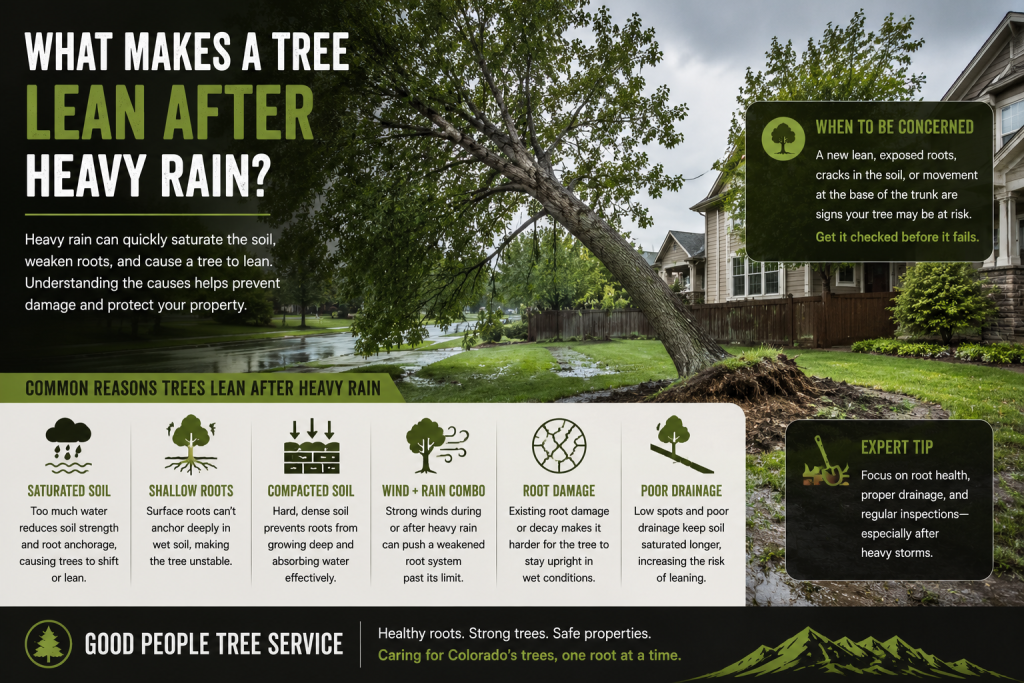
A tree can stand for years with root damage, soil compaction, decay, or poor structure. Then heavy rain softens the ground, reduces soil strength, and changes how the tree’s weight is supported. If the root system cannot hold firm, the trunk may begin leaning toward the house, driveway, fence, street, or open yard.
For Colorado homeowners, this topic matters because Front Range trees deal with dry periods, compacted soils, heavy clay, sudden storms, irrigation changes, and freeze-thaw cycles. A long dry stretch followed by heavy rain can be especially stressful. Roots that were already weakened by drought or construction may lose support when the soil becomes saturated.
Understanding what makes a tree lean after heavy rain helps homeowners know whether a tree can be monitored, corrected, pruned, or removed before it becomes dangerous.
If a tree on your property starts leaning after rain, Good People Tree Service can inspect the roots, trunk, canopy, and surrounding soil to help determine the safest next step.
What makes a tree lean after heavy rain?
What makes a tree lean after heavy rain is not simply the amount of water falling from the sky. The bigger issue is how that water changes the soil and exposes root weaknesses.
Roots anchor a tree by spreading through the soil. When the ground is firm, the root plate can resist movement. After heavy rain, soil may become softer and less stable. In clay-heavy areas, water can collect and reduce oxygen around roots. In compacted areas, water may sit near the surface instead of draining evenly.
A tree may begin to lean when:
- the soil becomes saturated
- roots are decayed or damaged
- the tree already had a slight lean
- the canopy is heavy or unbalanced
- construction damaged the root zone
- poor drainage keeps water near the base
- soil lifts or shifts around the root plate
- internal decay reduces structural strength
The rain is often the moment when existing weakness becomes visible.
Saturated soil reduces root anchorage
Tree roots need soil that holds them firmly. Heavy rain changes that relationship.
When soil becomes saturated, the spaces between soil particles fill with water. Oxygen availability decreases, and the soil can lose some of its ability to resist movement. A tree with a strong root system may tolerate this temporary change. A tree with weak, cut, compacted, or decayed roots may start shifting.
This is why a tree may lean after a storm even if the wind was not strong. The root system may have been relying on firm soil for support. Once the ground softened, the tree’s own weight became enough to move it.
Saturated soil is especially concerning when the tree is large, already leaning, or growing near a slope, retaining wall, drainage swale, or driveway edge.
Colorado clay soils can make leaning worse
Many Colorado yards have clay or clay-like soils. These soils can hold moisture for a long time, especially when they are compacted.
Clay soil is not automatically bad for trees, but it requires careful water management. When dry, clay may become hard and pull away from roots. Once wet, it may hold too much water and limit oxygen. This repeated shrink-swell pattern can stress roots over time.
After heavy rain, clay soil can become slick, dense, and slow to drain. Roots may not get enough oxygen if water remains around them. A tree that has already been weakened by drought may suddenly face the opposite problem: too much moisture in a root zone that cannot breathe well.
This back-and-forth is one reason what makes a tree lean after heavy rain in Colorado is different from what happens in many wetter climates. Local soil swings from dry stress to wet stress quickly.
Root damage may have started years earlier
A tree that leans after heavy rain may have root damage that began long before the storm.
Root damage can happen during driveway replacement, sidewalk repair, fence installation, patio construction, utility trenching, irrigation work, grading, or soil compaction.
The tree may look normal for a while. Leaves may stay green. Below ground, however, the root system may be less able to anchor the tree.
Heavy rain exposes that weakness.
A damaged root system may not fail during dry weather because the soil is firm. Once the soil softens, the same root system may no longer hold the tree upright.
This delayed pattern confuses homeowners. They may blame the rain, but the real problem may have started during a project several years earlier.
Case example: the tree that leaned after a backyard renovation
Imagine a homeowner who adds a patio near a mature shade tree. During construction, equipment crosses the root zone, cuts a few roots, and compacts soil near the patio edge.
The tree looks fine the next season. Two years later, heavy rain falls for several days. The soil becomes soft, and the tree begins leaning slightly toward the patio.
The storm did not act alone. It revealed a root system that had already lost strength, which is why the tree should be inspected instead of pushed back upright.
Soil heaving is a major warning sign
One of the most serious signs after heavy rain is soil heaving near the base of the tree.
Soil heaving means the ground is lifting or mounding on one side of the trunk. This often happens on the opposite side of the lean as roots and soil begin pulling upward. It may indicate root plate movement.
Look for:
- raised soil near the trunk
- cracks in the ground
- exposed roots
- gaps around the base
- roots pulling from the soil
- fresh leaning after a storm
- soft or sunken soil near the root flare
Soil heaving should be treated seriously. It can mean the tree is already in the early stages of uprooting.
Keep people, pets, and vehicles away from the fall zone until the tree is inspected.
A new lean is different from an old lean
Not every leaning tree is an emergency.
Some trees grow at an angle for many years. They may lean toward sunlight, away from competition, or because of old wind exposure. If the lean is stable and the roots have adapted, the tree may not be an immediate concern.
A new lean after heavy rain is different.
A sudden lean suggests something changed. The soil may have shifted. Roots may have failed. Decay may have reached a structural limit. A heavy canopy may have pulled the tree out of balance.
Homeowners should compare the tree to past photos if possible. If branches are suddenly closer to the roof, driveway, or fence, the lean may be new. A noticeable change after rain should be inspected promptly.
Drainage problems can create repeated leaning risk
Poor drainage can make a tree more likely to lean after rain.
Water should move away from the trunk and root zone at a reasonable pace. When water pools near a tree, roots may sit in saturated soil for too long. Over time, poor drainage can weaken roots and encourage decay.
Drainage issues may come from:
- downspouts emptying near the tree
- low spots in the yard
- compacted soil
- irrigation leaks
- grading toward the trunk
- hardscape blocking water movement
- clay soil that drains slowly
A tree may survive one wet event, but repeated saturation can reduce root health over time. If the same area stays soggy after every storm, the tree may be at higher risk during future rain.
Drought before rain can make failure more likely
A heavy rain after a long dry period can be risky for stressed trees.
Drought can weaken fine roots, reduce canopy health, and lower the tree’s energy reserves. Soil may shrink away from roots during dry periods. When heavy rain arrives, the soil may swell, soften, or shift.
This drought-to-rain pattern can be hard on Colorado trees.
A tree may have been weakened by months of dry weather. Then sudden saturation changes the ground around a compromised root system. The result may be new leaning, branch drop, or root plate movement.
This is another reason what makes a tree lean after heavy rain often involves more than the storm itself. The months before the storm matter too.
Heavy canopy weight adds stress
Rain can add temporary weight to a tree’s canopy. Leaves, branches, and bark all hold moisture during and after a storm. If the canopy is dense, unbalanced, or already heavy on one side, that added weight can increase stress on the root system.
A tree with a balanced canopy and strong roots may handle the load. A tree with root damage or poor structure may shift.
Canopy weight becomes more concerning when one side is much heavier, large limbs extend over a house, branches are overextended, or the trunk has cracks or decay.
Pruning can sometimes reduce risk, but it must be done carefully. Removing too much canopy can stress the tree and make problems worse.
Root rot and decay can hide underground
Root rot is one of the hidden reasons trees lean after rain.
Some decay organisms attack roots or the lower trunk. The tree may look alive above ground while roots lose strength below. Heavy rain can make the problem more visible because wet soil and weakened roots cannot hold the tree as well.
Warning signs may include mushrooms near the base, soft wood, bark loss, canopy thinning, dead branches, poor growth, and a new lean after wet weather.
Root decay is difficult to judge from the surface. A tree can have serious underground problems with only subtle above-ground symptoms.
If mushrooms or soft areas appear near a leaning tree, professional inspection is important.
Trees on slopes or edges are more vulnerable
Trees growing on slopes, berms, retaining wall edges, or raised beds may be more vulnerable after heavy rain.
Water can move through sloped soil unevenly. Erosion may expose roots. Soil downhill from the trunk may lose support. Retaining walls or hardscape edges may limit root spread on one side.
A tree near an edge may have fewer roots on the unsupported side. When heavy rain softens the soil, the tree may lean toward the weaker area.
Warning signs include erosion, exposed roots, cracks in the slope, leaning toward the downhill side, soil slumping, and water channels near the trunk.
Trees in these locations should be monitored carefully after major storms.
Should you try to straighten a leaning tree?
Do not try to straighten a large leaning tree yourself.
Pulling a tree with a rope, truck, winch, or chain can be dangerous. It may break roots, snap the trunk, or cause the tree to fall unpredictably. Even if the tree moves back, the root system may remain damaged.
Small newly planted trees may sometimes be corrected with proper staking if the root ball shifted and the trunk is still flexible. Mature trees are different. A new lean in a large tree usually means root or soil stability needs professional evaluation.
The safest first step is to keep people away from the fall zone and schedule an inspection.
Can a tree recover after leaning from heavy rain?
Sometimes, yes. Recovery depends on the size of the tree, amount of root movement, soil condition, lean direction, and whether the root system is damaged.
A young tree with a shifted root ball may recover if corrected properly. A mature tree with soil heaving, root plate movement, or decay is much more concerning.
A tree may be monitored if the lean is slight, old, stable, and not near a target. Removal may be recommended if the lean is new, worsening, or directed toward a structure.
Support systems are not a universal fix. Cabling and bracing may help certain branch or trunk issues, but they do not repair failed roots. Staking a mature leaning tree rarely solves the underlying problem.
What homeowners should check after heavy rain
A simple ground-level check can help identify risk.
Look for new lean, soil heaving, cracked ground, exposed roots, mushrooms, soft soil, standing water, trunk cracks, dead branches, hanging limbs, canopy imbalance, and branches suddenly closer to structures.
Photos are useful. Take pictures from the same angle after storms so changes are easier to see. If the lean appears to be increasing, act quickly.
Avoid standing under the leaning side or spending time in the possible fall zone.
When leaning becomes urgent
A leaning tree becomes urgent when it is new, increasing, or connected to visible root movement.
Call for help quickly if:
- the tree leaned suddenly after rain
- soil is lifting around the roots
- cracks appear in the ground
- roots are pulling up
- the tree leans toward a house
- the tree is near power lines
- the trunk is cracked
- large limbs are hanging
- the ground is soft around the base
- the lean is getting worse
If utility lines are involved, stay away and contact the utility company or emergency services.
How professionals evaluate a leaning tree
A professional evaluation looks at the whole tree and site, not just the trunk angle.
Important factors include root plate condition, soil moisture, drainage, trunk defects, canopy weight, lean direction, nearby targets, decay signs, construction history, and whether the lean is new or old.
A slight lean in a low-use area may be monitored. A new lean with soil heaving toward a house may require urgent removal. Another tree may need pruning, drainage correction, or ongoing observation.
How to reduce future leaning risk
Prevention starts with root protection and water management.
Helpful steps include:
- improve drainage around trees
- extend downspouts away from root zones
- avoid overwatering
- water deeply during drought
- mulch properly
- keep mulch away from the trunk
- protect roots during construction
- avoid parking over root zones
- inspect trees after storms
- prune for balanced structure
- address leaning early
Colorado trees need both moisture and oxygen. Too little water weakens roots. Too much water can also create root problems. The goal is balance.
Frequently asked questions
What makes a tree lean after heavy rain?
A tree may lean after heavy rain because saturated soil reduces anchorage, damaged roots lose support, canopy weight increases, or hidden decay becomes more serious.
Is a leaning tree always dangerous?
Not always. Some trees have stable old leans. A new or worsening lean after rain is more concerning, especially if soil is lifting or the tree leans toward a structure.
Can heavy rain uproot a tree without wind?
Yes. If soil is saturated and roots are weak or decayed, a tree can shift or fail even without strong wind.
Final thoughts
What makes a tree lean after heavy rain is usually a combination of saturated soil, root weakness, drainage problems, canopy weight, and hidden structural issues. The rain may be the visible trigger, but the real cause often starts underground.
For Colorado homeowners, dry-to-wet soil swings, clay soils, compacted yards, construction damage, irrigation problems, and sudden storms can all increase risk.
A leaning tree should not be ignored, especially if the lean is new or pointed toward a home, driveway, sidewalk, fence, or utility line.
Good People Tree Service helps Colorado homeowners evaluate leaning trees, identify root and soil problems, and decide whether pruning, monitoring, or removal is the safest option.
If your tree started leaning after heavy rain, schedule an inspection before the next storm adds more stress.