
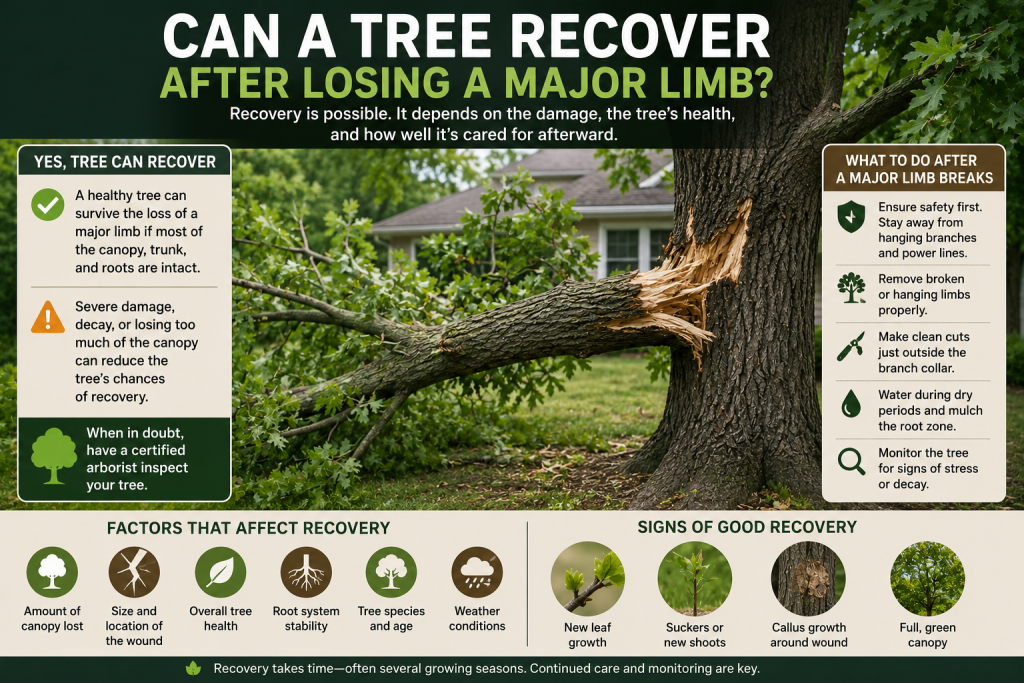
Can a tree recover after losing a major limb? In many cases, yes. A healthy tree can often survive the loss of one large branch, especially if the trunk is not split, the root system is stable, and most of the canopy is still intact. But recovery depends on the size of the wound, the tree species, the time of year, the tree’s overall health, and whether the broken limb created a structural risk.
A major limb loss is different from a small branch breaking in a storm. Large limbs play an important role in the tree’s structure, shade, energy production, and balance. When one breaks, the tree has to respond to a large wound while adjusting to a change in canopy weight.
For Colorado homeowners, this question often comes up after heavy wet snow, strong wind, spring storms, or sudden branch failure. A limb may snap onto a roof, driveway, fence, sidewalk, or yard. After cleanup, the bigger question remains: can the tree survive?
The answer is not always obvious from the ground. Some trees recover well after losing a major limb. Others begin to decline because the break exposed decay, damaged the trunk, or left the canopy too unbalanced.
If your tree has lost a large branch, Good People Tree Service can inspect the damage and help determine whether pruning, monitoring, or removal is the safest next step.
Can a tree recover after losing a major limb after a storm?
Can a tree recover after losing a major limb after a storm? Often, the answer depends on how much of the tree was damaged during the event.
A single broken limb does not automatically mean the tree is doomed. Many mature trees can continue growing after storm damage if they still have a strong trunk, stable roots, and enough healthy canopy.
The concern increases when the damage involves more than one large limb, a split trunk, torn bark, exposed decay, or a large wound near the main stem.
Storm damage is also unpredictable because the first broken limb may not be the only problem. Other branches may be cracked, twisted, or hanging in the canopy. The tree may look stable from one angle while still holding damaged wood overhead.
After wind or snow damage, homeowners should avoid standing under the tree for a long inspection. A broken limb can leave other branches under tension. Hanging limbs can fall later, even during calm weather.
A professional inspection is especially important when the broken limb was large, high in the canopy, or attached near the trunk.
Why losing a major limb is stressful for a tree
A major limb is not just extra growth. It is part of the tree’s structure and energy system.
Leaves on that limb produce energy through photosynthesis. Branches help distribute weight. The limb may also balance the canopy against wind, snow, and gravity.
When a major limb breaks, the tree loses part of its leaf area. It also has to respond to a large wound. The exposed wood may dry, crack, or become vulnerable to decay organisms.
This is why can a tree recover after losing a major limb is not just a yes-or-no question. Recovery is a process.
The tree must:
- Seal off damaged tissue
- Maintain enough leaf area
- Resist decay
- Adjust to canopy imbalance
- Continue moving water and nutrients
- Avoid further branch failure
- Build new growth over time
A healthy tree has a better chance. A stressed tree may struggle.
Drought, root damage, soil compaction, disease, or old wounds can all reduce recovery potential.
The size of the wound matters
The larger the broken limb, the larger the wound.
Small wounds are easier for a tree to close over time. Large wounds may remain open longer. That gives decay more opportunity to move into exposed wood.
A clean pruning cut made in the right place is much better than a torn, jagged break. Storm-damaged limbs often rip bark down the trunk or leave splintered wood behind. These wounds are harder for the tree to manage.
A large wound near the trunk is especially important. Damage in that area may affect the main structure of the tree.
A tree may recover if the broken limb came off cleanly and the trunk is still sound. Recovery becomes less likely if the break tore deeply into the trunk, exposed rot, or created a crack that continues spreading.
Trees do not heal like people do
Many homeowners ask whether the tree will “heal” after losing a major limb. The better word is seal.
Trees do not heal wounds by replacing damaged wood with identical new tissue. Instead, they respond by compartmentalizing the injured area. The tree forms boundaries around damaged tissue and grows new wood around the wound over time.
This process helps limit the spread of decay, but it does not erase the original injury.
That is why large limb loss can remain a structural concern even if the tree survives.
The wound may close slowly around the edges, but the internal damaged area can still affect long-term strength.
This is one reason wound paint, tar, or sealant is usually not the solution homeowners expect. The tree needs proper pruning, good growing conditions, and time.
When a tree is more likely to recover
A tree has a better chance of recovery when the damage is limited and the tree is otherwise healthy.
Recovery is more likely when:
- Only one major limb was lost
- The trunk is not split
- The root system is stable
- Most of the canopy remains healthy
- The wound can be pruned cleanly
- There is no major internal decay
- The tree is not leaning toward a structure
- Other large limbs are not cracked
- The tree has good vigor
- The site has adequate water and soil conditions
A mature shade tree can sometimes survive the loss of a large limb if the rest of the structure is strong.
This is why can a tree recover after losing a major limb often depends on the whole tree, not just the broken branch.
A strong tree with one damaged limb may be worth preserving. A declining tree with multiple structural problems may not recover safely.
When major limb loss becomes a serious warning sign
A broken limb may reveal a problem that was already inside the tree.
The limb might have failed because of wind or snow. But the real reason may have been decay, included bark, weak attachment, poor pruning history, or drought stress.
Warning signs include:
- Dark or soft wood inside the break
- Hollow areas
- Mushrooms or fungal growth
- A crack extending into the trunk
- Bark peeling around the wound
- A split branch union
- Multiple dead limbs
- Large cavities
- Sudden canopy thinning
- Repeated branch failure
These signs suggest that the tree may have been structurally weak before the limb broke.
A major limb failure should not be treated as an isolated event if other warning signs are present.
Colorado weather can make limb loss more common
Colorado weather can put a lot of stress on tree limbs.
Heavy wet snow adds weight to branches. High winds twist the canopy. Freeze-thaw cycles can worsen cracks. Drought can weaken branches over time.
Trees along the Front Range may face several stressors in the same year. A tree can go through drought stress in summer, winter moisture loss, and then heavy spring snow. That combination can make limb failure more likely.
A branch may break during the storm. Another cracked limb may fall weeks later.
This is why storm-damaged trees should be evaluated carefully. Removing the obvious broken limb is not always enough. The rest of the canopy may need inspection.
The branch attachment tells a lot
The way the limb was attached affects recovery.
Branches with strong attachments usually have a better structure. Weak attachments may fail more easily and create larger wounds.
One common issue is included bark. This happens when bark becomes trapped between two limbs or stems. Instead of forming a strong wood connection, the union becomes weaker.
A limb with included bark may split away during wind or snow. The wound can be large and jagged.
Co-dominant stems are another concern. These are two main stems competing for dominance. When one breaks or splits, the damage can affect a major part of the tree.
In Colorado, many storm-related failures are connected to structural problems that could have been reduced earlier with proper pruning.
Good structural pruning is especially important when trees are young. Once a large mature limb fails, repair options are more limited.
Proper pruning after limb loss matters
Correct pruning can improve the tree’s chance of recovery.
The goal is not to cut more than necessary. The first priority is to remove broken, hanging, or damaged wood safely. After that, the tree may need selective pruning to reduce risk or balance the canopy.
A proper cut should usually be made near the branch collar without cutting flush against the trunk. The branch collar is the swollen area where the branch meets the trunk or a larger limb. Cutting into it can slow the tree’s natural wound response.
Bad cuts can make recovery harder.
Common mistakes include:
- Cutting flush against the trunk
- Leaving long stubs
- Tearing bark during removal
- Removing too much live canopy
- Topping the tree
- Cutting large limbs without a plan
- Using sealants instead of proper pruning
A tree that already lost a major limb does not need extra stress from aggressive pruning.
Should the broken area be sealed?
In most cases, wound sealants are not recommended for routine branch wounds.
Many homeowners want to paint over the wound to protect it. That impulse makes sense, but sealants can trap moisture or interfere with the tree’s natural response.
The better approach is usually to make a clean pruning cut, avoid unnecessary damage, and support the tree’s health.
There are exceptions in certain pest or disease situations, but those should be handled with professional guidance.
For most storm-damaged shade trees, proper pruning is more important than painting the wound.
Can a tree recover after losing a major limb if the trunk is split?
Can a tree recover after losing a major limb if the trunk is split? The answer becomes much less certain.
A trunk split is a more serious structural problem than a missing branch. If the broken limb tore into the main trunk or opened a crack between major stems, the tree may be unstable.
A split trunk may continue separating under wind, snow, or canopy weight. Decay may also enter the exposed wood.
Removal may be recommended when:
- The trunk split is deep
- The crack is widening
- The tree leans toward a structure
- Major stems are separating
- Decay is visible inside the split
- More than half the canopy is damaged
- Large limbs are still under tension
- The root system is unstable
Some split trees can be managed with pruning, cabling, bracing, or monitoring. But those options depend on the tree’s condition and location.
A large split tree near a home should be evaluated quickly.
How much canopy did the tree lose?
Canopy loss is one of the biggest factors in recovery.
A tree needs leaves to produce energy. Losing one major limb may be manageable if the tree still has most of its canopy. Losing several large limbs can reduce energy production and create long-term stress.
The tree may also become unbalanced.
If one side of the canopy is gone, wind can affect the tree differently. Remaining limbs may carry more stress. Sun exposure may change. New growth may develop unevenly.
A tree with major canopy loss may need several years of monitoring.
The question is not only whether the tree is alive right now. A better question is whether the tree can remain healthy and structurally safe over time.
The tree species affects recovery
Some tree species respond better to major wounds than others.
Fast-growing trees may replace canopy quickly, but they may also have weaker wood or poor attachment patterns. Slower-growing trees may close wounds more slowly but maintain stronger structure.
Certain species are more decay-resistant. Others are more vulnerable after large wounds.
This is why the same type of limb loss can have different outcomes in different trees.
A cottonwood, maple, ash, pine, oak, or elm may each respond differently. Local growing conditions also matter.
In Colorado, drought tolerance, site stress, and species suitability can strongly affect recovery.
Age and health matter
A young, vigorous tree may recover better than an older tree with multiple stress problems.
Mature trees are valuable, but they also carry more weight and may have a history of old wounds, root stress, soil compaction, and past storm damage.
A tree is less likely to recover well if it already had:
- Crown thinning
- Deadwood
- Leaf scorch
- Bark cracks
- Root damage
- Internal decay
- Poor structure
- Insect activity
- Drought stress
- Repeated limb failure
A tree that was healthy before the break has more energy to respond.
That is why can a tree recover after losing a major limb must include a full tree health assessment.
When removal may be the safer option
Removal may be the safest option when the tree has lost too much structure or poses a serious risk.
This is more likely when:
- The trunk is split
- The wound is very large
- The tree has severe decay
- The root system is unstable
- The tree leans toward a house
- Several major limbs are gone
- The canopy is mostly damaged
- Large dead limbs remain
- The tree is near people or property
- Pruning cannot reduce risk enough
Location matters. A damaged tree in an open field is different from a damaged tree over a roof, driveway, sidewalk, or play area.
A tree does not need to be perfect to be worth keeping. Still, it does need to be reasonably safe for its location.
What homeowners should do after a major limb breaks
Start with safety.
Do not stand under the damaged tree. Avoid pulling hanging branches. Keep children and pets away from the area. Never use a chainsaw on a ladder or cut branches that are under tension.
From a safe distance, look for:
- Hanging limbs
- Trunk cracks
- Split branch unions
- Torn bark
- Exposed decay
- Leaning
- Dead branches
- Soil movement near roots
- Damage to nearby structures
- Utility lines
If utility lines are involved, stay away and contact the utility company.
For large limbs, professional cleanup is usually the safest choice.
After the immediate hazard is handled, the tree should be inspected to determine whether recovery is realistic.
Helping the tree recover after limb loss
A tree that can be saved needs time and reduced stress.
Helpful steps include:
- Remove broken limbs with proper cuts
- Avoid topping
- Do not over-prune
- Water during dry periods
- Mulch properly around the root zone
- Keep mulch away from the trunk
- Protect roots from compaction
- Avoid construction near the tree
- Watch for decay around the wound
- Inspect the tree after storms
- Monitor canopy growth over the next seasons
Recovery does not happen in a few weeks. It may take several growing seasons to see how the tree responds.
New growth is a good sign, but it does not automatically mean the tree is structurally safe. Large wounds and old defects still need monitoring.
Can a tree recover after losing a major limb and still be safe?
Can a tree recover after losing a major limb and still be safe? Yes, in some cases. A tree can survive, grow new canopy, and remain a valuable part of the landscape.
Safety depends on structure.
A recovering tree should be checked for decay, cracks, weak unions, hanging branches, and canopy imbalance. If the tree is near a home or high-use area, monitoring becomes more important.
Some trees recover biologically but remain structurally compromised. Others recover well and only need routine care.
This distinction matters for homeowners. A tree can be alive without being safe. It can also look damaged at first but still have a strong future.
A professional evaluation helps separate those possibilities.
Final Thoughts
Can a tree recover after losing a major limb? Many trees can, especially when the damage is limited, the trunk is intact, and the tree is otherwise healthy. A single major limb loss does not always mean removal is required.
The situation becomes more serious when the trunk is split, the wound is large, decay is visible, the canopy is badly unbalanced, or the tree is close to a home, driveway, sidewalk, or fence.
Colorado weather adds another layer of risk. Heavy wet snow, strong winds, drought, and freeze-thaw cycles can all make storm damage worse.
Good People Tree Service helps Colorado homeowners evaluate trees after major limb loss, remove hazardous broken branches, and decide whether the tree can recover safely.
If your tree has lost a major limb, schedule an evaluation before the next storm puts more stress on the damaged structure.