
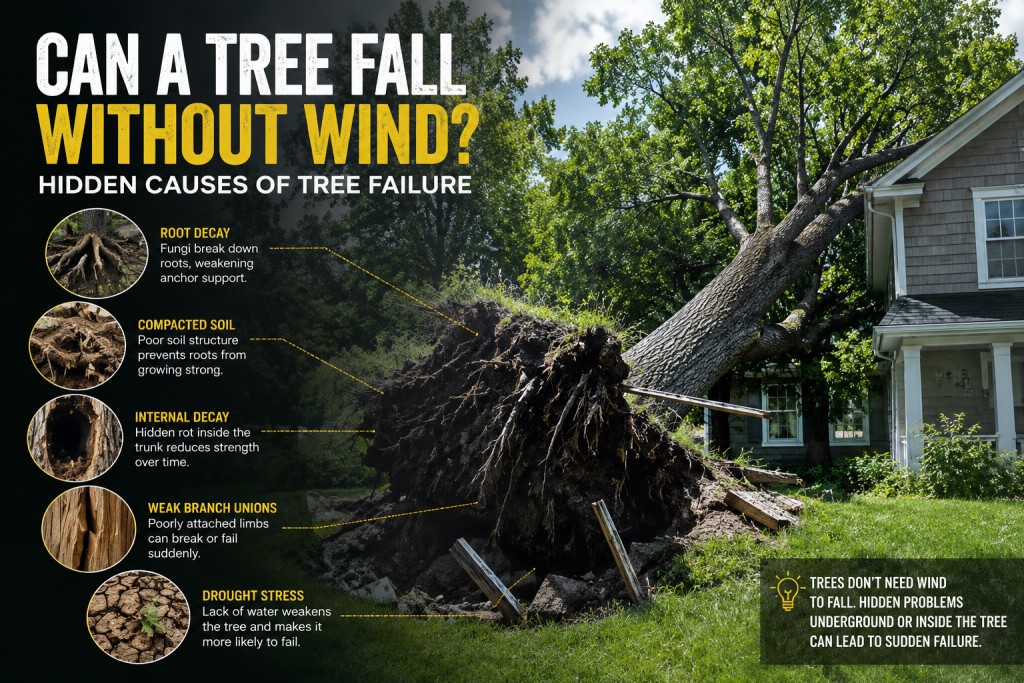
That is what makes this topic unsettling for homeowners. A tree may look green and solid from the outside while decay spreads inside the trunk. Roots may be damaged underground. Soil may be saturated after heavy rain. Drought may have weakened the canopy. A large limb may be carrying more weight than its attachment can support.
When the final failure happens, it can seem random.
For Colorado homeowners, the question “can a tree fall without wind?” is especially important. Front Range trees deal with drought stress, compacted soil, freeze-thaw cycles, heavy wet snow, construction disturbance, root damage, and sudden moisture changes. These conditions can build risk quietly long before a storm arrives.
A calm day does not always mean a safe tree. It only means wind was not the final trigger.
Why trees can fall even when the weather seems calm
Most people associate falling trees with storms because wind, snow, and severe weather are easy to see. When a tree falls without wind, the event feels harder to explain.
The hidden cause is usually structural failure.
A tree stands because its roots anchor it, its trunk supports weight, and its canopy distributes force. If one of those systems becomes weak, the tree can fail under its own weight. Gravity never stops pulling.
Wind is only one force acting on a tree.
A calm-weather failure may happen because:
- roots are decayed or cut
- soil is saturated or unstable
- the trunk is hollow or cracked
- a large limb has a weak attachment
- internal decay has reduced wood strength
- drought has caused deadwood or branch dieback
- construction damage reduced root support
- the tree is leaning and gravity keeps adding stress
This is why a tree can fall without wind even with leaves still on the canopy.
Root failure is one of the biggest hidden causes
Roots do more than feed the tree. They anchor it.
When roots are healthy, they spread through the soil and help hold the tree upright. If roots are damaged, decayed, cut, or growing in poor soil, the tree may lose stability.
Root failure is serious because the problem is often underground. Homeowners may not see anything wrong until the tree leans, soil lifts, or the entire tree falls.
Root failure may happen because of root rot, construction cuts, soil compaction, trenching, driveway or sidewalk work, drought damage, saturated soil, poor drainage, grade changes, or roots buried under fill soil.
A tree with damaged roots may remain standing for a long time. Then the root plate can fail suddenly, even without a strong wind event.
This is one reason the answer to “can a tree fall without wind?” is yes. If the root system has already lost strength, gravity and soil movement may be enough.
Colorado soil conditions can make root problems worse
Many Colorado landscapes are tough on tree roots.
Some yards have heavy clay soils, compacted soil from construction or foot traffic, or disturbed soil that was graded before landscaping was installed.
Roots need oxygen and moisture. When soil is compacted, oxygen is limited, water may not move properly, and roots may become restricted. Over time, this can weaken the tree.
A tree with root stress may show above-ground symptoms such as:
- thinning canopy
- smaller leaves
- leaf scorch
- branch dieback
- early fall color
- slow growth
- leaning
- mushrooms near the base
These signs may look like normal aging at first. In reality, they may point to a root system that cannot fully support the tree.
If root stress continues, a tree can fall without wind because the support system has been compromised.
Saturated soil can trigger calm-weather failure
Wind is not always needed when the soil is unstable.
After heavy rain, snowmelt, irrigation leaks, or poor drainage, soil can become saturated. Wet soil may lose strength around the root system. Roots that normally hold firm may shift more easily.
A tree may fall on a calm day after a wet period because the ground no longer holds the root plate securely.
This risk increases when the tree already has:
- shallow roots
- root decay
- recent trenching
- soil compaction
- a lean
- crown imbalance
- poor drainage
- limited rooting space
Colorado weather can create this pattern. A dry period may weaken roots. Later, wet snow or irrigation may saturate the soil. The tree may not fail during the storm itself; it may shift later when the ground remains soft.
Internal decay can make a tree weaker than it looks
One of the most common hidden causes of tree failure is internal decay.
A tree can have green leaves and still be structurally weak. The living tissue that moves water and nutrients is closer to the outside of the trunk. The center of the tree may decay while the canopy continues to look alive.
Decay often begins after:
- old pruning wounds
- storm damage
- broken branches
- trunk injuries
- animal damage
- root wounds
- fungal infection
- cavities
Over time, decayed wood loses strength. The tree may still stand during normal conditions, but the margin of safety becomes smaller.
A calm-weather failure can happen when the remaining sound wood can no longer carry the weight of the tree.
Warning signs of possible decay include:
- mushrooms or conks
- cavities
- hollow-sounding trunk areas
- soft or crumbly wood
- bark falling off
- large old wounds
- repeated branch failure
- cracks near cavities
This is another reason a tree can fall without wind. The failure may look sudden, but decay may have been weakening the tree for years.
Case example: the hollow shade tree that looked healthy
Imagine a mature shade tree in a Colorado backyard. It has a full canopy in spring and provides shade over the patio. From the house, it looks healthy.
Closer inspection tells a different story. A large branch broke years ago and left a wound near the trunk. The wound never closed completely. Over time, decay entered the trunk. A cavity formed inside, but the tree continued growing leaves each year.
One summer morning, a major section breaks away on a calm day.
To the homeowner, it seems like the tree fell without warning. In reality, the warning signs were subtle: an old wound, soft wood near the break, and a cavity that slowly expanded.
Its own weight became too much for the weakened trunk.
Large limbs can fail under their own weight
A tree does not need to fall completely to create danger. A large limb can fail without wind too.
Some branches become overextended. Others grow from weak unions. Heavy limbs may develop cracks, decay, or poor attachment points. When the branch becomes too heavy for its connection, it can break under its own weight.
This can happen on calm days, especially during hot weather, after drought stress, or after internal decay has developed.
Large limb failure is more likely when the branch has:
- included bark
- a narrow V-shaped union
- old storm damage
- internal decay
- excessive length
- heavy foliage
- cracks near the attachment
- deadwood near the branch
A falling limb can damage a roof, car, fence, patio, or person underneath. In some cases, limb failure also tears into the trunk and creates a larger structural problem.
When homeowners ask, “can a tree fall without wind?” they should also consider whether large branches can fail without wind. The answer is also yes.
Co-dominant stems and included bark
Co-dominant stems are a common structural issue in residential trees.
This happens when two main stems grow from the same point. Instead of one strong central trunk, the tree has competing stems. The union between them may become weak over time.
Included bark makes the problem worse. It occurs when bark becomes trapped between the stems, preventing strong wood from forming in the union.
These weak connections can split apart without much warning.
A tree with co-dominant stems may look full and attractive for years. But as the stems grow larger, their weight increases. The weak union may slowly crack. Eventually, one side can split away, even without high wind.
Watch for:
- tight V-shaped unions
- a seam between two stems
- cracks below the union
- bark trapped inside the fork
- one stem leaning away from the other
- past branch failure in the same area
Structural defects like these are a major reason mature trees should be inspected early.
Drought stress can create delayed failure
Drought does not always kill a tree quickly. It often weakens roots, branches, and energy reserves over time.
This delayed pattern is common in Colorado. A dry year can damage fine roots, thin the canopy, and leave branches more brittle. Months or years later, a limb may fall or the trunk may fail.
Drought-related warning signs include small leaves, early leaf drop, dead branch tips, top dieback, leaf scorch, sparse canopy, bark cracking, and increased insect activity.
If a tree falls without wind, drought may not seem like the obvious cause. Yet it may have weakened the tree long before the failure happened.
Construction damage can take years to show up
Construction-related root damage is one of the easiest tree problems to miss.
A driveway project, patio installation, fence replacement, trench, irrigation repair, or grading change can cut or compact roots. The tree may look fine immediately afterward, and decline may not become visible for years. That delay makes the damage easy to forget.
Symptoms may include slower growth, thinning canopy, dead branches, leaf scorch, mushrooms near roots, new lean, branch failure, or soil lifting near the base.
When a tree falls without wind after construction, the root system may have been compromised long before the failure.
This is especially important in Colorado neighborhoods where mature trees often share space with hardscape, utilities, fences, and home improvement projects.
Protecting the root zone before construction is usually easier than saving the tree afterward.
Case example: the tree that fell after a calm night
A homeowner wakes up and finds a mature tree leaning across the yard. There was no major wind overnight, and no storm came through. At first, the failure seems impossible.
A closer look shows wet soil near the base, mushrooms around one side of the root flare, and a driveway trench installed several years earlier. Root decay, old root injury, and saturated soil worked together. The final movement happened during calm weather because the support system had already weakened.
Insects and disease can weaken the structure
Insects and disease can contribute to tree failure, especially when the tree is already stressed.
Some pests attack weakened trees. Others create galleries, wounds, or dieback that reduce strength. Fungal diseases may decay roots or trunk wood, while cankers can weaken branches and stems.
Watch for boring dust, small holes, pitch tubes on conifers, peeling bark, fungal growth, sudden branch dieback, crown thinning, or woodpecker activity.
Insect activity does not always mean a tree will fall. Many insects are secondary, arriving after drought, root damage, or decay has already weakened the tree. Still, pest signs should be evaluated as part of the whole condition.
Why a green tree can still be unsafe
A green canopy does not prove a tree is structurally safe.
This is one of the most important points for homeowners to understand. A tree can move water to leaves while still having major defects in the trunk or roots.
A tree may have a hollow trunk, decayed roots, a split union, large dead limbs, root damage, fungal decay, or cracks hidden by bark. The canopy may stay green until failure happens.
That is why visual health and structural safety are related but not identical. A tree can look alive and still be dangerous in the wrong location.
What homeowners should check from the ground
Homeowners can make useful observations without climbing or cutting.
From a safe distance, check for new lean, soil cracks, exposed roots, mushrooms, trunk cavities, deep cracks, peeling bark, dead branches, hanging limbs, thinning canopy, recent construction near roots, or repeated branch drop.
Photos from the same angle every few months can show whether leaning, cracks, or canopy thinning are getting worse. Avoid standing under a suspicious tree for long, and do not pull hanging limbs or cut large branches from a ladder.
When the risk becomes urgent
Some signs deserve immediate attention.
Call for help quickly if you notice:
- sudden leaning
- soil lifting around the roots
- cracking sounds
- a split trunk
- large hanging branches
- roots pulling from the ground
- major trunk decay
- a tree leaning toward a home
- storm damage near power lines
- rapid canopy collapse
If utility lines are involved, stay away and contact the utility company or emergency services.
An unstable tree should be treated as a potential hazard until inspected.
Can a tree with hidden defects be saved?
Sometimes, yes.
A tree with limited deadwood may only need pruning. Root stress may improve with better watering, mulch, and soil protection. Minor structural defects may be monitored or managed.
Removal may be recommended when roots are severely decayed, the trunk is compromised, the tree has a major lean, large limbs keep failing, decay affects the base, or pruning cannot reduce risk enough.
The goal is not to remove every imperfect tree. Many mature trees can live safely for years with good care. The decision depends on defect severity, tree location, and what could be damaged if it fails.
Good People Tree Service can help determine whether the tree can be managed or should be removed before it falls.
How to reduce the chance of calm-weather failure
Preventing tree failure starts with early care.
Helpful steps include inspecting mature trees regularly, removing deadwood, protecting roots during construction, avoiding major root cuts, watering deeply during drought, mulching properly, watching for fungi, avoiding topping, correcting young tree structure early, and addressing leaning before it worsens.
Colorado trees face heat, drought, snow, wind, and compacted soils. Regular inspections help catch hidden problems before failure happens.
Frequently asked questions
Can a tree fall without wind at all?
Yes. A tree can fall without wind if roots are decayed, soil is unstable, the trunk is hollow, or the canopy weight exceeds the tree’s structural strength.
Why would a tree fall on a calm day?
A calm-weather failure often happens because hidden decay, root damage, saturated soil, or structural weakness has reached a breaking point.
Can a healthy-looking tree fall?
Yes. A tree can look green and still have hidden root decay, internal trunk decay, weak branch unions, or structural cracks.
Final thoughts
Can a tree fall without wind? Yes, and the hidden causes often begin long before the tree fails. Root decay, internal trunk decay, saturated soil, drought stress, weak branch unions, construction damage, pests, and disease can all reduce stability.
Wind may be the most visible trigger, but it is not always required.
For Colorado homeowners, this matters because local trees face drought, compacted soil, heavy snow, construction pressure, and fast weather changes. Calm weather does not guarantee that a weakened tree is safe.
Good People Tree Service helps homeowners identify hidden causes of tree failure, reduce hazards, and safely remove trees when removal is the best option.
If a tree near your home, driveway, sidewalk, fence, or outdoor living area shows signs of weakness, schedule an evaluation before hidden damage turns into a sudden failure.