
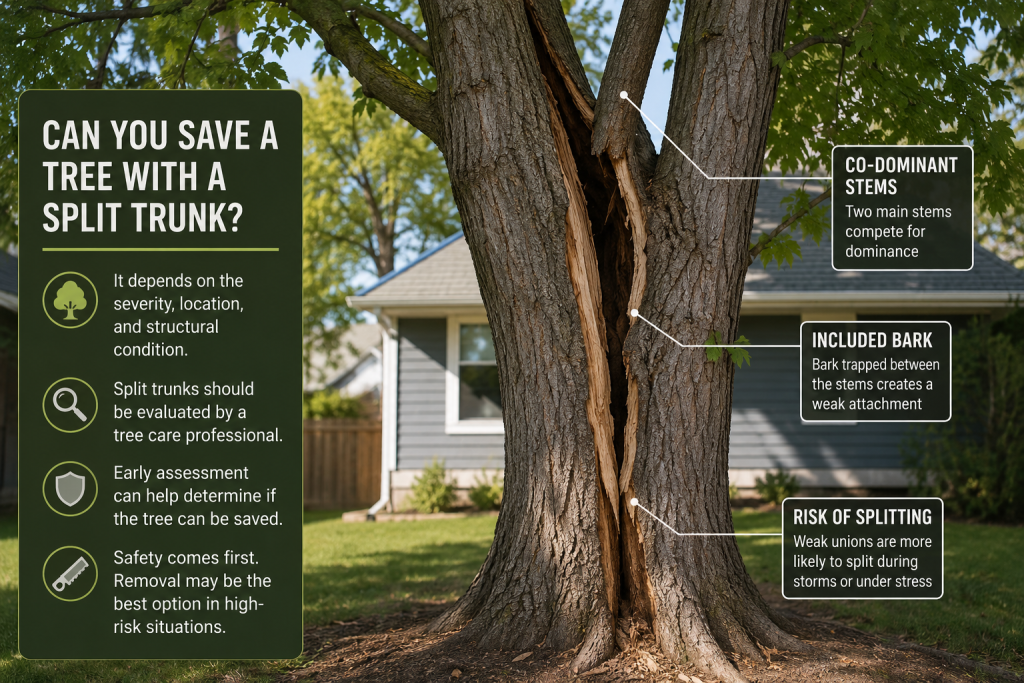
Can you save a tree with a split trunk? Sometimes, yes. But it depends on how severe the split is, where it is located, how much of the tree is still structurally sound, and whether the tree creates a safety risk for people or property. A small split in a young tree is very different from a deep crack running down the main trunk of a mature tree near a home.
A split trunk is one of the more serious tree problems homeowners can notice. Unlike a small broken branch, a trunk split can affect the entire structure of the tree. It may also expose internal wood to decay, insects, and future storm damage.
In Colorado, split trunks are especially important to evaluate quickly. Trees along the Front Range deal with heavy wet snow, strong winds, drought stress, freeze-thaw cycles, and sudden weather changes. Those conditions can make an existing split worse.
A split does not always mean the tree has to be removed. But it should never be ignored.
If your tree has a visible trunk split, Good People Tree Service can inspect the damage and help determine whether pruning, support, monitoring, or removal is the safest option.
Why Tree Trunks Split
Tree trunks split for several reasons. Some splits happen suddenly during storms. Others develop slowly over time because of weak structure, included bark, decay, or freeze-related stress.
Common causes include:
- Heavy snow loading
- High wind stress
- Co-dominant stems
- Included bark
- Internal decay
- Old storm wounds
- Improper pruning
- Freeze-thaw stress
- Drought stress
- Mechanical injury
- Weak branch attachments
A split trunk usually means the tree has been placed under more stress than it can handle at that point.
Sometimes the split is the result of one major event. A wet spring snowstorm may load the canopy with weight. A wind event may twist the trunk. A large limb may tear away and open a wound.
Other times, the split is the final result of a long-term structural problem.
Can You Save a Tree With a Split Trunk After a Storm?
Can you save a tree with a split trunk after a storm? The answer depends on how much of the tree was damaged and whether the main structure is still intact.
The Colorado State Forest Service advises homeowners to assess storm-damaged trees carefully before cutting. It notes that if a tree is healthy overall and still has its main leader, most major limbs, and 50 percent or more of its crown, the chance of recovery may be good.
That guidance is useful, but a split trunk adds complexity. A tree may still have much of its crown and still be structurally unsafe if the split runs through the main trunk or affects a major union.
A small split in a smaller limb may be manageable. A deep split between two main stems may be much more serious.
After a storm, do not stand under the damaged tree. Do not try to pull the trunk together with rope, chain, or a vehicle. A split trunk can shift suddenly, especially if branches are still under tension.
Co-Dominant Stems Are a Common Cause of Splitting
Many split trunks begin with co-dominant stems.
Co-dominant stems happen when two large stems grow from the same point and compete with each other. Instead of one central leader and smaller side branches, the tree develops two main trunks.
This can create a weak union.
The issue becomes worse when included bark forms between the stems. Included bark is bark trapped inside the union, preventing a strong wood connection from forming.
Research published in Arboriculture & Urban Forestry found that codominant stems with included bark are significantly weaker than those without included bark.
This matters because many homeowners do not recognize co-dominant stems as a risk. The tree may look full and healthy for years. Then wind or snow causes the weak union to split.
Trees with sharp V-shaped unions often deserve closer attention than trees with wider, stronger U-shaped branch attachments.
When a Split Trunk Is More Likely to Be Saved
Not every split trunk means immediate removal.
A tree may have a better chance of being saved when:
- The split is small
- The split does not run deeply through the main trunk
- The tree is young and vigorous
- The root system is stable
- The canopy is mostly intact
- There is no major decay
- The split is not widening
- The tree is not leaning toward a structure
- The damaged area can be pruned or reduced safely
Younger trees often recover better than older trees because they have more growth potential and less overall weight.
Some split trees may be managed through selective pruning, weight reduction, cabling, bracing, or monitoring. However, those decisions require a professional evaluation.
A split trunk should not be treated with DIY fixes. Wrapping the trunk, filling the crack, or bolting without proper training can make the problem worse.
When a Split Trunk Usually Means Removal
A split trunk is more concerning when it affects the tree’s main support system.
Removal may be recommended when:
- The split runs deep into the main trunk
- The tree is splitting into two major sections
- The crack is widening
- The tree has major internal decay
- Large limbs are pulling the split apart
- The tree leans toward a house or driveway
- The root system is unstable
- More than half the crown is damaged
- The tree has repeated storm failure
- The split exposes a rotten core
A severely split trunk is often difficult for a tree to seal. If the wound is too large, decay may continue spreading. The tree may remain standing for a while, but its structure may be compromised.
The location also matters. A split tree in an open area is different from a split tree over a home, garage, sidewalk, or parked vehicle.
If a split trunk threatens people or property, safety should come before preservation.
Good People Tree Service can assess the split and explain whether the tree can be managed or should be removed before it fails.
Why Colorado Weather Makes Split Trunks Worse
Colorado weather can make trunk splits more dangerous.
Wet snow adds weight to the canopy. Wind twists branches and stems. Freeze-thaw cycles can stress bark and wood. Drought weakens the tree’s ability to recover. Rapid weather changes can make existing cracks worse.
The Colorado State Forest Service advises homeowners to remove broken branches after storm damage because this helps minimize the risk of decay, insects, or disease entering the wound. It also warns homeowners to be mindful of pent-up energy when branches are twisted or bent.
That warning matters with split trunks. A tree may be under tension after storm damage. Cutting the wrong branch can shift weight suddenly. A split may open further.
This is one reason professional evaluation is important after major wind or snow events.
Can Cabling or Bracing Help a Split Trunk?
Cabling and bracing may help in some situations, but they are not a universal fix.
Cabling uses flexible support installed in the canopy to reduce movement between major limbs or stems. Bracing uses rigid rods installed through weak unions or split areas. These methods are sometimes used for trees with structural weaknesses.
University of Florida tree structure guidance notes that cabling and bracing can be used to help hold certain trees together, especially where co-dominant stems or structural weaknesses are present.
However, support systems do not “heal” a split trunk. They may reduce movement and lower risk in some cases, but the tree still needs monitoring.
Cabling or bracing may not be appropriate if the tree is badly decayed, severely split, unstable, or located where failure would cause serious damage.
A professional should determine whether support is realistic or whether removal is safer.
Why DIY Repairs Are Risky
Many homeowners try to save a split tree on their own.
Common DIY attempts include:
- Wrapping the trunk with rope
- Pulling the split together with straps
- Using chains or ratchet straps
- Filling the crack with foam or sealant
- Cutting large limbs without a plan
- Bolting the trunk without proper equipment
These methods can be dangerous.
A split trunk may be holding heavy tension. Pulling or cutting the wrong section can cause sudden movement. Improper hardware can damage the tree further. Sealing the wound can trap moisture and decay organisms.
Tree wound dressings and fillers are generally not a reliable way to restore structural strength. The tree must form its own wound response over time.
If the tree is large, near a house, or visibly unstable, DIY work can create serious risk.
What a Professional Looks For
A professional tree evaluation looks at the split and the whole tree.
Important factors include:
- Depth of the split
- Length of the crack
- Location of the split
- Presence of decay
- Tree species
- Tree age
- Canopy weight
- Root stability
- Lean direction
- Nearby targets
- Storm damage
- Branch structure
- Past pruning history
The goal is to answer a practical question: can the tree be made reasonably safe?
Sometimes the answer is yes. Sometimes the answer is no.
A tree may be saved if the split is limited and the structure can be managed. A tree may need removal if the split compromises the main trunk or creates an unacceptable risk.
Signs a Split Trunk Is an Emergency
A split trunk may require urgent attention if the tree is actively failing or threatening a structure.
Call for help quickly if you notice:
- The crack is widening
- The tree is making cracking sounds
- The trunk is separating into two sections
- Large limbs are hanging
- The tree is leaning toward a house
- The split happened after a storm
- The tree is touching power lines
- Soil is lifting near the roots
- The trunk has visible decay
- The canopy is severely damaged
If utility lines are involved, stay away and contact the utility company or emergency services.
Do not walk under the damaged tree. Do not park vehicles beneath it. Keep children and pets away from the fall zone.
How Pruning Can Reduce Stress on a Split Tree
Pruning may help reduce stress on a split tree when the damage is manageable.
The goal is to reduce weight and wind resistance without removing too much live canopy.
Possible pruning goals may include:
- Removing broken limbs
- Reducing weight on the split side
- Removing deadwood
- Improving canopy balance
- Reducing overextended limbs
- Preventing further tearing
Colorado State University Extension explains that pruning cuts should be made properly and that different pruning cuts, such as removal cuts and reduction cuts, serve different purposes.
Improper pruning can make the problem worse. Removing too much live canopy can stress the tree. Cutting in the wrong place can create decay entry points.
A split tree needs careful, targeted pruning.
Can a Split Tree Heal?
Trees do not heal the way people do. They do not replace damaged wood with new identical tissue. Instead, trees seal and compartmentalize wounds.
This means a split may close over time if the tree is healthy and the damage is limited. But the original wood structure may remain weaker than it was before.
Large trunk splits are especially difficult.
The larger the wound, the harder it is for the tree to seal it effectively. Exposed wood may decay. Water may enter. Insects and fungi may become more likely.
A tree may survive with a split for years, but survival is not the same as safety.
That is why ongoing monitoring matters.
Preventing Split Trunks in the Future
Not every split can be prevented, but good tree care reduces risk.
Helpful steps include:
- Prune young trees for strong structure
- Reduce co-dominant stems early
- Avoid topping
- Remove dead or broken branches
- Inspect trees after storms
- Watch for V-shaped unions
- Protect roots during construction
- Water during drought
- Avoid overloading weak limbs
- Schedule mature tree inspections
Early structural pruning is one of the best ways to prevent trunk splits later. Once a tree is mature, correcting major structural problems becomes more difficult.
Final Thoughts
Can you save a tree with a split trunk? Sometimes, but not always. The answer depends on the depth of the split, the condition of the tree, the amount of crown remaining, the presence of decay, and the risk to nearby property.
A minor split in a young, healthy tree may be manageable. A deep split in the main trunk of a mature tree near a house is much more serious.
Colorado weather adds urgency. Wind, wet snow, drought, and freeze-thaw stress can make a split worse quickly.
Good People Tree Service helps Colorado homeowners evaluate split trunks, storm damage, weak branch unions, and hazardous trees. Our team can help determine whether pruning, support, monitoring, or removal is the safest path forward.
If your tree has a split trunk, schedule a professional evaluation before the damage worsens.