
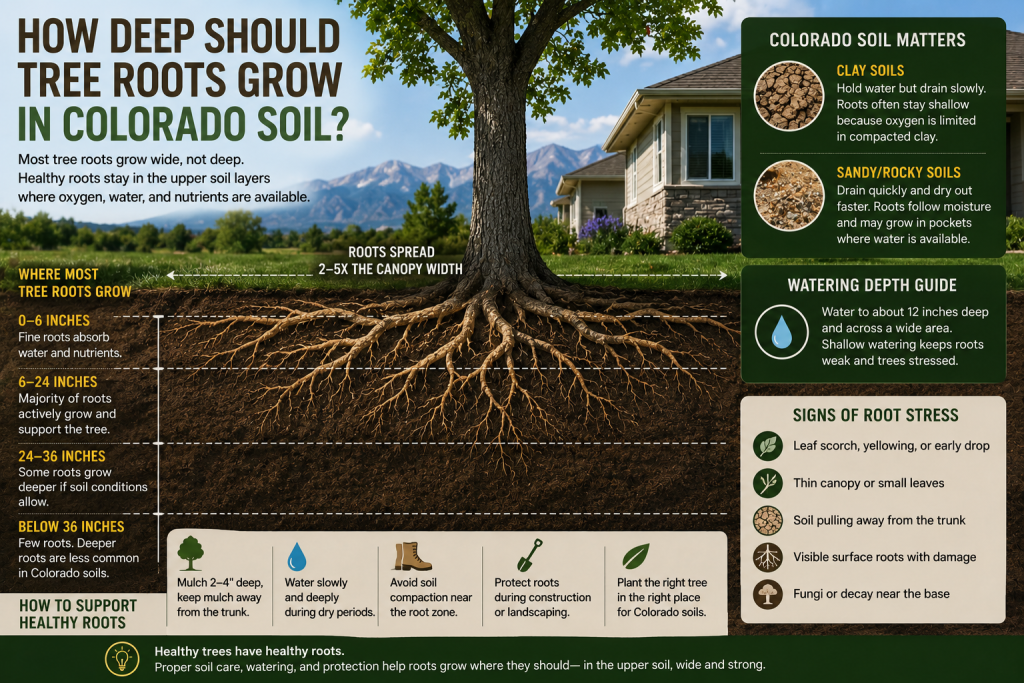
How deep should tree roots grow in Colorado soil? Many homeowners picture tree roots going straight down like a deep anchor, but most tree roots grow much closer to the surface than people expect. In Colorado landscapes, roots usually spread outward through the upper soil layers where oxygen, moisture, and nutrients are available.
That shallow root pattern is normal. It does not mean the tree is weak. A healthy tree often has roots that extend far beyond the edge of the canopy while staying within the upper few feet of soil. The problem starts when roots cannot spread properly, soil is compacted, watering is too shallow, or the tree was planted too deeply.
For Colorado homeowners, root depth matters because soil conditions vary widely. Some yards have heavy clay that drains slowly. Others have sandy or rocky soil that dries quickly. Many residential landscapes also have compacted soil from construction, foot traffic, driveways, sidewalks, patios, or lawn equipment.
Understanding how deep tree roots should grow in Colorado soil helps homeowners water more effectively, protect mature trees during construction, avoid root damage, and recognize when surface roots are normal rather than a sign of trouble.
If a tree on your property is showing surface roots, leaf scorch, thinning canopy, or signs of root stress, Good People Tree Service can evaluate the tree and help determine whether soil care, pruning, monitoring, or removal should be considered.
How deep should tree roots grow in Colorado soil?
Tree roots in Colorado soil should usually grow wide first and deep second. Most important roots are not several feet underground. Instead, they occupy the upper soil layers because those layers contain more oxygen and organic matter.
This surprises many homeowners. A large tree may look like it needs a deep taproot to stay upright, but most mature landscape trees rely on a broad root system. Structural roots help anchor the tree, while smaller absorbing roots collect water and nutrients from the soil.
The practical answer is that many tree roots are found in the top 6 to 24 inches of soil. In favorable conditions, roots may extend deeper, but the majority still remain in the upper root zone.
In compacted, clayey, or poorly drained Colorado soils, roots may be even shallower. That is not because the tree “chooses” to damage lawns or sidewalks. It happens because roots need oxygen. If deeper soil has poor air movement, roots stay closer to the surface.
Why roots grow wide instead of deep
A tree root system is built to explore soil. Roots grow where they find oxygen, moisture, and space. They do not grow toward foundations, sidewalks, or pipes on purpose. They follow conditions that support growth.
In a natural forest soil, roots may have leaf litter, organic matter, and less compaction. In a residential Colorado yard, the soil may be disturbed, graded, compacted, irrigated unevenly, or covered with lawn.
Those conditions change root behavior.
Roots spread outward because water and oxygen are often more available near the surface. Lawn irrigation, mulch, rainfall, and organic material all influence the upper soil zone. Deeper soil may be drier, denser, colder, wetter, or less oxygen-rich.
This is why the question “how deep should tree roots grow in Colorado soil?” should be paired with another question: how far should roots spread?
For many trees, width matters more than depth. A healthy root system can extend far beyond the dripline, sometimes several times wider than the canopy.
Colorado clay soil can keep roots shallow
Heavy clay soil is common in many Colorado landscapes. Clay has small particles that hold water tightly and drain slowly. When clay is compacted, it can become especially difficult for roots.
Roots need oxygen as much as they need water. Wet or compacted clay can limit oxygen, so roots may stay near the surface where air exchange is better.
This can create several visible symptoms:
- surface roots
- slow growth
- leaf scorch
- canopy thinning
- poor drought tolerance
- roots lifting hardscape
- decline after overwatering
Clay soil also changes how trees should be watered. Water applied too quickly may run off instead of soaking in. Once clay does become wet, it can hold moisture for a long time. That means deep watering should be slow, careful, and adjusted to the site.
A homeowner who waters clay soil like sandy soil may create root stress without realizing it. In many Front Range neighborhoods, this is made worse by how yards are built. Soil may be scraped, replaced, packed, and covered with sod before a tree is planted. The tree then grows in a shallow usable layer instead of a loose forest soil profile. That is why root health often depends less on deep digging and more on protecting the upper root zone from compaction and moisture extremes.
Sandy and rocky soils create a different challenge
Not all Colorado yards have heavy clay. Some properties have sandy, gravelly, or rocky soils that drain quickly. These soils may allow more air movement, but they do not hold moisture as well.
Roots in sandy soil may grow where irrigation is consistent, but they can dry out faster during hot weather. A tree may need more frequent moisture checks, especially when young or newly planted.
Rocky soil creates another issue. Roots may grow around obstacles and remain in pockets where soil and moisture are available. The root system may still be shallow and wide, but its pattern can be irregular.
That is why root depth is not a fixed number. Two trees of the same species may grow differently depending on the site.
Case example: the surface roots in a mature front yard tree
Imagine a mature shade tree in a Colorado front yard. Large roots are visible in the lawn, and the homeowner worries that the tree is “too shallow” and unstable.
A closer look shows that the tree has been growing in compacted lawn soil for years. Grass is thin under the canopy, and mower damage appears on a few exposed roots. The canopy is mostly healthy, but the soil is hard and dry near the surface.
In this case, the surface roots are not automatically a problem. They are part of the tree’s normal root system. Covering them with several inches of soil could reduce oxygen and make the tree worse. Cutting them could harm stability.
A better approach may be expanding the mulch ring, reducing mowing near roots, improving watering, and protecting the root zone.
Surface roots are not always bad
Surface roots often look alarming, but they are common in mature trees.
Visible roots may appear because soil erodes, grass struggles under shade, compaction limits deeper growth, or the tree naturally develops large structural roots near the surface.
Surface roots become a concern when they are damaged, cut, buried too deeply, or creating serious conflicts with sidewalks, driveways, foundations, or mowing.
Homeowners should not remove large surface roots without professional guidance. A large root may help anchor the tree or move water. Cutting it can reduce stability, invite decay, and increase stress.
Adding deep soil over surface roots is also risky. Roots need oxygen, and burying them can suffocate the root zone.
Mulch is usually a safer solution than soil. A wide, flat mulch area can protect roots while still allowing oxygen and water to move into the soil.
How deep should you water tree roots?
Watering depth is one of the most practical reasons homeowners ask how deep tree roots should grow in Colorado soil.
For many established trees, the goal is to moisten the active root zone rather than flood deep subsoil. Tree roots absorb water best when moisture reaches the upper root zone where most fine roots are active.
In Colorado guidance, watering to about 12 inches deep is often recommended for trees. That does not mean roots stop at 12 inches. It means water should reach the area where many absorbing roots are functioning.
Shallow lawn watering is usually not enough for mature trees. A sprinkler cycle that keeps turf green may only wet the top few inches. Tree roots may need slower watering across a wider area under the canopy and beyond.
Good watering focuses on width as well as depth.
Case example: the lawn looks green, but the tree is dry
A homeowner sees a green lawn and assumes the tree is getting enough water. By August, the tree has leaf scorch, smaller leaves, and dead branch tips.
The issue is not total water use. The problem is placement and depth. Short sprinkler cycles wet the grass but do not soak the broader root zone. The tree’s roots are spread far beyond the trunk, but irrigation only reaches the lawn surface.
This situation is common in Colorado yards.
A better watering plan would use slower, deeper irrigation around the dripline and beyond. Mulch could reduce evaporation. The homeowner may also need to check soil moisture with a probe or screwdriver rather than guessing from the grass.
Newly planted trees have different root needs
Newly planted trees do not behave like established trees. Their roots are mostly limited to the original root ball. Even if the surrounding soil is moist, the root ball itself may dry out.
That is why new trees need more frequent attention during the establishment period.
A newly planted tree should not be watered only far from the trunk. The original root ball needs water first. Over time, roots should expand into surrounding soil. Once that happens, watering can gradually cover a wider area.
Planting depth also matters. The root flare should be visible near the soil surface. If the tree is planted too deep, structural roots may sit too low, oxygen may be limited, and trunk decay or girdling roots may develop later.
When homeowners ask how deep tree roots should grow in Colorado soil, newly planted trees are a special case. They need correct planting depth before root depth can develop normally.
Deep planting causes long-term root problems
A tree planted too deeply may look fine at first, then decline years later.
Deep planting buries the root flare and may place structural roots below the oxygen-rich zone. It can also encourage trunk-circling roots or girdling roots, especially in certain species.
Signs of deep planting include:
- no visible root flare
- trunk enters soil like a pole
- poor growth
- leaf scorch
- thinning canopy
- suckers near the base
- circling roots
- bark problems near the soil line
Correct planting depth helps roots develop where they belong. A tree should not be forced to grow from a buried trunk.
This is especially important in Colorado soils where compaction, clay, and moisture swings already challenge root growth.
Construction damage affects root depth and spread
Construction can harm roots even when the trunk is untouched.
Driveway replacement, utility trenching, patios, fence installation, grading, and heavy equipment can cut, crush, or compact roots. Because many important roots grow in the top 6 to 24 inches, shallow construction work can still damage the tree.
Root damage may not show immediately. The tree may decline months or years later.
Symptoms include:
- canopy thinning
- branch dieback
- leaf scorch
- early fall color
- poor growth
- new leaning
- mushrooms near roots
- repeated branch drop
A tree protection zone should be planned before construction begins. Once roots are cut or compacted, recovery can be difficult.
Roots and tree stability
Tree stability depends on more than root depth.
A tree with a shallow but wide and healthy root system can be stable. A tree with deeper roots but decay, root cuts, or saturated soil may be unstable.
Anchorage depends on soil type, root spread, root health, tree species, soil moisture, and wind exposure.
This is why surface roots do not automatically mean danger. The bigger concern is root damage, root decay, soil movement, or sudden leaning.
Warning signs of root instability include:
- soil lifting on one side
- new lean
- cracked soil near the base
- mushrooms at the root flare
- exposed torn roots
- sudden canopy decline
- construction near the tree
If these signs appear, the tree should be evaluated.
How root depth affects sidewalks and driveways
Shallow roots can lift sidewalks and driveways when trees and hardscape compete for the same space.
The roots are not doing something unnatural. They are growing where oxygen and moisture exist. If concrete is nearby, roots may expand under or beside it. Over time, the surface can crack or lift.
Cutting roots to repair concrete may create tree health or stability problems. The risk depends on root size, distance from the trunk, and tree condition.
Better options may include rerouting walkways, using flexible materials, bridging over roots, expanding mulch areas, or evaluating whether the tree has outgrown the site.
How to encourage healthier root growth
Homeowners cannot force roots to grow deep, but they can create conditions that support a healthier root system.
Helpful steps include:
- water slowly and deeply
- water across a wide root zone
- mulch around the tree
- keep mulch away from the trunk
- avoid compacting soil
- protect roots during construction
- do not pile soil over roots
- avoid cutting large surface roots
- choose trees suited to Colorado soils
- inspect mature trees regularly
Healthy roots need oxygen, moisture, and space. Those basics matter more than trying to push roots deeper.
Frequently asked questions
How deep do most tree roots grow in Colorado?
Most tree roots are found in the upper soil layers. Many important roots grow in the top 6 to 24 inches, while much of the absorbing root system may be even closer to the surface in compacted or clayey soil.
Are surface roots a sign of a problem?
Not always. Surface roots are common, especially in mature trees. They become a problem when damaged, cut, buried, or creating hardscape conflicts.
Should I deep-root water my trees?
Watering should reach the active root zone, often around 12 inches deep, and should be applied across a wide area. Very deep watering is not always better because most absorbing roots are not extremely deep.
Can roots grow deeper if I water deeply?
Good watering can encourage healthier root distribution, but roots still need oxygen and suitable soil. In compacted clay or wet soil, roots may remain shallow because deeper conditions are poor.
Is it safe to cut exposed roots?
Large exposed roots should not be cut without professional guidance. Cutting major roots can stress the tree and reduce stability.
Final thoughts
How deep should tree roots grow in Colorado soil? In most cases, the healthiest answer is not “as deep as possible.” Tree roots should grow where oxygen, moisture, and space are available. In Colorado landscapes, that usually means a wide root system concentrated in the upper soil layers.
Shallow roots are not automatically bad. They are normal for many trees. Problems begin when soil is compacted, watering is shallow, roots are buried, construction damages the root zone, or homeowners cut roots without understanding their purpose.
Good People Tree Service helps Colorado homeowners evaluate root issues, surface roots, soil stress, and tree stability concerns.
If your tree has exposed roots, canopy decline, sidewalk lifting, or signs of root damage, schedule an evaluation before root stress becomes a larger tree health or safety problem.