
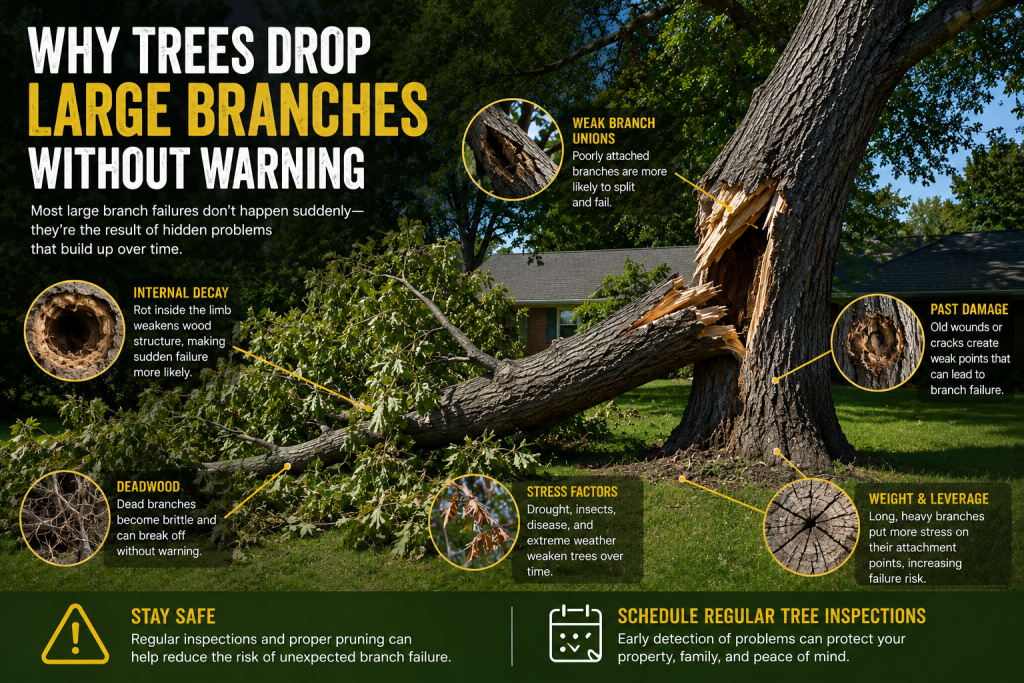
Trees drop large branches without warning more often than homeowners expect. One day the tree looks full, green, and stable. The next day a heavy limb is lying across the lawn, driveway, fence, patio, or roof. There may have been no major storm, no obvious wind event, and no clear reason from the ground.
That suddenness is what makes branch drop so frustrating. A large branch failure can feel random, but it usually has a cause. Decay, weak attachment, drought stress, internal cracking, old storm damage, heavy canopy weight, insects, disease, or poor pruning history may have been building risk long before the limb fell.
For Colorado homeowners, this issue deserves attention. Trees along the Front Range face dry air, drought cycles, wet spring snow, strong sun, rapid temperature shifts, compacted soil, and sudden wind events. These conditions can weaken branches over time and make failures more likely later.
Understanding why trees drop large branches without warning helps homeowners know when a fallen limb is a one-time problem and when it may be a sign of deeper tree failure risk.
If a large branch has fallen from a tree near your home, driveway, sidewalk, or outdoor living space, Good People Tree Service can inspect the tree and help determine whether pruning, monitoring, or removal is the safest next step.
Why trees drop large branches without warning
Trees drop large branches without warning when a limb can no longer support its own weight or withstand normal stress. The final break may happen quickly, but the weakness usually develops slowly.
A branch is supported by living wood, internal fibers, and its attachment to the trunk or parent limb. If decay, cracks, poor structure, or water stress weakens that system, the branch may eventually fail under gravity alone.
Common causes include:
- internal decay
- deadwood
- weak branch unions
- included bark
- drought stress
- old storm damage
- heavy wet snow history
- insects or disease
- poor pruning cuts
- overextended limbs
- unbalanced canopy weight
The branch does not need extreme wind to fail. Sometimes heat, gravity, internal moisture changes, or the limb’s own weight are enough.
A green tree can still have weak branches
One of the most important things to understand is that a green canopy does not guarantee structural safety.
A branch may still produce leaves while decay is spreading inside. Living tissue near the outside can keep the branch alive, even when the internal wood is losing strength. From the ground, the limb may look normal.
That is why trees drop large branches without warning even when they seem healthy. The tree may be alive, but one branch may be structurally compromised.
This is especially common in mature trees. Older branches may have old wounds, past pruning cuts, cavities, or internal defects that are hard to see. A branch can look leafy in June and still fail in July or August.
Deadwood is one of the most common causes
Dead branches become brittle over time. Once a limb dies, it no longer has the same flexibility or strength as living wood. Wind, snow, gravity, or decay can eventually bring it down.
Small dead twigs are usually less concerning. Large dead branches are different because they carry more weight and can fall from greater height.
Deadwood becomes more serious when it is:
- larger than a few inches in diameter
- high in the canopy
- over a roof or driveway
- above sidewalks or play areas
- increasing each year
- connected to other signs of decline
A dead limb does not always fall immediately. It may remain attached for months or years. That delay can make the eventual failure feel unexpected.
Regular pruning can reduce this risk when the rest of the tree is structurally sound.
Weak branch unions and included bark
Some branches fail because they were poorly attached from the beginning.
A strong branch union forms when wood from the trunk and branch grow together properly. Weak unions often form at tight V-shaped angles. These angles may trap bark between the branch and trunk, a defect known as included bark.
Included bark prevents strong wood from forming in the union. As the branch grows larger and heavier, that weak connection becomes more stressed.
Warning signs include:
- tight V-shaped branch angles
- a visible seam where limbs meet
- cracks below the union
- two large stems competing for dominance
- bark trapped between stems
- one side pulling away from the other
A tree with included bark may look healthy for years. Then one large branch can split away suddenly, especially after heat, snow, or routine loading.
This is one reason structural pruning is so important when trees are young. Once a weak union becomes large, options are more limited.
Internal decay can hide inside a major limb
Decay is one of the biggest hidden reasons trees drop large branches without warning.
A limb may begin decaying after a storm break, pruning wound, animal injury, bark damage, or fungal infection. The decay may spread inside the branch while the outside remains covered in bark.
Visible clues may include:
- cavities
- fungal growth
- old wounds
- peeling bark
- soft or dark wood
- cracks near the branch base
- woodpecker activity
- repeated branch failure nearby
Unfortunately, decay is not always visible from the ground. By the time a large branch breaks, internal strength may have been declining for years.
A fallen branch with dark, hollow, or crumbly wood at the break should not be ignored. Other limbs may have similar defects.
Colorado drought stress can weaken branches slowly
Drought stress is a major reason trees drop large branches without warning in Colorado.
During dry periods, a tree may not have enough moisture to support its full canopy. Fine roots can decline, leaves may scorch, and smaller branches may die back. Larger limbs can also become more brittle over time.
Drought-related stress may show up as:
- sparse canopy
- smaller leaves
- early leaf drop
- dead branch tips
- top dieback
- leaf scorch
- bark cracking
- increased insect pressure
The branch may not fail during the drought itself. It may drop later after the limb has weakened, dried, cracked, or decayed.
This delayed pattern makes drought damage easy to underestimate. A dry summer can contribute to branch failure months or even years later.
Case example: the backyard shade tree
Imagine a mature shade tree in a Colorado backyard. The tree looks healthy from the patio, and the canopy still produces plenty of leaves. During a calm summer afternoon, a large limb suddenly drops across the lawn.
A closer look shows several clues. The limb was long and heavy. The break point has dark wood inside. A small cavity near the branch union was hidden by foliage. The tree also had leaf scorch the previous summer after a dry season.
The branch did not truly fail for no reason. Drought stress, old decay, and branch weight worked together until the limb finally broke.
This is a common pattern when trees drop large branches without warning.
Summer branch drop and calm-weather failure
Some large branches fall during warm weather even when there is no storm. This is sometimes called summer branch drop or sudden limb failure.
Arborists and researchers still discuss the exact causes, but several factors may contribute. Heat, internal moisture changes, heavy limb weight, long branches, hidden defects, and tree species can all play a role.
This type of failure is often reported in mature broadleaf trees with large horizontal limbs. The branch may break several feet away from the trunk rather than directly at the attachment.
For homeowners, the practical lesson is simple. A large limb that falls on a calm day should be treated as a warning sign. The rest of the tree may need inspection, especially if the fallen branch was large, decayed, or located over a high-use area.
Heavy wet snow can start damage that appears later
Colorado snow can be heavy, wet, and difficult for trees to carry.
A branch may bend under snow load, crack internally, or split at the union. The limb might not fall during the storm. Instead, it may remain attached in a weakened condition and fail later.
This delayed failure is easy to miss. After snow melts, the tree may look mostly normal. A crack, tear, or internal fracture may remain hidden in the canopy.
Later, during heat, wind, or normal movement, the branch may drop.
After a heavy snow event, homeowners should look for:
- hanging branches
- torn bark
- split unions
- uneven canopy shape
- branches resting on other limbs
- fresh cracks near branch attachments
Do not stand under damaged branches or try to knock snow off large limbs aggressively. Branches under load can break suddenly.
Poor pruning can create future branch failures
Pruning is supposed to improve tree health and structure, but poor cuts can create long-term problems.
Flush cuts remove the branch collar and make it harder for the tree to compartmentalize the wound. Stub cuts leave dead wood that can decay backward into the limb. Topping creates weak regrowth that may fail later.
Over-pruning can also stress the tree. Removing too much live canopy reduces the tree’s ability to produce energy and can expose bark to sunscald.
Bad pruning does not always cause immediate failure. The damage may show up years later as decay, weak attachments, or repeated branch drop.
When trees drop large branches without warning, old pruning wounds are often worth checking.
Insects and disease can contribute to limb failure
Insects and disease may weaken branches directly or take advantage of trees that are already stressed.
Some pests attack weakened limbs. Fungal diseases can cause cankers, decay, or dieback. Borers may move into stressed branches and reduce wood quality.
Warning signs include:
- small holes in bark
- sawdust-like boring dust
- peeling bark
- dead branch tips
- fungal growth
- oozing sap
- sudden branch dieback
- woodpecker damage
Insect activity is not always the first cause. Often, pests arrive after drought, root damage, or old wounds have already weakened the tree.
Still, visible pest or disease signs near large limbs should be evaluated, especially when branch drop has already occurred.
Overextended limbs carry more stress
Long horizontal limbs often carry heavy mechanical loads. The farther a limb extends from the trunk, the more leverage it creates at the attachment point and along the branch.
Overextended limbs are more likely to fail when they also have:
- heavy foliage
- internal decay
- poor attachment
- cracks
- old storm damage
- uneven weight distribution
- weak wood species characteristics
A long limb over a roof or driveway may look beautiful, but it can also carry risk.
Professional pruning may reduce weight carefully without removing too much live canopy. The goal is not to cut randomly. Good pruning reduces stress while preserving the tree’s natural form.
Case example: the limb over the driveway
A homeowner notices a large limb extending over the driveway. It has been there for years, and the tree appears healthy. After a hot, dry summer, the limb drops overnight and damages a parked vehicle.
Inspection shows a narrow branch union and a pocket of decay near the attachment. The limb had also grown long and heavy over time.
The failure seemed sudden because the homeowner only saw the final break. The branch had been developing risk quietly for years.
This is why large limbs over driveways, roofs, and sidewalks deserve regular inspection.
What homeowners should do after a large branch falls
Start with safety.
Do not stand under the tree to look for more damage. Avoid pulling hanging branches. Keep children, pets, and vehicles away from the area. If the branch touched utility lines, stay away and contact the utility company or emergency services.
From a safe distance, observe:
- where the branch broke
- whether the break looks decayed
- whether other limbs are hanging
- whether the trunk has cracks
- whether the canopy looks unbalanced
- whether large limbs remain over structures
- whether the branch was dead or alive
Photos can be helpful, especially if there is property damage.
A professional inspection is recommended when the fallen branch was large, high in the canopy, close to structures, or connected to decay.
Can the tree recover after dropping a large branch?
Sometimes, yes.
A tree may recover if the branch loss is limited, the trunk is sound, and most of the canopy remains healthy. Proper pruning can clean up the damaged area and reduce the risk of decay entering the wound.
Recovery is less likely when:
- the trunk is split
- several major limbs have failed
- decay is present
- the canopy is mostly dead
- the tree is leaning
- large weak unions remain
- root problems are visible
A tree can survive branch loss but still be structurally compromised. Survival and safety are not always the same thing.
Good People Tree Service can evaluate whether pruning, monitoring, or removal is the right choice after major branch failure.
How to reduce the risk of sudden branch drop
Not every branch failure can be prevented, but regular care reduces risk.
Helpful steps include:
- inspect mature trees regularly
- remove large deadwood
- prune for structure
- avoid topping
- address weak unions early
- water during drought
- protect roots during construction
- monitor trees after snowstorms
- watch for fungal growth or cavities
- avoid parking under questionable limbs
- inspect trees after large branch loss
Colorado homeowners should pay extra attention after drought, heavy snow, high winds, and construction near the root zone.
Frequently asked questions
Why do trees drop large branches without warning?
Trees often drop large branches because decay, weak unions, drought stress, deadwood, or structural defects have weakened the limb over time.
Can a healthy-looking tree drop a large limb?
Yes. A tree can look healthy while one branch has internal decay, included bark, old storm damage, or hidden cracks.
Is summer branch drop real?
Yes. Large limbs can fail during warm or calm weather, especially in mature trees with heavy limbs or hidden defects.
Should I remove a tree after one large branch falls?
Not always. Some trees recover after losing one limb. Removal may be needed if decay, trunk splitting, repeated failure, or major structural risk is present.
When is branch drop an emergency?
Branch drop becomes urgent when hanging limbs remain, the trunk is split, the tree is near power lines, or large branches threaten homes, driveways, sidewalks, or people.
Final thoughts
Trees drop large branches without warning when hidden stress reaches a breaking point. The final failure may happen suddenly, but the causes often develop over time.
Deadwood, internal decay, drought stress, included bark, weak unions, storm damage, pests, poor pruning, and overextended limbs can all contribute. Colorado’s dry climate, wet snow, and rapid weather changes can make these problems more likely.
A single small branch may not be a major concern. A large limb falling near a home, driveway, sidewalk, or outdoor living area deserves attention.
Good People Tree Service helps Colorado homeowners inspect trees after branch failure, remove hazardous limbs, and decide whether a tree can be preserved safely.
If a large branch has fallen from your tree, schedule an evaluation before the next limb drops. Early inspection matters because the safest solution is usually easier to choose before another heavy limb fails.