
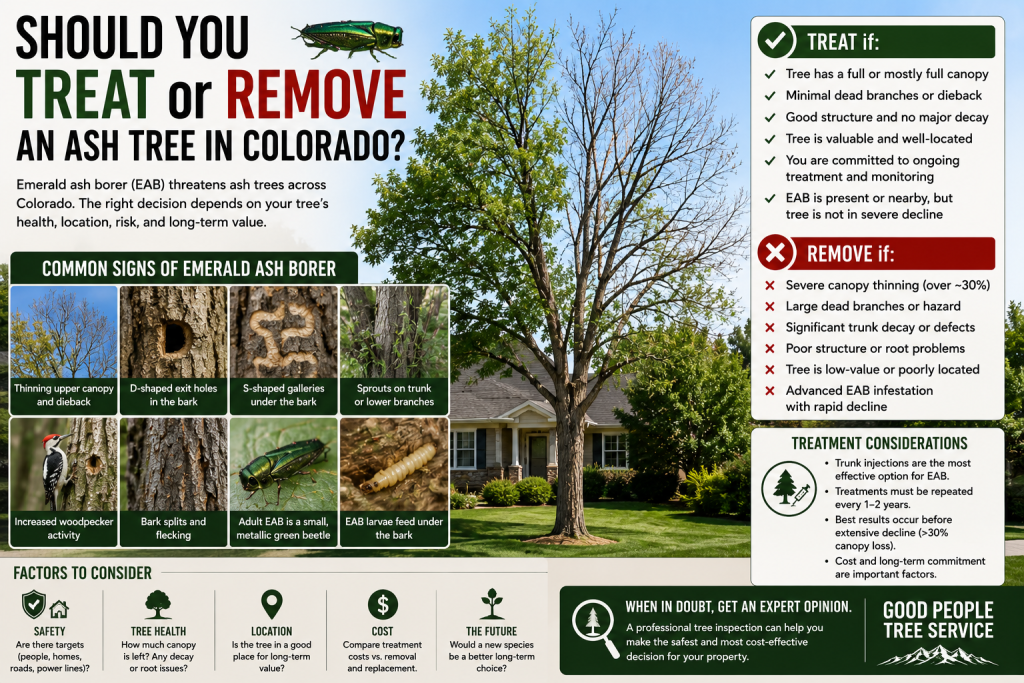
Should you treat or remove an ash tree in Colorado? That question has become more urgent for homeowners as emerald ash borer spreads through Front Range communities. For years, many Colorado homeowners could treat ash decline as a normal tree-health issue. Now, ash trees need a more serious decision: protect the tree with ongoing treatment, monitor it closely, or remove it before it becomes hazardous.
Ash trees are common in Colorado neighborhoods. They line streets, shade yards, frame driveways, and stand near homes, sidewalks, fences, and patios. Many were planted because they grew well in urban conditions and provided strong shade. That popularity now creates risk because emerald ash borer targets ash trees specifically.
The right answer depends on the tree’s health, size, location, structure, value, cost, and pest risk. A healthy ash in a good location may be worth treating. A declining ash with dead branches over a roof may be safer and more practical to remove. A small, replaceable ash in poor condition may not justify long-term treatment costs.
Learning whether to treat or remove an ash tree in Colorado helps homeowners avoid two expensive mistakes. One mistake is removing a valuable tree too early. The other is waiting too long and dealing with a dangerous, brittle, costly removal later.
If you have an ash tree with thinning canopy, branch dieback, bark damage, woodpecker activity, or signs of emerald ash borer, Good People Tree Service can inspect the tree and help you understand your options.
Should you treat or remove an ash tree in Colorado?
Should you treat or remove an ash tree in Colorado? Start with a basic decision framework.
Treatment may make sense when the tree is healthy enough to benefit, structurally sound, valuable to the property, located in a useful shade position, and not already showing severe decline. Removal may make more sense when the tree has major canopy loss, large dead limbs, structural defects, decay, poor location, high risk, or low long-term value.
This decision should not rely on one symptom. Ash trees can decline from emerald ash borer, lilac/ash borer, drought, root damage, compacted soil, poor pruning, storm damage, old wounds, or planting problems.
A homeowner needs to ask several questions:
- Is the tree truly an ash?
- Is emerald ash borer present or nearby?
- How much canopy has the tree lost?
- Are large branches dead or dying?
- Does the tree stand near a target?
- Is the trunk sound?
- Would treatment need to continue for years?
- Would removal and replacement create a better long-term result?
The best choice balances tree preservation with safety, cost, and realistic recovery.
First, make sure the tree is an ash
Before deciding anything, confirm the species. Emerald ash borer attacks true ash trees, not mountain ash. True ash trees belong to the Fraxinus genus.
Ash trees usually have opposite branching. Leaves often grow in compound groups with several leaflets. Mature ash bark often develops diamond-shaped ridges. Seeds can appear as paddle-shaped samaras.
Species identification matters because homeowners sometimes confuse ash with other shade trees. Treating the wrong tree wastes money. Removing the wrong tree creates an even bigger mistake.
A tree service, arborist, city forester, or CSU Extension resource can help confirm whether the tree is ash.
Why emerald ash borer changes the decision
Emerald ash borer, often called EAB, is an invasive beetle that attacks ash trees. The larvae feed under the bark and damage the tissues that move water and nutrients. Over time, the canopy thins, branches die back, and the tree declines.
EAB often starts high in the canopy, so homeowners may miss early symptoms. By the time obvious decline appears from the ground, the infestation may already have advanced.
Colorado first confirmed EAB in Boulder in 2013. Since then, detections have spread into more Front Range communities. That spread means many homeowners can no longer assume their ash tree is outside the risk zone.
EAB changes ash care because “wait and see” can become risky. A homeowner may wait until the tree looks bad, but treatment works best before heavy canopy loss. Once the tree declines too far, removal may become the only practical choice.
Signs your ash tree may have emerald ash borer
Homeowners should watch ash trees carefully during the growing season.
Common warning signs include thinning in the upper canopy, branch dieback, smaller leaves, sprouting from the trunk or lower branches, increased woodpecker activity, bark flecking, vertical bark splits, S-shaped galleries under bark, and small D-shaped exit holes.
Some signs appear late. D-shaped exit holes are small, and homeowners may not see them easily. Galleries under bark require bark removal, which homeowners should not do casually because it can damage the tree.
Woodpecker activity can provide an important clue. Birds often remove bark while searching for larvae, leaving pale patches or flecking on the trunk and branches.
These symptoms do not always prove EAB. Ash trees can suffer from drought, lilac/ash borer, root problems, poor soil, or other pests. Still, a symptomatic ash tree in Colorado deserves inspection.
Treatment makes sense for some ash trees
Treatment can make sense when an ash tree still has strong value and enough health to respond.
A good treatment candidate often has a full or mostly full canopy, strong structure, no major trunk decay, no major root damage, and a useful location. The tree may shade the home, reduce heat on a patio, improve curb appeal, or anchor the landscape.
Large, healthy ash trees can take decades to replace. Removing one may expose the house to more sun, reduce property shade, and change the yard dramatically. In those cases, treatment may offer real value.
Treatment also makes more sense before severe EAB damage appears. Preventive or early treatment usually gives the tree a better chance than rescue treatment after major canopy loss.
A professional should evaluate the tree before treatment. Treating a tree with hidden structural problems may preserve a tree that still poses risk.
Treatment requires a long-term commitment
Ash tree treatment is not usually a one-time fix. EAB pressure can continue for years. Homeowners who choose treatment should expect an ongoing maintenance plan.
The treatment interval depends on the product, tree size, pest pressure, local recommendations, and professional guidance. Some trunk-injection treatments can protect trees for more than one season, but homeowners still need repeated treatments over time.
This long-term cost matters. A homeowner should compare the cost of ongoing treatment with the cost of removal and replacement.
For a healthy, high-value ash, treatment may justify the cost. For a small or poorly placed ash, replacement may create better long-term value.
Removal makes sense when the tree is too far gone
Removal may be the safer choice when an ash tree has severe canopy thinning, major branch dieback, trunk decay, poor structure, root damage, or signs of advanced decline.
A severely declining ash can become brittle. Dead branches can fail. A dead or dying tree near a home, driveway, sidewalk, street, or patio can create a serious property risk.
The timing matters. Waiting too long can make removal harder and more expensive. A tree crew may need extra equipment when branches become brittle or when the tree cannot support safe climbing.
If the tree has already lost a large portion of its canopy, treatment may not restore it. Some professional guidance uses canopy-thinning thresholds to decide whether treatment still makes sense. Once decline passes a certain point, removal often becomes the more realistic option.
Location changes the answer
The same tree can lead to different decisions depending on location.
An ash tree in the middle of an open yard may allow more time for monitoring. A declining ash over a roof, driveway, sidewalk, playground, street, or neighbor’s fence creates a more urgent concern.
Targets matter. A target is anything a tree or branch could hit. The more important the target, the less room there is for delay.
A tree near power lines also requires caution. Homeowners should not attempt removal or pruning near utility lines.
Location also affects treatment value. An ash that shades the west side of a home may reduce summer heat and provide meaningful comfort. A crowded ash in a poor site may offer less benefit.
Tree structure matters as much as pest pressure
Some ash trees are worth treating biologically but not structurally.
A tree may still have green leaves, yet have weak branch unions, large cracks, included bark, decay pockets, trunk wounds, or major storm damage. Treatment does not fix structural weakness.
This is why an ash decision should include more than pest control. A qualified tree professional should look at canopy health, trunk condition, branch attachments, root flare, decay signs, lean, deadwood, and site conditions.
Treating a structurally risky ash can delay a necessary removal. Removing a structurally sound ash too soon can waste a valuable tree. The inspection helps avoid both mistakes.
Canopy loss is one of the biggest decision points
Canopy condition tells a lot about recovery potential.
A healthy ash should produce a reasonably full canopy during the growing season. If the top looks thin, branches die back, or large sections fail to leaf out, the tree may already have significant stress.
Mild thinning may still allow treatment, especially if the tree has good structure and high value. Moderate thinning calls for careful evaluation. Severe thinning usually pushes the decision toward removal.
Homeowners should compare the ash with photos from previous years. Gradual thinning can be hard to notice. Old street-view images, real estate photos, or yard photos can help show how much canopy the tree has lost.
Drought and root stress can mimic EAB decline
Not every struggling ash has emerald ash borer. Colorado ash trees also decline from drought stress, compacted soil, shallow watering, root damage, road salt, poor drainage, construction, and old pruning wounds.
A lawn may look green while the ash root zone stays dry. Turf irrigation often waters grass, not deep tree roots. Rock mulch and pavement can add heat. Clay soil can stay dry in some areas and soggy in others.
These site problems can weaken an ash and make pest problems worse. They can also cause symptoms that resemble EAB.
This is why homeowners should avoid diagnosing from one symptom. A tree service can evaluate the whole site and help determine whether treatment, watering changes, pruning, or removal makes sense.
Cost should include more than treatment price
A treatment-versus-removal decision should include short-term and long-term cost.
Treatment costs repeat. Removal costs usually happen once, though stump grinding and replacement add more. Delayed removal can cost more if the tree dies and becomes hazardous.
Replacement also has a cost. A new tree may take decades to provide the shade of a mature ash. That lost shade has value, especially on hot Colorado afternoons.
Homeowners should compare:
- treatment cost over several years
- removal cost now
- removal cost later if the tree dies
- replacement tree cost
- lost shade and landscape value
- risk to nearby structures
- value of keeping a mature tree
The cheapest option today may not create the best long-term result.
Do not wait for the ash to look dead
Waiting until an ash looks dead usually removes your options.
Treatment works best when the tree still has enough living canopy and vascular function to move the product. If the tree has too much dieback, treatment may not help enough.
Removal also becomes harder after death. Dead ash trees can become brittle. Branches may break more easily, and crews may need different removal methods.
A homeowner who waits too long may lose the chance to treat and pay more for removal.
Early inspection gives you more control.
Treating an ash tree near known EAB areas
If your community has confirmed EAB nearby, your ash tree needs a plan. That plan may include treatment, scheduled inspection, or staged removal and replacement.
Preventive treatment may make sense for a healthy, valuable ash in an EAB area. The goal is to protect the tree before heavy infestation causes visible decline.
Monitoring may make sense for a lower-value tree if EAB has not reached the immediate area, but this approach carries risk as the pest spreads.
Removal and replacement may make sense when the tree already has health problems or occupies a poor location.
Local city forestry pages and Colorado State Forest Service updates can help homeowners understand nearby detections, but the tree itself still needs individual evaluation.
Replacement may be the best long-term choice
Some homeowners focus only on saving or removing the current ash. Replacement planning deserves equal attention.
If an ash tree has poor long-term prospects, planting a new tree before removal can help preserve shade over time. This approach gives the replacement tree a head start while the ash still provides some canopy.
Choose a different species instead of replacing ash with ash. Diversity helps protect neighborhoods from future pest outbreaks. A landscape with many tree species can handle pest pressure better than one dominated by a single tree type.
The right replacement depends on yard size, soil, sun, irrigation, overhead lines, mature tree height, and Colorado climate conditions.
Case example: the healthy shade ash
A homeowner has a large ash tree shading the west side of the house. The canopy looks full. The trunk appears sound. The tree sits far enough from the foundation and has no major dead limbs. EAB has been confirmed in nearby communities.
This tree may be a strong treatment candidate. It provides shade, property value, and comfort. Removing it would change the home’s summer exposure.
The homeowner should schedule an inspection, confirm tree condition, and discuss treatment timing and long-term cost. If the tree remains structurally sound, treatment may make sense.
Case example: the declining ash over a driveway
Another homeowner has an ash tree with major upper canopy dieback, large dead branches, bark damage, and woodpecker activity. The tree hangs over a driveway and sidewalk.
This tree may not justify treatment. Even if EAB treatment slows pest damage, the dead branches and canopy loss create risk. Removal may be safer and more practical.
The homeowner should not wait for the tree to decline further. A professional removal while the tree remains manageable may cost less and reduce hazard.
Case example: the small ash in a poor location
A small ash grows too close to a fence and under overhead lines. It has a thin canopy and trunk wounds from lawn equipment.
Treatment may not make sense even if the tree is still alive. The tree has limited future value and may create maintenance problems. Removing it and planting a better species in a better location may create a stronger landscape.
This example shows why treatment decisions should consider the whole property, not only pest risk.
What homeowners should not do
Do not let a door-to-door salesperson pressure you into immediate treatment or removal. Ash decisions should rely on tree condition, EAB risk, structure, location, and long-term goals.
Do not apply insecticides without correct identification and label-compliant use. Some effective products require professional application. Wrong timing or wrong product can waste money and fail to protect the tree.
Do not move ash firewood or infested wood to another area. Moving wood can spread pests.
Do not climb, cut, or remove a large declining ash yourself. Dead or dying ash trees can fail unpredictably, especially near structures or hardscape.
When to call a tree service
Call a tree service if your ash tree shows thinning canopy, branch dieback, dead limbs, woodpecker activity, bark splits, D-shaped holes, boring dust, trunk sprouts, cracks, mushrooms, or sudden decline.
Also call if the tree stands near a home, driveway, sidewalk, street, patio, or fence. Risk increases when people or property sit under the canopy.
Good People Tree Service can inspect the tree, identify visible warning signs, evaluate safety concerns, and explain whether treatment, monitoring, pruning, removal, or replacement planning makes sense.
Frequently asked questions
Is it worth treating an ash tree in Colorado?
It can be worth treating a healthy, valuable ash tree with good structure and limited canopy decline. Treatment may not make sense for a severely declining, damaged, or poorly located tree.
When should an ash tree be removed?
An ash tree may need removal when it has severe canopy loss, large dead branches, trunk decay, structural defects, major root problems, or creates risk near a home, sidewalk, street, or driveway.
Can an ash tree recover from emerald ash borer?
Some ash trees with limited EAB injury may respond to professional treatment. Trees with severe canopy thinning or advanced decline often have poor recovery potential.
Do all ash trees in Colorado need treatment?
Not every ash needs treatment immediately, but every ash tree needs a plan. The plan may include treatment, monitoring, replacement planting, or removal depending on risk and condition.
What happens if I do nothing?
If EAB reaches an untreated ash tree, the tree will likely decline and eventually die. Waiting too long can reduce treatment options and make removal more difficult or expensive.
Final thoughts
Should you treat or remove an ash tree in Colorado? The answer depends on tree health, canopy condition, structure, location, value, EAB risk, and long-term cost.
Treat a healthy, valuable ash when it has strong structure, limited decline, and meaningful property benefits. Remove an ash when it has severe dieback, major defects, poor location, or safety concerns. Monitor only when the tree has low immediate risk and you have a clear follow-up plan.
Emerald ash borer has changed ash tree care in Colorado. Homeowners should not wait until a tree looks dead. Early inspection gives you more options, whether that means treatment, planned replacement, or safer removal.
Good People Tree Service helps Colorado homeowners evaluate ash trees, identify visible pest and decline symptoms, remove hazardous trees, and make practical decisions before small problems become expensive risks.
If you are unsure whether to treat or remove your ash tree, schedule an inspection and make the decision while the tree is still manageable.