
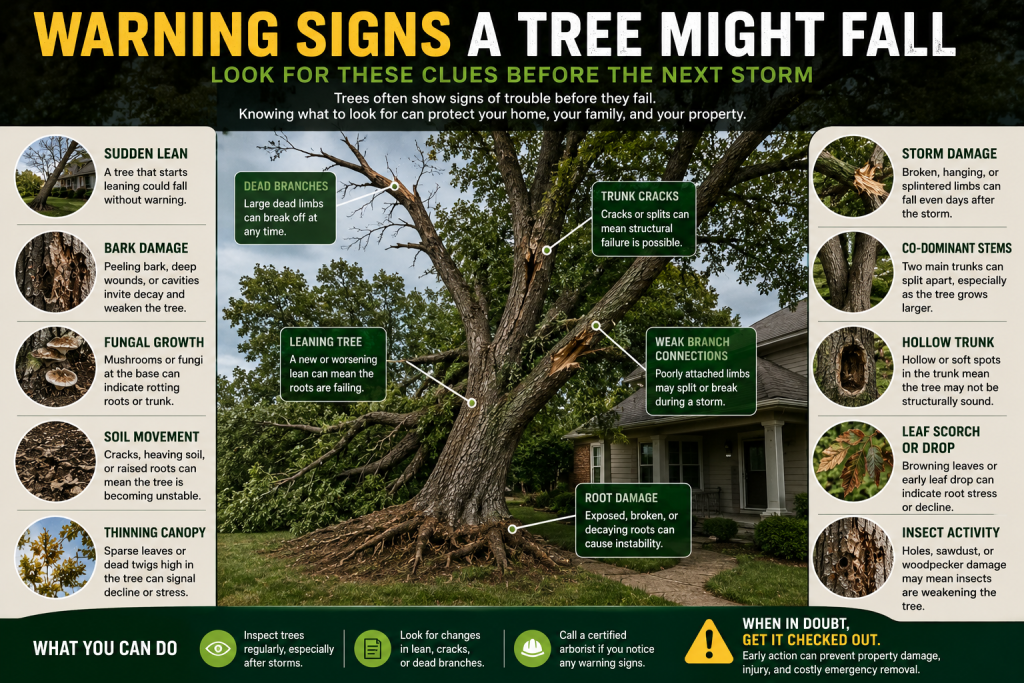
For Colorado homeowners, this topic matters because trees along the Front Range face strong winds, wet spring snow, drought stress, compacted soils, freeze-thaw cycles, and construction-related root damage. These conditions can turn a small tree defect into a serious safety concern.
A dangerous tree does not always fall without warning. Many trees show clues before they fail. The challenge is knowing which signs are minor and which ones deserve immediate attention.
Some warning signs a tree might fall include a new lean, trunk cracks, dead branches, root movement, fungal growth, soil lifting, sudden canopy thinning, or large limbs hanging over a roof, driveway, sidewalk, or play area.
If you are concerned about a tree near your home, garage, fence, driveway, or outdoor living space, Good People Tree Service can inspect the tree and help determine whether pruning, monitoring, or removal is the safest next step.
Why warning signs a tree might fall are easy to miss
Many homeowners miss the warning signs a tree might fall because trees decline slowly. A tree may lose a few branches over several years. Leaves may become smaller. Bark may crack. The canopy may thin little by little.
Those changes can look normal, especially in mature trees.
Aging trees do need more maintenance than young trees. Some dead twigs inside the canopy can be normal. Slower growth may also happen over time. Still, repeated branch drop, major cracks, root problems, or spreading dieback should not be dismissed as ordinary aging.
Tree risk usually involves two things: the condition of the tree and what the tree could hit if it fails.
A tree with defects in an open field may be lower risk. The same tree leaning over a house, driveway, sidewalk, or power line is much more concerning.
Location changes urgency.
A new or worsening lean
One of the clearest warning signs a tree might fall is a new lean.
Some trees naturally grow at an angle. If the tree has leaned the same way for many years and the roots are stable, the lean may not be urgent. A new lean is different.
A tree that suddenly leans after wind, snow, saturated soil, or construction may have lost root support.
Watch for:
- A lean that appeared recently
- A lean that is getting worse
- Soil lifting on one side
- Cracks in the ground around the base
- Exposed or torn roots
- Branches suddenly closer to the roof
- The tree leaning toward a structure
A newly leaning tree should be evaluated quickly, especially if it is close to a home, garage, street, or walkway.
Do not try to pull a large leaning tree upright with a rope, truck, chain, or winch. That can be dangerous and may make the tree more unstable.
Soil lifting around the base
Roots anchor the tree. When roots begin to fail, the ground around the tree may move.
Soil lifting or cracking near the base is one of the warning signs a tree might fall because it can indicate root plate movement. This may happen after strong winds, saturated soil, construction damage, or root decay.
Look for:
- Raised soil on one side of the tree
- Fresh cracks near the trunk
- Roots pulling out of the ground
- Gaps around the base
- Soil movement after a storm
- A leaning tree with disturbed ground
The root zone is not always visible, so surface changes matter. If the soil is moving, the tree may already be unstable.
Keep people, pets, and vehicles away from the fall zone until the tree is evaluated.
Large dead branches in the canopy
Dead branches are common in mature trees, but size and location matter.
Small dead twigs are usually less serious. Large dead limbs high in the canopy are different. They can break without much warning and cause damage below.
Dead limbs over a roof, driveway, sidewalk, patio, or play area should be taken seriously.
Warning signs include:
- Large dead branches high in the tree
- Dead limbs over structures
- Multiple dead branches in one area
- Deadwood increasing each year
- Branches breaking during calm weather
- Hanging limbs after a storm
A tree does not have to fall completely to be dangerous. One large limb can damage a roof, vehicle, fence, or person underneath.
Regular pruning can reduce this risk when the rest of the tree is structurally sound.
Cracks in the trunk or major limbs
Trunk cracks are among the most important warning signs a tree might fall.
A crack may indicate that the tree is under structural stress. It may also show that internal wood is failing. Cracks become more serious when they are deep, long, widening, or connected to other defects.
Pay close attention to:
- Vertical cracks in the trunk
- Cracks where large limbs meet
- Splits between co-dominant stems
- Cracks that appeared after a storm
- Open wounds with soft or dark wood
- Bark separating near a crack
- A crack on the side toward the lean
A small surface crack is not always an emergency. A deep split in the trunk can be much more serious.
If the tree is close to a house or driveway, a major trunk crack should be inspected promptly.
Co-dominant stems and weak unions
Co-dominant stems happen when two large stems grow from the same point. Instead of one main leader, the tree develops competing trunks.
This can create a weak union.
The problem becomes worse when bark is trapped between the stems. This is called included bark. The trapped bark prevents strong wood from forming between the stems.
A weak union may hold for years. Then wind, snow, or limb weight can cause the stems to split apart.
Signs of a weak union include:
- A tight V-shaped split between stems
- Bark trapped inside the union
- A seam running down the trunk
- Cracks where stems meet
- Two large stems competing for dominance
- One side of the tree pulling away
These are warning signs a tree might fall or lose a major section of its canopy.
Structural pruning can sometimes reduce risk when problems are caught early. Mature trees with large weak unions may need more careful evaluation.
Mushrooms or fungal growth near the base
Mushrooms near a tree are not always a problem. Some fungi grow on organic matter in the soil. Others may indicate root or trunk decay.
Fungal growth near the base becomes concerning when it appears around the root flare, trunk, or major roots.
Decay can weaken the wood that supports the tree. If roots or the lower trunk are compromised, the tree may become less stable.
Watch for:
- Mushrooms at the base
- Shelf fungi on the trunk
- Soft or crumbling wood
- Hollow areas
- Bark falling off near the base
- A tree with fungi plus leaning or dieback
Fungal growth combined with cracks, dead branches, or a new lean is more concerning than fungal growth by itself.
Because root decay is often hidden, a professional inspection is the safest way to understand the risk.
Bark peeling, cavities, or hollow areas
Bark protects the tree. When bark is missing, peeling, or damaged in large sections, the tree may be under stress.
Cavities and hollow areas can also indicate decay. A tree may live for years with some internal decay, but structural strength may still be reduced.
Look for:
- Large sections of missing bark
- Cavities in the trunk
- Soft wood inside wounds
- Hollow-sounding areas
- Old wounds that never closed
- Woodpecker activity
- Insect holes around damaged bark
A hollow tree is not automatically dangerous. The risk depends on how much sound wood remains, where the cavity is located, and what the tree could hit if it fails.
However, bark loss, cavities, and decay are important warning signs a tree might fall when they appear with leaning, cracks, or canopy decline.
Sudden canopy thinning or top dieback
The canopy often shows stress before homeowners notice trunk or root problems.
If the top of the tree is dying, thinning, or browning, the tree may not be moving enough water to the upper branches. That can happen because of drought stress, root damage, soil compaction, disease, insects, or internal vascular problems.
Signs include:
- Top branches dying
- Sparse leaves
- Smaller leaves than usual
- Early leaf drop
- Browning needles
- Dead branch tips
- Canopy thinning that worsens each year
A tree with a thinning canopy may not fall immediately. But canopy decline can reveal deeper stress.
When top dieback appears with dead limbs, root damage, or trunk cracks, the concern increases.
Root damage after construction
Root damage is one of the most overlooked warning signs a tree might fall.
Many tree roots grow close to the surface and spread far beyond the trunk. Construction work can harm roots even when the trunk is untouched.
Root damage may happen during:
- Driveway replacement
- Sidewalk repair
- Utility trenching
- Fence installation
- Patio construction
- Irrigation work
- Soil grading
- Heavy equipment use
- Parking over the root zone
The tree may not decline right away. Symptoms can appear months or years later.
A tree with damaged roots may show leaf scorch, crown thinning, branch dieback, early fall color, or leaning. In some cases, stability may also be reduced.
If a tree near your house started declining after construction or landscaping work, root damage should be considered.
Branches hanging after wind or snow
Colorado storms can leave hidden hazards in the canopy.
A branch may crack but remain stuck in the tree. Another limb may be under tension. Storm damage can also tear bark, split unions, or weaken branch attachments.
After wind or snow, check from a safe distance.
Look for:
- Hanging branches
- Broken limbs caught in the canopy
- Torn bark
- Split branch unions
- Fresh cracks
- Branches resting on the roof
- Large limbs bent under tension
Do not stand under damaged branches. Avoid pulling limbs down by hand. Cutting storm-damaged branches can be dangerous because wood may shift suddenly.
A storm-damaged tree may need pruning, risk reduction, or removal depending on the extent of damage.
Repeated branch drop
One fallen branch may be caused by a single storm or an isolated defect. Repeated branch drop suggests a larger issue.
A tree that keeps dropping limbs may have decay, drought stress, weak branch unions, pest damage, or internal structural problems.
This pattern should not be ignored.
Repeated branch drop is more serious when:
- Branches are large
- Limbs fall during calm weather
- Broken limbs come from the same area
- Branches fall near people or property
- The tree has visible cracks or decay
- Deadwood is increasing each season
These are practical warning signs a tree might fall or lose more large limbs.
A professional inspection can determine whether pruning is enough or whether the tree has a deeper structural problem.
Insect activity and woodpecker damage
Insects do not always mean a tree will fall. Many insects are harmless or secondary. Still, certain pest activity can indicate that a tree is stressed or declining.
Look for:
- Boring dust
- Small exit holes
- Pitch tubes on conifers
- Bark flaking
- Sap or resin flow
- Woodpecker activity
- Sudden crown fading
- Branch dieback
Woodpeckers often feed where insects are active under bark. That can be a clue that the tree is already under stress.
In Colorado, some beetles and borers attack weakened trees. Drought, root damage, soil compaction, and storm wounds can make trees more vulnerable.
Insect signs should be evaluated with the tree’s overall condition.
Leaf scorch and early leaf drop
Leaf scorch and early leaf drop can seem minor, but they may point to deeper stress.
Scorched leaves often have brown edges or dry tips. Early leaf drop means the tree is shedding leaves before the normal fall season.
Possible causes include:
- Drought
- Poor watering
- Root damage
- Soil compaction
- Overwatering
- Disease
- Heat stress
- Construction disturbance
These symptoms do not always mean a tree is about to fall. But repeated scorch, early leaf drop, and canopy thinning can show that the tree is losing vigor.
A weakened tree may be more vulnerable to branch failure, pests, and decay over time.
When warning signs a tree might fall become urgent
Some warning signs a tree might fall require faster action than others.
Urgent signs include:
- A sudden lean
- Soil lifting near roots
- A deep trunk crack
- A split trunk
- Large hanging branches
- A tree touching power lines
- Major roots pulling from the ground
- A tree leaning toward a house
- Fresh storm damage over a walkway
- Loud cracking sounds from the tree
If power lines are involved, stay away and contact the utility company or emergency services.
For trees near structures, keep people and pets out of the fall zone until the tree is inspected.
What homeowners should not do
A dangerous tree can become more dangerous when handled incorrectly.
Avoid:
- Climbing the tree
- Cutting large limbs from a ladder
- Pulling hanging branches
- Using a vehicle to pull a tree
- Cutting roots without evaluation
- Ignoring utility lines
- Standing under damaged limbs
- Removing too much canopy at once
- Assuming a green tree is safe
A tree can be alive and still structurally unsafe.
The safest first step is a ground-level visual check from a distance, followed by professional evaluation when warning signs are present.
Can a dangerous tree be saved?
Sometimes, yes.
A tree with limited deadwood may only need pruning. One with minor storm damage may recover after proper cuts. A tree with root-zone stress may benefit from watering, mulching, soil care, and monitoring.
In other cases, removal may be the safer option.
Removal may be recommended when:
- The trunk is splitting
- The tree is leaning and root movement is visible
- Major decay affects the base
- Large dead limbs threaten structures
- The canopy is mostly dead
- Root damage is severe
- The tree has repeated failures
- Pruning cannot reduce risk enough
The goal is not to remove every imperfect tree. Many mature trees can be preserved with good care. The real goal is to decide whether the tree can be made reasonably safe for its location.
Good People Tree Service can evaluate the warning signs a tree might fall and explain whether pruning, monitoring, or removal makes the most sense.
How to reduce the risk before the next storm
Homeowners can reduce tree risk with regular care.
Helpful steps include:
- Inspect mature trees yearly
- Remove deadwood
- Prune for structure
- Avoid topping
- Protect roots during construction
- Water during drought
- Mulch properly around the root zone
- Keep mulch away from the trunk
- Inspect trees after wind or snow
- Watch for cracks, fungi, and leaning
- Address root damage early
- Remove hazardous trees before they fail
Prevention is usually safer and less stressful than emergency removal.
A planned inspection gives homeowners more options. Waiting until a tree fails usually limits those options.
Final Thoughts
Warning signs a tree might fall can appear slowly or suddenly. A new lean, soil movement, trunk cracks, dead limbs, fungal growth, root damage, repeated branch drop, and storm damage should all be taken seriously.
Not every concerning tree needs removal. Some can be pruned, monitored, or improved with better care. Others may be too unstable to keep safely.
For Colorado homeowners, the combination of wind, wet snow, drought, compacted soils, and construction-related root damage makes tree inspections especially important.
Good People Tree Service helps homeowners identify warning signs a tree might fall, reduce hazards, and safely remove trees when removal is the best option.
If a tree near your home, driveway, sidewalk, fence, or outdoor living area is showing warning signs, schedule an evaluation before the next storm tests it.