
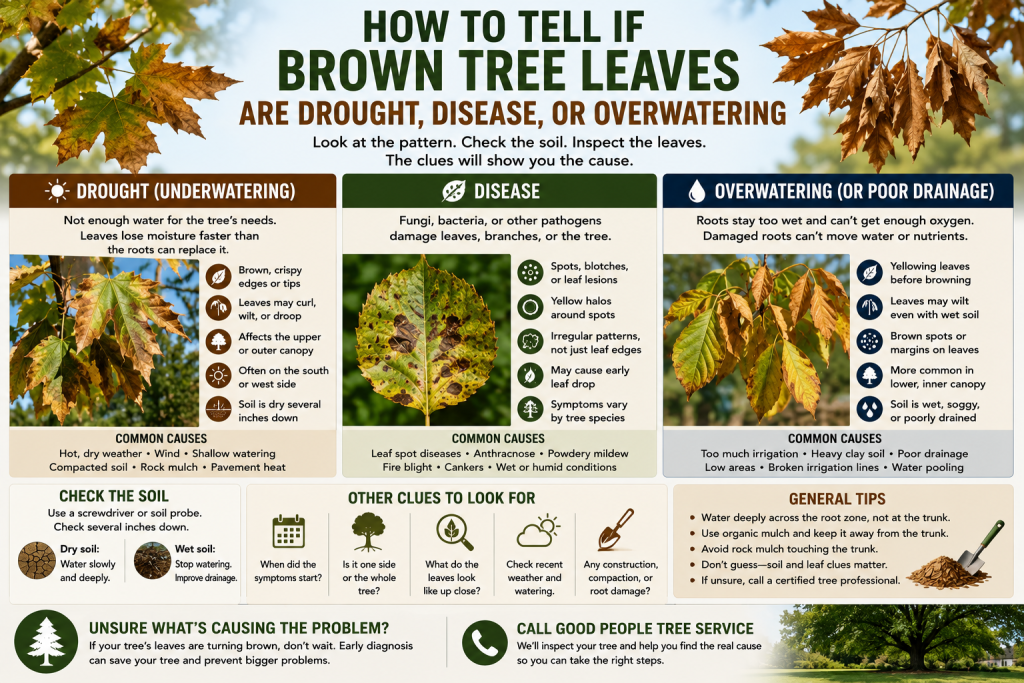
How to tell if brown tree leaves are drought, disease, or overwatering starts with the pattern. Brown leaves can look similar from a distance, but the cause often leaves clues in timing, soil moisture, leaf shape, canopy location, and overall tree condition.
Colorado homeowners often notice browning during summer. A maple gets crispy leaf edges in July. An ash thins from the top. A linden drops yellow leaves early. An aspen develops brown spots. A newly planted tree wilts even though the sprinkler runs. A tree in clay soil looks stressed after extra watering.
The hard part is that brown leaves do not point to one cause. Drought can brown leaf edges. Disease can create spots, blotches, or branch dieback. Overwatering can damage roots and cause leaves to yellow, wilt, scorch, or drop. Root damage, compacted soil, rock mulch, heat, pests, and construction can make the diagnosis even more confusing.
The right first step is not guessing. It is observation. Look at where the browning appears. Check whether the soil is dry, soggy, compacted, or uneven. Notice whether leaves have spots, curled edges, crispy margins, yellowing, or premature drop. Compare the tree with nearby trees of the same species.
Learning how to tell if brown tree leaves are drought, disease, or overwatering helps homeowners avoid the two most common mistakes: watering a tree that already has wet roots or treating a disease when the real issue is drought stress.
If your Colorado tree has brown leaves, thinning canopy, leaf spots, dead branch tips, or sudden summer decline, Good People Tree Service can inspect it and help determine whether watering, disease, roots, pests, or structure are part of the problem.
How to tell if brown tree leaves are drought, disease, or overwatering
How to tell if brown tree leaves are drought, disease, or overwatering begins with four questions.
Where are the brown leaves?
When did they appear?
What does the soil feel like?
What do the leaves look like up close?
Drought stress often appears during hot, dry weather and may show as crispy edges, curling leaves, wilting, early fall color, thinning canopy, or browning on exposed parts of the tree.
Disease often creates spots, blotches, discoloration patterns, dead patches, cankers, twig dieback, or symptoms that follow a specific host tree, such as aspen, crabapple, apple, ash, elm, or maple.
Overwatering often starts in the root zone. Leaves may yellow, wilt, brown, or drop because roots cannot get enough oxygen or have started to decline. The confusing part is that an overwatered tree can still look dry from above because damaged roots cannot move water properly.
A homeowner needs to check the tree and the soil together. Brown leaves alone do not give enough information.
Drought usually shows up as scorch, curl, or crispy edges
Drought stress often appears as leaf scorch. The edges or tips of leaves turn brown first. The brown areas may feel dry, thin, and crispy. Leaves may curl inward or droop during hot afternoons.
This happens because the tree cannot move enough water from roots to leaves to replace what the leaves lose through heat, sun, wind, and low humidity. Colorado’s dry air can make this happen quickly during summer.
Drought symptoms often appear on the upper canopy, outer canopy, south or west side, or parts of the tree exposed to pavement, rock mulch, wind, or reflected heat.
A drought-stressed tree may also drop leaves early to reduce water demand. Some trees turn yellow or show early fall color before the season normally changes.
Drought does not always mean the homeowner never watered. It may mean water did not reach the right roots.
Overwatering can look like underwatering
Overwatering confuses homeowners because the canopy can still look wilted, yellow, or brown. The tree may appear thirsty even though the soil is too wet.
Roots need oxygen. When soil stays saturated, especially in heavy Colorado clay, roots can struggle to breathe. Damaged roots cannot move water well. Then leaves may brown, wilt, yellow, drop, or scorch.
This is why adding more water without checking soil can make the problem worse.
Overwatering often appears in low areas, heavy clay soil, poorly drained beds, areas near downspouts, places with broken irrigation lines, or newly planted trees that receive frequent water but cannot drain well.
A soggy root zone plus brown leaves points away from simple drought. It suggests drainage, oxygen, root rot, planting depth, or soil structure problems.
Disease often creates spots, blotches, or uneven patterns
Leaf diseases often look different from drought or overwatering when you inspect the leaves closely.
Disease may create round spots, irregular blotches, dark margins, yellow halos, black dots, browning between veins, or patches that spread across leaves. Some diseases cause early leaf drop. Others create twig dieback, cankers, or branch decline.
Aspen and poplar leaf spots, anthracnose on shade trees, fire blight on certain fruit and ornamental trees, needle diseases on evergreens, and other Colorado tree problems can all create brown or dead tissue.
Disease patterns often vary by tree species. A problem on aspen may not mean the same thing as a problem on crabapple or spruce.
Disease also depends on moisture, weather, host tree, and timing. Some leaf diseases follow wet spring weather. Others become more visible later in summer.
Check the soil before making any decision
Soil moisture tells you more than leaf color alone.
Use a screwdriver, soil probe, or small trowel. Check several inches down in multiple spots under the canopy and near the dripline. Do not check only at the trunk. Absorbing roots often grow away from the base.
Dry soil several inches down suggests the tree may need slow, deep watering. Soggy soil suggests overwatering, drainage issues, compacted soil, or low oxygen. Moist but compacted soil may still limit root function.
Check several areas because Colorado yards rarely hold moisture evenly. One side may sit near pavement and dry quickly. Another side may receive runoff from a roof. A rock bed may hide dry soil. A clay pocket may stay wet long after watering.
This simple step prevents bad decisions.
Look at the whole canopy
The location of browning matters.
Drought often affects the top, outer edges, or most exposed side of the canopy. Leaves may scorch on the side facing afternoon sun, wind, pavement, or reflected heat.
Overwatering or excess soil moisture may show more yellowing, thinning, or discoloration from lower and inner canopy areas, especially when roots sit in wet soil. However, symptoms can overlap when root damage becomes severe.
Disease may appear in scattered patches, on specific branches, on leaves with distinct spots, or in areas where airflow stays poor. Some diseases affect new growth. Others affect older leaves.
Do not diagnose from one leaf on the ground. Look for repeated patterns across the tree.
Drought clues in Colorado yards
Colorado drought stress often comes from several factors at once.
A tree may not receive enough deep water. Lawn sprinklers may water grass but miss tree roots. Rock mulch may increase heat. Pavement may reflect sun. Clay soil may resist water when dry. Wind may dry leaves faster. Construction may have damaged roots.
Common drought clues include:
- brown leaf edges
- crispy tips
- curled leaves
- wilting during hot afternoons
- early leaf drop
- smaller leaves
- thinning canopy
- dead branch tips
- dry soil several inches down
- stress on the south or west side
- stress near pavement or rock mulch
Drought stress may improve with better watering and mulch if the tree still has healthy roots and enough living canopy.
Overwatering clues in Colorado yards
Overwatering often happens when homeowners respond to brown leaves by adding more water without checking the soil.
Common overwatering clues include:
- soggy soil
- standing water
- sour or swampy soil smell
- yellow leaves
- soft new growth
- leaf drop despite wet soil
- mushrooms or fungal growth near the base
- poor drainage
- heavy clay soil
- frequent irrigation
- water pooling near the trunk
- decline after a sprinkler repair or irrigation change
A newly planted tree can also suffer if the root ball stays too wet or if the surrounding clay drains poorly.
The solution is not simply “stop watering forever.” The solution is to restore a healthy moisture balance and address drainage or planting issues.
Disease clues on brown tree leaves
Disease clues often appear on the leaves themselves.
Look for spots, rings, blotches, lesions, dark fruiting bodies, powdery growth, blackened shoots, cankers, sudden branch dieback, or a pattern that follows certain branches.
Disease may affect one species more than another. If every aspen in the neighborhood has leaf spots after wet weather, the pattern may point toward a common leaf disease. If one tree alone has severe decline, the problem may involve roots, pests, or structure.
Leaf spot diseases often reduce appearance more than they threaten a large mature tree, but repeated defoliation or disease on a stressed tree can matter more.
Diseased branches, cankers, and systemic problems need closer attention than a few spotted leaves.
Leaf scorch does not always mean drought
Leaf scorch is one of the most misunderstood symptoms.
A scorched leaf has brown tissue along the edges, tips, or between veins. Many homeowners assume scorch always means underwatering. It often does, but not always.
Scorch means the leaf did not receive enough usable water. The cause could be dry soil, root damage, construction injury, compacted soil, overwatering, trunk injury, branch infection, fertilizer stress, or restricted roots near pavement.
That is why the soil and site matter. If scorched leaves appear above dry soil, drought may be the main cause. If scorched leaves appear above soggy soil, damaged roots or low oxygen may be the issue.
The symptom shows water movement failure. It does not automatically explain why water movement failed.
Brown spots are different from brown edges
Brown leaf edges often point toward water stress, heat stress, root issues, or scorch.
Brown spots can suggest disease, insect feeding, hail wounds, chemical injury, or localized leaf damage. Spots may appear circular, irregular, dark-rimmed, yellow-haloed, or scattered across the leaf surface.
If leaves have many individual spots but the tree otherwise looks full, disease may be more likely than drought. If leaves have crispy edges across the canopy and the soil is dry, drought may be more likely.
Still, overlap happens. A drought-stressed tree can also get leaf disease. A diseased tree can also suffer from poor watering.
Yellowing before browning can point to root problems
Leaves that yellow before browning may suggest root stress, nutrient availability issues, excess water, compacted soil, or poor drainage.
In Colorado clay soil, too much water can reduce oxygen. Poor oxygen can damage roots. Damaged roots reduce nutrient uptake. Leaves may yellow, thin, and drop.
Iron chlorosis can also appear in some Colorado soils, especially on certain tree species. Leaves may yellow while veins stay greener. That is different from simple drought scorch.
Yellowing is not a complete diagnosis, but it tells you to look below ground. Check soil moisture, drainage, compaction, root flare, mulch depth, and planting depth.
Timing helps narrow the cause
When the browning appears gives another clue.
Early summer browning after a wet spring may suggest disease on some species. Browning during a hot, dry stretch may point toward drought or heat stress. Browning after a sprinkler change may suggest watering imbalance. Browning after construction may point toward root damage. Browning after heavy irrigation may suggest overwatering or poor drainage.
Late-summer browning can reflect accumulated stress. A tree may have survived dry weeks, heat waves, and shallow watering before symptoms finally appeared.
Do not judge timing by one day. Look at the last several weeks of weather, watering, storms, irrigation changes, and site disturbance.
Newly planted trees are easy to misread
Newly planted trees often show brown leaves because their root systems are limited. They may be underwatered, overwatered, planted too deep, planted with girdling roots, or surrounded by compacted soil.
A new tree can dry out quickly even when the surrounding soil looks moist. The original root ball may behave differently from the backfill soil. Water may run around it instead of soaking through it.
The opposite can also happen. A new tree planted in clay soil may sit in a wet planting hole with poor drainage.
Check the root ball and surrounding soil separately. A newly planted tree needs consistent moisture, but not a swamp.
Mature trees can hide the real problem
Mature trees often show delayed symptoms. A large tree may have enough stored energy to look fine for a while, even after drought, root damage, or overwatering begins.
By the time brown leaves appear, the tree may have root stress, dead branch tips, pests, or canopy thinning. Mature trees near driveways, sidewalks, streets, patios, and construction zones often face extra stress.
Do not assume a large tree can “handle it.” Mature tree problems can become expensive when they involve large branches, structures, or safety risks.
A mature tree with brown leaves plus dead limbs, trunk cracks, mushrooms, or new lean needs professional inspection.
Rock mulch and pavement can make diagnosis harder
Rock mulch and pavement can both increase heat around trees. They can also hide soil moisture problems.
A tree in rock mulch may suffer drought stress because the root zone gets hot and dries quickly. It may also suffer if landscape fabric changes how water enters the soil.
Pavement can restrict roots and reflect heat. Street trees and trees near driveways often show scorch because the site limits root growth and increases water demand.
If browning appears mostly near hardscape, do not look only at the leaves. Check soil moisture, root flare, trunk wounds, compaction, and available root space.
Pests can mimic drought, disease, or watering problems
Pests can also cause brown leaves or canopy decline. Aphids may cause sticky honeydew and curled leaves. Spider mites can cause stippling, bronzing, and dull foliage. Bark beetles can brown conifers. Borers can cause branch dieback. Emerald ash borer can thin ash canopies.
Drought-stressed trees often become more vulnerable to pests, so pests and water stress can appear together.
Look for boring dust, holes, pitch, woodpecker activity, sticky residue, webbing, scale bumps, bark splits, or sudden branch dieback.
If pest signs appear with brown leaves, watering alone may not solve the problem.
What to do if drought is likely
If the soil is dry several inches down and the leaves show scorch, curling, or wilting, water slowly and deeply.
Apply water across the root zone, not just at the trunk. Use a soaker hose, soft spray wand, or slow hose flow. Let water soak in instead of running off. Water under the canopy and out toward the dripline.
Refresh organic mulch if needed. Keep mulch away from the trunk. Reduce additional stress by avoiding heavy pruning, fertilizing, or construction near the roots during hot weather.
Monitor the tree for recovery. Some scorched leaves will not turn green again, but new wilting or worsening scorch should slow if the root zone improves.
What to do if overwatering is likely
If the soil is soggy, stop adding water until the soil begins to dry. Check irrigation schedules, sprinkler leaks, drainage paths, downspouts, and low spots.
Do not fertilize a waterlogged tree. Do not pile soil around the trunk. Do not add more mulch against the base.
Improve airflow and drainage where possible. Pull mulch or rock back from the trunk if it is touching bark. Keep the root flare visible.
If the tree continues to decline despite adjusting water, call a professional. Root rot, planting depth, compacted soil, or drainage problems may need a closer look.
What to do if disease is likely
If leaves show spots, blotches, cankers, or disease-like patterns, identify the tree species and symptom pattern before treating.
Do not apply fungicide without knowing the disease and timing. Many leaf diseases do not improve with late treatment after symptoms already appear. Some diseases require sanitation, pruning, improved airflow, or preventive timing in future seasons.
Rake heavily infected leaves when appropriate. Prune dead or diseased branches using proper cuts. Avoid overhead watering if it keeps foliage wet and contributes to disease pressure.
Call a tree service if disease appears with branch dieback, cankers, structural weakness, or rapid decline.
When to call a tree service
Call a tree service if brown leaves appear with large dead branches, sudden canopy thinning, trunk cracks, mushrooms near the base, boring dust, pitch, D-shaped holes, a new lean, root damage, or branches over a home, driveway, sidewalk, or patio.
Also call if you cannot tell whether the tree is dry, diseased, or overwatered. Guessing can waste time and make the problem worse.
Good People Tree Service can inspect the tree, check visible site conditions, evaluate safety concerns, and help determine whether watering changes, pruning, monitoring, pest evaluation, or removal makes sense.
Frequently asked questions
How do I know if brown tree leaves are from drought?
Drought often causes crispy brown edges, curling leaves, afternoon wilting, early leaf drop, and dry soil several inches down. Symptoms often appear during hot, dry weather.
How do I know if brown leaves are from disease?
Disease often causes spots, blotches, lesions, cankers, blackened shoots, or uneven patterns on specific leaves or branches. Species and timing matter.
Can overwatering make leaves turn brown?
Yes. Overwatering can damage roots by reducing oxygen in the soil. Damaged roots cannot move water well, so leaves may yellow, wilt, brown, or drop.
Should I water a tree with brown leaves?
Check the soil first. If the soil is dry, water slowly and deeply. If it is soggy, more water may make the problem worse.
Will brown leaves turn green again?
Usually no. Damaged brown leaf tissue will not turn green again. The goal is to prevent new damage and support healthier growth.
Final thoughts
How to tell if brown tree leaves are drought, disease, or overwatering starts with pattern recognition. Brown edges often suggest water stress or scorch. Spots and blotches often suggest disease or leaf damage. Yellowing, wilting, and browning with soggy soil may point toward overwatering or root problems.
Colorado conditions make diagnosis harder. Dry air, intense sun, clay soil, rock mulch, pavement, storms, pests, and inconsistent watering can all create brown leaves. The best step is to check the soil, inspect the canopy, look closely at the leaves, and consider recent weather and watering changes.
Good People Tree Service helps Colorado homeowners evaluate brown leaves, drought stress, root-zone problems, disease symptoms, pest signs, and branch hazards.
If your tree has brown leaves and you are not sure why, schedule an inspection before a small symptom turns into long-term decline.