
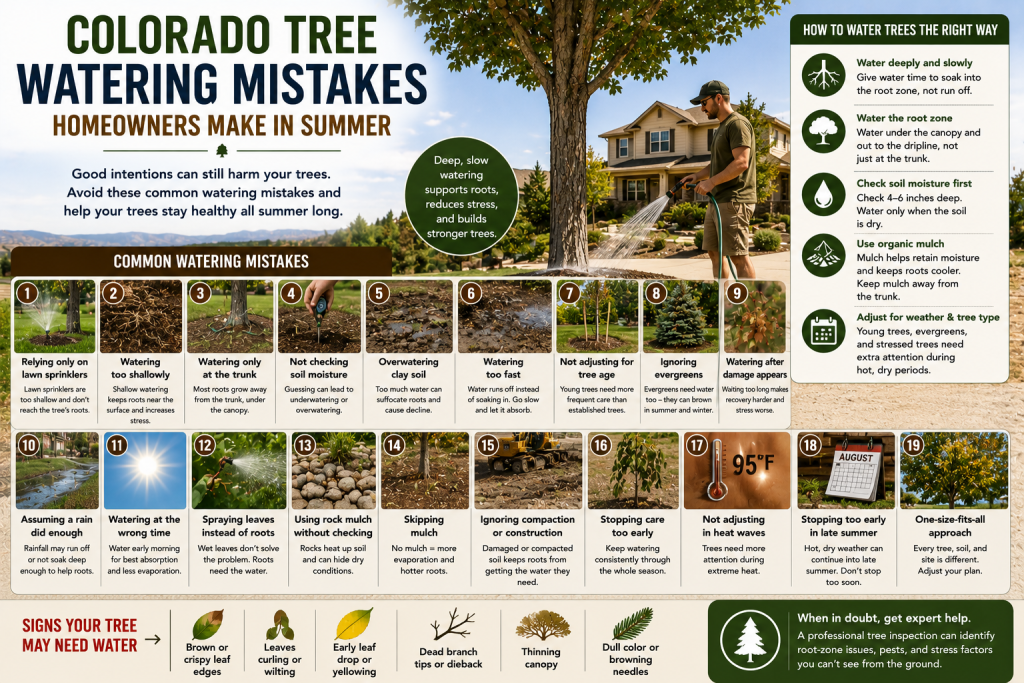
Colorado tree watering mistakes homeowners make in summer often start with good intentions. A homeowner sees hot weather, dry soil, or brown leaf edges and wants to help the tree quickly. They turn on the sprinklers longer, spray the trunk, water every day for a week, or assume a green lawn means the tree has enough moisture. Sometimes those choices help a little. Other times, they miss the real root-zone problem.
Colorado summers create a difficult environment for trees. Hot afternoons, dry air, strong sun, wind, clay soil, drought cycles, rock mulch, compacted yards, and reflected heat from pavement all increase water stress. A tree must move enough water from roots to leaves to keep up with summer demand. When watering does not reach the right area, the tree can still scorch, wilt, drop leaves, or thin out.
The problem is not always a lack of water. Some trees suffer because they get too much water in heavy clay soil. Others decline because water never reaches the absorbing roots. Many mature trees struggle because lawn sprinklers only wet the surface. Young trees can fail because the original root ball dries faster than the surrounding soil.
Understanding Colorado tree watering mistakes homeowners make in summer helps protect trees before stress turns into dead branches, pest problems, or removal risk.
If a tree in your yard shows leaf scorch, thinning canopy, curling leaves, dead tips, or sudden summer decline, Good People Tree Service can inspect it and help determine whether watering, roots, pests, or structure are part of the problem.
Colorado tree watering mistakes homeowners make in summer
Colorado tree watering mistakes homeowners make in summer usually come from one assumption: if water touches the yard, the tree must be getting what it needs.
Trees do not work that way. Roots spread widely. Soil absorbs water unevenly. Grass competes for moisture. Rock beds heat up. Clay soil may repel water when dry and hold too much water when saturated. A large tree may need moisture far beyond the area a sprinkler reaches.
Good summer watering depends on the tree’s age, species, soil, location, mulch, weather, and root health. A young tree near a south-facing wall needs different care than a mature cottonwood in a wide lawn. An evergreen in rock mulch needs different attention than a deciduous shade tree in an organic mulch ring.
The best approach starts with checking soil moisture and watering the root zone slowly, broadly, and deeply.
Mistake 1: Assuming lawn sprinklers are enough
A green lawn does not prove the tree has enough water. This is one of the most common watering mistakes in Colorado yards.
Lawn sprinklers often run short cycles. They keep turf alive near the surface. Grass roots use water quickly, especially during hot weather. Mature tree roots need a wider and deeper moisture pattern.
A tree can show brown leaf edges while the lawn still looks fine. The homeowner may think the tree has disease, pests, or heat damage, but the real issue may be shallow watering.
Trees in irrigated lawns may do well when the entire root area receives adequate moisture. The problem starts when the sprinkler pattern misses the tree, runs too briefly, or only supports the grass.
Check the soil under the canopy and near the dripline. If it feels dry several inches down, the tree may need separate deep watering.
Mistake 2: Watering too shallowly
Frequent shallow watering encourages surface moisture but does little for deeper root-zone support. It may also create a false sense of security.
A quick spray from a hose can wet the top layer of soil without reaching the roots that need water most. In Colorado heat, that shallow moisture may evaporate quickly. The tree still faces stress during the hottest part of the day.
Deep watering works better. It allows moisture to soak into the root zone slowly. A soaker hose, drip line, deep root fork, or soft spray wand can help water penetrate instead of running off.
The goal is not to flood the tree. The goal is to water slowly enough that the soil absorbs moisture where roots can use it.
Mistake 3: Watering only near the trunk
Many homeowners place a hose at the base of the trunk and walk away. That may help a newly planted tree in some situations, but it does not support most established trees well.
Absorbing roots usually grow away from the trunk. Many fine roots sit under the canopy and near or beyond the dripline. Watering only at the trunk misses much of the active root system.
Too much water at the base can also keep bark and the root flare too wet. That can hide problems and create unhealthy conditions around the trunk.
Water the soil broadly under the canopy instead. Move the hose or use a soaker system that covers a wider root zone.
Mistake 4: Not checking soil before watering
Guessing causes many watering problems. Leaves may turn brown from drought, but they can also brown from root damage, overwatering, compacted soil, pests, disease, or heat reflected from hardscape.
Before adding water, check the soil. Use a screwdriver, soil probe, or small trowel. Test several inches down in multiple spots under the canopy.
If the soil feels dry, water slowly. If the soil feels soggy, pause and look for drainage or root problems. If the soil feels hard and dry, water may need more time to soak in.
A simple soil check can prevent both under-watering and overwatering. It also helps homeowners understand how different parts of the yard behave.
Mistake 5: Overwatering heavy clay soil
Many Colorado yards contain clay or clay-like soil. Clay can hold water well, but it can also create oxygen problems when saturated.
Roots need water and air. When clay soil stays too wet, roots may struggle to breathe. The tree may show yellow leaves, leaf drop, weak growth, or canopy decline even though the ground contains plenty of water.
This confuses homeowners. They see stress and add more water. The root zone becomes wetter, and the tree gets worse.
Watering clay soil requires patience. Apply water slowly. Let it soak in. Check moisture before watering again. Avoid daily soaking unless the tree is newly planted and the soil check shows it needs moisture.
Mistake 6: Watering too fast on dry soil
Dry Colorado soil can resist water. Hard clay, compacted ground, slopes, and rock beds often cause runoff. Water may move across the surface instead of soaking down.
A homeowner may run a hose for 20 minutes and assume the tree received enough water. In reality, much of the water may flow into the street, down the slope, or away from the root zone.
Slow watering solves more problems than fast watering. Use a low-flow hose, soaker hose, or soft spray. Move the water around the tree. Give the soil time to absorb moisture.
If runoff starts, stop for a short period and resume after water soaks in.
Mistake 7: Treating all trees the same
A young tree and a mature tree do not need the same watering strategy.
Newly planted trees have limited root systems. Their roots may still sit close to the original planting hole. They need careful, consistent moisture while they establish.
Mature trees need less frequent watering, but they need a wider watering area. A mature shade tree can have roots extending far beyond the trunk. A small trickle near the base does not support the full tree.
Evergreens also need special attention because they keep needles year-round and can enter winter stressed if summer and fall soil moisture stay low.
Tree age, species, exposure, and location should shape the watering plan.
Mistake 8: Forgetting newly planted trees after the first few weeks
Many homeowners water a new tree carefully for the first few weeks, then assume it has settled in. That can be risky in Colorado.
New trees can take years to establish. Their root systems remain smaller than the canopy demands. During hot, dry summer weather, the original root ball can dry out faster than surrounding soil.
A newly planted tree may need regular checks through the entire growing season. This is especially true for trees in windy areas, rock mulch, south-facing yards, or compacted soil.
Watch for wilting, curling leaves, browning edges, early leaf drop, or slow growth. Those signs may mean the tree needs better root-zone moisture or a planting inspection.
Mistake 9: Ignoring mature tree drought stress
Mature trees can look strong for years and still suffer during dry summers. Their size can make homeowners assume they no longer need care.
A large tree uses a lot of water during hot weather. If the root zone dries out, the tree may show leaf scorch, smaller leaves, thinning canopy, branch tip dieback, or early fall color.
Mature tree stress can build slowly. A tree may survive one dry summer but decline after several years of inconsistent watering.
Homeowners should monitor older shade trees during hot, dry stretches. Deep watering during prolonged dry periods can help protect root health and canopy strength.
Mistake 10: Forgetting evergreens in summer
Evergreens need summer moisture too. Pines, spruce, firs, and other conifers can show drought stress as dull color, browning needles, thinning sections, or branch dieback.
Homeowners sometimes focus on leafy trees because scorch looks obvious. Evergreen stress may build quietly until large sections turn brown.
Conifers in Colorado can also become more vulnerable to bark beetles and other pests when drought weakens them. Summer watering can support vigor, especially during extended dry periods.
Evergreens near rock mulch, pavement, walls, slopes, or windy exposures need careful soil checks.
Mistake 11: Watering after visible damage only
Waiting until leaves are already crispy gives the tree fewer options. Brown leaf edges, curling leaves, wilting, and early leaf drop often mean the tree has already experienced stress.
Watering still matters at that point, but prevention works better than rescue. A tree that receives slow, deep water before severe stress develops can maintain healthier roots and foliage.
Homeowners should watch weather patterns, not just symptoms. Long stretches of heat, wind, low humidity, and little rain should trigger soil checks.
The best watering plan responds before the canopy looks damaged.
Mistake 12: Assuming a summer storm watered the tree enough
Colorado summer storms can be dramatic. Heavy rain, hail, and wind may pass through quickly. The yard looks wet, and homeowners may skip watering for days.
Sometimes that makes sense. Other times, fast stormwater runs off compacted soil, slopes, clay, rock beds, driveways, or dry ground. The soil surface may look wet while the deeper root zone remains dry.
After a storm, check soil moisture several inches down. Do not rely only on how wet the mulch, lawn, or driveway looks.
Storms can also damage branches and roots. A storm-damaged tree may need inspection in addition to water.
Mistake 13: Watering at the wrong time of day
Watering during the hottest part of the day can waste more water to evaporation, especially in Colorado’s dry air. It may also make homeowners use more water than needed because the soil surface dries quickly.
Early morning often works better because temperatures are cooler, wind may be calmer, and water has time to soak into the soil. Evening watering can work in some cases, but wet foliage overnight may create issues for certain plants.
For trees, the most important factor is not wetting leaves. It is getting water into the root zone. Use slow soil watering rather than spraying the canopy.
Mistake 14: Spraying the leaves instead of watering the roots
A stressed tree needs root-zone moisture, not a shower.
Spraying leaves may cool the canopy briefly, but it does not solve dry soil. Water must reach the roots for the tree to use it. In hot, dry weather, water on leaves may evaporate quickly.
Focus on the ground under and around the canopy. Keep water low and slow. Avoid blasting soil away from roots or soaking the trunk.
Leaves tell you when the tree struggles. Roots decide whether the tree recovers.
Mistake 15: Using rock mulch without checking moisture
Rock mulch is common in Colorado yards. It can look clean and low-maintenance, but it can also increase heat around trees and hide dry soil.
A tree in a rock bed may face hotter surface temperatures, reflected heat, and uneven water movement. Landscape fabric under rock can make the root zone harder to monitor.
Homeowners may assume rock reduces water needs. Around trees, it may do the opposite in hot sites.
If a tree in rock mulch shows scorch, thinning, or dead tips, pull back a small area carefully and check the soil. Consider whether an organic mulch ring would support the tree better.
Mistake 16: Skipping organic mulch
Organic mulch helps tree watering work better. It reduces evaporation, moderates soil temperature, protects shallow roots, and reduces grass competition.
Wood chips, bark, pine needles, leaf mulch, and arborist chips can all help when used correctly. Spread mulch wide and flat. Keep it away from the trunk so the root flare remains visible.
Skipping mulch exposes soil to more heat and drying. Piling mulch against the trunk creates a different problem. A mulch volcano can trap moisture against bark and hide decay or pests.
The right mulch helps the root zone stay healthier through summer.
Mistake 17: Ignoring compaction and construction damage
A tree may receive water but still struggle if roots cannot function well. Compacted soil limits oxygen and water movement. Construction can cut roots, change grade, or damage soil structure.
A homeowner may respond by watering more. That may not solve the problem if roots cannot absorb water efficiently.
Watch trees near driveways, patios, sidewalks, utility trenches, fences, and recent landscaping projects. Summer heat often reveals root damage that happened earlier.
Water helps, but root-zone protection and professional inspection may matter more.
Mistake 18: Not adjusting during heat waves
A normal watering routine may not work during a Colorado heat wave. Hot weather, wind, and low humidity increase water loss from leaves and soil.
Homeowners should check soil more often during prolonged heat. Young trees, evergreens, and stressed trees may need extra attention. Mature trees may need deeper soaking if dry weather continues.
Adjust based on soil moisture, not panic. More heat does not always mean daily watering. It means the root zone needs closer monitoring.
Mistake 19: Stopping too early in late summer
Some homeowners reduce watering as soon as the calendar moves toward late summer. But August and September can still bring hot, dry conditions in Colorado.
Stopping too early can leave trees stressed before fall. A dry late summer can also set up winter injury, evergreen browning, and spring dieback.
Keep checking soil through late summer and into fall. Continue watering during dry periods until cooler weather and soil moisture reduce the need.
What homeowners should do instead
Good summer tree watering starts with observation.
Check the soil several inches down. Water slowly and deeply when the root zone is dry. Water broadly under the canopy and toward the dripline. Use organic mulch to conserve moisture. Keep mulch away from the trunk. Adjust for tree age, soil type, weather, and site exposure.
Watch for signs of stress, including leaf scorch, wilting, curling leaves, early leaf drop, thinning canopy, dead branch tips, dull evergreen color, and browning needles.
Call a tree service if watering does not improve the tree, if large branches die back, or if pests, cracks, decay, or leaning appear.
Frequently asked questions
How often should I water trees in Colorado summer?
Water based on soil moisture, tree age, weather, and soil type. Check several inches down. If the soil is dry, water slowly and deeply across the root zone.
Is lawn watering enough for trees?
Sometimes, but not always. Lawn sprinklers may only water shallow turf roots. Mature trees often need deeper, wider watering during dry summer periods.
Can I overwater trees in Colorado?
Yes. Overwatering can reduce oxygen around roots, especially in clay soil. Check soil moisture before watering again.
Should I water the trunk of the tree?
No. Water the root zone, not the trunk. Most absorbing roots grow away from the trunk under and beyond the canopy.
Why are my tree leaves turning brown even though I water?
Water may not be reaching the roots. The tree may also have root damage, compacted soil, pests, disease, heat stress, or overwatering problems.
Final thoughts
Colorado tree watering mistakes homeowners make in summer usually come from watering too shallowly, watering the wrong area, ignoring soil moisture, relying only on lawn sprinklers, overwatering clay soil, or stopping too early during dry weather.
Colorado trees need thoughtful watering because summer conditions can be harsh. Dry air, intense sun, wind, compacted soil, rock mulch, pavement heat, and drought cycles all increase stress. A tree may need deep moisture across the root zone, not quick sprays or daily surface watering.
Good People Tree Service helps Colorado homeowners evaluate summer tree stress, root-zone problems, dead branches, pest symptoms, and decline risks.
If your tree looks scorched, thin, dry, or unhealthy during summer, schedule an inspection before watering mistakes turn into long-term damage.