
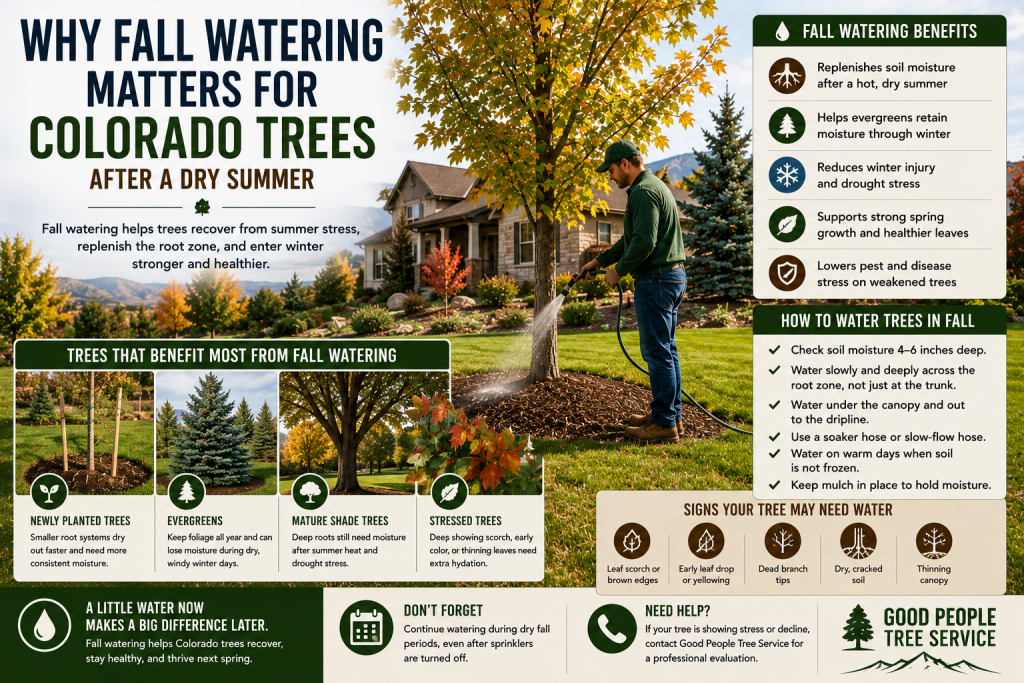
Why fall watering matters for Colorado trees after a dry summer is easy to overlook because the hottest part of the year has already passed. Homeowners often stop worrying about trees once temperatures cool, leaves begin to change, and sprinkler systems shut down. But a dry Colorado summer can leave trees with depleted soil moisture, stressed roots, scorched leaves, and fewer reserves going into winter.
Fall watering gives trees a chance to recover before the ground freezes. It helps refill the root zone after months of heat, wind, low humidity, and drought stress. It also supports evergreens, newly planted trees, and mature shade trees that may have used more water than the landscape received during summer.
Colorado’s fall weather can look forgiving. Afternoons may feel mild. Leaves may look seasonal. Lawns may need less water. But tree roots still matter. Many roots continue functioning while soil temperatures remain warm enough. If the soil stays dry, a tree can enter winter already behind.
Learning why fall watering matters for Colorado trees after a dry summer helps homeowners reduce winter injury, spring dieback, pest pressure, and long-term decline.
If a tree in your yard looks scorched, thin, brittle, or drought-stressed after summer, Good People Tree Service can inspect it and help determine whether watering, pruning, monitoring, or removal makes sense.
Why fall watering matters for Colorado trees after a dry summer
Why fall watering matters for Colorado trees after a dry summer comes down to root health. Leaves may get most of the attention, but roots decide whether the tree enters winter with enough moisture and strength.
During a dry summer, trees lose water through leaves every day. Hot afternoons, dry wind, reflected heat from pavement, and compacted soil all increase demand. If irrigation or rainfall does not replace enough moisture, the tree begins to draw down reserves.
By fall, the tree may still be alive and standing, but the root zone may remain dry. That dry soil can damage fine absorbing roots. These small roots collect much of the water and nutrients the tree needs. When they decline, the tree has a harder time recovering next spring.
Fall watering helps replenish the soil before winter. It does not erase every summer problem, but it gives the tree a better starting point before cold, wind, and dry winter air arrive.
Trees still need moisture after summer ends
A tree does not stop using water the moment August ends. Deciduous trees slow down as fall progresses, but they still need moisture while leaves remain active and soil temperatures allow root activity.
Evergreens need even more attention because they keep needles through winter. Pines, spruce, firs, and other conifers can lose moisture during dry winter days. If an evergreen enters winter dry, browning may appear later, often in late winter or spring.
This delayed damage confuses homeowners. They may think the tree suddenly declined in spring, when the stress actually started during a dry summer and continued through a dry fall.
Fall watering helps close that gap.
Dry summer stress can show up later
Tree stress often works slowly. A tree may survive a dry summer but show the consequences months later.
Homeowners may notice more dead branch tips in spring. Evergreens may brown on exposed sides. Leaves may emerge smaller than normal. A canopy may look thinner the following year. Pests may attack a weakened tree that no longer has strong defenses.
This is why fall watering matters for Colorado trees after a dry summer. It helps reduce the carryover effect. A tree with better fall soil moisture has a stronger chance of protecting roots, maintaining branch tissue, and handling winter weather.
A dry summer is not always fatal. But repeated dry summers without fall recovery can push a tree into long-term decline.
Colorado fall weather can stay dry
Colorado does not always receive enough fall moisture to refill the soil. Some years bring rain or early snow. Other years bring warm afternoons, dry wind, and long stretches without meaningful precipitation.
Even when a storm passes through, it may not soak the full tree root zone. Light rain can wet the surface while deeper soil stays dry. Hail or quick downpours may create runoff instead of slow absorption, especially in compacted clay soil.
Homeowners should not assume fall weather has done the watering for them. Soil moisture matters more than the calendar.
Check the soil several inches down before deciding whether a tree needs water.
Lawn sprinklers are not enough for many trees
Many Colorado homeowners rely on lawn irrigation during summer. That can help, but it does not always meet tree needs.
Turf roots use water near the surface. Sprinklers often run short cycles. Mature tree roots spread much farther than the lawn zone homeowners usually water. A large tree may need slow moisture across a wide area under and beyond the canopy.
Once the sprinkler system shuts off, the gap becomes larger. The grass may go dormant or need less water, but the tree may still need deeper soil moisture before winter.
Fall watering should target the root zone, not just the trunk. Water broadly, slowly, and deeply.
How to check whether your tree needs fall watering
Start with a soil test you can do by hand.
Use a screwdriver, soil probe, or small trowel. Check several inches down in multiple spots under the canopy and near the dripline. The dripline is the outer edge of the canopy, but roots often extend beyond it.
If the soil feels dry several inches down, the tree may need water. If the tool cannot easily enter the soil, the area may be too dry or compacted. If the soil feels soggy, watering may not help and drainage may be the bigger issue.
Check more than one spot. Colorado yards often have uneven soil moisture because of slopes, clay, rock mulch, downspouts, pavement, and irrigation patterns.
Water deeply, not quickly
Fall watering works best when water soaks slowly into the root zone. A fast blast from a hose may run off, especially on slopes or hard clay soil.
Use a soaker hose, drip system, soft spray wand, or slow hose flow. Move the water around the tree instead of soaking one small spot. Water under the canopy and outward toward the dripline.
Avoid placing water only against the trunk. Most absorbing roots grow away from the trunk. Too much water at the base can also keep bark and the root flare too wet.
The goal is slow moisture spread across the root zone.
Young trees need special fall attention
Newly planted trees need more consistent fall watering than established trees. Their root systems remain limited for several years. A hot, dry summer can dry the original root ball faster than surrounding soil.
Young trees in rock mulch, windy sites, south-facing yards, or compacted soil need close monitoring. They may look healthy in spring but struggle by late summer because their roots have not spread far enough.
Fall watering helps young trees enter winter with better moisture. It also lowers the chance of winter drying and spring failure.
Do not assume a new tree is established after one season. Many young tree problems appear in the first one to three years.
Mature trees need a wider watering area
Mature trees often need less frequent watering than young trees, but they need a much wider watering area.
A large shade tree may have roots extending under lawn, sidewalks, planting beds, and beyond the canopy. A small trickle at the trunk does little for the full root system.
During fall, focus on deep soaking across the broader root zone. This helps fine roots recover after dry summer conditions.
Mature trees that show leaf scorch, thinning canopy, early leaf drop, or branch tip dieback after summer should receive extra attention. Those signs can mean the tree enters fall stressed.
Evergreens can suffer winter drying
Evergreens deserve their own fall watering plan. They keep needles all year, so they can lose water during sunny, windy winter weather. Frozen or dry soil can limit replacement moisture.
Colorado evergreens often brown after winter when they entered cold weather already dry. The damage may appear on the south or west side, the windward side, or branch tips.
Fall watering helps pines, spruce, firs, arborvitae, and other evergreens before soil freezes. This matters especially for newly planted evergreens and trees near pavement, rock mulch, or exposed slopes.
If an evergreen already looks dull or thin in late summer, inspect it before assuming water alone will solve the problem. Pests, mites, root issues, and disease can also cause browning.
Dry soil makes winter injury worse
Winter injury does not only come from cold. Dry soil can make cold weather more damaging because roots and branches start the season with less moisture.
Trees in dry soil can suffer root injury during freeze-thaw cycles. Young roots may die back. Branches may dry out. Thin-barked trees may become more vulnerable to sunscald and frost cracks when overall stress is high.
Fall watering cannot prevent every winter problem, but it reduces one major stress factor. Moist soil also changes temperature more slowly than dry soil, which can help buffer roots during cold swings.
Fall watering supports spring growth
Spring growth depends partly on what happened the previous season. A tree that enters winter stressed may leaf out slowly, produce smaller leaves, or drop branches the next year.
Fall watering helps the tree maintain root health and stored energy. It gives the tree a better chance to wake up with stronger buds, healthier fine roots, and more stable branch tissue.
This matters for shade trees that already showed drought stress. It also matters for fruit trees, ornamentals, and evergreens that need healthy roots before the next growing season.
A strong spring often starts with good fall soil moisture.
Watering helps reduce pest pressure
Drought-stressed trees often become more vulnerable to pests. Bark beetles, borers, mites, aphids, and scale insects may take advantage of weak trees.
Conifers use resin as part of their defense against bark beetles. Drought can reduce that defense. Deciduous trees with weak roots and low vigor may also struggle to tolerate insects or disease.
Fall watering does not replace pest treatment when pests are already active. It does support tree vigor, which helps trees resist or recover from some pest pressure.
If you see boring dust, bark holes, pitch, woodpecker activity, sticky residue, or sudden thinning, call a tree service before assuming water is enough.
Mulch makes fall watering work better
Organic mulch helps hold soil moisture, reduce evaporation, moderate temperature swings, and protect shallow roots. It also reduces grass competition near the trunk.
Use a flat layer of wood chips, bark, pine needles, leaf mulch, or arborist chips. Keep the mulch away from the trunk so the root flare remains visible.
A mulch volcano can trap moisture against bark and hide decay. A wide, flat mulch ring works much better.
Fall is a good time to refresh thin mulch before winter. Mulch plus deep watering gives trees a stronger root-zone environment after a dry summer.
Rock mulch can hide dry roots
Rock mulch can make a yard look clean, but it can also increase heat during summer and hide dry soil in fall. A tree may look surrounded by a finished landscape while the root zone below remains dry.
Landscape fabric under rock can also complicate water movement and soil health. Water may not soak evenly into the root zone, and organic matter does not build naturally.
If a tree in rock mulch shows scorch, thinning, exposed roots, or poor growth, check the soil carefully. An organic mulch ring around the tree may help support root health better than hot rock directly over the root zone.
Do not overwater clay soil
Fall watering matters, but more water is not always better. Many Colorado yards have clay soil. Clay absorbs water slowly and can stay wet for a long time once saturated.
Overwatering can reduce oxygen around roots. Roots need both moisture and air. A tree in soggy clay may show yellowing, leaf drop, or decline even though the soil has plenty of water.
This is why soil checking matters. Water dry soil. Pause when soil stays moist. Adjust for slope, drainage, rainfall, soil type, and tree species.
Deep watering should mean thoughtful watering, not constant watering.
Keep watering after sprinklers shut off
Many homeowners winterize irrigation systems before trees stop needing water. That creates a dry window in fall, especially if warm weather continues.
After sprinkler shutdown, use a hose, soaker hose, watering wand, or buckets where practical. Water on warmer days when soil can absorb moisture. Avoid watering frozen ground.
This habit matters most for young trees, evergreens, trees in exposed sites, and trees that showed drought stress during summer.
A few fall waterings during dry periods can make a major difference before winter.
Case example: the dry maple after summer
A Colorado homeowner notices a maple with brown leaf edges in August. By September, some leaves drop early. The sprinkler system kept the lawn green, but a screwdriver barely enters the soil under the canopy.
This tree likely needs fall watering. The lawn irrigation did not provide enough deep moisture for the broader root zone. Without fall recovery, the maple may show more dieback next spring.
The homeowner should water slowly across the root zone, refresh organic mulch, and watch for dead branch tips or pest signs.
Case example: the evergreen near rock mulch
A spruce grows near a south-facing wall with rock mulch around the base. It looks dull by late summer. Some needles brown at the tips.
This tree faces heat, reflected sun, dry air, and a hot root zone. Fall watering may help, but the homeowner should also check soil moisture, inspect for mites or beetles, and consider replacing some rock near the tree with organic mulch.
Evergreens in hot, dry sites need fall moisture before winter winds arrive.
When fall watering is not enough
Fall watering helps many trees, but it cannot fix every problem. A tree with severe root damage, trunk decay, major storm cracks, bark beetle infestation, advanced emerald ash borer symptoms, or large dead limbs may need professional care.
Watering a hazardous tree does not make it safe. It may support living tissue, but it will not repair structural defects.
Call a tree service if you see large dead branches, sudden canopy thinning, trunk cracks, mushrooms near the base, a new lean, boring dust, pitch tubes, D-shaped holes, or branches over a roof, driveway, sidewalk, or patio.
Frequently asked questions
Should I water Colorado trees in the fall?
Yes, water Colorado trees in fall when the soil is dry. Fall watering matters most after a dry summer, during warm dry autumn weather, and before the ground freezes.
How often should I water trees in fall?
Water based on soil moisture, not a fixed schedule. Check several inches down. If the soil is dry, water slowly and deeply across the root zone.
Should I water evergreens in fall?
Yes. Evergreens keep needles through winter and can lose moisture during dry, windy weather. Fall watering helps them enter winter with better moisture.
Can I water after my sprinkler system is shut off?
Yes. Use a hose, soaker hose, watering wand, or slow hand watering when the soil is not frozen and the weather allows absorption.
Can too much fall watering hurt a tree?
Yes. Overwatering can reduce oxygen around roots, especially in clay soil. Always check soil moisture before watering.
Final thoughts
Why fall watering matters for Colorado trees after a dry summer comes down to recovery. Trees often enter fall with dry soil, stressed roots, scorched leaves, and reduced reserves. Cooler weather does not automatically solve those problems.
Fall watering helps replenish the root zone before winter. It supports fine roots, strengthens evergreens, reduces drought carryover, and gives trees a better chance of healthy spring growth.
Check the soil before watering. Water slowly and broadly. Focus on young trees, evergreens, and trees that showed summer stress. Use organic mulch to conserve moisture, but keep mulch away from the trunk. Avoid overwatering heavy clay soil.
Good People Tree Service helps Colorado homeowners evaluate drought-stressed trees, identify visible pest or structural problems, and decide whether watering, pruning, monitoring, or removal is the right next step.
If your tree looks scorched, thin, dry, or weak after a hot Colorado summer, schedule an inspection before winter adds more stress.