
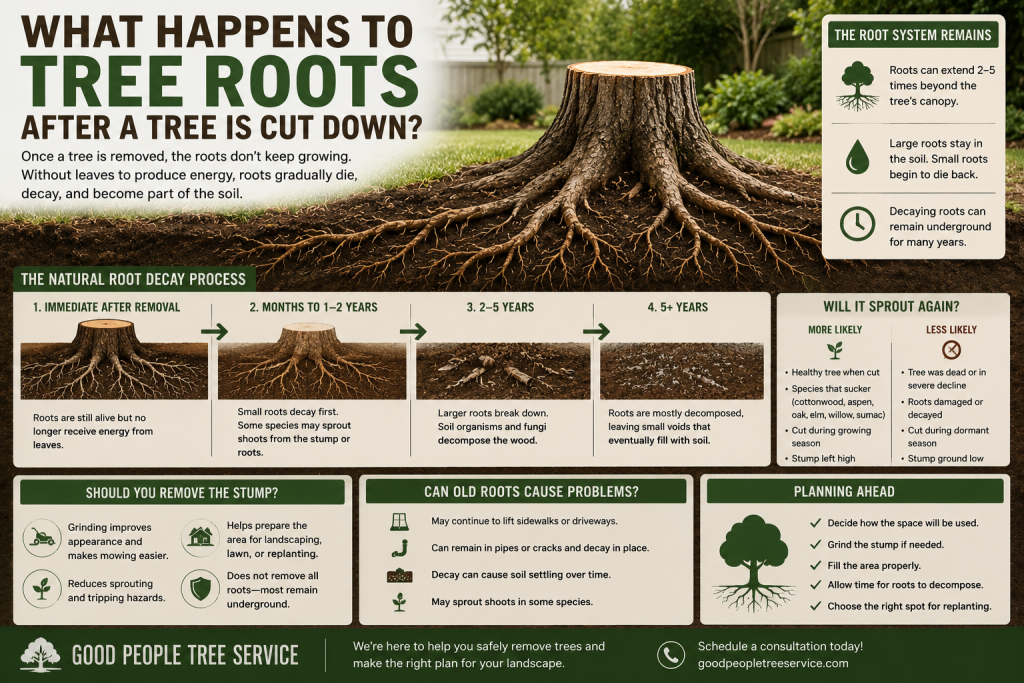
What happens to tree roots after a tree is cut down is one of the most common questions homeowners ask after tree removal. The trunk is gone, the branches are cleaned up, and the yard looks open again. Still, the root system remains underground, and many people wonder whether those roots keep growing, decay naturally, damage nearby concrete, or send up new shoots.
The answer depends on the tree species, the condition of the tree before removal, whether the stump was ground, how large the root system was, and what the homeowner wants to do with the space afterward.
In most cases, tree roots do not keep growing aggressively after the tree is cut down because the canopy is no longer producing energy through leaves. Without that energy source, the root system gradually declines and decomposes. However, some species can sprout from the stump or roots for a while, especially if the root system is still healthy.
For Colorado homeowners, this topic matters because roots often remain in dry, compacted, clayey, or hardscape-heavy landscapes. A removed tree may leave behind roots under lawns, sidewalks, driveways, irrigation lines, or planting beds. Understanding what happens to tree roots after a tree is cut down helps homeowners decide whether stump grinding, root removal, replanting, or simple monitoring is the best next step.
If you recently had a tree removed and are unsure what to do with the stump, roots, or surrounding soil, Good People Tree Service can help evaluate the site and recommend the safest cleanup or restoration option.
What happens to tree roots after a tree is cut down?
Tree roots usually remain in the soil after a tree is cut down. The visible trunk may be removed, but the underground root system can extend far beyond the stump. Large structural roots may remain near the surface, while smaller absorbing roots spread throughout the upper soil.
Once the trunk and canopy are gone, the roots lose their main energy source. Leaves produce sugars that feed roots. Without leaves, most roots begin to die back over time.
That process is not instant. Roots may remain firm for months or years depending on size, species, soil moisture, and microbial activity. Small roots decay faster. Large woody roots take longer.
In some cases, the stump or roots may produce sprouts. These shoots are the tree’s attempt to survive using stored energy in the root system. Sprouting is more common in certain species and less likely when the removed tree was already dead or severely declining.
Do tree roots keep growing after removal?
Most tree roots do not continue growing normally after the tree is cut down. Without a canopy, the roots cannot receive a steady supply of energy. They may stay alive briefly, especially if the stump remains and stored carbohydrates are available, but long-term root growth usually slows and stops.
Some trees are exceptions. Species that sucker or resprout may send up new shoots from the stump, root collar, or lateral roots. Cottonwoods, aspens, some oaks, elms, willows, sumacs, and other vigorous species may produce growth after cutting if the root system is still alive.
This does not mean the full tree is growing underground like before. It means the remaining root system is using stored energy to attempt regrowth.
If sprouts are repeatedly cut off, the root system may eventually exhaust its reserves. However, some species can be persistent and may need ongoing management.
Why some stumps sprout and others do not
Stump sprouting depends on species, age, tree health, season, stump height, and root condition.
A healthy tree cut down during active growth may have enough stored energy to send up shoots. A dead tree removed after years of decline may not have enough living root tissue to resprout.
Sprouting may appear as shoots growing from the stump, suckers emerging near the root flare, sprouts appearing several feet away, clusters of young stems around the old root system, or repeated regrowth after mowing.
This is especially important when a tree was removed because it was too close to a structure, sidewalk, driveway, or utility line. If new sprouts are allowed to grow, the same location may develop new conflicts.
Case example: the cottonwood that kept sending up shoots
Imagine a Colorado homeowner removes a cottonwood that had become too large for the backyard. The trunk is removed, but the stump is left low to the ground. By mid-summer, small shoots begin appearing around the stump and in nearby lawn areas.
This can happen because cottonwoods can sucker from healthy root systems. The tree is gone above ground, but the roots still have stored energy.
The homeowner may mow the shoots, but more appear. Over time, repeated removal can reduce regrowth, though some situations require a more deliberate plan. Stump grinding, targeted maintenance, and site restoration may all be part of the solution.
This is one reason homeowners should ask what happens to tree roots after a tree is cut down before deciding to leave the stump untreated.
Dead roots slowly decompose underground
After the root system dies, roots begin decomposing. Soil organisms, fungi, insects, moisture, and time all help break down woody material.
Small roots can disappear relatively quickly. Large roots may stay in the soil for many years, especially in dry areas or compacted soil with limited microbial activity.
Colorado conditions can slow this process in some landscapes. Dry soil, low organic matter, limited irrigation, and compacted clay may reduce decomposition speed. Moist, biologically active soil usually breaks roots down faster.
As roots decay, they can leave small voids in the soil. In lawns or planting beds, this may lead to minor settling over time. Around large stumps or major roots, the soil surface may slowly sink as woody material breaks down.
This settling is usually manageable, but it matters if the homeowner wants to install a patio, walkway, fence, irrigation line, or new tree in the same area.
What stump grinding does and does not remove
Stump grinding removes the visible stump and part of the root crown by grinding wood into chips. It is usually the most practical way to eliminate the stump as a yard obstacle.
However, stump grinding does not remove every root underground.
Most of the wider root system remains in the soil and decomposes naturally. This is normal. Complete root excavation is much more disruptive and is usually unnecessary unless construction, hardscape repair, or utility work requires it.
Stump grinding can improve yard appearance, remove a tripping hazard, make mowing easier, reduce stump sprouting, open space for landscaping, and prepare an area for topsoil or mulch.
The deeper and wider the grind, the more stump material is removed. Still, roots extending far from the stump are generally left in place.
Can old tree roots damage sidewalks or driveways after removal?
Roots that are already lifting sidewalks or driveways will not instantly disappear after the tree is cut down. Large woody roots may remain in place for years as they decay.
If roots have lifted concrete, the hardscape may still need repair. Cutting down the tree may stop future root growth in many cases, but it does not automatically lower a lifted slab or remove existing root pressure.
As roots decay, the opposite issue can happen. Soil may settle where large roots break down, creating dips or uneven areas.
For homeowners planning concrete repair, it is important to understand where major roots are located. Removing roots near hardscape can make repairs cleaner, but root excavation may disturb soil and require proper backfilling and compaction.
A tree service and concrete contractor may need to coordinate if roots are affecting a driveway, sidewalk, or patio.
Can old roots affect foundations or pipes after removal?
After a tree is cut down, roots generally stop removing moisture from soil over time. This may change soil moisture patterns near a foundation, especially in expansive clay. Removing a tree does not automatically fix cracks, settlement, drainage problems, or pipe damage.
Old roots may remain in existing cracks, weak spots, sewer joints, or irrigation lines. If they die, they can decay in place and leave small openings where water or soil can move. A plumber, drainage specialist, or foundation professional may still be needed when structural symptoms or recurring backups are present.
Case example: the stump that looked gone but kept causing problems
A homeowner removes a tree near a patio and has the stump ground a few inches below grade. The area is covered with soil and seed. The lawn looks normal for a season.
Later, the homeowner notices mushrooms, soft spots, and uneven settling where the tree used to be. The issue is not that the tree is alive. It is the buried woody material decomposing below the surface.
This can happen when large roots and stump material remain underground. As they break down, the soil shifts.
For lawns, this may be easy to fix with topdressing and reseeding. For patios or walkways, the area may need more careful preparation before hardscape is installed.
Should old roots be removed?
Old roots do not always need to be removed. In many yards, leaving roots in the soil is practical and safe. They decompose over time and may even contribute organic matter back into the soil as they break down.
Root removal may be useful when roots are lifting concrete, new hardscape will be installed, grading work is blocked, a new tree will be planted in the same exact spot, roots are interfering with irrigation work, the stump is sprouting repeatedly, the area needs leveling, or roots are creating trip hazards.
Complete root removal can be labor-intensive and disruptive. It may damage surrounding lawns, garden beds, irrigation, or nearby trees. The decision should match the future use of the space.
Can you plant a new tree where the old tree was removed?
You can plant a new tree near the old location, but planting directly in the same spot can be challenging.
Old roots, wood chips, compacted soil, decay organisms, and poor soil structure may make establishment harder. Stump grinding also leaves wood chips in the hole, and too much buried wood can temporarily affect soil nitrogen balance as it decomposes.
A better approach is often to plant the new tree several feet away from the old stump location if space allows. The new site should have good soil, proper drainage, enough room for mature roots, and the correct planting depth.
If planting in the same area is necessary, old woody material should be removed as much as practical, and the soil should be prepared carefully. A young tree should not be placed into a pocket of decomposing chips and compacted soil.
Why filling a stump hole correctly matters
After stump grinding, the hole is often filled with wood chips, soil, or a mix of both. This is fine for some uses, but not ideal for every plan.
Wood chips settle as they decompose. If the area will become lawn, extra topsoil may be needed later. If the area will support a patio, walkway, or structure, wood chips should not be used as structural fill.
Poor filling can lead to sinking, soft ground, fungal growth, or uneven surfaces.
A good restoration plan depends on the next use. Lawn areas need topsoil and seed. Planting beds may benefit from organic matter. Hardscape areas need compactable fill. Replanting areas need suitable soil and enough room for new roots.
The stump may be gone, but the site still needs proper finishing.
Do old roots attract pests or fungi?
Decaying roots can attract fungi, insects, and soil organisms. That is part of natural decomposition.
In most yards, this is not a major problem. Mushrooms may appear after rain or irrigation as old roots break down. Some insects may feed on decaying wood without harming healthy plants.
However, homeowners should pay attention if fungal growth appears near living trees, if the removed tree died from root disease, or if decay is close to structures.
If a tree was removed because of disease, pests, or root rot, the site may need more careful evaluation before replanting.
Do roots from a dead tree help or hurt the soil?
As old roots decompose, they can contribute organic material to the soil. Root channels may also create pathways for air and water. In natural systems, dead roots are part of soil building.
At the same time, in residential landscapes, the effect depends on location.
And in a lawn or garden bed, decomposition may be beneficial over time. Under a patio or walkway, decaying roots may create settling. Near a foundation or pipe, old root channels may affect water movement.
That is why context matters. The same old root system can be harmless in one area and inconvenient in another.
What homeowners should do after tree removal
After a tree is removed, inspect the site before deciding what comes next.
Look for visible surface roots, stump height, sprouting, holes, soft soil, nearby concrete damage, irrigation lines, drainage patterns, and future planting plans.
A simple checklist helps homeowners decide whether stump grinding is needed, remove or manage sprouts, fill the area correctly, avoid planting too soon in poor soil, check nearby hardscape, monitor settling, watch for mushrooms, protect nearby trees from equipment, and plan replanting with enough space.
Good People Tree Service can help homeowners decide whether grinding, cleanup, root management, or replanting preparation is the right next step.
Frequently asked questions
Do tree roots die after a tree is cut down?
In most cases, yes. Without leaves to produce energy, roots gradually die and decompose. Some species may sprout from the stump or roots before the root system fully declines.
How long do tree roots stay in the ground?
Small roots may break down faster, while large woody roots can remain for many years. Decomposition depends on species, root size, soil moisture, oxygen, and microbial activity.
Will stump grinding remove all roots?
No. Stump grinding removes the stump and part of the root crown, but most roots extending through the yard remain underground and decay naturally.
Can roots keep damaging concrete after removal?
Existing root-related lifting does not disappear immediately. Future growth usually slows or stops, but large roots can remain under concrete for years and may need to be addressed during repair.
Final thoughts
What happens to tree roots after a tree is cut down depends on the species, root health, stump treatment, soil conditions, and future plans for the area. Most roots gradually die and decompose once the canopy is removed. Some species may sprout from the stump or roots for a while, especially if the tree was healthy when cut.
Stump grinding removes the visible obstacle but usually leaves most roots underground. That is normal. Those roots may decay slowly, settle over time, or interfere with hardscape and replanting plans depending on the site.
For Colorado homeowners, the best next step depends on the landscape goal. A lawn area may only need grinding, soil, and monitoring. A patio or driveway area may require more root removal and proper fill. A replanting area may need soil preparation and a better tree location.
Good People Tree Service helps homeowners manage stumps, roots, replanting areas, and tree removal cleanup throughout Colorado’s Front Range communities.
If you recently removed a tree and are unsure what to do with the remaining roots, schedule an evaluation before replanting, repairing concrete, or covering the area.