
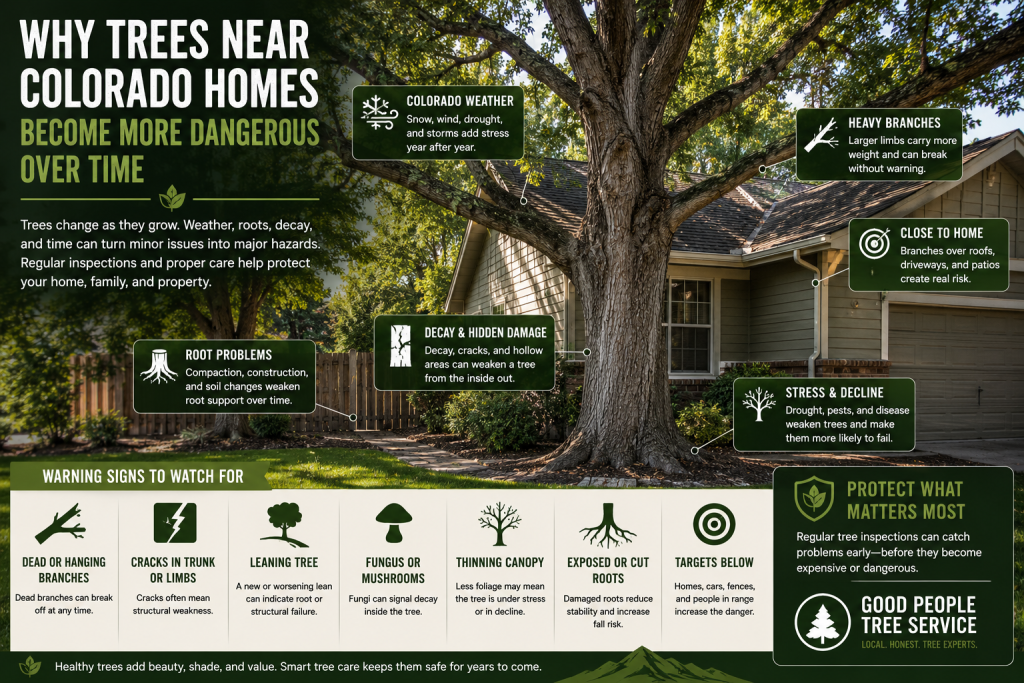
Trees near Colorado homes become more dangerous over time because they grow larger, carry more weight, and face years of stress from weather, soil, roots, pruning, decay, and nearby hardscape. A tree that looked harmless when it was small can eventually hang over a roof, shade a driveway, press roots under concrete, or lean toward a fence.
That does not mean every mature tree near a house is unsafe. Many large trees add shade, privacy, wildlife value, and curb appeal for decades. The risk grows when homeowners stop seeing the tree as a living structure that changes every year.
A tree does not need one dramatic storm to become dangerous. Colorado’s dry summers, heavy wet snow, high winds, compacted clay soil, drought cycles, and construction projects can slowly weaken roots, branches, and trunk wood. The tree may stay green while hidden defects develop.
Understanding why trees near Colorado homes become more dangerous over time helps homeowners catch early warning signs before a branch falls, roots shift, or removal becomes urgent.
If a tree near your home, driveway, sidewalk, patio, or fence looks stressed, cracked, leaning, or overgrown, Good People Tree Service can inspect it and help determine whether pruning, monitoring, or removal makes the safest sense.
Why trees near Colorado homes become more dangerous over time
Trees near Colorado homes become more dangerous over time because size changes everything. A young tree may have small limbs, a light canopy, and plenty of space. A mature tree may weigh several tons, spread over structures, and depend on roots that run under lawns, sidewalks, driveways, and patios.
As a tree grows, every defect matters more. A small crack in a branch union may not threaten much when the branch is young. Years later, that same union may support a large limb over a roof. A minor root cut near a driveway may look harmless at first. After drought, wind, or wet soil, that lost root support may matter much more.
The hazard depends on two things: the tree’s condition and what it could hit. A tree beside a house, garage, sidewalk, or play area creates higher risk because people and property sit inside the fall zone.
Proximity turns normal tree problems into property risks
Every tree drops twigs, sheds leaves, and develops deadwood. In a forest, those events usually feed the soil. Near a Colorado home, the same events can damage shingles, gutters, vehicles, fences, patios, or people underneath.
Location changes the seriousness of a defect. A dead branch in the middle of a field may not require urgent action. A dead branch over a driveway deserves faster attention. A leaning tree in an open space may only need monitoring. A leaning tree toward a bedroom wall needs a different response.
This is why homeowners should look at targets. Targets include roofs, garages, parked cars, sidewalks, streets, decks, patios, fences, utility lines, neighboring property, and areas where children, guests, or pets spend time.
A tree becomes more dangerous when its canopy, trunk, or roots overlap with those targets.
Colorado weather increases stress year after year
Colorado weather adds repeated stress to trees near homes.
Heavy wet spring snow can load branches after trees have begun leafing out. Strong winds can test weak unions and old cracks. Hot, dry summers can reduce root function and weaken defenses. Sudden freezes can injure buds, needles, bark, and small branches. Hail can shred leaves and wound bark.
One weather event may not ruin a tree. Repeated events create a longer story.
A limb may bend during one snowstorm, crack during another, and finally fail during a summer wind. A tree may survive drought for several seasons, but each dry year can reduce fine roots and stored energy. Over time, the tree loses resilience.
That pattern explains why trees near Colorado homes become more dangerous over time even when they survive many storms. Surviving the last storm does not prove the next one will be safe.
Large branches become heavier and less forgiving
Branches gain weight as they grow. They also gain leverage. A long horizontal limb over a roof or driveway can place a large load on the trunk or branch union.
If the branch has a narrow attachment, included bark, old pruning wound, internal decay, or crack, risk increases as the limb grows larger. The branch may produce leaves and look healthy while the attachment weakens.
Homeowners should watch large limbs that stretch over structures, hang low over driveways, grow from tight V-shaped unions, show cracks near the base, or carry dead sections.
A heavy limb does not need extreme wind to fail. Heat, snow, rain, gravity, and normal movement can break a limb that already has a defect.
Deadwood becomes more dangerous near homes
Dead branches create one of the most obvious hazards near houses. Once a branch dies, it loses flexibility and strength. It can break during wind, snow, or calm weather as decay advances.
A small dead twig usually creates little concern. A large dead branch high in the canopy can hit with serious force.
Deadwood often points to deeper stress. Drought, root damage, disease, insects, poor pruning, shade, or age can all create dead branches. If a tree develops more deadwood each year, homeowners should not treat it as normal aging.
Trees near Colorado homes become more dangerous over time when dead branches stay in the canopy. Removing hazardous deadwood early usually costs less and creates less urgency than waiting until a limb hangs over the roof after a storm.
Weak branch unions can split with age
Some trees develop weak structure early in life. The problem becomes more serious as the tree matures.
Co-dominant stems form when two large stems compete as main trunks. A tight V-shaped union may trap bark between the stems. Arborists call this included bark. That trapped bark prevents strong wood from forming between the stems.
At first, the defect may look like an attractive fork. As both stems grow larger, they push against each other and carry more weight. Cracks may form below the union. One side may eventually split away.
Colorado’s snow and wind make weak unions especially important. Wet snow can add sudden weight. Wind can twist stems. A weak union near a house deserves attention before it becomes a split trunk emergency.
Trunk decay can stay hidden for years
A tree can look green and still lose strength inside the trunk.
Living tissue near the outside of the trunk moves water and nutrients. The interior can decay while the canopy continues to leaf out. That means homeowners may not notice a major structural issue until mushrooms appear, bark falls off, a cavity opens, or a branch fails.
Decay often starts after wounds. Old pruning cuts, storm breaks, mower damage, sunscald, cracks, animal damage, and broken limbs can all allow decay organisms to enter.
Warning signs include cavities, soft wood, fungal growth, bark loss, old wounds, cracks, repeated branch failure, and hollow sounds in some areas.
Trunk decay becomes more concerning when the tree stands close to a home. A decayed tree in the fall zone of a roof, deck, or driveway needs professional evaluation.
Root problems create hidden danger
Roots anchor the tree and move water. They also stay mostly out of sight.
A tree near a Colorado home may lose root strength because of construction, trenching, driveway work, sidewalk repair, soil compaction, drought, overwatering, poor drainage, or root decay. The canopy may look acceptable while roots decline underground.
Root problems can create leaning, branch dieback, leaf scorch, early fall color, poor growth, or sudden instability after rain or wind. Mushrooms near the base can also point to root or lower trunk decay.
A tree can become dangerous even if the trunk looks solid. When roots fail, the whole tree can shift or fall.
Homeowners should pay attention to soil lifting, new lean, exposed roots, cracks in the ground, and recent work near the root zone.
Construction around homes often starts delayed decline
Many Colorado homeowners upgrade patios, driveways, fences, irrigation, utilities, or additions without realizing how much tree root area the project affects.
Construction damage often hits the roots, not the trunk. Equipment compacts soil. Trenches cut roots. Grade changes bury or expose roots. Materials stored under the canopy reduce oxygen in the soil. New hardscape changes drainage and heat around the tree.
The tree may look fine the first season after construction. Symptoms may show up months or years later as leaf scorch, canopy thinning, branch dieback, pest activity, or leaning.
This delay makes the connection easy to miss.
Trees near Colorado homes become more dangerous over time when construction damage reduces root support and homeowners do not monitor the tree afterward.
Hardscape increases heat and root conflict
Driveways, sidewalks, patios, retaining walls, and rock beds can make trees near homes harder to manage.
Hardscape reflects heat, limits open soil, changes runoff, and traps roots in narrow spaces. As roots grow, they may lift concrete or run along edges where oxygen and moisture exist. Cutting those roots to repair hardscape can injure the tree or reduce stability.
The conflict grows with time. A small tree beside a walkway may fit for a few years. A mature tree may later crowd the same space with roots and limbs.
Drought stress weakens trees slowly
Colorado drought can weaken trees near homes without killing them right away.
During dry summers, trees may lose fine roots, reduce growth, scorch leaves, drop leaves early, or develop dead branch tips. During dry winters, evergreens and young trees may lose moisture while roots cannot replace it easily.
A drought-stressed tree often becomes more vulnerable to insects, disease, and branch dieback. The decline may unfold over several years.
Homeowners sometimes water the lawn and assume the tree has enough moisture. Mature trees need water across a wider root zone. Short turf irrigation may not soak deeply enough.
Drought stress matters most near homes because it can turn branches brittle, increase deadwood, and reduce the tree’s ability to recover from storms.
Pests and disease often move into stressed trees
Insects and diseases often exploit trees that already face drought, root damage, poor soil, or old wounds. Borers, bark beetles, cankers, fungal decay, mites, aphids, and other problems can accelerate decline.
Watch for boring dust, exit holes, pitch or sap flow, bark peeling, woodpecker activity, fungal growth, sudden branch dieback, or rapid needle browning. Pest activity near a home deserves attention because it may signal larger decline.
Case example: the shade tree over the roof
A homeowner has a large shade tree beside the house. For years, it cools the upstairs rooms and makes the backyard more comfortable. One major limb now stretches over the roof.
The tree still looks green, but a closer look shows a tight branch union, a few dead branches, and an old pruning wound. During heavy snow, the limb bends lower. During summer, the leaves on one side scorch.
This tree may still have value, but it now needs attention. The location turns structural defects into property risk. Selective pruning, deadwood removal, and inspection may reduce risk. Waiting for the limb to fail could damage the roof.
Case example: the driveway tree after concrete repair
Another homeowner replaces a driveway near a mature tree. Workers cut several roots along the edge and compact the soil with equipment. The tree leafs out normally the next spring.
Two summers later, the canopy above the driveway thins. Dead branches appear, and the tree starts dropping limbs over parked vehicles.
The problem did not begin when the branches fell. It began when root damage reduced the tree’s support and water uptake. Colorado heat and drought made the damage visible later.
This case shows why homeowners should monitor mature trees near recent construction, even when the tree looks fine at first.
Warning signs homeowners should not ignore
Trees near homes deserve inspection when warning signs appear.
Look for large dead limbs, hanging branches, trunk cracks, cavities, fungal growth, new lean, soil lifting, exposed or cut roots, repeated branch drop, bark loss, canopy thinning, early fall color, leaf scorch, insect holes, sawdust-like material, and branches touching or overhanging structures.
One sign may not mean emergency. Several signs together raise concern.
Timing also matters. A new lean after rain, a fresh trunk crack, or a large hanging limb needs faster action than slow, minor canopy thinning.
What homeowners can do to reduce risk
Homeowners can reduce risk by treating trees near homes as living structures that need routine care.
Helpful steps include annual ground-level inspections, deadwood removal, structural pruning, root-zone protection, deep watering during drought, mulch around roots, construction planning, and professional evaluation after storms.
Avoid topping trees or cutting large roots without guidance. Both choices can create bigger long-term problems. Good care does not mean removing every mature tree near a house. It means managing risk before damage happens.
When removal becomes the safest option
Sometimes pruning and monitoring are not enough.
A tree service may recommend removal when a tree has severe trunk decay, major root failure, large dead sections, a new lean toward a structure, repeated limb failure, severe storm damage, or too little healthy canopy left to recover.
Removal may also make sense when a tree has outgrown the site and constantly threatens the roof, driveway, sidewalk, utilities, or foundation area.
The decision should weigh tree health, structure, location, and consequences of failure. A valuable tree in a safe location may deserve preservation. A compromised tree beside a home may need removal before it becomes an emergency.
Frequently asked questions
Why do trees near homes become more dangerous over time?
Trees near homes become more dangerous over time because they grow larger, defects carry more weight, roots face more conflicts, and nearby targets increase the consequences of failure.
Is a mature tree near a house always dangerous?
No. Many mature trees near homes remain safe with proper care. Risk increases when the tree has decay, deadwood, weak limbs, root damage, leaning, or branches over structures.
How often should trees near homes be inspected?
Homeowners should look at mature trees at least once a year and after major storms. Trees with large limbs over homes, visible defects, or recent construction nearby may need professional inspection.
Should I remove branches that hang over my roof?
Not always. A tree service can evaluate whether selective pruning can reduce weight and risk without harming the tree. Heavy cutting can stress the tree if done poorly.
What is the biggest warning sign?
A new lean, large dead limb, trunk crack, root movement, or hanging branch near a target deserves quick attention.
Final thoughts
Trees near Colorado homes become more dangerous over time when growth, defects, weather, soil stress, root damage, decay, and proximity to structures all overlap. The tree may remain beautiful and valuable, but risk changes as the tree gets larger and the site around it changes.
Colorado homeowners should pay special attention to trees near roofs, driveways, sidewalks, patios, fences, utility lines, and neighboring property. Dead branches, weak unions, trunk decay, root damage, construction impacts, drought stress, and pest activity all matter more when a tree stands close to the house.
Good People Tree Service helps homeowners evaluate trees near homes, remove hazardous branches, identify root and structural problems, and decide whether pruning, monitoring, or removal is the safest option.
If a tree near your home looks stressed, overgrown, cracked, leaning, or hazardous, schedule an inspection before age, weather, and hidden damage turn it into an emergency.