
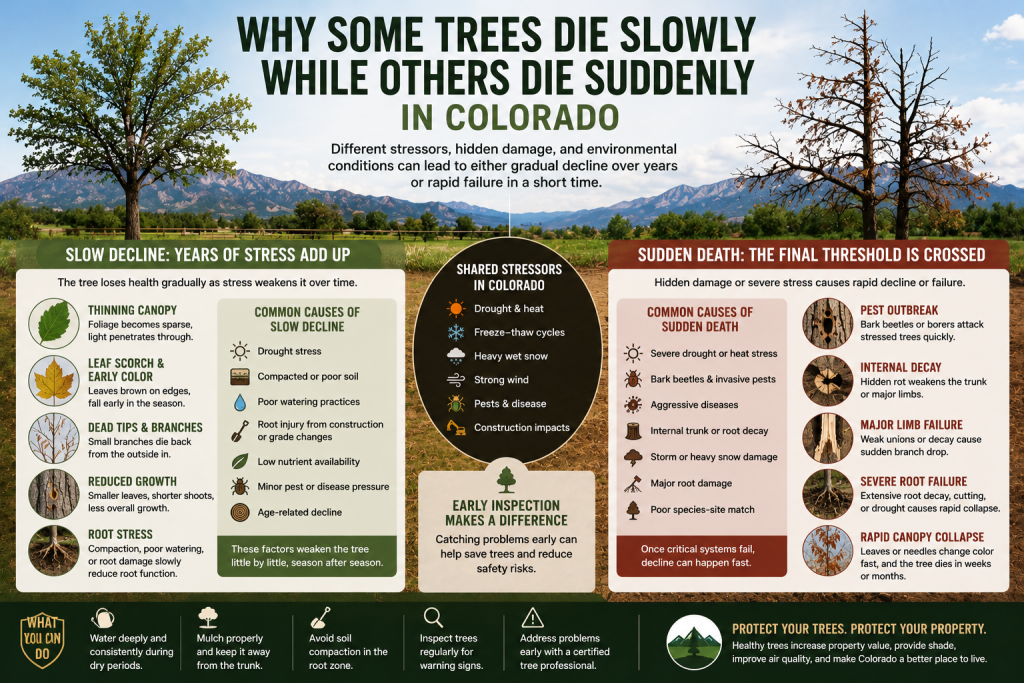
Why some trees die slowly while others die suddenly in Colorado comes down to how stress moves through the tree. Some trees decline little by little over several seasons. Others appear green and stable until a branch fails, the canopy collapses, or the whole tree dies much faster than expected.
To homeowners, the difference can feel confusing. One tree may spend years showing thinning leaves, dead tips, early fall color, and branch dieback. Another tree may look mostly normal in spring and be dead by late summer. A third may stay green but suddenly drop a major limb or fail during calm weather.
Colorado makes these patterns more common because trees here face overlapping stress. Dry air, drought cycles, intense sun, compacted soils, heavy wet snow, freeze-thaw swings, insects, disease, and construction damage can all affect tree health. The same stress may weaken one tree slowly and push another tree into sudden decline.
Understanding why some trees die slowly while others die suddenly in Colorado helps homeowners know when a tree needs monitoring, when it needs treatment, and when removal may be the safer option.
If a tree on your property is declining, thinning, dropping branches, or changing quickly, Good People Tree Service can inspect it and help determine whether the tree can recover or should be removed before it becomes hazardous.
Why some trees die slowly while others die suddenly in Colorado
Trees die at different speeds because tree decline is not one single process. It depends on the tree species, age, root health, water access, disease pressure, structural condition, and the type of stress involved.
A tree that dies slowly usually has enough remaining function to survive for a while. Roots may still absorb some water. Leaves may still produce energy. The trunk may still move moisture. The tree is declining, but it has not lost the systems it needs all at once.
A tree that dies suddenly often crosses a critical threshold. Roots may fail. Vascular tissue may stop moving water. A pest outbreak may overwhelm the tree. Internal decay may reach a breaking point. Severe drought may push the tree past recovery.
The visible difference is speed. The hidden difference is how much reserve capacity the tree had before the final stress arrived.
Slow decline usually starts with chronic stress
Slow tree death often begins with chronic stress. This means the tree is not killed by one event. Instead, it loses health over time.
Common chronic stress factors include:
- drought stress
- compacted soil
- poor watering
- root damage
- limited rooting space
- repeated leaf scorch
- low energy reserves
- minor disease pressure
- repeated insect activity
- gradual canopy thinning
A slow decline can last several years. The tree may look a little worse each season. Leaves may become smaller. Deadwood may increase. Growth may slow. The top of the canopy may thin first.
Because the decline is gradual, homeowners often mistake it for normal aging. That is risky because early symptoms may be easier to manage than advanced decline.
Sudden decline often happens after a hidden threshold
Sudden tree death does not always mean the problem started suddenly. Many sudden failures begin with hidden stress that builds quietly.
A tree may look green while roots are decaying underground. Another tree may keep leafing out while internal trunk decay weakens the structure. Some pests attack under the bark, and symptoms may not appear until the damage is advanced.
Once a critical system fails, the tree can decline quickly.
Sudden decline may happen when:
- roots can no longer support the canopy
- drought damages water movement
- borers or beetles overwhelm a stressed tree
- internal decay compromises the trunk
- vascular disease blocks water flow
- a major limb failure tears into the trunk
- soil moisture changes quickly around damaged roots
This is why some trees die slowly while others die suddenly in Colorado. The sudden tree may have been declining invisibly before symptoms appeared.
Colorado drought creates both slow and sudden decline
Drought is one of the biggest reasons tree decline behaves differently from tree to tree.
A tree with moderate drought stress may decline slowly. It may show leaf scorch, smaller leaves, early leaf drop, top dieback, or sparse growth. If the tree still has healthy roots and enough stored energy, it may survive for several years while struggling.
A tree under severe or repeated drought stress may die much faster. Fine roots can decline. Water movement can become limited. Insects and disease may take advantage of weakened defenses.
Colorado State Forest Service has warned that drought-stressed trees become more susceptible to root and branch dieback plus later insect and disease problems. That delayed chain reaction is important. A drought may not kill the tree immediately, but it can start the process.
In some cases, a tree dies slowly because drought weakens it season after season. In others, drought leaves the tree so depleted that one hot summer, pest attack, or root problem causes a sudden crash.
Case example: the maple that faded over five years
Imagine a mature maple in a Colorado front yard. At first, it looks slightly thinner than usual. The leaves are smaller one summer, but the tree still shades the house. The next year, the top branches begin to die back. By year three, leaf scorch appears every August. During year four, deadwood increases, and the canopy becomes uneven.
This is slow decline.
The tree may be dealing with drought stress, compacted soil, limited root space, or poor watering. None of those problems killed it immediately. Together, they reduced the tree’s ability to recover.
By the time the homeowner sees major dieback, the tree may have been stressed for years.
That is why slow tree death deserves attention early. A tree in year one of decline may have options. A tree in year five may have fewer.
Case example: the pine that died in one season
Now imagine a pine tree that looks mostly normal in spring. By mid-summer, the needles begin fading. By fall, the tree is largely brown.
The decline may involve bark beetles, drought stress, root damage, or a combination of problems. Many conifers do not show stress the same way broadleaf trees do. By the time needles fade dramatically, the attack or internal decline may already be advanced.
For homeowners, this can feel like the tree died almost overnight. In reality, the tree may have been stressed for months before visible symptoms became obvious.
This pattern is common with some insect and drought-related issues in Colorado conifers.
Root damage can create delayed death
Root damage is one of the clearest reasons trees decline at different speeds.
A tree with partial root damage may die slowly. It can still absorb some water, but not enough to support a full canopy during heat or drought. Symptoms may appear as leaf scorch, thinning, smaller leaves, and branch dieback.
Severe root damage can produce faster decline. If too many roots are cut, crushed, buried, or decayed, the tree may no longer support itself or move water properly.
Root damage may come from:
- trenching
- driveway work
- patio installation
- fence posts
- utility repairs
- soil grading
- heavy equipment
- soil compaction
- grade changes
- overwatering or poor drainage
The hard part is timing. A tree may not show symptoms immediately after construction. Decline may appear months or years later.
Soil compaction slowly weakens trees
Compacted soil is a quiet cause of slow decline in Colorado landscapes.
Roots need oxygen and moisture. When soil is compacted, pore space shrinks. Water may not soak in properly, and air movement becomes limited. Roots struggle to grow and function.
A compacted root zone can reduce a tree’s tolerance to drought, heat, wind, insects, and disease. That means the tree may survive normal years but struggle during stressful ones.
Symptoms often develop gradually:
- reduced growth
- leaf scorch
- smaller leaves
- canopy thinning
- branch dieback
- early fall color
- increased pest pressure
A tree in compacted soil may not die suddenly at first. It may lose strength year after year until another stress pushes it over the edge.
Internal decay can make death look sudden
Decay can create a different pattern. The tree may look alive until the structure fails.
A tree can have green leaves while decay spreads inside the trunk or major limbs. Living tissue near the outer part of the tree may still move water, while the center loses strength.
If decay is advanced, the tree may fail suddenly during normal weather or after a minor trigger. A large branch may drop. The trunk may split. The tree may lean after rain because roots are decayed.
Warning signs of decay include:
- cavities
- mushrooms near the base
- soft wood
- bark loss
- large old wounds
- hollow-sounding trunk areas
- repeated branch failure
- cracks near major unions
This is why a tree can appear healthy and still be dangerous. Biological life and structural safety are not the same thing.
Insects and disease can speed up decline
Some trees die slowly from stress alone. Others decline quickly once insects or disease become involved.
Drought and root stress weaken a tree’s natural defenses. Once that happens, pests and pathogens may become more successful. Borers, bark beetles, cankers, root diseases, and vascular diseases can all speed up decline.
Insects may be secondary, meaning they attack after the tree is already stressed. In other cases, they become the main driver of rapid decline.
Signs to watch for include:
- boring dust
- pitch tubes
- bark peeling
- small exit holes
- sudden branch dieback
- fungal growth
- oozing sap
- woodpecker activity
- rapid needle or leaf discoloration
When pest or disease symptoms appear with drought stress or canopy thinning, the decline may accelerate.
Species respond differently to the same stress
Tree species matter. Some trees show stress slowly and keep fighting for years. Others decline quickly when their preferred conditions disappear.
Aspen, for example, can be sensitive to drought, heat, pests, disease, and site conditions. Some pines may appear green until bark beetle damage is advanced. Maples can show years of leaf scorch and branch dieback before major decline. Cottonwoods may shed limbs or decline structurally even while portions remain alive.
The same yard can hold trees with different reactions to the same weather. One tree may have deeper access to moisture. Another may be planted in compacted soil. A third may have old root damage or hidden decay.
That is why comparing trees side by side can be misleading. Two trees may experience the same drought but have very different levels of resilience.
Age affects decline speed
Age also affects how trees respond.
Young trees may fail quickly if they never establish roots. Mature trees may decline slowly because they have stored energy and larger root systems. Older trees may look stable but carry more old wounds, decay pockets, and structural defects.
An older tree may die slowly from reduced vigor. Another may fail suddenly because internal decay finally reaches a structural limit.
Age does not automatically make a tree unsafe. Many mature trees can remain healthy for decades with proper care. However, mature trees need more monitoring because the consequences of failure are larger.
Weather triggers reveal hidden problems
Colorado weather often reveals tree problems rather than causing them alone.
Wet spring snow may break limbs that already had weak unions. High heat may expose drought stress that began months earlier. A sudden freeze may damage tissue already weakened by poor health. Heavy rain may destabilize roots that were already decayed or cut.
Weather becomes the final trigger.
This is one reason why some trees die slowly while others die suddenly in Colorado. The slow tree shows stress between events. The sudden tree may hide its weakness until weather exposes it.
What homeowners often mistake for normal aging
Slow decline is often dismissed as age.
Homeowners may say the tree is “just old” when it shows:
- thinning canopy
- smaller leaves
- early fall color
- top dieback
- dead branches
- bark cracks
- repeated leaf scorch
- slow growth
Some changes are normal in mature trees, but repeated or worsening symptoms are not something to ignore.
If the tree looks worse each year, something more than age may be happening.
What makes sudden tree death more likely
Sudden tree death is more likely when several risk factors overlap.
A stressed tree with compacted soil, drought history, and insect pressure is more likely to crash than a healthy tree with good roots. A tree with internal decay and a heavy canopy may fail even if leaves remain green. A conifer under bark beetle pressure may fade quickly once damage becomes visible.
High-risk combinations include:
- drought plus insects
- root damage plus heat
- decay plus heavy limbs
- saturated soil plus root rot
- construction damage plus compacted soil
- weak unions plus snow load
When multiple stressors overlap, decline can move from slow to sudden.
Can slow decline be reversed?
Sometimes, yes.
A tree in early decline may respond to better watering, mulch, root protection, deadwood pruning, pest management, soil improvement, or reduced competition from grass.
Recovery is more likely when most of the canopy is alive, roots are not severely damaged, decay is not advanced, pests are not overwhelming the tree, symptoms are caught early, and site conditions can be improved.
A tree in advanced decline may not recover. If the canopy is mostly dead, the trunk is decayed, or roots are unstable, removal may be safer.
Good People Tree Service can inspect the tree and explain whether care, monitoring, or removal makes sense.
What homeowners should check from the ground
A simple ground-level inspection can reveal a lot.
Look for canopy thinning, dead branches, smaller leaves, early leaf drop, mushrooms, bark loss, trunk cracks, root damage, soil movement, leaning, boring dust, pitch tubes, and repeated branch drop.
Photos help track changes over time. Take pictures from the same angle every few months. This makes slow decline easier to notice.
Avoid climbing the tree or cutting large limbs yourself. Declining trees can fail unpredictably, especially when decay or deadwood is present.
Frequently asked questions
Why do some trees die slowly?
Trees often die slowly when chronic stress affects them over time. Drought, compacted soil, poor watering, root damage, and mild disease pressure can gradually reduce health.
Why do some trees die suddenly?
Sudden tree death usually happens when a hidden problem crosses a threshold. Root failure, vascular disease, beetle attack, severe drought, or internal decay can make decline appear rapid.
Can a green tree still be dying?
Yes. A tree may still produce leaves while roots, trunk wood, or major limbs are compromised. Green leaves do not always mean the tree is structurally safe.
Is drought always visible right away?
No. Drought stress can be delayed. A tree may show symptoms months or years after root damage or moisture stress begins.
Final thoughts
Why some trees die slowly while others die suddenly in Colorado depends on the type of stress, how long it has been building, and how much reserve capacity the tree has left. Slow decline often comes from chronic drought, soil compaction, root damage, poor watering, or gradual disease pressure. Sudden decline usually happens when hidden damage crosses a critical point.
Colorado conditions make both patterns more common. Dry summers, winter moisture loss, compacted soils, wet snow, pests, disease, and construction damage can all affect tree health.
Good People Tree Service helps homeowners identify whether a tree is slowly declining, suddenly failing, or still recoverable with the right care.
If a tree on your property is thinning, dying back, dropping limbs, or changing quickly, schedule an evaluation before the problem becomes a safety concern.