
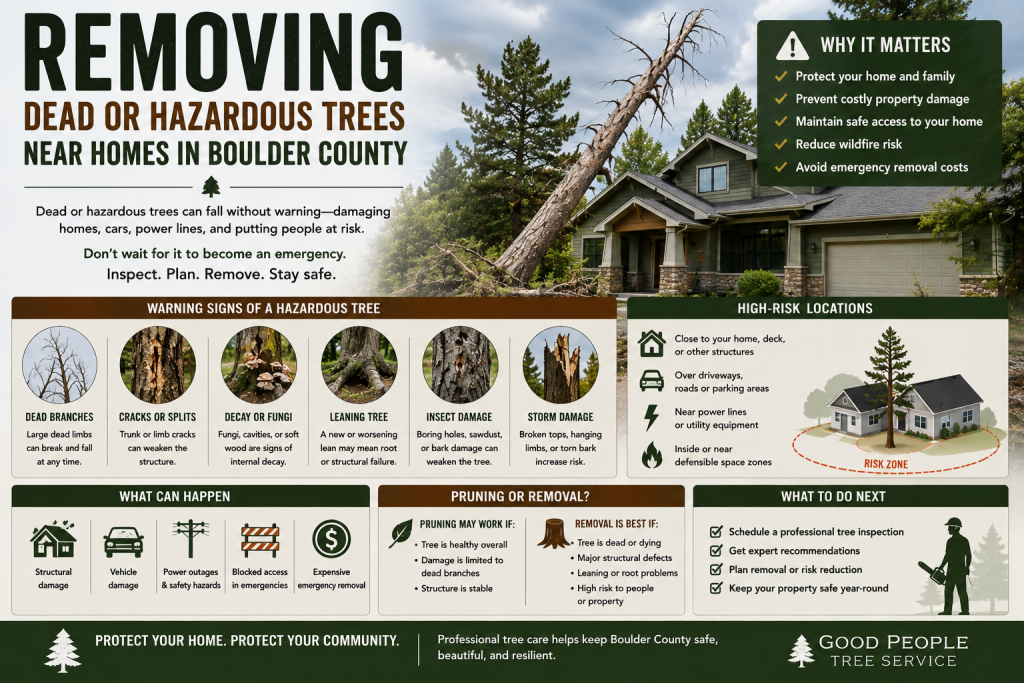
Removing dead or hazardous trees near homes in Boulder County is not only about improving the look of a yard. It is about protecting people, structures, driveways, roads, utility areas, decks, fences, and access routes before a weak tree fails. A dead tree may stand quietly for months. A cracked branch may stay in place after one storm. A leaning trunk may look unchanged for years. But once the tree loses strength, the risk can change quickly.
Boulder County has a wide range of tree-care conditions. A homeowner in the City of Boulder may deal with mature shade trees near sidewalks, streets, fences, and older neighborhoods. A homeowner in the foothills may deal with conifers, slopes, wildfire risk, beetle damage, rocky soils, and long driveways. A property near Nederland, Jamestown, Lyons, or the foothills may face snow loading, wind exposure, wildfire mitigation needs, and limited access for emergency vehicles.
Dead and hazardous trees create different kinds of risk depending on where they stand. A dead tree in an open area may not need urgent removal. A dead tree beside a house, driveway, patio, power line, propane tank, or county road deserves faster attention.
Understanding when removal makes sense helps Boulder County homeowners avoid waiting until a tree becomes harder, more dangerous, or more expensive to remove.
If you have a dead, leaning, cracked, storm-damaged, beetle-damaged, or hazardous tree near your home, Good People Tree Service can inspect it and help determine whether removal, pruning, monitoring, or mitigation is the right next step.
Removing dead or hazardous trees near homes in Boulder County
Removing dead or hazardous trees near homes in Boulder County starts with a simple question: what could the tree hit if it failed?
Tree professionals often call this a target. A target can be a home, garage, roof, driveway, car, sidewalk, deck, fence, shed, street, propane tank, septic area, play space, utility line, or neighbor’s property.
A dead tree away from targets may be less urgent. A dead or unstable tree near a target can become a serious concern. The same applies to large dead limbs, hanging branches, split trunks, root movement, and trees leaning toward structures.
A hazardous tree is not always fully dead. A living tree can be hazardous if it has serious structural problems, decay, root instability, storm damage, or large dead sections. Some hazardous trees still have green leaves. That is why homeowners should not judge safety only by whether the canopy has foliage.
Tree removal becomes more urgent when tree condition and target location overlap.
Dead trees become weaker over time
A dead tree does not stay structurally strong forever. After death, branches dry out. Bark loosens. Wood cracks. Decay organisms move in. The top may weaken. Roots may lose grip. Wind and snow increase the chance of failure.
The timeline varies by species, size, location, moisture, decay, insects, and weather exposure. Some dead trees stand for years. Others fail sooner, especially if they already had decay, root damage, or storm cracks.
Homeowners should not rely on the tree’s current appearance alone. A dead tree near a roof or driveway may look stable today and fail during the next windstorm or wet snow event.
Early removal often gives a crew more control. Waiting until the tree becomes brittle can make the work more difficult and potentially more expensive.
Hazardous trees are not always obvious
Many homeowners recognize a fully dead tree with no leaves or needles. Fewer homeowners notice hidden risk in a tree that still looks partly alive.
Warning signs include large dead limbs, cracks in the trunk, split branch unions, mushrooms near the base, cavities, loose bark, root heaving, sudden lean, broken tops, hanging branches, heavy woodpecker activity, boring dust, and major canopy thinning.
A tree can also become hazardous after construction, trenching, grading, driveway work, or soil compaction damages roots. The canopy may stay green for a while, but the root system may no longer anchor the tree well.
If a tree stands close to a house, the risk threshold should be lower. A defect that might be monitored in an open area may require action when the tree sits over a roof, patio, or driveway.
Boulder County weather can turn tree defects into emergencies
Colorado weather can be hard on trees. Boulder County sees wind, heavy snow, hail, lightning, intense sun, dry stretches, and fast temperature changes. These conditions can turn old defects into sudden failures.
Wind can break dead branches or push leaning trees. Heavy wet snow can load branches that already have weak unions. Hail can damage foliage and bark. Lightning can split trunks or injure internal wood. Saturated soil after heavy rain can reduce root stability, especially on slopes or compacted sites.
A tree with existing cracks or deadwood may survive one storm but fail during the next. That is why hazardous trees near homes should be inspected before storm season, not only after damage occurs.
Snow and wind damage often reveal hidden problems
After a strong wind event or heavy snow, homeowners may see broken limbs on the ground. The more serious problems can remain in the canopy.
A large cracked branch may stay attached. A broken limb may hang in another branch. A trunk split may open slightly but not fail yet. A root plate may shift underground without obvious surface damage.
Homeowners should inspect from the ground and avoid standing under broken limbs. Large hanging branches can fall without warning. Branches near power lines require extra caution and utility coordination.
Storm cleanup should focus on safety first. Some trees can recover after proper pruning. Others need removal when the trunk, roots, or main structure have failed.
Trees near homes create higher stakes
A dead or hazardous tree near a home creates more risk than the same tree in an open field. Homes add targets in every direction: roofs, gutters, windows, decks, patios, fences, walkways, HVAC units, vehicles, and people.
Branches that overhang roofs can break during snow or wind. Large limbs can damage shingles, gutters, skylights, or siding. A whole tree failure can cause major structural damage.
Homeowners should pay special attention to trees that lean toward the house, have dead limbs over the roof, show trunk cracks facing the home, or stand close enough to hit the structure if they fall.
Removal may feel aggressive, but waiting can turn a manageable tree-care issue into an emergency.
Driveways and access routes matter
In Boulder County, access can be just as important as the house itself. A tree that falls across a driveway can block residents, emergency vehicles, deliveries, contractors, or snow removal.
This matters in mountain and foothills properties with long private drives, narrow roads, steep slopes, and limited turnaround areas. It also matters in suburban neighborhoods where a fallen tree can block a driveway or street access.
Trees along access routes should be inspected for dead tops, leaning trunks, root movement, bark beetle damage, cracks, and large limbs over the road.
Removing high-risk trees before they fall can help prevent emergency access problems later.
Trees near utility lines require special caution
Dead or hazardous trees near utility lines create serious safety concerns. Homeowners should not attempt to prune or remove trees touching or leaning toward energized lines.
A tree can conduct electricity if it contacts a line. A branch can shift suddenly during cutting. A dead tree can break unpredictably and pull lines down.
If a tree is tangled with a utility line, leaning toward one, or has storm damage near one, keep people away and contact the utility provider or a qualified tree professional.
Utility proximity can change the removal process. It may require coordination, specialized equipment, or a different safety plan.
Wildfire risk affects tree removal decisions
In forested and foothills parts of Boulder County, dead and hazardous trees also affect wildfire planning. Dead trees, dry branches, ladder fuels, and dense vegetation near homes can increase risk.
Removing a dead tree near a home may support defensible space goals. So can pruning lower branches, reducing dense fuels, spacing trees, and cleaning up needles, leaves, and slash.
Wildfire mitigation does not mean removing every tree. Healthy, well-spaced trees can remain valuable. The goal is to reduce continuous fuel and protect the home ignition zone.
Dead trees near homes, decks, fences, propane tanks, and access routes deserve special attention because they can add fuel and create safety issues.
Beetle-damaged trees can become hazardous
Bark beetles and borers can weaken or kill trees in Boulder County, especially when drought and heat stress reduce tree defenses. Pine, spruce, ash, and other species can face different pest concerns.
A beetle-killed pine may turn red or brown, show boring dust, develop bark holes, attract woodpeckers, and eventually lose needles. An ash with emerald ash borer or borer decline may show canopy thinning, branch dieback, bark flecking, or exit holes.
Once a pest-damaged tree dies, it can become brittle over time. If it stands near a home or driveway, removal may become safer than waiting.
Pest diagnosis matters because nearby trees may also need monitoring, treatment decisions, or forest-health planning.
Decay at the base is a major warning sign
Mushrooms, conks, cavities, soft wood, or cracking near the base can signal decay. The base and root flare area support the whole tree. When decay affects that area, the tree may lose stability.
A tree with base decay may still have green leaves. That can mislead homeowners. The canopy shows that some living tissue remains, but it does not prove the trunk or roots are structurally sound.
Trees with base decay near homes, sidewalks, patios, or driveways should be inspected. Removal may be necessary if the tree lacks enough sound wood to remain safely.
Do not cover base problems with mulch or soil. Keep the root flare visible so defects can be seen.
Leaning trees need context
Not every leaning tree is dangerous. Some trees grow with a natural lean for years. The concern increases when the lean is new, worsening, or paired with root movement, cracked soil, exposed roots, trunk cracks, or dead canopy.
A tree leaning toward a home, driveway, road, or power line deserves faster inspection. A large tree with a new lean after heavy rain or wind can indicate root failure.
Homeowners should not try to pull a large leaning tree upright. Cabling, bracing, pruning, or removal decisions require inspection and proper equipment.
The key question is whether the lean is stable and old or unstable and changing.
Root damage can make a tree hazardous
Roots anchor the tree and supply water. Damage to major roots can create both health problems and stability problems.
Construction, trenching, driveway installation, grading, retaining-wall work, patio construction, utility work, and soil compaction can damage roots. A tree may decline slowly after the work, or it may become less stable during wind and saturated soil.
Warning signs include canopy thinning, dieback on one side, soil cracks, exposed roots, root cuts, sudden lean, and mushrooms near the base.
A tree near a home with significant root damage may need removal even if part of the canopy remains green.
When pruning may be enough
Not every dead or damaged tree issue requires removal. A tree with a few dead branches may only need deadwood pruning. A storm-damaged tree may recover if it still has strong structure, stable roots, and enough living canopy.
Pruning may make sense when the trunk is sound, the roots are stable, the main scaffold limbs remain strong, and the defects are limited to removable branches.
The decision depends on risk. Dead branches over a target need attention, but they do not always mean the whole tree must come down.
A professional inspection can help separate trees that can be managed from trees that should be removed.
When removal is usually the safer option
Removal often makes sense when a tree is dead, mostly dead, severely leaning, split through the trunk, unstable at the roots, affected by major decay, heavily beetle-damaged, or has large dead limbs over targets.
Removal also makes sense when the tree stands too close to a home and has structural defects that pruning cannot correct.
If the tree could hit a roof, driveway, sidewalk, road, utility line, or neighbor’s property, the removal decision becomes more urgent.
A hazardous tree does not improve with time. Once decay, death, or instability reaches a certain point, waiting usually increases risk.
Boulder County homeowners should check local requirements
Tree removal rules can vary by location and property status. A private tree in one area may not require permission, while another property may have rules tied to development agreements, site plan review, HOA conditions, wildfire mitigation requirements, right-of-way issues, or municipal codes.
Boulder County also has right-of-way responsibilities and private-property responsibilities that may affect trees overhanging roads, signs, or travel lanes. City-level rules can differ from county rules.
Before major tree removal, especially if several trees are involved or the property is under a planning condition, homeowners should check the applicable local authority, HOA, or county/city guidance.
This is especially important for wildfire mitigation projects, mountain properties, and properties near roads or public rights-of-way.
Cleanup matters after removal
Removing a dead or hazardous tree is only part of the job. Cleanup matters too.
Large logs, branches, needles, leaves, and slash can create tripping hazards, pest concerns, drainage problems, or wildfire fuel. In mountain areas, slash management plays a bigger role in defensible space.
Homeowners should plan whether material will be hauled away, chipped, cut for firewood, or handled through an approved local program when applicable.
Do not pile dry branches against the home, under decks, or near propane tanks. Do not store potentially infested wood near healthy trees without understanding pest risk.
A clean removal plan helps reduce the next problem.
Case example: the dead pine near a foothills driveway
A homeowner in the Boulder foothills has a dead pine leaning toward a narrow driveway. The tree has red needles, boring dust, and woodpecker activity. It does not threaten the house directly, so the homeowner considers waiting.
Waiting may be risky. If the tree falls, it can block the driveway and create an emergency access issue. If it stands near other trees, the property may also need pest and fuels evaluation.
Removal before the tree becomes more brittle may be the safest and most practical choice.
Case example: the cracked maple near a Boulder home
A mature maple near a home has a large cracked limb over the roof after a summer storm. Most of the tree is still alive, but the branch union looks weak.
This tree may not need full removal. It may need professional pruning, branch removal, and structural evaluation. If the trunk and roots are sound, pruning may reduce risk while preserving the tree.
This example shows why inspection matters. The best answer is not always removal. It is the right level of action for the defect.
Case example: the declining tree with mushrooms at the base
A homeowner notices mushrooms near the base of a large tree beside a patio. The leaves still appear normal, but one side of the canopy has dead branches.
This tree needs professional inspection. Base decay can undermine stability even while the tree looks partly healthy. If the tree could hit the patio or home, removal may be safer than waiting.
Mushrooms do not always mean immediate failure, but they are important warning signs near targets.
What homeowners should not do
Do not climb a dead or hazardous tree. Do not cut large limbs from a ladder. Do not remove branches near power lines. Do not assume a dead tree is safe because it has not fallen yet.
Do not top a hazardous tree as a substitute for removal. Topping can create weak regrowth, large wounds, and future decay.
Do not ignore a tree because only one side looks dead. Partial failure can still create serious risk.
Do not delay inspection when a tree stands near a home, driveway, sidewalk, or utility line.
When to call a tree service
Call a tree service if you see a dead tree near the home, large dead limbs, hanging branches, trunk cracks, mushrooms near the base, root movement, a new lean, storm damage, bark beetle signs, sudden canopy thinning, or branches over a roof, driveway, sidewalk, fence, or road.
Good People Tree Service can inspect the tree, identify visible risk factors, explain whether pruning or removal makes sense, and help homeowners plan safe removal when needed.
Frequently asked questions
When should a dead tree near a house be removed?
A dead tree near a house should usually be removed before it becomes brittle, unstable, or storm-damaged. The closer it stands to the home or access areas, the more urgent the decision becomes.
Is a tree hazardous if it still has leaves?
Yes, it can be. A tree may still have leaves while also having trunk decay, root damage, cracks, weak unions, or large dead limbs.
Can pruning fix a hazardous tree?
Sometimes. Pruning can remove dead or broken limbs when the trunk and roots remain sound. Removal may be safer when the tree has major decay, root instability, severe lean, or widespread death.
Do I need permission to remove a tree in Boulder County?
It depends on the property, municipality, right-of-way, HOA, planning status, and wildfire mitigation requirements. Check local guidance before major removal, especially for multiple trees.
What makes a tree removal urgent?
Removal becomes urgent when a dead or unstable tree could hit a home, driveway, sidewalk, road, power line, propane tank, or other target.
Final thoughts
Removing dead or hazardous trees near homes in Boulder County is about safety, timing, and practical risk management. Dead trees weaken over time. Hazardous trees may still look alive. Storms, snow, wind, wildfire risk, pests, decay, and root damage can all make tree problems more serious.
The right decision depends on tree condition and location. A dead tree far from targets may be monitored. A dead or unstable tree near a house, driveway, road, or utility line needs faster attention.
Good People Tree Service helps Boulder County homeowners inspect dead, leaning, storm-damaged, beetle-damaged, and hazardous trees. The goal is to preserve healthy trees when possible and remove high-risk trees before they create damage or emergency access problems.
If you are unsure whether a tree near your home is safe, schedule an inspection before the next storm or dry season makes the decision more urgent.