
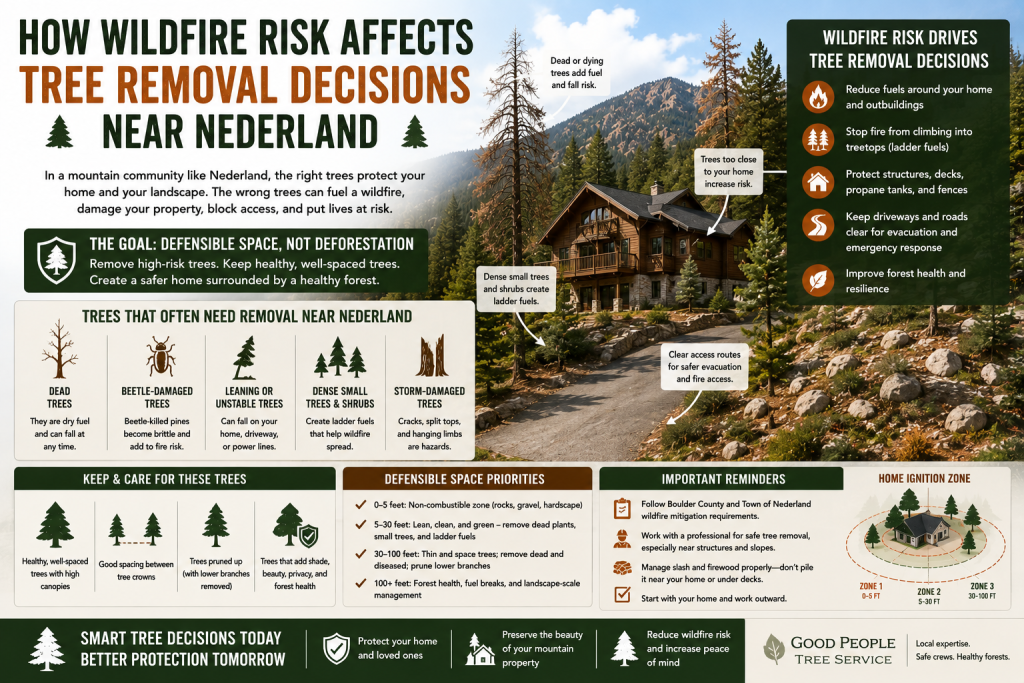
How wildfire risk affects tree removal decisions near Nederland is different from how homeowners think about tree removal in a flat suburban yard. In a mountain community, a tree is not only a landscape feature. It can affect defensible space, home safety, driveway access, fuel continuity, emergency response, slope stability, and the way fire could move through a property.
Nederland-area homes often sit close to forests, conifers, rocky slopes, narrow roads, and dense vegetation. Trees give these properties privacy, shade, beauty, wildlife habitat, and mountain character. They also create important decisions when they grow too close to homes, die from beetles, lean over driveways, collect dead branches, or create ladder fuels near decks and roofs.
Wildfire risk does not mean every tree should come down. Clear-cutting a mountain lot can damage the look, ecology, shade, privacy, and soil stability of the property. The goal is smarter selection. Some trees should stay because they are healthy, well-spaced, and valuable. Other trees should be removed because they increase fire risk, threaten structures, block access, or add dangerous fuel near the home.
Understanding how wildfire risk affects tree removal decisions near Nederland helps homeowners make practical choices before mitigation becomes urgent.
If your Nederland-area property has dead trees, beetle-damaged pines, dense conifers, low branches, or trees close to the home, Good People Tree Service can inspect the site and help you decide whether removal, pruning, spacing, or monitoring makes the most sense.
How wildfire risk affects tree removal decisions near Nederland
How wildfire risk affects tree removal decisions near Nederland starts with the home ignition zone. This is the area around the house where vegetation, trees, decks, fences, needles, firewood, shrubs, and other materials can influence whether a home survives a wildfire.
In this zone, tree removal decisions should focus on fuel reduction and structure protection. A healthy tree far from the house may stay. A dead pine next to a deck may need removal. A dense group of small conifers under larger trees may create ladder fuels and require thinning. A tree leaning over the only driveway may need removal even if it does not touch the home.
Wildfire risk changes the question from “Do I like this tree?” to “Does this tree make the property safer or more vulnerable?”
That does not remove personal preference. It simply adds safety, access, and fire behavior to the decision.
Defensible space does not mean removing every tree
Many homeowners worry that wildfire mitigation means stripping the property bare. That is not the goal.
Defensible space focuses on reducing how easily fire can move from vegetation to the home. That can involve tree removal, but it can also involve pruning, thinning, mowing, cleaning needles, moving firewood, removing dead limbs, and increasing spacing between plants.
A well-mitigated mountain property can still look natural. It can still have trees. The difference is that trees are selected and maintained more carefully.
Near Nederland, this matters because homeowners often want both safety and mountain character. The right plan should protect the home while keeping healthy trees that add value, shade, and beauty.
Dead trees become higher priorities
Dead trees usually move toward the top of the removal list on wildfire-prone properties. They add dry fuel, drop limbs, attract insects, and can fail during wind or snow.
A dead standing tree near a house, deck, driveway, propane tank, garage, or road creates several concerns at once. It can burn more readily than a healthy tree. It can fall during a storm. It can block access. It can damage structures. It can also become harder to remove safely as it dries and weakens.
Dead trees in open forest areas may sometimes remain for wildlife habitat when they are far from targets. Near the home ignition zone, they need a different level of attention.
Removal often makes sense when a dead tree stands close enough to hit a structure, block a driveway, or contribute fuel near the home.
Beetle-damaged pines can change the risk quickly
Nederland and the Boulder Foothills include many pine-covered properties. Bark beetles can attack stressed pines, especially after drought, heat, dense competition, or root stress.
A beetle-damaged pine may show boring dust, pitch tubes, exit holes, woodpecker activity, fading needles, red needles, or dead tops. By the time a pine turns red or brown, it may already be dead or close to it.
Beetle-killed pines matter in wildfire planning because they can add dry fuel and become structural hazards. They also matter because removal timing gets harder if the tree becomes brittle.
A pine with beetle signs near a house, driveway, road, or defensible space zone should be inspected early. Waiting may reduce options and increase removal difficulty.
Ladder fuels often drive removal decisions
Ladder fuels help fire move from the ground into tree crowns. They can include small conifers, shrubs, low branches, dead limbs, brush piles, and dense vegetation under larger trees.
Tree removal decisions near Nederland often focus on breaking that ladder. A homeowner may not need to remove a mature healthy pine, but small trees growing beneath it may need thinning. Lower branches may need pruning. Dead material may need cleanup.
This type of work can reduce the chance that a ground fire climbs into the canopy. It can also make a property easier to defend.
The goal is vertical separation. Remove or reduce the fuels that connect the ground to the treetops.
Tree spacing matters in mountain properties
Dense trees can create continuous crown fuel. If branches from several trees touch or overlap, fire may move more easily through the canopy. Dense stands also increase competition for moisture, which can weaken trees during drought.
Selective removal can improve spacing. Removing weak, suppressed, dead, or poorly placed trees can help remaining trees grow stronger and reduce fuel continuity.
This does not mean all trees need wide park-like spacing in every area. The most important areas are closest to the home, along driveways, around decks, near outbuildings, and near access routes.
A professional can help decide which trees provide long-term value and which trees increase risk.
Trees close to structures need extra scrutiny
Trees near homes, decks, wooden stairs, sheds, fences, and propane tanks need careful evaluation. Even healthy trees can create risk if branches touch or overhang structures, collect needles on roofs, or create continuous fuel near combustible materials.
A tree beside a deck may provide privacy, but if it is dead, heavily leaning, crowded, or full of low branches, removal may make sense. A conifer growing too close to siding or windows may also create more risk than benefit.
Near Nederland, many homes were built into forested lots. That often means trees grew close to structures for years. Wildfire risk asks homeowners to reassess those trees with safety in mind.
Sometimes pruning creates enough clearance. Sometimes removal is the better choice.
Driveway access can be a fire-safety issue
Driveways matter in mountain fire planning. A narrow or tree-lined driveway may create problems for residents leaving, firefighters entering, or equipment reaching the home.
A dead or leaning tree over a driveway can block access during wind, snow, or a fire event. Dense branches along the route may also reduce clearance for emergency vehicles.
Tree removal decisions near Nederland should include the full access route, not only the trees beside the house. A tree that cannot hit the home may still create a serious risk if it can block the only road in or out.
Homeowners should look at trees along driveways, private roads, and turnarounds. Dead, leaning, beetle-damaged, or low-branching trees along those routes deserve attention.
Slopes change how trees fail and how fire moves
Nederland-area properties often have slopes, rocky terrain, and uneven ground. Slopes change both tree failure risk and fire behavior.
A tree leaning downhill toward a house or driveway may be more concerning than a similar tree in a flat yard. Roots may grow in shallow soil around rock. Erosion, runoff, snowmelt, and freeze-thaw cycles can affect stability.
Fire can also move differently on slopes because heat rises and preheats vegetation uphill. This means tree spacing, ladder fuels, and defensible space can become especially important on hillside properties.
Removal decisions should account for slope, fall direction, access, and where the tree sits in relation to the home.
Firewood and slash affect the removal plan
Tree removal creates material: logs, branches, needles, small-diameter slash, and chips. On a wildfire-prone property, cleanup is part of the mitigation plan.
Leaving slash near the home can create new fuel. Stacking firewood against the house or under a deck can increase risk. Fresh pine material may also create pest concerns if handled poorly.
Before removing trees, homeowners should plan what happens to the debris. Material may need hauling, chipping, cutting, moving, or disposal through appropriate local programs.
Good tree removal should reduce risk, not leave a new fuel problem behind.
Healthy trees can stay when they fit the plan
Wildfire risk does not make every tree a problem. Healthy, well-spaced trees can remain part of a safe mountain landscape.
A strong tree can provide shade, reduce erosion, protect soil, support wildlife, and preserve the natural feel of the property. Removing too many trees can expose the home to more wind, sun, and slope issues.
The best decisions are selective. Keep trees that are healthy, structurally sound, properly spaced, and not creating dangerous fuel connections. Remove trees that are dead, diseased, unstable, too close to structures, or part of a high-risk fuel pathway.
This balanced approach protects both the home and the mountain setting.
Wildfire mitigation may overlap with tree health
A tree may need removal because of wildfire risk, tree health, or both. Many high-risk trees fall into more than one category.
A beetle-damaged pine may be dead and flammable. A crowded group of small conifers may create ladder fuel and compete for moisture. A drought-stressed tree may be more vulnerable to pests and more likely to fail later.
Tree health and fire mitigation often support each other. Removing weak trees can reduce competition. Pruning lower branches can reduce ladder fuels and improve structure. Cleaning deadwood can reduce hazards and fuel.
The best plan looks at the whole property, not just one tree.
Permits and local requirements can matter
Tree removal near Nederland may involve local requirements depending on property location, building status, HOA rules, Boulder County conditions, right-of-way issues, or wildfire mitigation requirements.
For new or remodeled buildings, defensible space rules may apply. Some Boulder County or town processes may involve wildfire mitigation plans, assessments, or marked vegetation for removal. HOA or site-plan conditions may also affect what homeowners can remove.
Before major tree removal, especially if several trees are involved, homeowners should check the correct local authority or program. Rules can differ between Town of Nederland properties, unincorporated Boulder County properties, and private community requirements.
A local tree service can often help homeowners understand which questions to ask before work begins.
Case example: dead pine beside a deck
A homeowner near Nederland has a dead pine beside a wooden deck. The tree still stands, but the needles have turned red and branches have started dropping. The deck connects directly to the house.
This tree creates multiple concerns. It adds dry fuel near the structure. It can drop limbs onto the deck. It may become harder to remove safely if it gets more brittle. If wildfire enters the property, the tree could add risk close to the home.
Removal may be the practical choice. The homeowner may also need to clean needles under the deck, move firewood, and check nearby trees for beetle signs.
Case example: dense young conifers under mature trees
A mountain property has several healthy mature pines. Under them, many small conifers and shrubs fill the space between the ground and lower branches.
The mature trees may not need removal. The ladder fuels below them may need thinning. Removing some small trees and pruning lower branches can break vertical fuel connections while keeping the stronger trees.
This approach preserves mountain character while reducing fire behavior concerns.
Case example: tree leaning over the driveway
A pine leans over a narrow driveway that serves as the only access to the home. The tree is still partly green, but it has dead branches and root exposure on the uphill side.
Even if the tree does not threaten the house, it threatens access. If it falls, it can block evacuation, emergency response, snow removal, and daily use.
Wildfire risk changes this decision because access is part of safety. Removal may make sense before the tree becomes an emergency.
What homeowners should inspect first
Start with the area closest to the home. Look for dead trees, conifers touching structures, branches over roofs, needles in gutters, firewood against buildings, shrubs under trees, and low branches that connect ground fuels to crowns.
Then move outward. Check driveways, access roads, propane tanks, sheds, fences, and slope areas. Look for beetle signs, dead tops, leaning trunks, crowded trees, hanging limbs, and slash piles.
After that, look at the broader forested area. Identify which trees are strong and worth preserving, and which trees may create risk over time.
This order matches how wildfire mitigation should work: start with the home and move outward.
Warning signs that removal may be needed
Tree removal may be needed when you see dead standing trees, beetle-damaged pines, red or brown needles, boring dust, bark holes, pitch tubes, heavy woodpecker activity, leaning trunks, root movement, trunk cracks, broken tops, large dead limbs, dense small conifers near the home, or branches touching structures.
Location matters. A dead tree far from the house may be lower priority. The same tree beside a deck or driveway may be urgent.
When several warning signs appear together, schedule an inspection.
When pruning may be enough
Pruning may solve some wildfire-related concerns. Removing lower branches can reduce ladder fuels. Removing dead branches can reduce hazards. Creating roof clearance can lower structure risk. Light thinning may improve spacing without removing the whole tree.
Pruning works best when the tree is healthy, structurally sound, and well placed.
Removal makes more sense when the tree is dead, unstable, heavily beetle-damaged, too close to the home, leaning toward a target, or part of dense fuel that cannot be corrected with pruning alone.
What not to do
Do not remove trees randomly without a plan. That can damage the landscape and leave the wrong trees standing.
Do not leave slash piled near structures. Do not stack firewood under decks or against the house. Do not ignore beetle-damaged trees because they still stand. Do not assume a green tree is safe if it has cracks, root movement, or major structural defects.
Do not attempt to remove large trees near power lines, structures, steep slopes, or roads by yourself.
When to call a tree service
Call a tree service when trees near your Nederland property are dead, beetle-damaged, leaning, crowded near the home, blocking defensible space goals, threatening driveways, or growing too close to structures.
Good People Tree Service can inspect the site, identify visible risk factors, remove hazardous trees, and help preserve healthy trees that still belong in the landscape.
Frequently asked questions
Does wildfire risk mean I should remove all trees near my Nederland home?
No. The goal is defensible space, not removing every tree. Healthy, well-spaced trees can often stay. Dead, crowded, unstable, or poorly located trees may need removal.
Which trees should be removed first?
Start with dead trees, beetle-damaged pines, trees touching structures, trees leaning over driveways, trees with major defects, and trees that create ladder fuels near the home.
Can pruning reduce wildfire risk?
Yes. Pruning lower branches, removing deadwood, and creating clearance can reduce ladder fuels and structure risk. Removal is needed when pruning cannot solve the problem.
Should beetle-killed pines be removed?
Often yes, especially near homes, decks, driveways, roads, utility lines, or defensible space zones. Beetle-killed pines can become brittle and add fuel.
Do I need to check local rules before removing trees?
Yes, especially for major removals, defensible space projects, new or remodeled buildings, HOA properties, or properties inside town or county review processes.
Final thoughts
How wildfire risk affects tree removal decisions near Nederland comes down to safety, spacing, access, and fuel reduction. Mountain properties need trees, but they also need thoughtful management.
The best plan removes dead, beetle-damaged, unstable, crowded, or poorly located trees while preserving healthy trees that add value and can remain safely. It also addresses ladder fuels, slash cleanup, driveway access, and defensible space around the home.
Good People Tree Service helps Nederland-area homeowners evaluate wildfire-related tree risks, remove hazardous trees, and protect mountain properties without removing more than necessary.
If your property has dead pines, dense conifers, beetle signs, trees close to structures, or branches over access routes, schedule an inspection before fire season or storm damage makes the decision more urgent.