
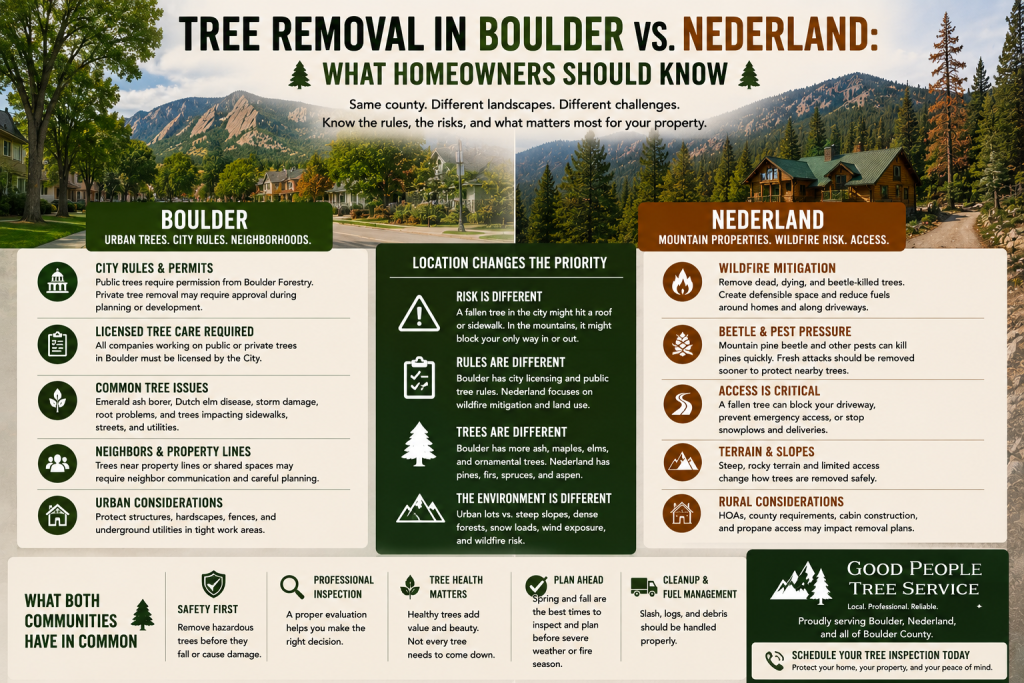
The tree itself matters, but location often matters more. A dead ash near a Boulder sidewalk creates a different problem than a beetle-killed pine above a Nederland driveway. A cracked maple beside a city home needs a different risk assessment than a leaning conifer near a mountain cabin. A public tree in a right-of-way may involve city permission, while a tree on a mountain property may require thinking about defensible space, access, and wildfire fuel.
This is why homeowners should not treat tree removal as a one-size-fits-all service. The right decision depends on tree health, ownership, local rules, safety risk, terrain, access, species, pests, and property goals.
Understanding tree removal in Boulder vs. Nederland helps homeowners ask better questions before scheduling work. It also helps avoid delays, unsafe removal attempts, and unnecessary tree loss.
If you are unsure whether a tree near your Boulder or Nederland property should be removed, Good People Tree Service can inspect the tree, evaluate visible risk factors, and help determine whether removal, pruning, treatment, or monitoring makes sense.
Tree removal in Boulder vs. Nederland
Tree removal in Boulder vs. Nederland differs because the two areas have different landscapes. Boulder has more urban and suburban tree issues. Nederland has more mountain and forest-edge tree issues.
In Boulder, tree removal often involves shade trees, street trees, private yards, alleys, sidewalks, fences, driveways, older neighborhoods, and urban forest rules. Homeowners may deal with ash trees, maples, elms, lindens, cottonwoods, honeylocusts, fruit trees, ornamentals, and trees near public property.
Near Nederland, tree removal often involves pines, spruce, fir, aspen, dense conifers, beetle damage, wildfire mitigation, snow loading, rocky slopes, narrow driveways, and access concerns. A tree may stand far from the house but still create risk if it can block the only road in or out.
The biggest difference is context. Boulder tree removal often centers on urban safety, public/private ownership, pests, and property damage. Nederland tree removal often centers on mountain safety, defensible space, beetles, access, terrain, and wildfire readiness.
Boulder tree removal is often an urban forest decision
Boulder has a developed urban forest. Trees shade homes, streets, sidewalks, parks, and neighborhoods. Many trees grow near property lines, public rights-of-way, utility corridors, and pedestrian areas.
That urban setting affects removal decisions. A tree may drop limbs over a sidewalk. Roots may affect pavement. Branches may hang over a driveway or roof. A public street tree may require permission before removal. A private tree may still require a licensed tree care company if work happens within city limits.
Boulder homeowners also need to consider neighbors. A tree that could fail onto public property may involve different responsibilities than a tree that only affects private property. The closer a tree stands to sidewalks, alleys, streets, or public spaces, the more carefully the homeowner should evaluate risk and rules.
In Boulder, removal is often not just “Can this tree come down?” It is also “Who owns it, where is it located, and what rules apply?”
Nederland tree removal is often a mountain-property decision
Nederland-area properties sit in a different environment. Many homes are surrounded by forest, slopes, conifers, rocky soil, and narrow access routes. Tree removal decisions often involve more than one tree and more than one type of risk.
A dead pine near a mountain driveway can block access during snow, wind, or wildfire evacuation. A beetle-killed tree near a deck can add dry fuel. Dense small conifers under larger trees can create ladder fuels. A leaning tree on a slope can fall downhill toward a road, cabin, or propane tank.
Nederland homeowners often need to think about the whole property, not only the single tree. Tree removal may support safety, defensible space, forest health, and emergency access at the same time.
This does not mean removing every tree. It means choosing which trees create real risk and which healthy trees should remain.
Rules and permissions can differ
Local rules matter in both places, but the questions are different.
In Boulder, homeowners should determine whether the tree is private or public. Private trees generally fall under different rules than public trees in rights-of-way, parks, or other public spaces. Public trees cannot simply be removed like private landscape trees.
Boulder also licenses tree care companies performing tree work within city limits. That matters because improper tree work can create safety problems, spread pests, or damage the urban forest.
In Nederland and nearby unincorporated Boulder County areas, homeowners should think about town rules, county requirements, wildfire mitigation plans, building permits, HOA requirements, defensible space conditions, and property-specific land-use obligations. A tree removal project connected to new construction, remodeling, or wildfire mitigation may involve more review than a single dead tree far from structures.
Before major removal in either area, homeowners should check the location and rule set. The right question is not only “Do I need a permit?” It is also “Is this tree private, public, protected by a site plan, inside a right-of-way, or tied to a wildfire mitigation requirement?”
Tree species change the removal decision
Boulder and Nederland often have different tree species and different problems.
In Boulder, ash trees remain a major concern because of emerald ash borer. Shade trees such as maples, lindens, elms, cottonwoods, and ornamentals may suffer from drought, root restriction, storm damage, decay, or poor pruning. Trees may also decline from compacted urban soil, irrigation problems, and construction damage.
Near Nederland, conifers often drive removal decisions. Pines and spruce can suffer from bark beetles, drought stress, wind exposure, snow damage, and crowding. Aspen may decline from root issues, cankers, age, or structural weakness. Dead or beetle-killed pines near homes or driveways can become urgent because they affect safety and wildfire planning.
Species matters because trees fail differently. A large cottonwood limb over a Boulder driveway creates a different problem than a dead pine above a Nederland access road. The removal plan should reflect the tree type and the setting.
Pests create different priorities
Pest pressure also changes by location and species.
In Boulder, emerald ash borer often shapes decisions about ash trees. A healthy, valuable ash may be worth treating if decline is limited. A severely declining ash near a sidewalk, driveway, or home may need removal.
In Nederland and the Boulder Foothills, bark beetles can shape decisions about pines. Mountain pine beetle and Ips beetles can attack stressed conifers. A freshly attacked pine may need faster attention than an older dead tree far from structures because timing can affect spread risk and nearby tree management.
Pest-damaged trees require more than a quick visual guess. Homeowners should look for crown thinning, boring dust, exit holes, pitch, woodpecker activity, red needles, branch dieback, and rapid decline.
Removal may be the right choice when pests have already killed or severely weakened a tree near a target. Monitoring or treatment may be possible when the tree still has value and the problem is caught early.
Wildfire risk matters more near Nederland
Wildfire risk affects Nederland tree removal more directly than many Boulder city properties. Mountain and foothills homes often sit in the wildland-urban interface, where structures and forest vegetation meet.
Defensible space planning may involve removing dead trees, thinning crowded trees, pruning ladder fuels, clearing slash, and improving spacing near homes, decks, driveways, propane tanks, and access roads.
This does not mean clear-cutting the property. A well-managed mountain lot can still have healthy trees, privacy, shade, and natural beauty. The goal is to reduce dangerous fuel continuity and improve the home’s chance of surviving wildfire.
In Boulder city neighborhoods, wildfire can still matter, especially near open space and interface areas. But many Boulder tree removal decisions focus more on public/private ownership, urban hazards, storm damage, pest management, and structural risk near homes or sidewalks.
Driveway and road access matter more in mountain areas
Access is one of the biggest differences between Boulder and Nederland.
In Boulder, a fallen tree may block a driveway, sidewalk, alley, or street. That matters, but alternate access or city response may be easier in many neighborhoods.
Near Nederland, a fallen tree can block the only driveway or private road. That can stop residents from leaving, prevent emergency vehicles from entering, delay snow removal, or create problems during wildfire evacuation.
A dead tree that cannot hit the house may still be high priority if it can block access. This is why homeowners near Nederland should inspect trees along the full driveway, not only those near the home.
A tree leaning over a narrow mountain driveway deserves different urgency than a similar tree leaning over an unused back corner of a flat yard.
Terrain changes the removal process
Terrain affects cost, safety, timing, and equipment.
Boulder properties often have tighter urban workspaces: fences, houses, garages, alleys, patios, cars, sidewalks, utilities, and neighbors nearby. Crews may need careful rigging, traffic awareness, and protection for hardscape.
Nederland properties often add steep slopes, uneven ground, rocks, limited equipment access, forest density, snow, narrow driveways, and longer haul distances. A dead pine on a slope above a driveway can require different planning than a tree in a flat front yard.
Terrain can make removal more complex even when the tree is not huge. Access, fall direction, rigging points, cleanup, and weather all matter.
Homeowners should avoid comparing removal decisions only by tree size. A smaller tree in a difficult location can create more complexity than a larger tree in an open, level yard.
Storm damage looks different in each location
Colorado storms affect both Boulder and Nederland, but the impact often differs.
In Boulder, summer wind, hail, heavy rain, and snow can break limbs over homes, sidewalks, and streets. Large shade trees may lose branches or develop cracks at weak unions. Storm cleanup may involve removing hanging limbs, deadwood, or split branches.
Near Nederland, wind and snow can affect conifers, aspens, and trees on slopes. Heavy snow can break dead pine tops or load leaning trees. Wind can push beetle-killed trees or loosen root plates. Storm-damaged trees can block private roads and mountain driveways.
In both areas, storm damage should be inspected before cutting. A branch under tension can move suddenly. A split trunk may be more serious than it first appears.
Neighbor and property-line issues are more common in Boulder
Boulder neighborhoods often have smaller lots and trees close to property lines. A tree may lean over a fence, drop limbs into a neighbor’s yard, or grow near shared boundaries.
This can make removal decisions more sensitive. If a private tree threatens only private property, the issue may become a neighbor-to-neighbor matter. If it threatens public property, sidewalks, streets, or rights-of-way, public safety concerns may become more important.
Homeowners should communicate clearly with neighbors before removing or pruning trees that affect shared areas. A professional inspection can help provide an objective basis for the decision.
In Nederland, property-line issues still happen, but mountain lots often add driveway, wildfire, slope, and access concerns that can matter more than yard boundaries alone.
Boulder homeowners should ask these questions
Before removing a tree in Boulder, homeowners should ask:
Is the tree private or public?
Is it in a right-of-way or near a sidewalk or street?
Is the property under a development agreement or planning process?
Is the tree an ash affected by emerald ash borer?
Could the tree hit public property if it fails?
Is the tree near utility lines?
Is the tree company licensed to work in Boulder?
Could pruning or treatment preserve the tree safely?
These questions help homeowners avoid rule problems and unnecessary removal. They also help separate a tree that needs removal from a tree that may need pruning, treatment, or monitoring.
Nederland homeowners should ask these questions
Before removing a tree near Nederland, homeowners should ask:
Is the tree dead, beetle-damaged, leaning, or storm-damaged?
Could it hit the home, deck, propane tank, driveway, road, or power line?
Could it block access for residents, snowplows, or emergency vehicles?
Is the tree part of a defensible space or wildfire mitigation concern?
Are there ladder fuels below it?
Is the property in town, unincorporated Boulder County, or an HOA area?
Is the tree removal connected to building, remodeling, or mitigation requirements?
What will happen to slash, logs, and firewood?
These questions make the tree removal decision more practical. They also help preserve healthy trees that should remain.
When removal is usually urgent in Boulder
Tree removal in Boulder becomes more urgent when a tree is dead, structurally unsound, split, leaning toward a home or sidewalk, dropping large limbs, blocking public access, infested beyond recovery, or near utility lines.
A public tree marked for removal should be handled through the proper city process. A private tree near a structure should be evaluated based on risk, not only appearance.
Urban trees can create serious property damage because they stand near homes, cars, fences, sidewalks, and people. A dead branch over a sidewalk or driveway needs attention even if the rest of the tree still looks alive.
When removal is usually urgent near Nederland
Tree removal near Nederland becomes more urgent when a tree is dead, beetle-killed, leaning over a driveway, standing near a structure, affecting wildfire mitigation, blocking access, or showing root instability on a slope.
A dead pine far from targets may be lower priority. A dead pine above the only driveway may be urgent. A beetle-damaged tree beside a deck may need removal before it becomes brittle. Dense small conifers near the home may need thinning to reduce ladder fuels.
Urgency comes from the combination of tree condition, fall path, access, fire risk, and weather exposure.
Removal is not always the best answer
In both Boulder and Nederland, removal should not be automatic.
A Boulder shade tree with limited deadwood may only need pruning. A healthy ash may be worth treatment. A storm-damaged tree may recover if the trunk, roots, and main structure remain strong.
A Nederland pine may remain valuable if it is healthy, well-spaced, and not part of a fuel problem. A leaning tree may be stable if the lean is old, away from targets, and not worsening.
The best tree care protects people and property while preserving healthy trees when possible. A good inspection helps homeowners avoid both mistakes: removing too soon and waiting too long.
Case example: Boulder ash near a sidewalk
A Boulder homeowner has an ash tree near the sidewalk. The upper canopy is thinning, and woodpecker activity has increased. The tree may be affected by emerald ash borer or another stress factor.
This tree needs proper evaluation. If it is private, removal rules may differ from a public street tree. If branches threaten public access, risk increases. If the tree still has strong structure and limited decline, treatment may be worth discussing. If decline is advanced, removal may be safer.
This is a classic Boulder decision: tree health, public/private location, pest pressure, and urban targets all matter.
Case example: Nederland pine above a driveway
A Nederland-area homeowner has a pine turning red above a steep driveway. Boring dust appears in bark crevices. The tree leans toward the access route.
This tree may be beetle-killed and may become more brittle over time. Even if it cannot hit the house, it can block access, delay emergency response, and add fuel near the driveway.
This is a classic Nederland decision: beetle damage, slope, access, wildfire readiness, and removal timing all matter.
Case example: Boulder maple with storm damage
A mature maple in Boulder loses one large branch during a summer storm. The trunk is sound, roots appear stable, and most of the canopy remains healthy.
This tree may not need removal. It may need proper pruning, risk assessment, and monitoring. Removing the whole tree may be unnecessary if the main structure remains strong.
In an urban yard, preserving a healthy mature shade tree can provide major value when risk can be managed.
Case example: Nederland conifer cluster near a cabin
A cabin near Nederland has several small conifers growing close to the deck and under larger trees. The trees are not all dead, but they create dense ladder fuel.
The best plan may involve selective removal, limbing, spacing, and slash cleanup rather than removing every tree. Healthy, well-spaced trees can remain while fuel continuity near the cabin is reduced.
This is where wildfire risk changes the tree removal conversation.
What homeowners should not do
Do not assume Boulder and Nederland tree removal follow the same logic. Do not remove a public tree in Boulder without proper permission. Do not hire an unlicensed company for work inside Boulder city limits. Do not ignore wildfire mitigation requirements near Nederland when tree work connects to building or remodeling.
Do not wait for dead trees near driveways, homes, or power lines to fail. Do not climb or cut large hazardous trees yourself. Do not pile slash near homes, decks, or healthy pines after removal. Do not remove healthy trees randomly when pruning, spacing, or monitoring would solve the issue.
Tree removal should be planned, not rushed or guessed.
Frequently asked questions
Is tree removal in Boulder different from Nederland?
Yes. Boulder tree removal often involves urban trees, public/private ownership, city licensing, ash trees, sidewalks, and neighbors. Nederland tree removal often involves wildfire risk, conifers, beetles, slopes, snow, and driveway access.
Do Boulder homeowners need permission to remove a private tree?
Private tree removal rules depend on location and property status. Public trees require permission. Homeowners should also check whether the property is under a development agreement or city planning process.
Why is tree removal near Nederland more wildfire-focused?
Nederland-area homes often sit in forested mountain settings. Dead trees, ladder fuels, dense conifers, slash, and driveway access can affect defensible space and wildfire readiness.
Are beetle-damaged pines near Nederland urgent?
They can be, especially if freshly attacked, near structures, near driveways, or close to healthy susceptible pines. Older dead pines far from targets may be lower priority.
Should I remove a tree or prune it?
It depends on tree condition and risk. Pruning may work for limited deadwood or storm damage. Removal may be safer for dead, unstable, severely infested, or structurally unsound trees near targets.
Final thoughts
Tree removal in Boulder vs. Nederland requires different thinking. Boulder homeowners often need to consider urban forest rules, public trees, licensed contractors, ash decline, sidewalks, neighbors, and property targets. Nederland homeowners often need to consider wildfire mitigation, beetle-damaged pines, steep terrain, access routes, snow, wind, and defensible space.
The common thread is risk. A tree should be evaluated by health, structure, location, and what it could hit or block. Removal is sometimes the safest option. In other cases, pruning, treatment, or monitoring may protect both the tree and the property.
Good People Tree Service helps homeowners in Boulder, Nederland, and nearby Boulder County communities evaluate tree removal decisions based on local conditions, not generic advice.
If you are unsure whether a tree should stay or go, schedule an inspection before storm damage, beetle spread, wildfire planning, or winter access problems make the decision more urgent.