
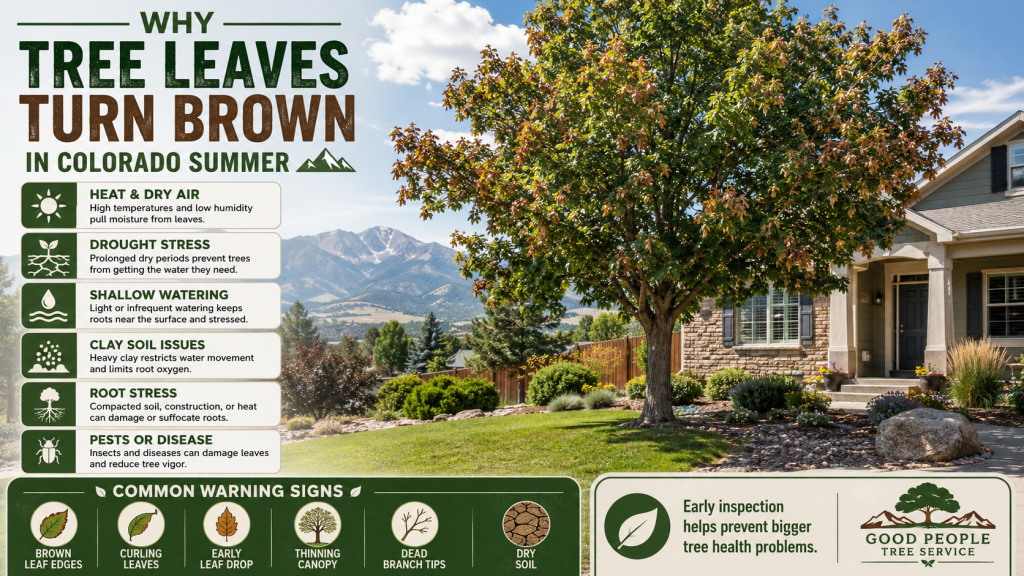
Tree leaves turn brown in Colorado summer when heat, low humidity, dry soil, root stress, and local growing conditions prevent the tree from moving enough water to the canopy. A homeowner may first notice crispy leaf edges in July, curled leaves in August, or patches of brown leaves on one side of the tree after several hot afternoons. The tree may still look alive, but the browning tells you that something in the tree’s water system has fallen out of balance.
Colorado makes this problem especially common. Front Range trees deal with dry air, intense sun, clay soil, compacted yards, shallow lawn irrigation, pavement heat, drought cycles, and sudden summer storms. A tree can look healthy in spring, then struggle once summer weather increases water demand.
Many homeowners assume brown leaves mean the tree needs more water immediately. Sometimes that is true. Other times, compaction, poor drainage, root damage, or low oxygen prevents roots from using the water already in the soil.
Understanding why tree leaves turn brown in Colorado summer helps homeowners respond correctly. Some trees need deeper watering. Others need root-zone protection, pest inspection, drainage improvement, or professional evaluation.
If a tree on your property has brown leaves, thinning canopy, dead branch tips, or summer decline, Good People Tree Service can inspect the tree and help identify the cause.
Why tree leaves turn brown in Colorado summer
Tree leaves turn brown in Colorado summer because leaves lose moisture faster than roots can replace it. Leaves constantly release water through tiny openings as part of normal tree function. Hot, dry, windy weather speeds up that water loss.
When roots cannot keep up, leaf tissue begins to dry. The edges often brown first because they sit farthest from the main veins that carry water. Tips may curl. Entire leaves may turn brown if the stress continues.
This condition often appears as leaf scorch, but leaf scorch describes a symptom, not a single cause. The tree may scorch because soil lacks moisture. Roots may also struggle because the soil has poor oxygen, compaction, construction damage, disease, or overwatering.
Common reasons include:
- drought stress
- shallow watering
- compacted soil
- clay soil problems
- root damage
- heat reflected from pavement
- overwatering or poor drainage
- pest pressure
- trunk or branch injury
- winter drought damage that shows up later
A brown leaf tells you the canopy needs help. It does not always tell you the exact cause by itself.
Leaf scorch: the most common summer explanation
Leaf scorch shows up as brown edges, crispy tips, yellowing between veins, curling, or dry patches on leaves. In Colorado, homeowners often see scorch after long periods of hot, dry, windy weather.
Leaf scorch happens when the leaf loses more water than the tree can supply. The leaf tissue dries, browns, and may die along the margins.
Some trees show scorch more often than others. Maples, lindens, cottonwoods, aspens, ash, spruce, pine, and many ornamentals can all show scorch under stress. Young trees may scorch because their roots have not expanded. Mature trees may scorch because compaction, drought, or root damage limits water uptake.
Tree leaves turn brown in Colorado summer most often when scorch develops across the canopy after heat waves. The pattern can appear stronger on the south or west side because those areas receive harsher afternoon sun.
Colorado’s dry air makes browning more likely
Colorado’s low humidity increases summer tree stress. Dry air pulls moisture from leaves quickly. Wind adds more pressure because it strips away moisture around leaf surfaces.
A tree in a humid climate may handle the same temperature with less stress. A Front Range tree faces heat, sun, wind, and dry air at the same time. That combination raises water demand.
This helps explain why tree leaves turn brown in Colorado summer even when the temperature does not seem extreme. A 90-degree day with strong sun and low humidity can stress a tree more than homeowners expect.
Street trees, driveway trees, and trees near rock mulch often struggle first. These trees live in hotter microclimates than trees in larger mulched yards or natural areas.
Drought stress often starts below ground
Drought stress begins in the root zone. When soil moisture drops, fine roots cannot absorb enough water to support the canopy. The tree may reduce growth, close leaf openings, shed leaves early, or sacrifice branch tips.
Above ground, homeowners may notice:
- brown leaf edges
- curled leaves
- small leaves
- early leaf drop
- thinning canopy
- dead branch tips
- early fall color
- increased pests
- branch dieback
Drought stress can also damage fine feeder roots. Once those roots decline, the tree may recover slowly even after watering improves. The canopy may keep browning because the root system needs time to rebuild.
This delayed recovery often confuses homeowners. They water once or twice and expect the leaves to turn green again. Brown leaf tissue usually does not become green again. The goal is to protect the remaining healthy canopy and reduce future damage.
Case example: the green lawn and brown tree leaves
A homeowner in a Colorado neighborhood notices brown leaves on a mature linden. The lawn looks green, so the homeowner assumes the tree gets enough water.
A closer look tells a different story. The sprinkler system runs short cycles. Grass roots use the surface water, but the tree needs slower watering across a wider root zone. Compacted soil near the sidewalk and afternoon pavement heat add more stress.
This is one of the most common reasons tree leaves turn brown in Colorado summer. Homeowners water the visible lawn, while the tree’s deeper and wider root zone stays stressed.
Shallow watering can leave mature trees thirsty
Mature trees need water across a wide area. Many absorbing roots grow away from the trunk and through the upper soil layers. A quick sprinkler cycle may wet grass but fail to soak enough soil for the tree.
A better summer watering approach usually uses slow, deep watering across the root zone. That often means watering under the canopy and slightly beyond it, not just at the trunk.
In Colorado, water should soak into the soil gradually. Fast watering can run off clay soil or flow away from compacted areas. A soaker hose, drip line, soft spray, or slow sprinkler cycle can work better than a short burst of irrigation.
Homeowners should check soil moisture several inches down. If the surface looks dry but deeper soil still holds moisture, wait. If the soil stays dry below the surface, the tree may need a deeper soak.
Overwatering can also turn leaves brown
More water does not always solve brown leaves.
Roots need oxygen. When soil stays saturated, roots cannot function well. Damaged roots struggle to move water into the canopy, so leaves may brown even though the soil contains plenty of water.
This happens often in clay soil, low spots, poorly drained planting areas, or yards with irrigation leaks. Overwatering symptoms may look similar to drought symptoms because both problems reduce water movement inside the tree.
Watch for wet soil, sour odor, yellowing leaves, soft ground, mushrooms in constantly damp areas, and decline despite frequent watering.
Before adding more water, check the soil. Tree leaves turn brown in Colorado summer from both too little usable moisture and too little oxygen around wet roots.
Clay soil complicates summer diagnosis
Many Colorado yards contain clay or clay-like soil. Clay can hold water and nutrients, but it can also drain slowly, compact easily, and limit oxygen.
Dry clay may harden and resist water. Wet clay may stay saturated too long. Compacted clay may block root growth and reduce air movement. This makes summer browning harder to diagnose.
A homeowner may see leaf scorch and water more. If clay soil already holds too much water, the extra irrigation worsens root stress. Another homeowner may avoid watering because clay seems wet on top, while the root zone beyond the surface stays dry.
The best approach uses soil checks, slow watering, mulch, and root-zone protection instead of guesswork.
Root damage can make leaves brown months later
Root damage often shows up in the canopy long after the damage happens.
Construction, trenching, driveway repair, sidewalk replacement, patio installation, fence work, grading, and heavy equipment can cut or compact roots. The tree may look normal at first because it still has stored energy. Later, summer heat reveals the loss of root function.
Signs may include browning leaves on one side, thinning canopy, early fall color, branch dieback, and poor growth after a recent project.
This delayed pattern explains why tree leaves turn brown in Colorado summer after a landscape or construction project. The heat did not create the root damage. It exposed it.
Homeowners should protect the root zone before any project starts. Once roots suffer damage, the tree may take years to recover, and some trees never regain full strength.
Pavement and rock mulch create extra heat
Hardscape can make tree leaves brown faster.
Driveways, streets, sidewalks, patios, walls, and rock mulch absorb heat during the day. They radiate that heat back toward trees. They can also limit root space, reduce soil moisture, and increase compaction.
A tree near a driveway may face hotter soil, drier air, and reflected sun. A tree in a rock bed may struggle more than one in organic mulch because rock can increase heat around shallow roots.
This does not mean every tree near hardscape will fail. It does mean homeowners should watch these trees closely during hot, dry weather.
A wide organic mulch ring can help reduce soil temperature swings and conserve moisture. Keep mulch away from the trunk, but spread it broadly over the root zone when possible.
Pests can cause browning too
Not all brown leaves come from water stress. Insects and diseases can also damage foliage, branches, bark, or water-moving tissue.
Aphids, mites, borers, scale insects, leaf diseases, cankers, and beetles may contribute to browning. Stressed trees often attract more pest activity because drought and root problems weaken natural defenses.
Look for sticky residue, webbing, small holes in leaves, boring dust, exit holes in bark, pitch or sap flow, dead branch tips, woodpecker activity, or sudden browning in one section.
Pests may act as the main cause or a secondary problem. Good diagnosis looks at the whole tree, not just the leaves.
Evergreens turn brown differently
Evergreens do not show browning the same way as deciduous trees.
Pines, spruce, junipers, and firs may show brown needles, tip dieback, interior needle drop, or whole-branch browning. Summer drought, winter desiccation, root damage, insects, disease, and poor planting conditions can all contribute.
A spruce that turns brown after summer heat may have root stress, drought injury, mites, needle disease, or damage that began during a dry winter. A pine that browns quickly may need inspection for bark beetles or other stress-related pests.
Brown leaves on one side of the tree
When browning appears mostly on one side, the pattern gives clues.
The affected side may face afternoon sun, pavement heat, wind exposure, root damage, irrigation gaps, or branch injury. If browning appears near a driveway or sidewalk, heat and root restriction may play a role. If it appears after trenching, root cutting may explain the pattern.
One-sided browning may also point to trunk or branch damage that interrupts water movement into part of the canopy.
Take photos from different angles and compare them over time. A stable pattern may need monitoring. A pattern that spreads quickly needs inspection.
Brown leaves after a wet period
A tree can develop brown leaves after rain or irrigation if roots sit in low-oxygen soil.
This surprises homeowners because they expect water to help. Heavy clay, poor drainage, compacted soil, or irrigation leaks can keep the root zone too wet. Roots slow down or decline, and the canopy browns because damaged roots cannot move water properly.
Check for standing water, soft soil, mushrooms, sour-smelling soil, yellowing before browning, or soggy grass nearby. If wet soil drives the problem, more irrigation will not fix it.
Brown leaves after winter drought
Colorado trees can suffer winter moisture damage that appears later.
Dry winter weather, low snow cover, wind, and frozen soil can reduce moisture available to roots. A tree may leaf out weakly, then brown during the first hot stretch because it started the season with stressed roots or low stored energy.
This is one reason Colorado tree care should not stop in fall. During dry winter periods, trees may need supplemental water when temperatures rise above freezing and soil allows absorption.
What homeowners should do first
When tree leaves turn brown in Colorado summer, start with observation and soil checks.
Look at the browning pattern. Check whether the whole canopy, leaf edges, one branch, one side, or only interior leaves show symptoms. Then check soil moisture several inches down in more than one location.
Ask whether the tree received deep water recently, construction happened near roots, water pools after irrigation, pavement reflects heat toward the tree, browning followed a heat wave, insects appear, or the tree showed stress last year.
Avoid automatic fertilizer. Fertilizer will not fix drought stress, compacted soil, root damage, or poor drainage.
How to reduce summer browning
Homeowners can reduce future browning by improving the root environment.
Helpful steps include watering slowly and deeply during dry periods, checking soil moisture before watering, mulching the root zone, keeping mulch away from the trunk, protecting roots during construction, avoiding parking under trees, fixing irrigation leaks, reducing competition from grass near young trees, pruning deadwood safely, and inspecting trees after heat waves.
Good care focuses on roots first. Healthy roots help the canopy handle summer heat.
When to call a tree service
Call a tree service when browning spreads quickly, large branches die, the tree drops limbs, the canopy thins severely, one side declines after construction, the trunk has cracks, fungi grow near the base, pests appear in the bark, or the tree stands near a home, driveway, sidewalk, fence, or utility line.
Good People Tree Service can inspect the tree, identify visible stress factors, and explain whether the problem likely comes from drought, roots, pests, disease, storm damage, or structural decline.
Frequently asked questions
Why do tree leaves turn brown in Colorado summer?
Tree leaves turn brown in Colorado summer because heat, low humidity, drought, wind, root stress, compacted soil, poor watering, pests, or disease interfere with water movement.
Will brown leaves turn green again?
Brown leaf tissue usually will not turn green again. The goal is to protect remaining healthy leaves and prevent more browning.
Should I water immediately when leaves turn brown?
Check the soil first. Dry soil may need slow watering. Wet soil may indicate poor drainage or root oxygen problems.
Are brown leaves always a sign the tree is dying?
No. Some trees recover from temporary scorch. Severe browning, branch dieback, pests, or repeated yearly decline deserves inspection.
Final thoughts
Tree leaves turn brown in Colorado summer when the canopy loses water faster than the root system can replace it. Heat, low humidity, drought, wind, compacted soil, clay, pavement, root damage, pests, disease, and winter moisture stress can all contribute.
The right response depends on the cause. More water may help a dry tree, but it can hurt a tree in saturated clay soil. Fertilizer rarely solves a root-zone problem.
Good People Tree Service helps Colorado homeowners evaluate brown leaves, leaf scorch, root stress, pest activity, and summer tree decline.
If your tree is turning brown this summer, schedule an inspection before leaf scorch becomes branch dieback or a larger safety concern.