
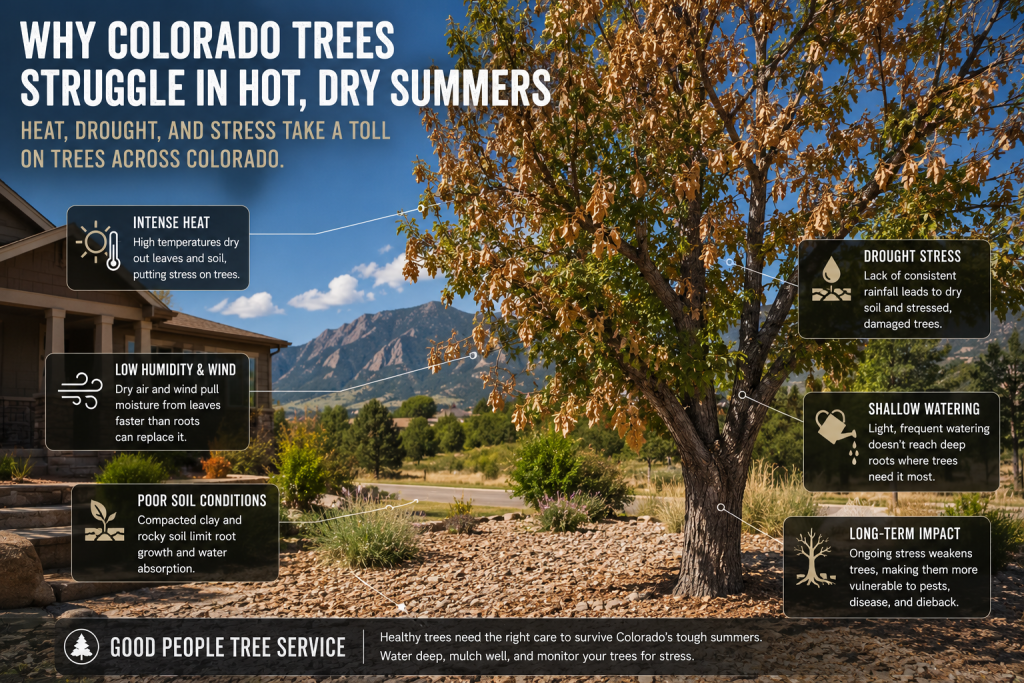
Colorado trees struggle during hot dry summers because heat, low humidity, intense sun, dry soil, and urban stress all hit the tree at the same time. A homeowner may notice brown leaf edges in July, thinning canopy in August, or dead branch tips by early fall. At first, the symptoms may look like a short-term heat problem. In reality, summer stress often starts in the roots long before the leaves show damage.
Trees along the Front Range face a difficult combination of conditions. Dry air pulls moisture from leaves faster. High elevation sun increases heat exposure. Clay soil can hold water too tightly or dry into a hard surface. Compacted soil blocks oxygen. Lawns may receive shallow sprinkler water, while deeper tree roots stay dry.
That is why Colorado trees struggle during hot dry summers even when homeowners water the lawn. Grass and trees do not always use water the same way. A lawn can look green while a mature tree still lacks enough moisture across its full root zone.
Understanding why Colorado trees struggle during hot dry summers helps homeowners notice early warning signs, water more effectively, and protect valuable shade trees before stress turns into decline.
If a tree on your property shows leaf scorch, thinning canopy, dead branches, or sudden summer stress, Good People Tree Service can inspect the tree and help determine whether watering, pruning, monitoring, or removal makes the most sense.
Why Colorado trees struggle during hot dry summers
Colorado trees struggle during hot dry summers because the tree loses water faster than the roots can replace it. Leaves release moisture through transpiration. During hot, dry, windy weather, that water loss speeds up. If roots cannot pull enough moisture from the soil, the tree begins to conserve energy and protect essential systems.
The first symptoms may seem small. Leaves curl. Edges brown. Growth slows. A few branches look thinner. Later, the tree may drop leaves early, shed small twigs, or develop more deadwood.
Several stress factors often overlap:
- drought
- low humidity
- strong sun
- compacted soil
- shallow watering
- clay soil problems
- root damage
- heat reflected from pavement
- insects and disease
- poor planting location
A tree can handle one stress better than five stresses at once. Summer becomes dangerous when heat, dry soil, and root limitations all combine.
Low humidity increases water loss
Colorado’s dry air plays a major role in summer tree stress.
In humid climates, leaves lose moisture more slowly. Along the Front Range, dry air pulls water from leaves quickly, especially during hot afternoons. Wind makes the problem worse because it removes the thin layer of moisture around leaf surfaces.
A tree responds by closing tiny leaf openings to reduce water loss. That helps the tree survive, but it also limits photosynthesis. When photosynthesis slows, the tree produces less energy. Growth drops. Defense systems weaken. Recovery becomes harder.
This is why Colorado trees struggle during hot dry summers even when temperatures do not look extreme on paper. A 92-degree day with low humidity and wind can stress a tree more than the same temperature in a more humid region.
Heat exposes root problems
Summer heat often reveals root problems that already existed.
A tree may have compacted soil, construction damage, girdling roots, poor planting depth, or limited root space. During mild weather, those issues may stay hidden. Once heat increases the canopy’s water demand, weak roots cannot keep up.
Root-related symptoms often appear in the canopy:
- leaf scorch
- smaller leaves
- early fall color
- thinning branches
- dead tips
- poor growth
- branch dieback
- increased insect activity
A homeowner may think the tree has a leaf problem. Many times, the real problem sits underground.
This matters because spraying leaves or adding fertilizer will not fix root stress. The tree needs better moisture, oxygen, soil conditions, or structural evaluation.
Case example: the green lawn and the stressed tree
Imagine a mature maple in a Colorado front yard. The lawn looks green because sprinklers run several times a week. The homeowner assumes the tree gets plenty of water.
By late July, the maple develops brown leaf edges. The top of the canopy looks thin. A few small branches die back near the upper crown.
The lawn watering helped the grass but did not fully support the tree. Short sprinkler cycles moistened the surface. The tree’s broader root zone needed slower, deeper water across a wider area. Compacted soil near the sidewalk made the problem worse.
This is a common reason Colorado trees struggle during hot dry summers. Homeowners water what they see, but the root zone that matters most may stay too dry or too compacted.
Leaf scorch is one of the clearest summer signals
Leaf scorch often appears as brown edges, crispy tips, or discolored areas between veins. It can affect maples, ash, lindens, cottonwoods, oaks, ornamentals, and many other trees.
Leaf scorch does not always mean the tree needs more water immediately. It means water movement does not match water loss. Dry soil can cause that imbalance. Wet, compacted soil can cause it too because low oxygen reduces root function.
That is why homeowners should check soil moisture before changing the watering schedule. Soil that feels dry several inches down may need slow watering. Soil that feels wet or smells sour may need time to drain.
Leaf scorch gives an early warning. If the homeowner responds correctly, the tree may recover. If the stress continues year after year, the tree may lose branches or decline.
Clay soil creates summer watering challenges
Many Colorado yards contain clay or clay-like soil. Clay can help trees by holding water and nutrients, but it also creates problems.
Dry clay can become hard and resistant to water. Fast irrigation may run off instead of soaking in. Wet clay can stay saturated too long and limit oxygen. Compacted clay makes both problems worse.
A tree growing in clay soil may face drought stress and overwatering stress in the same season. During a hot dry stretch, roots may lack usable moisture. After heavy watering or storms, roots may sit in low-oxygen soil.
This swing creates confusion. Leaves brown, so the homeowner waters more. If poor drainage caused root stress, extra water makes the problem worse. Later, the homeowner cuts back too much, and the tree dries out.
The better strategy uses slow watering, mulch, and soil checks instead of guesswork.
Compacted soil weakens trees before heat arrives
Compacted soil reduces pore space. Roots need those spaces for oxygen and water movement. Once foot traffic, construction equipment, vehicles, or repeated mowing compacts the soil, roots struggle to grow and function.
Compaction often appears in Colorado neighborhoods near driveways, sidewalks, patios, streets, and new construction. It may also occur under mature trees where people gather, park, store materials, or move equipment.
A compacted root zone reduces a tree’s tolerance for drought, heat, wind, insects, and disease. That means the tree may survive spring but struggle once July heat arrives.
Signs of compaction-related stress include limited growth, leaf scorch, canopy thinning, surface roots, branch dieback, and poor recovery after drought.
Heat reflected from hardscape adds stress
Urban yards create extra heat. Concrete, asphalt, rock mulch, patios, walls, and driveways absorb sunlight and radiate heat back toward trees.
A tree near pavement may experience a hotter microclimate than a tree in a mulched landscape bed. Hardscape also limits root space and can block water movement. Roots may grow under sidewalks or along driveway edges because they seek oxygen and moisture near the surface.
This is why a street tree or driveway tree may struggle more than a similar tree in a park. A tree does not live in the air temperature reported by the weather app. It lives in the heat, soil, and moisture conditions around its trunk and roots.
Drought stress can damage fine roots
Fine feeder roots absorb most water and nutrients. These roots are small, delicate, and often short-lived. Heat and drought can kill or suppress them.
Once fine roots decline, the tree may recover slowly even after watering improves. The tree must rebuild part of the root system before it can fully support the canopy again.
This delayed recovery explains why some trees look worse after the hottest weeks have passed. The damage may have already happened below ground.
A drought-stressed tree may also lose stored energy. With less energy, it defends itself poorly against insects and diseases. Borers, cankers, mites, aphids, and other problems may become more noticeable after dry summers.
Colorado trees struggle during hot dry summers because drought does not only affect leaves. It affects the roots, energy reserves, defenses, and long-term recovery.
Newly planted trees struggle even more
Newly planted trees face a different challenge from established trees.
Their roots still sit mostly inside the original root ball. Even if surrounding soil contains moisture, the root ball can dry out quickly. A young tree may wilt, scorch, or fail during hot weather because its root system has not expanded enough.
Many homeowners water the lawn and assume the new tree benefits. The root ball may still dry out. Another homeowner may water every day and keep the planting hole too wet, which reduces oxygen.
New trees need careful moisture management. They also need correct planting depth, visible root flare, mulch that stays away from the trunk, and protection from mower damage.
A drought-tolerant species does not act drought-tolerant immediately after planting. It needs time to establish roots first.
Mature trees can decline slowly after repeated summers
Mature trees often hide stress for a long time.
A large shade tree has stored energy and a broad root system. It may survive one tough summer, then another, while gradually losing vigor. By the time the homeowner notices serious dieback, the tree may have struggled for several seasons.
Slow decline may show as smaller leaves, thinning canopy, more deadwood, early fall color, branch drop, and increased pest activity.
This pattern explains why Colorado trees struggle during hot dry summers year after year before they appear truly unhealthy. The decline does not always happen in one season. Repeated summer stress reduces the tree’s margin of safety.
A tree that looks slightly thinner each year deserves attention before the canopy loss becomes severe.
Some trees drop twigs or branches during summer stress
Some trees respond to summer stress by shedding small branches or twigs. Cottonwoods, for example, may drop smaller branches during hot dry weather. Arborists often connect this pattern to stress, drought, and soil compaction.
Large branch drop needs more caution. A heavy limb can fail because of decay, weak unions, drought stress, or old storm damage. Heat does not always act alone, but hot dry weather can contribute to the stress load.
Homeowners should pay attention when a tree starts dropping branches during summer, especially near a driveway, sidewalk, patio, or roof. A few small twigs may not signal an emergency. A large falling limb deserves inspection.
Insects and disease often follow summer stress
Healthy trees defend themselves better than stressed trees. Hot, dry summers weaken that defense.
Drought-stressed trees may become more vulnerable to borers, bark beetles, cankers, mites, aphids, and fungal problems. Insects may not cause the original problem. They may arrive because drought, compaction, or root damage weakened the tree first.
Warning signs include boring dust, small exit holes, pitch or sap flow, bark peeling, sudden branch dieback, woodpecker activity, rapid needle browning, sticky residue, mite damage, and fungal growth near wounds.
Watering should focus on the root zone, not the trunk
Many homeowners water too close to the trunk.
Most absorbing roots grow away from the trunk and through the upper soil. Mature trees need water spread across a wide area under the canopy and often beyond it. Slow watering works better than quick surface watering.
Good summer watering often involves a soaker hose, soft spray, drip system, or slow sprinkler cycle that allows water to soak into the root zone. The goal is not to flood the trunk. The goal is to moisten the active root area.
For many trees, water should reach roughly 12 inches deep across the critical root zone. In clay soil, this requires patience. In sandy or rocky soil, it may require more frequent checks.
Mulch helps trees handle summer heat
Mulch gives trees a major advantage during hot dry summers.
A wide mulch ring helps conserve moisture, reduce soil temperature swings, limit weed and grass competition, and protect surface roots from mowers. It also improves the soil environment as organic material breaks down.
Mulch should not touch the trunk. Piling mulch against bark traps moisture and can encourage decay or pests. A flat ring works better than a mulch volcano.
For Colorado trees, mulch can reduce stress around both young and mature trees. It will not fix every problem, but it can make watering more effective and protect the root zone during hot weather.
What homeowners should check during summer
A summer tree check does not require climbing or cutting.
Look for leaf scorch, early leaf drop, smaller leaves, thinning canopy, dead branch tips, branch drop, bark cracking, insect holes, sap flow, mushrooms, surface roots, dry soil, wet soil, and changes after heat waves.
Pay attention to location. Trees near sidewalks, streets, rock beds, driveways, patios, and new construction often face more stress. Recently planted trees need extra attention. Trees with past storm damage also deserve monitoring.
Photos help track changes. Take pictures from the same angle each month during summer. Subtle decline becomes easier to see over time.
When summer stress becomes urgent
Some summer symptoms need faster action.
Call for an inspection if you notice large dead limbs, sudden canopy collapse, severe leaf loss, a new lean, soil lifting near roots, large branch drop, trunk cracks, mushrooms near the base, rapid needle browning, or major dieback near structures.
A tree does not need to fall to create risk. Dead branches and weakened limbs can damage homes, vehicles, fences, and people.
If a stressed tree stands near a house, sidewalk, driveway, play area, or utility line, treat the situation more seriously.
Frequently asked questions
Why do Colorado trees struggle during hot dry summers?
Colorado trees struggle during hot dry summers because heat, low humidity, dry soil, wind, compacted soil, and root limitations can make trees lose water faster than roots can replace it.
Should I water trees more often in summer?
Not always. Check soil moisture first. Trees usually benefit from slow, deep watering across the root zone rather than frequent shallow watering.
Why are my tree leaves turning brown on the edges?
Brown leaf edges often point to leaf scorch. Heat, drought, wind, poor soil oxygen, compacted soil, and root stress can all contribute.
Do mature trees need summer watering in Colorado?
Many mature trees benefit from supplemental water during prolonged hot, dry periods, especially if they grow in non-irrigated areas, compacted soil, or hardscape-heavy yards.
Final thoughts
Colorado trees struggle during hot dry summers because summer stress affects the whole tree, not just the leaves. Dry air increases water loss. Heat raises demand. Compacted soil limits root function. Clay soil complicates watering. Hardscape adds heat. Drought damages fine roots and weakens defenses.
Some trees show stress quickly. Others decline slowly over several summers. The earlier homeowners notice leaf scorch, canopy thinning, branch dieback, or root-zone problems, the more options they usually have.
Good People Tree Service helps Colorado homeowners evaluate summer tree stress, identify root and soil problems, remove hazardous limbs, and decide whether a declining tree can recover.
If your tree is browning, thinning, dropping branches, or struggling during hot dry weather, schedule an inspection before summer stress turns into a larger tree health or safety issue.