
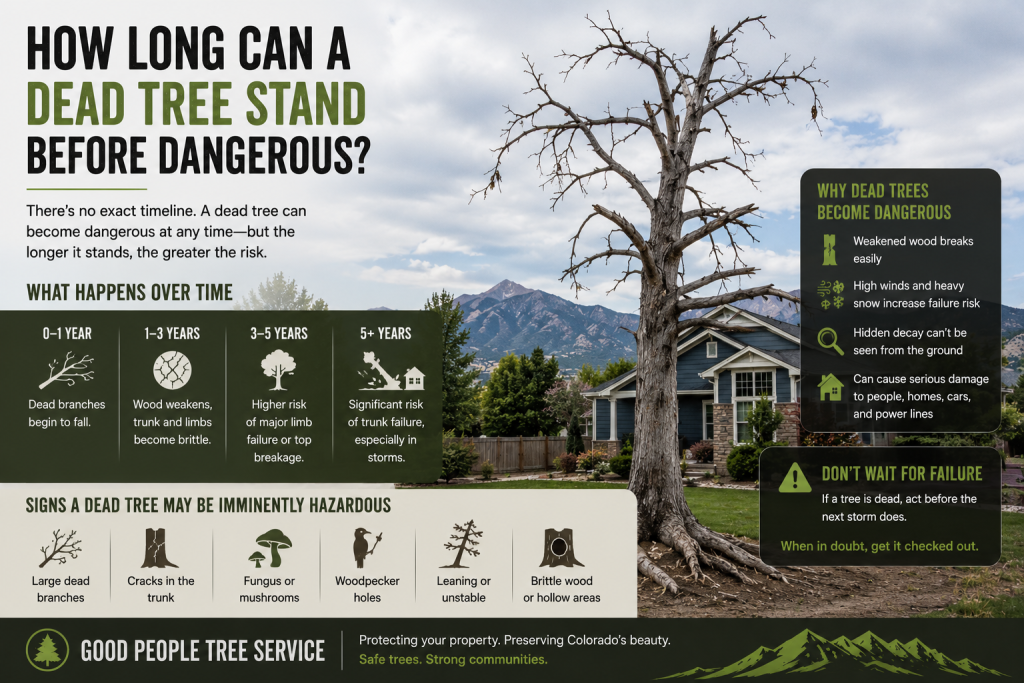
How long can a dead tree stand before it becomes dangerous? The honest answer is that there is no safe universal timeline. Some dead trees may stand for years in a low-risk area. Others can become hazardous within months, especially if they are near a home, driveway, sidewalk, fence, power line, or outdoor living space.
A dead tree is not stable forever. Once a tree dies, it stops producing new living tissue, stops defending itself against decay, and slowly loses structural strength. Branches become brittle. The trunk begins drying and breaking down. Roots may decay underground. At some point, the tree becomes less predictable.
For Colorado homeowners, this question matters because local weather can speed up risk. Dry air, intense sun, heavy wet snow, high winds, freeze-thaw cycles, drought stress, and insect activity can all affect how quickly a dead tree becomes unsafe.
The biggest mistake is assuming that a dead tree is fine because it is still standing. Standing does not mean stable. It only means the tree has not failed yet.
If a dead tree is located near people, structures, driveways, sidewalks, or neighboring property, Good People Tree Service can inspect it and help determine whether planned removal is safer than waiting for failure.
How long can a dead tree stand before it becomes dangerous?
How long can a dead tree stand before it becomes dangerous depends on the tree species, size, location, cause of death, trunk condition, root condition, and weather exposure. A small dead tree in an open area may create limited risk for a while. A large dead tree leaning toward a house is a different situation.
Some trees decay slowly. Dense wood may remain standing longer than softer or already weakened wood. Trees that died from drought may dry out differently than trees killed by root rot, insects, or trunk decay.
Location also changes the answer. A dead tree in a remote field may be mostly an ecological feature. The same dead tree next to a roof, driveway, street, or play area becomes a hazard much sooner because the consequences of failure are higher.
That is why the better question is not only how long the tree can stand. The real question is how long it can stand safely where it is.
A dead tree keeps changing after it dies
A living tree is active. It moves water, produces energy, responds to wounds, and grows new tissue. Once the tree dies, those systems stop.
Decay organisms begin breaking down wood. Insects may enter. Bark may loosen. Branches dry out. Roots begin losing strength. The tree becomes more brittle with time.
This process can be slow, but it is always moving in the wrong direction from a safety standpoint. A dead tree does not become stronger after death. It either stays temporarily stable or becomes weaker.
That is why homeowners should not treat a dead tree as a fixed object. The risk changes over time, even if the tree looks similar from one month to the next.
The first risk is often falling branches
Before an entire dead tree falls, large branches may begin breaking off.
Dead branches lose flexibility. They may snap during wind or snow, but they can also fall during calm weather after decay has weakened the attachment point. A large dead branch high in the canopy can damage a roof, fence, vehicle, deck, patio, or person underneath.
Dead branches are especially concerning when they are over a home or garage, above a driveway or sidewalk, near a street, hanging over a play area, high in the canopy, large enough to cause damage, or already cracked or broken.
This is why how long can a dead tree stand before it becomes dangerous often depends on the canopy first. The trunk may remain standing, but the branches may already be hazardous.
The trunk becomes less predictable over time
As a dead tree dries and decays, the trunk can lose strength from the inside or outside.
Some trunks remain solid for a while. Others develop cracks, cavities, soft spots, bark loss, or fungal decay. The outside may look mostly intact while internal wood breaks down.
Warning signs include bark falling off in large sections, vertical cracks, hollow areas, soft or crumbly wood, mushrooms or conks, insect holes, woodpecker activity, and dark or wet-looking decay pockets.
A dead trunk can fail at the base, snap partway up, or split where major limbs attach. The exact failure point is hard to predict without inspection.
This unpredictability is one reason dead tree removal becomes more difficult when homeowners wait too long.
Roots may decay before the tree falls
Root decay is one of the most dangerous hidden problems.
A dead tree may still look upright while roots are weakening underground. Once roots decay enough, the tree can lose anchorage. It may fall during a storm, after wet soil, or even during calm conditions if the root plate can no longer support the trunk.
Root risk increases when the tree died from root disease, flooding, poor drainage, soil compaction, construction damage, or long-term drought stress.
Visible signs may include mushrooms near the base, soil lifting or cracking, new leaning, exposed decayed roots, soft soil near the trunk, and sudden movement after rain or snowmelt.
When roots are involved, waiting is especially risky because homeowners cannot see most of the damage.
Colorado weather can speed up the danger
Colorado weather can turn a standing dead tree into a problem quickly.
High winds put pressure on brittle branches and dead trunks. Wet spring snow adds weight to already weakened limbs. Freeze-thaw cycles can expand cracks. Dry conditions can make dead wood more brittle. Sun exposure can loosen bark and accelerate drying.
A dead tree may stand through one season and fail in the next. Sometimes a tree survives several storms, then drops a limb on a calm day because decay has progressed.
The Front Range can also bring sudden weather changes. A dead tree near a house may look quiet for months, then face wet snow, wind, or saturated soil in a short period.
That is why Colorado homeowners should not use “it survived the last storm” as proof that a dead tree is safe.
Case example: the dead tree near a driveway
A homeowner notices that a mature tree near the driveway did not leaf out in spring. The bark still looks mostly intact, so removal is postponed. During summer, small branches start dropping. By fall, a larger limb falls near a parked car.
The tree has not fallen completely, but it has already become dangerous.
In this case, how long can a dead tree stand before it becomes dangerous is not measured by when the trunk falls. The hazard begins as soon as dead branches can land where people or property are present.
Planned removal would likely be safer than waiting for the next limb to fall.
Case example: the dead tree in an open corner of the yard
Another homeowner has a small dead tree in the back corner of a large property. It is far from the house, fence, vehicles, walkways, and neighbors. No one spends time under it.
This tree may be lower priority than a dead tree next to a home.
Even then, it should still be monitored. If it begins leaning, dropping large limbs, attracting pests, or creating fire fuel concerns, removal may become more important.
This is why location matters so much. Risk is not only about the tree. It is also about what the tree could hit.
Dead trees can become harder to remove safely
Waiting too long can make tree removal more complicated.
A dead tree may become too brittle to climb safely. Limbs may break unexpectedly. The trunk may not hold rigging well. Decayed roots can make the tree unstable during removal. More equipment may be needed if the tree is near structures.
This can affect cost and risk.
A planned removal while the tree is still structurally manageable is often easier than emergency removal after the tree has partially failed.
Homeowners sometimes wait because they hope removal will be simpler later. In reality, dead trees usually become more difficult to handle as decay progresses.
Insects, fungi, and pests may move in
Dead wood is part of the natural ecosystem. It provides habitat for insects, fungi, birds, and small wildlife. In a forest, this can be valuable.
In a residential yard, the situation is different.
A standing dead tree near a home may attract insects, woodpeckers, fungi, or decay organisms. Not every insect is a threat to the house, but increased activity near structures may be unwanted.
Some pests are attracted to stressed or recently dead wood. If nearby trees are also stressed, pest pressure may become part of a broader landscape concern.
Fungal decay can also continue weakening the trunk and roots. The longer the tree remains standing, the more decay can progress.
Fire risk can matter in Colorado landscapes
In some Colorado neighborhoods, wildfire risk is part of property management.
A dead tree contains dry fuel. A single dead tree in an irrigated urban lawn may not create the same concern as dead trees near foothills, open space, or wildland-urban interface areas. Still, dead wood close to structures deserves attention.
Colorado State Forest Service defensible space guidance often emphasizes reducing flammable material near homes and managing vegetation around structures. For homeowners in higher-risk areas, a dead standing tree may be part of a larger fire mitigation conversation.
If a dead tree has branches over the roof, drops dry material near the house, or stands close to other vegetation, removal may be more urgent.
Insurance and liability concerns
Insurance questions can become complicated when a dead tree damages property.
A healthy tree that falls during a covered storm may be treated differently from a visibly dead or neglected tree. If a tree was clearly dead, decayed, or known to be hazardous before it fell, homeowners may face more questions about maintenance and responsibility.
This is especially important near property lines.
If your dead tree falls into a neighbor’s yard, damages a fence, or hits a structure, the situation can become stressful. Documentation, prior warnings, and visible neglect may matter.
Insurance policies vary, so homeowners should not rely on assumptions. From a practical standpoint, removing a known dead tree near targets is usually safer than waiting for a claim situation.
How to tell whether a dead tree is becoming dangerous
A dead tree should be evaluated more quickly when signs of structural weakness appear.
Look for large dead limbs, new lean, deep trunk cracks, bark falling off, mushrooms near the base, hollow trunk areas, loose or hanging branches, roots lifting or decaying, branches over structures, woodpecker activity, recent storm damage, and proximity to people or property.
The more signs you see, the more urgent the situation becomes.
A dead tree does not need to show every symptom to be dangerous. One large dead limb over a driveway may be enough to justify action.
When removal should be a priority
Removal should be a priority when a dead tree is close to a target.
Targets include homes, garages, sheds, fences, vehicles, sidewalks, streets, patios, play areas, utility lines, and neighboring properties.
A dead tree in one of these locations should not be treated as a long-term feature. Even if it has stood for months or years, its condition will continue declining.
Removal is also more urgent if the tree is leaning, cracking, shedding large limbs, showing decay at the base, or located where children, pets, or visitors spend time.
If utility lines are involved, homeowners should stay away and contact the utility company or appropriate professionals.
Can a dead tree ever be left standing?
Sometimes, a dead tree can be left standing, but only when risk is low and the location is appropriate.
A dead tree far from homes, roads, trails, power lines, fences, and high-use areas may be left temporarily for wildlife habitat or natural decomposition. In larger rural properties, landowners may choose to retain some dead snags when they do not create a hazard.
Residential lots are different because space is limited and targets are usually nearby.
A dead tree in a small yard, near a home, or close to public access is rarely a good long-term candidate for leaving standing.
The decision should be based on risk, not simply preference.
What homeowners should not do
Dead trees can be dangerous to work around.
Avoid climbing a dead tree. Do not cut large limbs from a ladder. Stay away from hanging branches. Avoid pulling a dead tree with a vehicle, rope, or chain. Never work near utility lines.
Dead limbs can break without warning. A trunk may split unexpectedly. Roots may be weaker than they look.
DIY removal is especially risky when the tree is large, leaning, decayed, or near structures.
A professional tree service has the equipment and experience to control the work safely.
What happens after dead tree removal?
After removal, the homeowner can decide what to do with the stump and surrounding area.
Stump grinding is often recommended when the stump is in a lawn, planting bed, walkway area, or visible part of the yard. Grinding improves appearance, removes a mowing obstacle, reduces trip hazards, and prepares the space for future landscaping.
If the tree died from disease or pests, cleanup and disposal may also matter. The surrounding trees should be checked for similar stress symptoms.
Removal should not be the end of the conversation. It is also a chance to understand why the tree died and how to protect the rest of the landscape.
How to reduce future dead tree problems
The best way to avoid dangerous dead trees is to catch decline earlier.
Helpful steps include inspecting mature trees every year, removing deadwood before it falls, watering during drought, protecting roots during construction, avoiding soil compaction, monitoring insect activity, checking trees after storms, pruning for structure, addressing leaning early, and removing high-risk dead trees promptly.
Colorado trees face drought, snow, wind, insects, and compacted urban soils. Regular inspections help homeowners make decisions before emergencies happen.
Frequently asked questions
How long can a dead tree stand before it becomes dangerous?
There is no universal timeline. A dead tree may stand for months or years, but it becomes dangerous sooner when it is near a home, driveway, sidewalk, fence, street, or power line.
Will a dead tree fall on its own?
Eventually, most dead trees break down and fall in pieces or as a whole tree. Branches may fail first, followed by trunk or root failure.
Is a dead tree more dangerous in Colorado?
Colorado conditions can increase risk because wind, wet snow, dry air, freeze-thaw cycles, drought, and insect activity can weaken dead trees faster.
Should I remove a dead tree right away?
A dead tree near people or property should be inspected and usually removed sooner rather than later. Dead trees in open low-use areas may be lower priority but should still be monitored.
Can a dead tree damage nearby healthy trees?
Sometimes. If insects or disease contributed to death, nearby stressed trees may also be at risk. A professional inspection can help identify whether the issue is isolated.
Final thoughts
How long can a dead tree stand before it becomes dangerous depends on the tree’s condition, species, size, location, decay level, root stability, and exposure to weather. Some dead trees stand for a while, but none become safer with time.
The most important factor is location. A dead tree near a home, driveway, sidewalk, garage, fence, play area, or neighbor’s property should be taken seriously. Waiting may allow branches, trunk wood, and roots to weaken further.
Good People Tree Service helps Colorado homeowners evaluate dead trees, remove hazardous limbs, grind stumps, and safely remove trees before they cause damage.
If you have a dead tree on your property, schedule an inspection before the next storm, snowfall, or season of decay turns it into an emergency.