
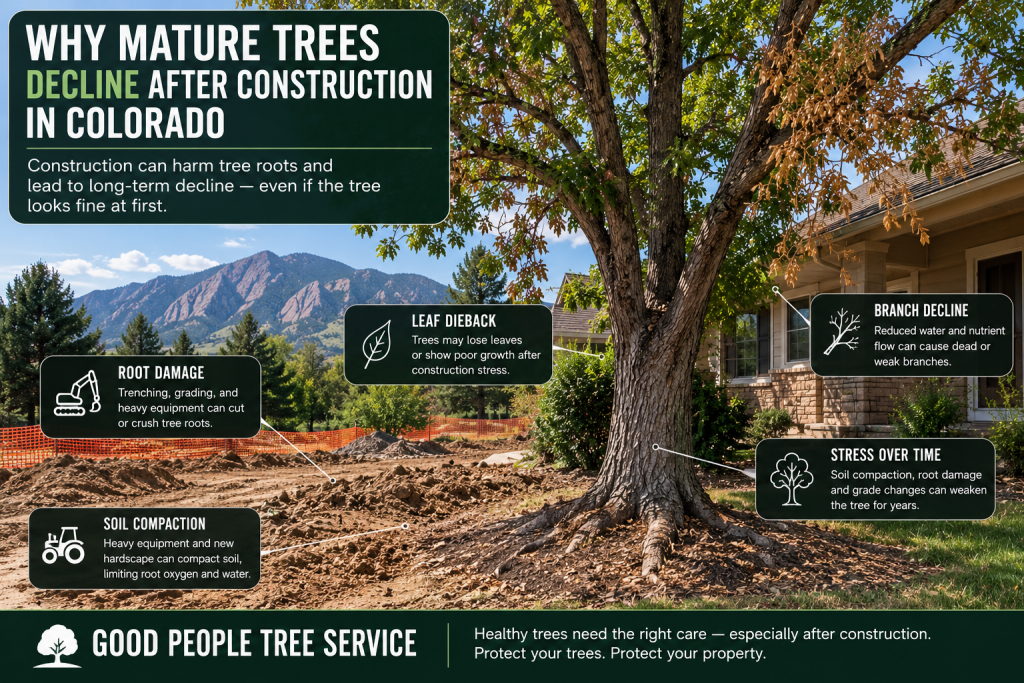
Why mature trees in Colorado neighborhoods decline after construction is a question many homeowners ask only after the damage becomes visible. A patio is finished. A driveway is replaced. A new fence, addition, sidewalk, or utility line is installed. For a while, the tree may look normal. Then one or two seasons later, the canopy begins thinning, leaves scorch in summer, branches die back, or the tree suddenly looks weaker than it did before the project.
The timing can feel confusing. If the construction happened last year, why is the tree declining now? If the trunk was never touched, how could the project have caused damage? The answer is usually underground.
Mature trees rely on wide, shallow root systems. Many important roots grow close to the surface and extend far beyond the trunk. Construction can cut, crush, compact, bury, dry out, or suffocate those roots without leaving obvious above-ground damage right away.
For Colorado homeowners, this issue is especially important because Front Range trees already deal with clay soils, drought stress, dry air, heavy wet snow, compacted landscapes, and sudden weather changes. Construction stress can push a mature tree that was coping into a slow decline.
Understanding why mature trees in Colorado neighborhoods decline after construction helps homeowners protect valuable trees before projects begin and recognize warning signs early.
If a mature tree near a recent project is thinning, dropping branches, leaning, or showing leaf scorch, Good People Tree Service can inspect it and help determine whether pruning, monitoring, soil care, or removal should be considered.
Why mature trees in Colorado neighborhoods decline after construction
Why mature trees in Colorado neighborhoods decline after construction usually comes down to root injury and soil disturbance. A mature tree may look strong because the trunk is large and the canopy is full, but the tree depends on thousands of roots that are easy to damage.
Most of those roots are not deep underground. They grow through the upper soil where oxygen and moisture are available. When construction activity happens under or near the canopy, roots may be harmed even when workers avoid hitting the trunk.
Common construction impacts include:
- trenching through roots
- compacting soil with equipment
- changing soil grade
- piling materials over the root zone
- removing soil around roots
- installing hardscape over roots
- changing drainage patterns
- cutting roots for foundations or utilities
- storing debris near the tree
- removing nearby trees that protected the site
A mature tree can survive some stress. The problem is that construction damage often affects several parts of the root system at once.
Construction damage often shows up late
One of the hardest parts of construction-related tree decline is the delay.
A tree may not show obvious symptoms immediately after roots are cut or soil is compacted. The canopy may still have stored energy. Existing leaves may finish the season. Roots that remain alive may keep the tree functioning temporarily.
Months later, the damage becomes harder to hide.
Symptoms may appear as:
- smaller leaves
- fewer leaves
- leaf scorch
- early fall color
- branch dieback
- thinning crown
- deadwood
- reduced growth
- increased insect activity
- sudden limb drop
This delay is why homeowners sometimes miss the connection between the project and the decline. The tree may look fine during construction and begin failing one to three years later.
Mature trees have wide root systems
Many homeowners underestimate how far tree roots spread.
A mature tree’s root system can extend well beyond the dripline. That means roots may be growing under lawns, walkways, driveways, patios, planting beds, and areas where equipment is parked.
Protecting only the trunk is not enough.
A fence placed around the trunk may prevent bark damage, but it does not protect most of the root zone. Heavy equipment outside that small circle can still compact soil and crush roots. Trenching several feet from the trunk can still cut important roots.
This is one reason why mature trees in Colorado neighborhoods decline after construction even when the tree “looked protected.” The visible protection may not have covered the area that mattered most.
Soil compaction is one of the biggest hidden problems
Soil compaction is a quiet but serious construction injury.
When heavy equipment, trucks, trailers, dumpsters, pallets, or repeated foot traffic move over the root zone, soil particles are pressed together. Pore space decreases. Oxygen movement slows. Water may run off or pool. Roots have a harder time growing through the soil.
Colorado clay soils can make compaction worse because they already tend to be dense and slow draining. Once compacted, clay can limit oxygen and root expansion for years.
The tree may respond slowly. Leaves may become smaller. Growth may stall. Branches may die back at the top. Drought tolerance may drop.
Compaction often looks harmless from above. The ground may simply look flattened. Underground, the tree may have lost the air space roots need to function.
Trenching can remove critical roots
Trenching for utilities, irrigation, drainage lines, fences, or foundations can cause major root damage.
A trench does not need to be close to the trunk to matter. Large roots may extend far into the yard. Cutting them can reduce water uptake, remove stored energy, create decay entry points, and affect stability.
The most damaging trenches are often long and continuous because they cut across many roots at once. A narrow trench through the root zone can act like a wall, separating the tree from part of its support system.
If trenching happens on multiple sides of a tree, the risk increases.
A tree may continue standing after root cutting, but its ability to handle drought, wind, snow, and heat may be reduced. Later, the tree may decline or become less stable.
Grade changes can suffocate or expose roots
Changing the soil grade around a mature tree can be harmful.
Adding soil over roots reduces oxygen. Removing soil can expose roots, dry them out, or physically damage them. Both raising and lowering grade can interfere with root function.
During construction, grade changes may happen when soil is leveled, patios are installed, retaining walls are added, fill is brought in, or drainage is adjusted.
A few inches can matter around a mature tree, especially when soil is compacted afterward. Roots that were functioning in the upper oxygen-rich zone may suddenly be buried too deep. Exposed roots may dry, crack, or be damaged by tools and equipment.
This is another reason why mature trees in Colorado neighborhoods decline after construction even when no one cut the trunk or branches.
Hardscape can limit future root function
Driveways, patios, sidewalks, and walkways can change the tree’s environment after construction is finished.
Hardscape may reduce the amount of open soil available for water and oxygen. It can reflect heat. It may compact the soil below. In some cases, it changes drainage and directs water away from the root zone.
A mature tree that once had lawn, mulch, or open soil around part of its roots may suddenly be surrounded by concrete, pavers, or gravel.
That does not always kill the tree. If roots were cut during installation and the remaining root zone is covered or compacted, decline may follow.
Hardscape conflicts are especially common in older Colorado neighborhoods where large trees grow near driveways, sidewalks, alleys, and home additions.
Case example: the driveway replacement
A homeowner replaces an old driveway next to a mature shade tree. During demolition, roots are exposed along the driveway edge. Some are cut to make room for the new concrete. Equipment parks under the canopy, and soil near the driveway is compacted.
The tree looks fine through the first summer. The next year, leaves on the driveway side are smaller. By the second year, the upper canopy begins thinning. A few dead branches appear over the parking area.
The decline is not random. Root cutting, soil compaction, heat from pavement, and reduced moisture access all contributed.
This is a common pattern in Colorado neighborhoods where mature trees and hardscape have grown into the same space.
Case example: the backyard addition
Another homeowner adds a sunroom at the back of the house. The contractor avoids the trunk of a nearby tree, but the project requires grading, material storage, trenching, and repeated equipment access under the canopy.
After construction, the tree still leafs out. Two seasons later, the canopy is sparse, and branches on the construction side are dying.
The tree was not damaged in one dramatic moment. It was damaged by many smaller impacts that added up.
This kind of cumulative stress is one of the clearest reasons why mature trees in Colorado neighborhoods decline after construction.
Construction can change drainage patterns
Tree roots are sensitive to water patterns.
A project can change how water moves through a yard. New roofs, patios, downspouts, retaining walls, grading, and drains may redirect water toward or away from the root zone.
Too little water can cause drought stress. Too much water can reduce oxygen and encourage root problems. Either extreme can weaken the tree.
Colorado soils often make this more complicated. Clay may hold water too long after rain or irrigation, while compacted areas may shed water instead of absorbing it.
A mature tree that lived for decades with one drainage pattern may decline when that pattern changes suddenly.
Drought makes construction damage worse
Construction damage is more serious when the tree is already drought stressed.
A healthy tree with strong roots may tolerate minor disturbance better than a tree that has spent several dry years under stress. Drought reduces fine roots, lowers stored energy, and makes trees more vulnerable to insects and disease.
If construction cuts or compacts roots during a drought period, the tree has less ability to recover.
Along the Front Range, hot summers, dry winters, and inconsistent irrigation can make that combination harder to survive.
Insects and disease often arrive after stress
Insect activity after construction does not always mean insects caused the original problem.
Stressed trees are more vulnerable. Once roots are damaged and the canopy begins thinning, pests and diseases may move in. Borers, bark beetles, cankers, root diseases, and decay organisms may take advantage of the weakened tree.
Warning signs include:
- boring dust
- exit holes
- woodpecker activity
- oozing sap
- fungal growth
- bark peeling
- sudden branch dieback
- rapid crown thinning
The tree may appear to decline from insects, but the real starting point may have been construction stress that weakened its defenses.
Tree decline may appear on one side first
Construction-related decline often shows up unevenly.
If roots were cut on one side, the canopy above or opposite that area may begin thinning. If a patio or driveway changed soil conditions near part of the root system, one side of the crown may look weaker.
This pattern can help homeowners connect symptoms to a past project.
Look for dieback on the construction side, branches dying above a trench line, leaf scorch on one side of the canopy, or thinning near newly installed hardscape.
Uneven decline does not prove construction damage by itself, but it is an important clue.
A declining construction-damaged tree can become a safety issue
Tree health and tree safety are connected.
A mature tree weakened by construction may develop deadwood, root instability, trunk decay, or branch failure. If the tree is near a home, sidewalk, driveway, patio, or play area, the risk becomes more important.
A tree can still be alive but structurally compromised.
Warning signs include:
- large dead limbs
- new lean
- soil lifting near roots
- mushrooms at the base
- cracks in the trunk
- branches dropping unexpectedly
- severe canopy thinning
- roots cut close to the trunk
- decay near old wounds
A tree with several of these symptoms should be inspected before the next storm, snowfall, or high-wind event.
Can a construction-damaged mature tree recover?
Sometimes, yes.
Recovery depends on how much root damage occurred, how healthy the tree was before construction, whether soil compaction can be reduced, how much canopy remains, and whether decay or instability has developed.
A tree is more likely to recover when damage was limited to one area, most of the canopy is still alive, roots were not cut close to the trunk, soil conditions can be improved, and watering can be managed carefully.
Recovery is less likely when roots were cut on several sides, the tree is leaning, the trunk has decay, the canopy is mostly dead, or the site has very limited remaining root space.
Good People Tree Service can inspect the tree and explain whether monitoring, pruning, soil care, or removal makes the most sense.
What homeowners should do before construction starts
The best protection starts before work begins.
A tree protection plan should identify the protected root zone, keep equipment and materials out of that area, avoid trenching near roots, maintain existing grade when possible, protect soil from compaction, and plan drainage carefully.
Temporary fencing should protect more than the trunk. It should protect as much root zone as possible.
Homeowners should talk with contractors before work starts. Once roots are cut, soil is compacted, or grade is changed, there may be little that can be done to fully reverse the damage.
What homeowners should do after construction
After construction, mature trees should be monitored for several years.
Watch for smaller leaves, canopy thinning, early fall color, leaf scorch, dead branches, new lean, fungal growth, pest activity, and branch drop.
Water management matters. A stressed tree may need deep, slow watering during dry periods, but overwatering compacted soil can make problems worse. Mulch can help protect the root zone, but it should not be piled against the trunk.
Avoid heavy pruning immediately unless dead or hazardous branches need removal. A stressed tree needs live foliage to produce energy. Removing too much canopy can reduce recovery potential.
Frequently asked questions
Why do mature trees decline after construction?
Mature trees decline after construction because roots may be cut, crushed, compacted, buried, dried out, or deprived of oxygen. Damage often happens underground and may not show for months or years.
How long after construction can tree damage appear?
Symptoms can appear within the same season, but they may also show up one to several years later. Delayed decline is common after root and soil damage.
Can a tree survive root damage from construction?
Some trees can survive limited root damage if the remaining root system is healthy and the site is managed well. Severe damage, compaction, decay, or root cutting on multiple sides can make recovery unlikely.
Should I fertilize a tree after construction damage?
Fertilizer is usually not the first fix. Water management, root-zone protection, compaction reduction, mulch, and inspection are often more important.
When should a construction-damaged tree be removed?
Removal may be needed if the tree has severe canopy dieback, root instability, trunk decay, major lean, repeated branch failure, or too little remaining root space to recover safely.
Final thoughts
The tree may look untouched above ground, but trenching, compaction, grade changes, drainage changes, and hardscape installation can seriously affect the root system.
Colorado conditions make recovery harder. Clay soils, drought stress, dry air, heat, snow loads, and compacted urban landscapes all add pressure to mature trees already weakened by construction.
Good People Tree Service helps homeowners evaluate mature trees after construction, identify root-related decline, remove hazardous limbs, and decide whether a tree can recover or should be removed.
If a mature tree near a recent project is thinning, dying back, leaning, or dropping branches, schedule an inspection before hidden construction damage becomes a larger safety issue.