
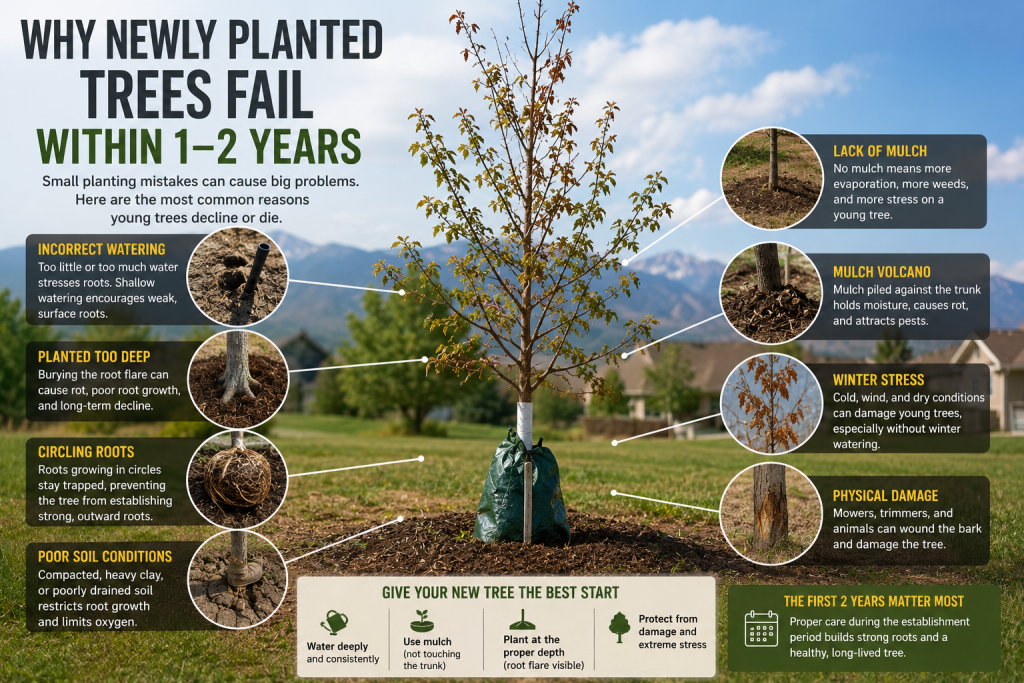
Newly planted trees fail within 1–2 years more often than many Colorado homeowners expect. A tree can look healthy on planting day, leaf out the first spring, and then slowly begin to decline. By the second summer, the leaves may be smaller, the canopy may thin, branches may die back, or the whole tree may stop growing.
Colorado makes that adjustment harder. Dry air, intense sun, winter moisture loss, clay soils, compacted landscapes, wind exposure, and inconsistent irrigation can all stress a young tree. A planting mistake that might be survivable in a milder climate can become a serious problem along the Front Range.
Understanding why newly planted trees fail within 1–2 years helps homeowners catch problems early. Some young trees can recover with better watering, mulch, and root-zone care. Others were planted too deeply, have severe root defects, or have already declined beyond repair.
If a newly planted tree on your property is wilting, browning, leaning, or failing to grow, Good People Tree Service can evaluate the tree and help determine whether it can recover or should be replaced correctly.
Why newly planted trees fail within 1–2 years
Newly planted trees fail within 1–2 years because they are not fully established yet. Even when the canopy looks normal, the root system is still limited. Most of the tree’s usable roots may still be inside the original root ball.
That creates a problem.
The tree needs water from the surrounding soil, but roots have not spread far enough to access it reliably. During hot, dry, or windy weather, leaves lose moisture faster than the young root system can replace it.
A newly planted tree is also dealing with transplant shock. It has been moved from a nursery, container, or field-grown root ball into a new landscape. Soil texture, drainage, sun exposure, wind, watering, and root space may all be different.
Common reasons for failure include:
- inconsistent watering
- planting too deeply
- circling or girdling roots
- mulch piled against the trunk
- poor drainage
- compacted soil
- winter drought
- mower or trimmer damage
- planting the wrong tree for the site
- lack of follow-up care after installation
The first year is about survival, not beauty
Homeowners often expect a newly planted tree to grow quickly. In the first year, though, the tree is mostly trying to survive.
Above ground, growth may look slow. Below ground, the tree is supposed to be producing new roots. If roots establish well, canopy growth can improve later. When root growth fails, the tree may look stalled or weak for several seasons.
This is why newly planted trees fail within 1–2 years even when they looked good at the nursery. Nursery health does not guarantee landscape success. A healthy tree can decline quickly if the planting depth is wrong, the root ball dries out, or soil conditions are poor.
Case example: the tree that looked fine the first spring
A homeowner plants a small shade tree in April. It leafs out in May and looks good through early June. By July, the leaves begin curling during hot afternoons. Watering happens through the lawn sprinklers, so the homeowner assumes the tree is getting enough moisture.
The problem is that lawn watering only wets the surface. The original root ball dries out below the surface, even though the surrounding grass looks green. By late summer, the tree drops leaves early. The following spring, it leafs out weakly, and several branches are dead.
This is one of the most common ways newly planted trees fail within 1–2 years. The tree was not ignored, but it was watered like grass instead of a tree.
Watering mistakes are the biggest issue
Watering is the most common reason young trees fail.
Too little water can dry out the root ball. Too much water can reduce oxygen and damage roots. Both problems can look similar from above because damaged roots cannot support the canopy.
Underwatered trees may show wilting, leaf scorch, early leaf drop, dry soil, brown needles, or dead branch tips. Overwatered trees may show yellowing leaves, slow growth, soft soil, root rot, or decline despite frequent irrigation.
The difficult part is that the root ball and surrounding soil can have different moisture levels. The backfill may feel damp while the root ball is dry. Another site may have a wet root ball sitting in heavy clay.
Young trees usually need careful watering through the first growing season and often beyond. During hot or windy periods, the schedule may need to tighten. In cooler weather, watering may be less frequent but still important.
Planting too deeply can slowly weaken the tree
Planting depth is one of the most serious hidden mistakes.
The root flare is the area where the trunk widens into the first major roots. It should be visible near the soil surface. When a tree is planted too deeply, the root flare is buried under soil or mulch.
That can create long-term problems. Moisture may stay against the trunk. Oxygen near the roots may be reduced. Roots may grow in poor directions. Decay can begin around buried trunk tissue.
Deep planting does not always kill a tree right away. That is why it is so easy to miss. A deeply planted tree may survive the first year but struggle during the second year as roots fail to establish properly.
Signs may include poor growth, leaf scorch, trunk swelling below the soil line, suckers near the base, bark problems, and a tree that looks like a telephone pole going straight into the ground.
When newly planted trees fail within 1–2 years, buried root flare should always be checked.
Circling roots can trap the tree in its original root ball
Container-grown trees can develop circling roots. These roots wrap around the inside of the pot instead of growing outward. If they are not corrected before planting, they may continue circling after installation.
A tree with circling roots may look fine at first. It may even grow for a season or two. Over time, those roots can restrict expansion, reduce stability, and interfere with water movement.
Girdling roots are an even bigger concern. They can press against the trunk or major roots and limit the tree’s ability to move water and nutrients.
This is another reason newly planted trees fail within 1–2 years. The tree may never truly leave the nursery root pattern. It sits in the landscape but keeps functioning like it is still trapped in a container.
Signs include poor growth, leaning, trunk stress, roots visible around the base, canopy thinning, and decline during heat.
Mulch helps, but mulch volcanoes hurt
Mulch is one of the best tools for helping young trees survive in Colorado. It helps conserve soil moisture, moderate soil temperature, reduce grass competition, and protect roots.
The problem is not mulch itself. The problem is bad mulch placement.
A mulch volcano forms when mulch is piled against the trunk. This traps moisture against bark and can encourage decay, insects, and root problems. The trunk should stay clear. Mulch should be spread in a wide, flat ring around the root zone.
A good mulch ring gives the tree breathing room. It also keeps mowers and string trimmers away from the trunk.
Grass competition is another issue. Turf right up to the trunk competes for water and nutrients. Sprinklers may be designed for grass, not deep tree root establishment.
A simple mulch ring can improve the tree’s first two years more than many homeowners realize.
Colorado winter drought can damage young trees
Many homeowners water new trees in spring and summer, then stop completely in fall. In Colorado, that can be a problem.
Dry winter conditions can damage young trees, especially evergreens and recently planted trees with limited root systems. Even dormant trees still need moisture in the soil. Evergreens continue losing water through needles during winter.
Winter drought damage may not show immediately. A tree may look acceptable in fall but emerge in spring with brown needles, dead tips, poor leaf-out, or dieback.
This delayed symptom pattern is one reason newly planted trees fail within 1–2 years. The tree may actually be damaged during winter, but the homeowner only notices in spring or summer.
Winter watering during dry periods can be important when temperatures are above freezing and soil is not frozen.
Soil compaction limits root expansion
Compacted soil is common around new homes, sidewalks, driveways, and landscaped yards. Heavy equipment may have crossed the site before the tree was planted. Foot traffic, stored materials, parked vehicles, and grading can also compact soil.
Roots need oxygen as much as they need water. Compacted soil reduces pore space, making it harder for roots to grow and function.
A newly planted tree in compacted soil may struggle to expand beyond the planting hole. The root ball can act like a pot in the ground. Water may collect in the hole or run away from it, depending on soil conditions.
Symptoms include slow growth, leaf scorch, small leaves, early leaf drop, and weak establishment.
If several trees planted in the same area are failing, the site may be the problem rather than the individual trees.
Poor drainage can look like drought stress
A young tree can decline from too much water even in Colorado’s dry climate.
Heavy clay soil, low areas, over-irrigated lawns, and poorly drained planting holes can keep roots too wet. Roots need oxygen, and saturated soil can suffocate them.
The confusing part is that overwatering can look like drought. Leaves may wilt, yellow, brown, or drop because damaged roots cannot move water properly.
Before adding more water to a struggling tree, check soil moisture. Dig gently near the root ball if needed. Soil that smells sour, stays muddy, or remains wet for days may indicate drainage problems.
A tree planted in a poorly draining hole may fail within the first two years even when the homeowner is trying hard to water it.
Case example: the fall-planted evergreen
A homeowner plants an evergreen in October. The tree is watered at planting and mulched well. Because the weather cools down, watering stops.
Winter brings long dry stretches, sunny days, and wind. The ground is not always snow-covered. By March, needles on the wind-facing side begin browning. In spring, the homeowner assumes the tree died suddenly.
The decline actually began during winter moisture loss.
This is common with newly planted evergreens in Colorado. Their roots are not established enough to replace water lost through needles. Without winter watering during dry periods, the tree may enter spring already stressed.
Planting the wrong tree for the site
Not every tree belongs in every yard.
A species that prefers more moisture may struggle in a hot, exposed Colorado landscape. A tree that grows large may be planted too close to a driveway, sidewalk, or house. Some trees tolerate clay soil better than others. Others need more space or protection from wind.
Wrong-tree problems may not show immediately. The tree may survive the first season but struggle once conditions become stressful.
Before planting, homeowners should consider mature size, water needs, sun exposure, soil type, wind exposure, hardscape distance, and long-term maintenance.
A tree that matches the site has a much better chance of surviving the first two years.
Mower and string trimmer damage
Small trunk wounds can be serious for young trees.
Mowers and string trimmers often damage bark near the base. A few small hits may not seem important, but repeated wounds can interrupt water movement and create openings for decay or pests.
Young bark is thin. Once damaged, it may not protect the tree well.
Mulch rings help prevent this problem by keeping lawn equipment away from the trunk. Tree guards can help in some situations, but they should be used correctly and checked regularly.
When newly planted trees fail within 1–2 years, look closely at the base. Mechanical damage is easy to overlook.
Fertilizer is not the first fix
When a young tree looks weak, many homeowners reach for fertilizer. That is often not the best first step.
A struggling newly planted tree usually needs water balance, oxygen, root correction, proper planting depth, mulch, and stress reduction before nutrients. Fertilizer cannot fix a buried root flare, circling roots, compacted soil, or a dry root ball.
In some cases, fertilizer can add stress if roots are damaged.
Can a failing newly planted tree recover?
Sometimes, yes.
A newly planted tree may recover if the problem is caught early. Watering can be corrected. Mulch can be adjusted. Grass competition can be reduced. A buried root flare may be exposed. Drainage problems may be improved in some cases.
Recovery is more likely when the tree still has live buds, flexible twigs, some healthy canopy, and no severe trunk damage.
Recovery is less likely when the root ball dried out completely, the trunk is damaged, most of the canopy is dead, roots are severely circling, or the tree never established after two growing seasons.
A professional evaluation can help decide whether continued care makes sense or replacement is the better investment.
How to help newly planted trees survive
The best approach is consistent care through the establishment period.
Helpful steps include:
- water the root ball directly
- check soil moisture often
- use a wide mulch ring
- keep mulch away from the trunk
- expose the root flare
- protect the trunk from equipment
- water during dry winter periods
- avoid over-pruning
- reduce grass competition
- monitor after heat waves
- choose species suited to Colorado sites
- inspect for circling roots before planting
Frequently asked questions
Why do newly planted trees fail within 1–2 years?
Most fail because roots never establish properly. Watering mistakes, deep planting, circling roots, compacted soil, poor drainage, winter drought, and mulch problems are common causes.
How long does it take a new tree to establish?
Small trees may establish faster than large nursery trees, but many trees need several growing seasons to fully expand roots into surrounding soil.
Should I water a new tree in winter?
Yes, during dry periods when temperatures are above freezing and soil is not frozen. This is especially important for evergreens and fall-planted trees.
Is a newly planted tree dead if it drops leaves?
Not always. Leaf drop can be a stress response. Check buds, twigs, bark condition, soil moisture, and whether dieback is spreading.
Should I replace a failing tree or keep trying?
That depends on how much live canopy remains, whether the root system is healthy, and whether planting errors can be corrected. Severe decline after two seasons may mean replacement is more practical.
Final thoughts
Newly planted trees fail within 1–2 years because establishment is harder than it looks. A tree may be new, but it is also vulnerable. Its roots are limited, its water needs are specific, and its new site may be stressful.
In Colorado, dry air, winter drought, intense sun, compacted soil, wind, clay, and inconsistent irrigation make the first two years especially important.
The good news is that many failures are preventable. Proper watering, visible root flare, corrected roots, good mulch, winter watering, and site-appropriate species all improve survival.
Good People Tree Service helps Colorado homeowners evaluate struggling young trees, identify planting problems, and decide whether a tree can recover or should be replaced.
If your newly planted tree is browning, wilting, leaning, or failing to grow, schedule an evaluation before the problem becomes permanent.