
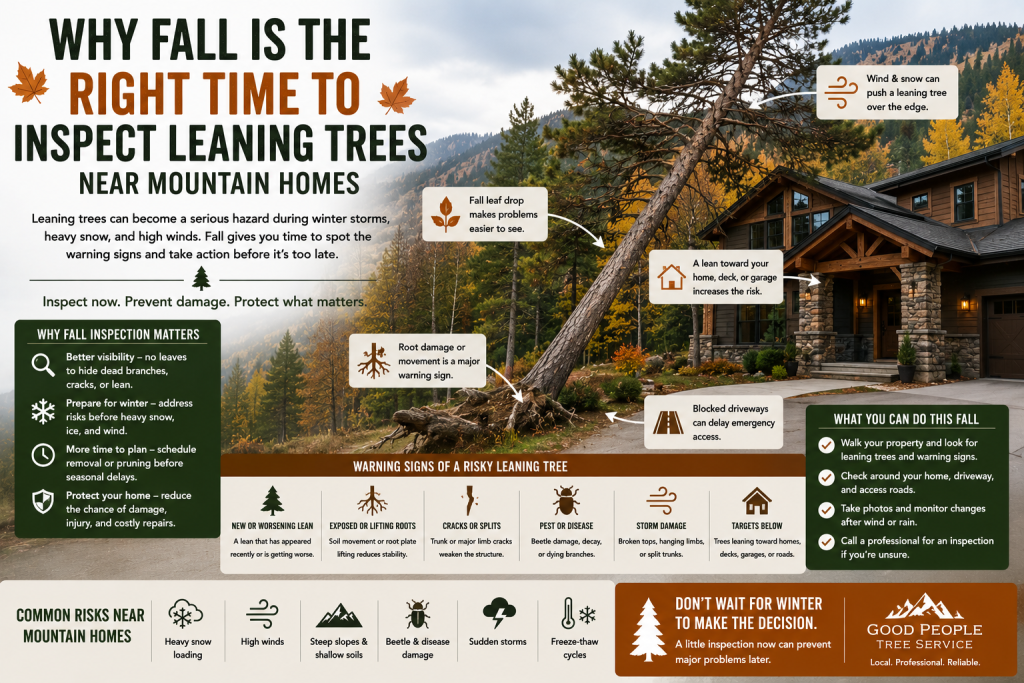
Near Nederland and the Boulder Foothills, leaning trees deserve extra attention because mountain properties have conditions that make tree risk more complicated. Homes often sit on slopes, among dense conifers, near narrow driveways, and close to forested lots. Soil can be rocky, shallow, compacted, or uneven. Trees may face drought, beetle pressure, snow loading, freeze-thaw cycles, and strong winds.
A leaning tree is not always dangerous. Some trees grow with a natural lean for many years and remain stable. The concern grows when the lean is new, increasing, directed toward a target, or paired with root movement, trunk cracks, dead branches, decay, storm damage, or soil lifting.
Fall gives homeowners a practical window to inspect these trees before winter adds weight, wind, and access problems. Waiting until snow, ice, or an emergency can make removal or pruning harder.
If you have a leaning tree near a mountain home, driveway, deck, or structure, Good People Tree Service can inspect the tree and help determine whether monitoring, pruning, cabling, or removal makes the most sense.
Why fall is the right time to inspect leaning trees near mountain homes
Why fall is the right time to inspect leaning trees near mountain homes starts with what happens next. Winter conditions can turn a manageable concern into an urgent problem. Wet snow can load branches. Wind can push an already compromised trunk. Frozen soil can limit root movement in one way, while freeze-thaw cycles and snowmelt can affect support in another. A tree that looked stable in September may behave differently in November, December, or spring thaw.
Fall also gives homeowners more visibility. As deciduous trees lose leaves, branch structure, cracks, deadwood, and trunk defects become easier to see. Conifers keep needles, but fall still makes it easier to compare crown color, inspect pitch, check dead tops, and notice beetle-related decline before winter.
This timing also helps with planning. If a leaning tree needs removal, it is usually better to address it before snow blocks access or creates emergency conditions.
A leaning tree is a warning sign, not an automatic removal decision
A leaning tree does not always need removal. Some trees lean because they grew toward light, adjusted to slope, or developed naturally over many years. If the lean is old, stable, and away from targets, monitoring may be enough.
The problem is change. A new lean after wind, rain, snow, construction, or soil movement is more serious. A lean that has increased over the past year also deserves attention. So does a lean toward a home, driveway, propane tank, garage, road, deck, or power line.
The key question is not simply “Is the tree leaning?” The better question is “Why is it leaning, and what could it hit if it fails?”
Fall gives homeowners a chance to answer that question before mountain weather adds more stress.
Mountain homes create higher stakes
A leaning tree near a mountain home often creates more risk than the same tree in an open field. Many Nederland-area properties have homes built close to trees for privacy, shade, wind protection, and mountain character. That means a falling tree may hit a roof, deck, garage, cabin, fence, vehicle, propane area, or access road.
A tree that could block a driveway can create a serious problem even if it cannot hit the house. In mountain areas, driveways may be long, steep, narrow, or the only route in and out. A tree across the driveway during snow, high wind, or a wildfire evacuation can become more than an inconvenience.
This is why leaning trees near structures and access routes deserve fall inspection. The location changes the urgency.
Slopes make leaning trees harder to judge
Nederland and Boulder Foothills properties often sit on slopes. Slope changes the way a tree grows, leans, and fails.
A tree growing on a hillside may lean naturally. It may also develop roots around rock, shallow soil, erosion channels, or drainage paths. Heavy rain, snowmelt, excavation, or soil movement can reduce root support.
A downhill lean toward a home or driveway creates a different concern than a mild uphill lean away from targets. The fall direction, root condition, soil stability, trunk angle, species, and wind exposure all matter.
Homeowners should inspect the ground as much as the canopy. A leaning tree with lifted soil, cracked ground, exposed roots, or a raised root plate may have stability problems that require professional evaluation.
Fall reveals root movement after summer storms
Colorado summer storms can loosen roots, break branches, and shift soil. A tree may not fall during the storm, but it can start leaning afterward.
By fall, homeowners may notice signs that were easy to miss in summer:
- soil cracking near the base
- lifted turf on one side
- exposed roots
- new gap between soil and trunk
- trunk lean toward a structure
- branches pulling heavily to one side
- roots disturbed by runoff or erosion
Root movement is one of the most important warning signs. A tree can still have green leaves while its anchoring system has weakened.
If root movement appears near a leaning tree, do not wait for winter snow to test the tree.
Snow load can make a leaning tree worse
Mountain properties near Nederland can receive heavy snow. Wet snow can add significant weight to branches, especially when leaves remain on some deciduous trees during early storms or when conifers hold snow on dense branches.
A leaning tree already carries weight off-center. Snow can add more force in the same direction. Branches may bend, unions may crack, and roots may experience additional pull.
A tree that leans over a roof, deck, driveway, or parking area becomes more concerning before snow season. Fall inspection gives homeowners time to remove hazards, reduce risk, or plan removal before a storm turns the situation into an emergency.
Wind exposure matters near the foothills
Wind can push leaning trees repeatedly. In foothills and mountain settings, wind exposure changes from property to property. A tree on a ridge, slope, open driveway edge, or exposed side of a home may face stronger force than a tree in a protected area.
Wind does not need to knock the tree over at once. Repeated movement can loosen soil, expand cracks, break roots, or worsen weak unions.
Look for trees that sway differently from nearby trees, lean more after storms, or show soil movement around the base. A leaning tree with a thin root system, dead canopy, or trunk defects may not handle winter wind well.
Fall is the right time to identify these trees before stronger seasonal weather arrives.
Leaf drop makes structural defects easier to see
Deciduous trees such as aspens, cottonwoods, maples, elms, ash, willows, and ornamentals often reveal more structure after fall leaf drop.
Without leaves, homeowners can see:
- cracked limbs
- broken tops
- dead branches
- weak branch unions
- codominant stems
- trunk splits
- branch imbalance
- storm damage
- canopy weight distribution
A leaning tree with poor structure becomes more concerning than a leaning tree with a balanced crown and strong trunk.
Fall inspection helps homeowners see whether the lean is the main issue or whether the tree also has branch defects that increase failure risk.
Conifers need fall inspection too
Pines, spruce, firs, and other conifers near Nederland can lean, decline, or fail just like deciduous trees. They also hold needles through winter, which means they can catch snow and wind differently.
Conifers may show beetle damage, drought stress, dead tops, pitch, boring dust, woodpecker activity, or red and brown needles. A leaning conifer with beetle signs near a driveway or home should be inspected quickly.
A dead or beetle-killed pine can become brittle over time. If it leans toward a structure or access road, fall may be the best time to plan removal before winter makes the job more difficult.
Beetle damage can make a leaning tree more urgent
Bark beetles and borers often attack stressed trees. Drought, dense stands, root damage, and heat can weaken mountain trees and make them more vulnerable.
A leaning pine with boring dust, pitch tubes, small holes, fading needles, or woodpecker activity may have more than a structural issue. It may also be dying or dead.
Beetle-damaged trees near homes create safety and wildfire concerns. Once the tree dies, branches can fall, the trunk can dry, and removal can become harder.
Fall inspection helps homeowners catch these signs before the tree declines further.
Drought stress can weaken roots before winter
Dry summers can leave trees with weakened roots and reduced reserves. A tree may keep standing through summer, but drought stress can reduce fine root health and make the tree less resilient.
This matters for leaning trees because roots anchor the tree. A tree with dry, weakened, or damaged roots may have less ability to handle wind, snow, and freeze-thaw stress.
Colorado fall can also stay dry. If soil moisture remains low, a tree may enter winter under stress. Fall inspection should include soil moisture, root flare visibility, mulch depth, and signs of drought stress.
A leaning tree with drought stress and root problems deserves more attention than a stable, well-rooted tree.
Freeze-thaw cycles can affect weakened trees
Mountain fall weather often brings warm days and cold nights. Later, snow, melt, and refreeze cycles can affect soil and roots.
Freeze-thaw cycles can widen cracks, shift shallow soil, and stress already weakened roots. They can also make access and removal more complicated.
A leaning tree with root movement, exposed roots, cracked soil, or drainage issues may become more unstable as conditions change. Fall gives homeowners a chance to inspect before frozen ground or snow cover hides the root zone.
Driveway access should be part of the inspection
When inspecting leaning trees near mountain homes, include the driveway and access road. Do not only inspect trees beside the house.
A leaning tree over a private road can block emergency access, snowplows, deliveries, or evacuation routes. In wildfire-prone areas, driveway clearance and access matter even more.
Look for trees leaning over the travel path, dead tops above the driveway, beetle-damaged pines near the road, and trunks rooted on slopes above access routes.
A tree that threatens access may need removal even if it does not threaten the home directly.
Wildfire mitigation and leaning trees overlap
Leaning trees can also affect wildfire mitigation. A dead or unstable tree near a structure may add fuel. A leaning conifer over a driveway may affect evacuation or fire access. Dense small trees under a leaning larger tree may create ladder fuels.
Defensible space work often focuses on reducing fuels around homes, maintaining spacing, and improving access. A leaning tree may become a priority when it sits inside those important zones.
Fall is a smart time to connect tree-risk inspection with defensible space planning. Homeowners can identify dead, leaning, crowded, or beetle-damaged trees and decide which should be removed before the next fire season.
Warning signs that a leaning tree needs inspection
A leaning tree near a mountain home should be inspected when you notice:
- a new lean
- worsening lean
- soil cracking near the base
- lifted root plate
- exposed or broken roots
- trunk cracks
- split stems
- mushrooms near the base
- dead branches
- broken top
- bark beetle signs
- red or brown needles
- heavy woodpecker activity
- branches over a roof, deck, road, or driveway
- lean toward a power line or propane area
- recent excavation near the roots
The more warning signs appear together, the more urgent the inspection becomes.
What homeowners can check safely
Homeowners can do a ground-level inspection without climbing or cutting.
Stand back and look at the whole tree. Compare the lean to nearby trees and to old photos if available. Check whether the lean points toward a target. Look at the soil around the base. Notice cracks, lifting, erosion, exposed roots, or gaps.
Then look at the trunk. Search for cracks, cavities, loose bark, decay, mushrooms, insect holes, pitch, or old wounds.
Finally, look up from a safe distance. Watch for broken limbs, dead tops, hanging branches, or uneven canopy weight.
Do not stand under a leaning tree that may fail. Do not pull, push, cable, or cut the tree yourself.
What not to do with a leaning tree
Do not assume the tree is safe because it has not fallen yet. A leaning tree can remain standing for a long time and still fail when conditions change.
Do not cut large branches to “balance” the tree without professional guidance. Removing the wrong limb can change forces inside the tree and make the situation worse.
Do not pile soil around exposed roots or the trunk. That can reduce oxygen and hide important warning signs.
Do not attach ropes, vehicles, or winches to a large leaning tree. That can create serious injury and property damage.
Do not work near power lines. If the tree leans toward utility lines, call the utility or a qualified professional.
When monitoring may be enough
Monitoring may be enough when the lean is old, stable, away from targets, and not paired with root movement, cracks, decay, deadwood, or pest signs.
A tree in an open area may remain part of the landscape or wildlife habitat if it does not threaten people, structures, driveways, or utilities.
Monitoring should still be intentional. Take photos from the same angle. Check after storms. Watch soil movement. Note changes in canopy condition.
If the lean increases or new defects appear, the tree needs another evaluation.
When removal may be safer
Removal may be safer when the lean is new, worsening, pointed toward a target, or paired with root plate movement, trunk cracks, base decay, dead canopy, beetle damage, storm damage, or severe structural defects.
Removal also makes sense when the tree threatens the only driveway, sits near a house or deck, leans over a road, or affects defensible space goals.
A leaning tree does not become easier to remove after it dies, cracks, or gets covered in snow. Early action usually gives crews better access and more control.
Case example: leaning pine above a Nederland driveway
A homeowner near Nederland notices a pine leaning over a steep driveway. It has red needles, boring dust at the base, and fresh woodpecker activity.
This tree creates several concerns. It may be beetle-damaged. It leans over an access route. It could block the driveway in a storm. It may also add fuel near the property.
Fall inspection may lead to removal before winter. Waiting could make the tree more brittle and the driveway more vulnerable.
Case example: leaning aspen near a mountain deck
An aspen leans toward a deck. It still has leaves, but one side of the canopy has dead branches. Mushrooms appear near the base after rain.
This tree should be inspected. Aspen can decline quickly when decay affects the trunk or roots. The deck creates a target, and fall gives the homeowner time to act before snow loads branches or hides the base.
Pruning may not be enough if the trunk or root system has lost strength.
Case example: old lean away from targets
A pine on a slope leans away from the house and driveway. It has been leaning for years. The canopy looks healthy. The soil shows no cracks. The trunk has no obvious decay.
This tree may not need removal. The homeowner can monitor it with photos and inspect after storms. The decision may change if the lean increases, roots move, or beetle signs appear.
This example shows why inspection matters. The goal is not to remove every leaning tree. The goal is to identify risk.
When to call a tree service
Call a tree service if a leaning tree stands near a home, driveway, road, deck, power line, propane tank, fence, garage, or other target. Also call if the lean is new, worsening, or paired with root movement, cracks, decay, dead branches, beetle signs, or storm damage.
Good People Tree Service can inspect the tree, evaluate visible risk factors, and recommend monitoring, pruning, or removal based on the tree and the property.
Frequently asked questions
Is a leaning tree always dangerous?
No. Some trees grow with a natural lean and remain stable for years. A leaning tree becomes more concerning when the lean is new, worsening, aimed at a target, or paired with root, trunk, decay, pest, or storm damage.
Why inspect leaning trees in fall?
Fall gives homeowners better visibility, time before winter snow and wind, and a chance to address risk before access becomes harder. It also helps connect tree safety with winter and wildfire planning.
What signs mean a leaning tree may fall?
Warning signs include soil cracking, lifted roots, exposed roots, trunk cracks, mushrooms near the base, dead canopy, worsening lean, storm damage, and bark beetle activity.
Can pruning fix a leaning tree?
Sometimes pruning can reduce branch hazards, but it does not fix root instability or trunk failure. A professional should inspect the tree before major pruning.
Should I remove a leaning tree near my driveway?
Maybe. If the tree could block access, fall toward vehicles, or prevent emergency response, removal may be the safest choice, especially if the lean is new or the tree is declining.
Final thoughts
Why fall is the right time to inspect leaning trees near mountain homes comes down to preparation. Fall gives homeowners a chance to see structure more clearly, check roots before snow covers the ground, plan around driveway access, and address hazards before winter weather makes problems worse.
Near Nederland and the Boulder Foothills, leaning trees deserve special attention because slopes, rocky soil, drought, beetles, snow, wind, wildfire risk, and narrow access routes all affect tree safety.
Not every leaning tree needs removal. Some can be monitored. Some need pruning. Others should be removed before they fall toward a home, deck, driveway, power line, or road.
Good People Tree Service helps mountain homeowners inspect leaning trees, identify visible risk factors, and make practical decisions before winter or wildfire season turns a concern into an emergency.
If a tree near your mountain home is leaning, changing, cracked, dying, or pointed toward something important, schedule an inspection this fall.