
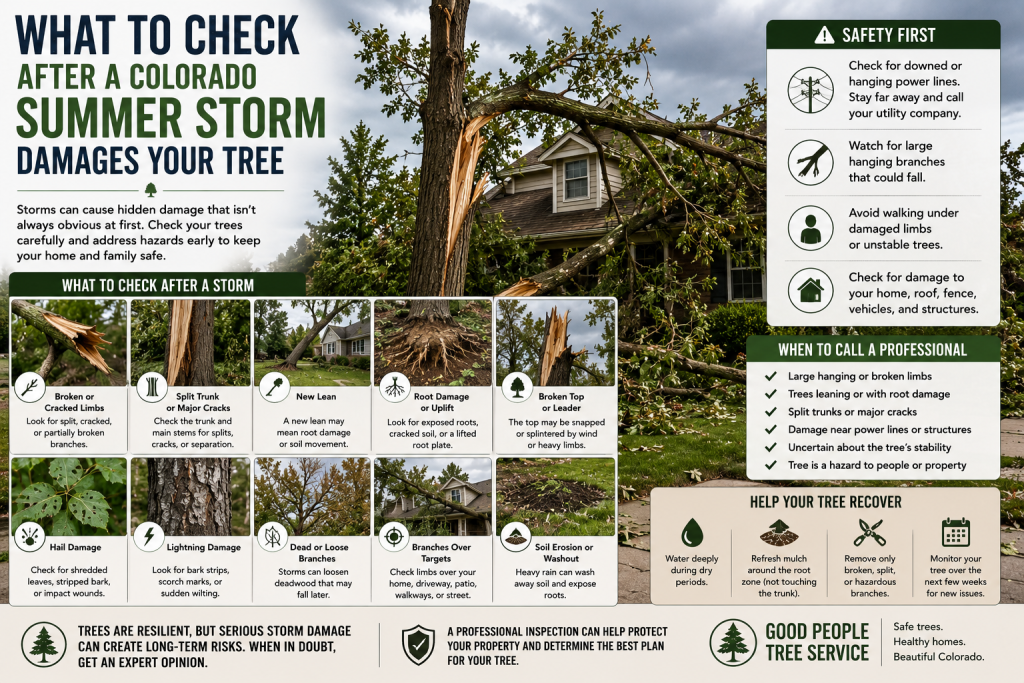
What to check after a Colorado summer storm damages your tree starts with safety, not cleanup. Many homeowners walk outside after wind, hail, heavy rain, or lightning and immediately want to move branches, start cutting, or see whether the tree can be saved. That first reaction makes sense, but storm-damaged trees can be unpredictable.
A branch may look stuck but still fall. A cracked limb may hold for now and break later. A leaning tree may have root damage underground. A tree that lost leaves to hail may recover, while a tree with a split trunk may not. Colorado summer storms can damage trees in obvious and hidden ways.
The Front Range and surrounding Colorado communities often deal with fast-moving storms. Strong wind, hail, sudden downpours, lightning, and saturated soil can all affect trees differently. Some storms shred leaves. Others break limbs, twist trunks, expose roots, or loosen the soil around the base.
Knowing what to check after a Colorado summer storm damages your tree helps you avoid unsafe cleanup, protect the tree if it can recover, and decide when a professional inspection is needed.
If a storm damaged a tree near your home, driveway, sidewalk, fence, or patio, Good People Tree Service can inspect the damage and help determine whether pruning, monitoring, or removal makes the most sense.
What to check after a Colorado summer storm damages your tree
What to check after a Colorado summer storm damages your tree can be broken into a simple order: safety hazards first, structural damage second, canopy damage third, root-zone problems fourth, and recovery potential last.
Do not start with the small branches on the lawn. Start by looking at the whole tree from a safe distance.
Check for:
- downed utility lines
- large hanging branches
- cracked limbs
- split trunk sections
- new lean
- exposed or lifted roots
- broken tops
- branches touching the roof
- limbs resting on fences or vehicles
- bark torn from the trunk
- hail wounds
- lightning scars
- soil movement around the base
- dead branches that may have loosened
- damage over walkways, driveways, patios, or play areas
A tree can look messy after a storm and still recover. It can also look mostly upright while hiding serious damage. The pattern matters more than the amount of debris on the ground.
Start by checking the area around the tree
Before you walk under the canopy, scan the whole area. Look for wires, broken branches overhead, split limbs under tension, and unstable debris.
Never touch a tree, branch, fence, or tool that may be in contact with a power line. Keep people and pets away. Call the utility company if any tree part touches or pulls on wires.
Also avoid standing under broken or hanging limbs. Arborists often call these “hangers.” They may sit lodged in the canopy after a storm, then fall later when wind, gravity, or another branch shifts them.
Look at nearby structures too. A branch resting on a roof, gutter, fence, shed, or vehicle may have hidden pressure. Cutting the wrong section can cause sudden movement.
The first inspection should happen from the ground and from a safe distance.
Check for large hanging branches
Large hanging branches are one of the most urgent storm hazards. A broken limb that remains lodged in the tree may fall without warning. It can also swing or shift during the next breeze.
Hanging branches matter even if they are not directly over a roof. They can fall on people, pets, cars, fences, or sidewalks. They can also tear bark as they move, causing more damage to the tree.
Do not try to pull down large limbs by hand. Do not throw ropes over them unless you know what you are doing. A branch can release suddenly, and the weight may surprise you.
A tree service should handle large hangers, especially when they sit high in the canopy or near a structure.
Look for cracks in major limbs
Storms often create cracks that homeowners miss at first. A limb may not fall during the storm, but a crack can weaken the branch and create future failure risk.
Look where large branches attach to the trunk. Check branch unions, especially V-shaped unions, tight crotches, and areas with included bark. These spots often fail during wind, wet snow, or heavy branch loading.
A crack may show as a dark line, fresh exposed wood, lifted bark, or a gap that opens when the branch moves. Sometimes the branch looks slightly lower than before.
Cracked major limbs over a home, driveway, or walkway need professional attention. Even if the tree survives, the branch may not be safe.
Check the trunk for splits
A split trunk is more serious than a broken small branch. Trunk splits can compromise the main structure of the tree.
Look for vertical cracks, fresh wood, torn bark, and openings between codominant stems. Codominant stems are two main trunks or leaders that grow close together. These unions can split during storms, especially if the connection is weak.
A tree with a split trunk may not be a good candidate for simple pruning. Some splits create long-term instability. Others expose large wounds that the tree cannot close effectively.
Do not assume straps, bolts, or cables can fix every split. A professional should evaluate whether the tree can recover safely or whether removal is the better choice.
Check whether the tree is leaning
A new lean after a storm deserves immediate attention. Strong wind and saturated soil can shift the root plate. The trunk may lean because roots have lifted, torn, or lost support.
Compare the tree to older photos if you have them. Look at the soil around the base. Fresh cracks, raised turf, exposed roots, or a mound on one side can indicate root movement.
A leaning tree near a house, street, driveway, sidewalk, or utility line should be inspected quickly. Do not stand on the side where the tree may fall. Do not try to push it upright.
Some small, newly planted trees can be reset or staked correctly after movement. Large leaning trees require professional evaluation.
Check the root zone after heavy rain
Colorado summer storms can bring sudden heavy rain. If soil becomes saturated, roots may lose support, especially in compacted or clay-heavy yards.
Walk around the root zone and look for soil lifting, cracking, erosion, exposed roots, puddling, or washed-out mulch. Pay attention to slopes, drainage paths, and areas near downspouts.
A tree with shallow roots, prior construction damage, or compacted soil may become less stable after heavy rain. Even if the trunk still stands straight, root movement can create future risk.
Do not pile soil over exposed roots as a quick fix. Heavy soil can reduce oxygen. A professional can help determine whether the root issue is cosmetic, manageable, or structural.
Check for broken tops
A broken top can change the tree’s future. Some trees recover from smaller top damage. Others become structurally weak or misshapen.
Young trees depend on a central leader for good structure. If a storm breaks the leader, the tree may need corrective pruning over time. Mature trees with broken tops may develop decay, weak regrowth, or large wounds.
Evergreens can be especially affected when the top breaks. A spruce or pine may try to form a new leader, but the final shape and strength depend on the damage.
A tree service can help decide whether restoration pruning is possible or whether the damage is too severe.
Check for hail damage
Hail is common in Colorado summer storms. It can shred leaves, knock off twigs, strip needles, wound bark, and bruise young stems.
Hail damage often looks dramatic right away. Leaves may look torn or full of holes. The ground may be covered in green debris. A tree may lose a large amount of foliage in minutes.
Leaf damage alone does not always mean the tree will die. Many healthy trees can grow new leaves or continue the season with reduced foliage. The bigger concern comes from broken branches, bark wounds, stripped young stems, and repeated stress.
Check the trunk and branches for impact wounds. Young trees with thin bark can suffer more from hail than mature trees with thicker bark.
Check for bark wounds
Bark protects the tree’s living tissue. Storms can tear, scrape, split, or remove bark. Hail, flying debris, broken branches, and twisting limbs can all wound the trunk or branches.
Look for fresh exposed wood, loose bark, long tears, missing bark patches, or jagged wounds where branches ripped away.
Do not paint tree wounds. Wound dressings usually do not help the tree heal. The better approach is proper pruning of broken limbs, protecting the tree from further stress, and monitoring the wound over time.
Large bark wounds on the trunk may reduce the tree’s ability to move water and nutrients. They can also create entry points for decay.
Check for lightning damage
Lightning can injure trees in different ways. Sometimes it creates a long strip of missing bark down the trunk. Sometimes damage looks subtle at first.
After a lightning strike, check for bark strips, cracks, fresh wood, scorch marks, broken branches, dead leaves, or sudden wilting. Also check nearby trees, structures, and soil if the strike affected more than one area.
A lightning-damaged tree may decline slowly. Some trees survive. Others develop internal damage, branch dieback, or decay over time.
A large lightning-struck tree near a home should be inspected, even if it still looks mostly green.
Check the canopy shape
Storm damage often leaves a tree unbalanced. One side may lose several limbs while the other side remains full. A heavy branch may break and shift the tree’s weight distribution.
An uneven canopy does not always mean the tree needs removal. Trees can often grow new foliage and gradually recover shape. But severe imbalance can increase stress on remaining limbs.
Look for missing scaffold branches, heavy branches pulling to one side, or remaining limbs with cracks. A professional can decide whether light cleanup, restoration pruning, or removal is the safer path.
Avoid trying to “even out” the tree with heavy pruning. Removing too much live canopy after storm damage can weaken the tree further.
Check how much canopy remains
Recovery potential depends partly on how much living canopy remains. A tree that keeps its main leader, most major limbs, and a significant portion of its crown often has a better chance of recovery.
A tree that loses most of its canopy may struggle. Leaves produce energy. If storm damage removes too much foliage, the tree may not have enough resources to recover well.
This is especially important late in summer. The tree has less growing season left to rebuild energy before fall and winter.
A professional inspection can help determine whether the tree has enough living crown to justify restoration.
Check for deadwood that became unstable
Storms do not only break healthy branches. They also loosen old deadwood. A dead limb may have stayed in the tree for months, then shifted during wind or hail.
Look for gray, leafless, brittle branches. Check whether any dead branch now hangs differently than before. Also look for cracks around old pruning cuts or dead stubs.
Deadwood near targets deserves removal. A summer storm may be the warning sign that the tree had hidden risk before the weather event.
Check branches over targets
A “target” means anything a branch could hit. Common targets include homes, garages, patios, sidewalks, driveways, fences, cars, sheds, streets, and play areas.
After a storm, prioritize damage over targets. A small broken branch in an open lawn can wait. A cracked branch over a bedroom, sidewalk, or driveway should not.
This helps homeowners make practical decisions. Not every damaged tree requires emergency service. But any damaged branch over people or property needs faster attention.
Check young trees differently
Young trees often bend, lean, or lose leaders during summer storms. They may look badly damaged but still have strong recovery potential if the trunk and roots remain healthy.
Check whether the main stem broke. Look at the root ball for movement. Inspect bark wounds, broken branches, and staking materials.
Do not leave tight stakes, wires, or straps rubbing the trunk. If the tree moved, it may need proper restaking, not random tying.
Young trees may need corrective pruning over several seasons after storm damage. The goal is to rebuild structure, not force a perfect shape immediately.
Check mature trees more cautiously
Mature trees hold far more weight. A broken limb on a mature cottonwood, maple, ash, elm, spruce, or pine can be heavy enough to cause major property damage.
Large mature trees also develop decay, old wounds, codominant stems, and hidden structural defects. A storm can reveal weaknesses that were already present.
Homeowners should be careful with mature trees after storms. Avoid climbing, chainsaw work, or pulling branches under tension. Large tree work belongs to trained professionals.
What not to do after storm damage
Do not top the tree. Topping creates large wounds, weak regrowth, decay risk, and long-term structural problems.
Do not remove large amounts of live canopy just to make the tree look symmetrical. The tree needs leaves to produce energy and recover.
Do not cut branches flush against the trunk. Proper pruning cuts protect the branch collar and help the tree seal wounds more effectively.
Do not use wound paint as a cure. Focus on clean cuts, tree health, and monitoring.
Do not ignore root movement, trunk cracks, or hanging limbs because the tree still looks green.
What homeowners can safely clean up
Homeowners can usually collect small branches and debris from the ground after checking for overhead hazards and wires.
Small twigs, shredded leaves, and light debris can be removed once the area is safe. This helps reveal the lawn, root zone, and base of the tree.
However, avoid cutting large limbs, climbing ladders, or working under broken branches. Also avoid using a chainsaw on limbs under tension. Storm-damaged wood can shift suddenly.
If cleanup requires climbing, rigging, or cutting overhead limbs, call a tree service.
When a storm-damaged tree can recover
Some storm-damaged trees recover well. A healthy tree with minor limb loss, intact trunk, stable roots, and enough remaining canopy may only need cleanup pruning and monitoring.
Trees can also grow new foliage after hail strips leaves, especially when the branch structure remains intact and the tree receives proper water.
Recovery depends on species, age, health, season, water, soil, and damage severity. A stressed tree that already had drought damage, pests, root problems, or decay may recover poorly from the same storm that a healthy tree survives.
The best question is not just “Is it alive?” The better question is “Can it recover safely?”
When removal may be the better option
Removal may make sense when the tree has a split trunk, major root movement, severe lean, broken main stem, extensive canopy loss, advanced decay, large hazardous limbs, or major damage over a target.
Removal may also be practical when a storm exposes long-term problems. A tree with old decay, weak unions, and repeated branch failures may not be worth restoring.
Good tree care includes preservation when realistic and removal when risk becomes too high.
What to monitor weeks after the storm
Some storm damage appears later. Check the tree again over the next few weeks.
Look for wilting leaves, new cracks, branch dieback, browning needles, bark peeling, sap flow, mushrooms, pest activity, and worsening lean. Also watch branches that were bent but not broken during the storm.
A tree may look okay the next morning and decline later because roots, bark, or internal structure were damaged.
Late-summer monitoring matters because the tree must still prepare for fall and winter.
How to support recovery after damage
Water the tree if soil is dry. Storm rain does not always soak the root zone evenly, especially in compacted Colorado soils. Check moisture before watering.
Refresh organic mulch if needed. Keep mulch away from the trunk. Protect the root zone from vehicles, construction, and heavy foot traffic.
Avoid fertilizing right away unless a professional recommends it. A storm-damaged tree often needs stability, moisture, and time more than fertilizer.
Schedule proper pruning for broken, dead, or hazardous limbs. Then give the tree time to respond.
When to call a tree service
Call a tree service if you see large hanging branches, trunk splits, new lean, exposed roots, broken tops, cracked major limbs, branches on the roof, storm damage near utility lines, severe hail wounds, lightning damage, or large dead branches over targets.
Good People Tree Service can inspect the tree, remove hazardous limbs, evaluate structure, and help determine whether the tree can recover or should be removed.
Frequently asked questions
Can a storm-damaged tree recover?
Yes, some trees recover when the trunk, roots, leader, and enough canopy remain intact. Severe trunk splits, root movement, or major canopy loss reduce recovery potential.
Should I prune a storm-damaged tree right away?
Remove hazardous, broken, or hanging branches when needed. Avoid heavy cosmetic pruning. A damaged tree still needs live foliage to recover.
Is hail damage enough to kill a tree?
Leaf shredding alone often does not kill a healthy tree. Severe bark wounds, broken branches, repeated stress, or damage to young trees can create bigger problems.
What if my tree is leaning after the storm?
A new lean can signal root movement. Keep away from the fall zone and call a tree service, especially if the tree stands near people or property.
Should I remove a branch touching my roof?
Do not cut large or tensioned branches yourself. A branch on a roof may shift suddenly when cut. Call a professional if the limb is large, heavy, or overhead.
Final thoughts
What to check after a Colorado summer storm damages your tree starts with safety. Look for wires, hanging limbs, cracked branches, trunk splits, new lean, root movement, hail wounds, lightning damage, and branches over targets.
Not every storm-damaged tree needs removal. Many trees recover after proper cleanup, watering, mulch, and monitoring. But some damage creates serious risk, especially when a tree stands near a home, driveway, sidewalk, fence, or patio.
The safest approach is to inspect from the ground, avoid risky cutting, and call a professional when the damage involves large limbs, trunk cracks, leaning trees, or overhead hazards.
Good People Tree Service helps Colorado homeowners inspect storm-damaged trees, remove unsafe branches, and decide whether a damaged tree can recover or should be removed.
If a summer storm left your tree cracked, leaning, broken, or unsafe, schedule an inspection before the next storm makes the damage worse.