
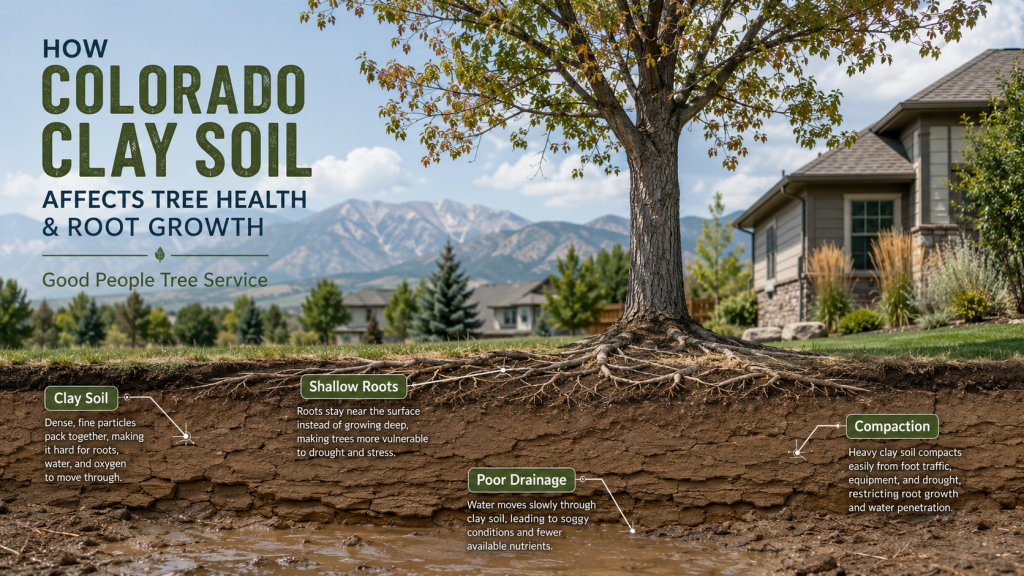
How Colorado’s clay soil affects tree health and root growth is something many homeowners only notice after a tree begins to struggle. The tree may have been planted correctly, watered regularly, and cared for with good intentions. Still, the leaves scorch, the canopy thins, roots stay close to the surface, or the tree seems to stop growing.
Clay soil is not automatically bad. In fact, clay can hold water and nutrients well. The challenge is that Colorado clay soil often holds water too tightly, drains slowly, compacts easily, and limits oxygen around roots. When those issues overlap with drought, heat, construction, or poor watering, tree roots may not grow the way homeowners expect.
For trees along the Front Range, root health is everything. A tree can only support its canopy if the root system has enough oxygen, moisture, and space. When soil conditions interfere with root growth, the symptoms usually appear above ground as leaf scorch, dieback, poor growth, early leaf drop, or branch failure.
Understanding how Colorado’s clay soil affects tree health and root growth helps homeowners water more wisely, protect trees during construction, avoid planting mistakes, and recognize root stress before the tree declines too far.
If a tree on your property is thinning, showing leaf scorch, struggling after planting, or growing in compacted clay soil, Good People Tree Service can evaluate the tree and help determine whether soil care, pruning, monitoring, or removal should be considered.
Why Colorado clay soil affects tree health and root growth
Colorado clay soil affects tree health and root growth because roots need more than water. They also need oxygen, pore space, drainage, and room to expand.
Clay particles are very small. Because they pack closely together, clay soils often have less large pore space than looser soils. Those large pores are important because they allow air and water to move through the soil. When clay becomes compacted, the problem becomes worse.
A tree root system in compacted clay may struggle to expand beyond the planting hole. Fine absorbing roots may stay shallow. Water may sit too long in one area, while another part of the root zone stays dry.
Common problems include:
- slow drainage
- low soil oxygen
- surface roots
- poor root expansion
- waterlogged planting holes
- drought stress during dry periods
- root rot in wet areas
- canopy thinning
- leaf scorch
- reduced growth
This is why the same tree species may do well in one Colorado yard and struggle in another. The difference is often below ground.
Clay soil holds water, but that does not always help trees
One of the most confusing things about clay soil is that it can hold a lot of water while still causing drought-like symptoms in trees.
That seems contradictory at first.
Clay holds water tightly. Some of that water may not be easy for roots to use. When clay is dry, it can become hard and difficult for water to penetrate. Once it becomes wet, it may stay wet for a long time. Neither extreme is ideal for roots.
A tree may show leaf scorch because roots cannot access usable moisture during dry periods. The same tree may later struggle after heavy watering because roots sit in saturated soil with limited oxygen.
This dry-to-wet swing is common in Colorado landscapes. Long dry periods may be followed by irrigation, thunderstorms, or snowmelt. Clay soil responds slowly, which can make watering decisions harder.
A homeowner may see brown leaf edges and add more water. If the soil is already wet below the surface, that extra water can create a different root problem.
Roots need oxygen as much as water
Tree roots breathe. They need oxygen in the soil to function.
When clay soil is compacted or waterlogged, oxygen drops. Roots become less active, and new root growth slows. If the problem continues, roots may die back. Once roots decline, the canopy begins showing stress.
Above-ground symptoms may include smaller leaves, yellowing, leaf scorch, early fall color, thinning canopy, branch dieback, and slow growth.
This is a major reason Colorado’s clay soil affects tree health and root growth in residential yards. Homeowners often focus on water, but oxygen is just as important.
A tree can decline in soil that is too dry. It can also decline in soil that stays too wet. In both cases, the root system cannot support the canopy well.
Compaction makes clay soil much worse
Clay soil is already dense compared with sandy soil. Once it is compacted, roots have an even harder time growing through it.
Compaction can happen when construction equipment crosses the yard, vehicles park under trees, foot traffic repeats across the same area, soil is graded during landscaping, or materials are stored over the root zone.
Compacted clay limits air movement, slows drainage, and physically resists root growth. A newly planted tree may remain trapped in the original root ball instead of expanding into surrounding soil. A mature tree may develop thinning canopy or surface roots because deeper growth is restricted.
If several trees in the same yard are struggling, the site may be the problem rather than the individual trees.
Case example: the newly planted tree that never took off
A homeowner plants a young shade tree in a Colorado front yard with heavy clay soil. The tree looks good when installed. It is watered often during the first summer, and the lawn around it stays green.
By the second year, the tree is barely growing. Leaves are small. A few branch tips are dead. When the homeowner checks the soil, the root ball is wet, but the surrounding clay is hard and compacted.
The tree is stuck in a difficult transition zone. Roots have not moved well into the site soil. Water collects in the planting hole, but oxygen is limited. The tree is watered, yet the roots are not healthy.
This is a classic example of how Colorado’s clay soil affects tree health and root growth. The problem is not lack of care. It is the combination of clay texture, poor drainage, compaction, and establishment stress.
Planting depth matters even more in clay
Planting too deeply is harmful in any soil, but clay makes the mistake more serious.
The root flare should be visible near the soil surface. When the root flare is buried, the trunk base may stay too moist, roots may develop poorly, and oxygen around the structural roots may be limited.
In clay soil, buried roots may struggle because the soil drains slowly and compacts easily. A tree planted too deep may look fine for a year or two, then begin declining as the root system fails to establish properly.
Signs of deep planting include no visible root flare, a trunk that enters the ground like a pole, slow growth, leaf scorch, trunk swelling near the soil line, suckers at the base, and girdling roots.
Correct planting depth gives roots better access to oxygen and helps the tree establish in the upper soil zone where roots naturally function best.
Watering clay soil requires patience
Clay soil absorbs water slowly. Applying water too quickly often causes runoff instead of deep soaking.
That means watering a tree in clay soil is not just about how much water is applied. It is also about how slowly the water is applied and how long the soil stays wet afterward.
A better approach is usually slow watering, cycle-and-soak irrigation, drip irrigation, or a soaker hose placed over the active root zone. Water should be applied broadly, not only at the trunk.
Watering on a fixed schedule can create problems because Colorado weather changes quickly. A tree may need water during a hot dry stretch, then need a break after rain.
Clay soil can cause both underwatering and overwatering symptoms
One of the hardest parts of clay soil is that underwatering and overwatering can look similar.
A tree with dry roots may wilt, scorch, drop leaves, or stop growing. A tree with waterlogged roots may show many of the same symptoms because damaged roots cannot move water efficiently.
This creates a cycle. The homeowner sees stress and adds water. If poor drainage is the real issue, the tree gets worse. Later, watering may be reduced too much, and the tree becomes drought stressed.
The best solution is to check the soil instead of guessing.
Colorado’s clay soil affects tree health and root growth most severely when homeowners respond to symptoms without checking what is happening below the surface.
Mature trees can suffer from clay soil too
Clay soil problems are not limited to young trees.
Mature trees often have large root systems, but those roots still need oxygen and moisture. If the soil becomes compacted, covered, cut, or poorly irrigated, even an established tree can decline.
Symptoms in mature trees may include thinning canopy, deadwood, smaller leaves, top dieback, repeated leaf scorch, early fall color, and increased susceptibility to insects or disease.
A mature tree may decline slowly because it has stored energy and a larger root system. That delay can make the problem easy to dismiss. By the time dead branches appear, root stress may have been building for years.
Case example: the mature tree near a patio
A mature tree grows near a backyard patio. Over the years, the area under the canopy becomes compacted from foot traffic and outdoor furniture. Later, a patio extension is added, and some roots are cut during construction.
The tree does not die immediately. For two seasons, it looks mostly normal. Then the canopy starts thinning, leaves scorch in late summer, and dead branches appear near the top.f
The clay soil under and around the patio has limited oxygen and root expansion. Construction damage reduced the root system. Summer heat increased water demand. Together, those stresses caused gradual decline.
This is why soil protection should be part of any project near a valuable tree.
Surface roots are common in clay soil
Surface roots can look like a problem, but they are often a natural response to soil conditions.
Because roots need oxygen, they tend to grow where oxygen is available. In compacted or wet clay, the upper soil may be the best place for roots to function. Over time, large roots may become visible in lawns or planting beds.
Surface roots should not be cut casually. They may help anchor the tree or move water. Removing them can stress the tree and increase instability.
A wide mulch ring is often a better solution. Mulch protects roots from mowers, reduces evaporation, moderates soil temperature, and improves the root environment over time.
Clay soil and sidewalk or driveway lifting
When roots grow near the surface, they may conflict with concrete.
Sidewalks, driveways, and patios can lift when roots expand under or beside them. Clay soil can contribute by limiting deeper rooting, holding moisture near the surface, and shifting with wet-dry cycles.
The tree is not intentionally damaging hardscape. The roots are growing where conditions allow.
Cutting roots to repair concrete can be dangerous if the roots are large or close to the trunk. Root cutting may reduce stability, create decay entry points, and worsen tree stress.
Better options may include rerouting a walkway, using flexible materials, bridging over roots, improving soil conditions, or removing the tree if the conflict is severe and the tree has outgrown the space.
Clay soil can worsen drought stress
It may seem strange that clay soil can hold water but still worsen drought stress.
When clay dries out, it can become hard and resistant to water infiltration. Light irrigation may run off or only wet the surface. Tree roots may still be dry below.
During drought, clay soil may shrink and crack. Roots may lose contact with the soil, making water uptake harder. Later, when irrigation resumes, water may move unevenly through cracks instead of soaking the entire root zone.
This is why deep, slow watering is important during dry periods. The goal is steady moisture, not sudden flooding after weeks of dryness.
Drought-stressed trees in clay soil may show leaf scorch, branch dieback, early leaf drop, and increased pest pressure.
Clay soil and winter tree stress
Colorado winter can be dry, sunny, and windy. Trees may lose moisture even when they are dormant. Evergreens are especially vulnerable because they continue losing water through needles.
Clay soil complicates winter watering. Frozen or saturated soil should not be watered. However, during dry winter periods when temperatures are above freezing and soil is not frozen, supplemental watering may help protect roots.
Newly planted trees and evergreens are often the most vulnerable.
If winter moisture is low, a tree may enter spring already stressed. Symptoms may appear later as browning needles, dieback, or poor leaf-out.
Fertilizer will not fix clay soil root stress
When a tree struggles, homeowners often think it needs fertilizer. Sometimes nutrients matter, but fertilizer is rarely the first solution for clay-related root stress.
If roots lack oxygen, sit in saturated soil, cannot expand, or are damaged by compaction, fertilizer will not solve the main problem. It may even add stress if the tree is already weak.
Better first steps include checking soil moisture, improving mulch, protecting the root zone, correcting watering, reducing compaction, and inspecting planting depth.
A soil test can be useful in some cases, but many tree problems in clay soil come from structure, drainage, and oxygen rather than nutrient shortage alone.
How to support trees growing in Colorado clay soil
Homeowners can support trees in clay soil by focusing on root environment.
Helpful steps include:
- water slowly and deeply
- avoid frequent shallow watering
- check soil moisture before irrigating
- use mulch around the root zone
- keep mulch away from the trunk
- protect soil from compaction
- avoid parking under trees
- prevent construction damage
- expose buried root flares when appropriate
- avoid cutting large roots
- choose trees suited to Colorado conditions
- inspect trees after drought or heavy rain
Frequently asked questions
Is clay soil bad for trees?
Clay soil is not automatically bad. It can hold water and nutrients, but it can also drain slowly, compact easily, and limit oxygen. Tree health depends on how the soil is managed.
Why do trees in clay soil get leaf scorch?
Leaf scorch can happen when roots cannot move enough water to the canopy. In clay soil, this may result from drought, compaction, waterlogging, root damage, or poor watering.
How should I water trees in clay soil?
Water slowly and deeply, then allow time for the soil to absorb moisture. Check the soil before watering again because clay can stay wet for a long time.
Can clay soil cause root rot?
Yes, poor drainage and waterlogged clay soil can increase root problems. Roots need oxygen, and saturated soil can reduce root function.
Final thoughts
How Colorado’s clay soil affects tree health and root growth comes down to water, oxygen, structure, and space. Clay can support healthy trees when managed well, but compacted or poorly drained clay can quietly damage roots for years.
The biggest challenge is balance. Too little water causes drought stress. Too much water limits oxygen. Compaction reduces root growth. Deep planting makes establishment harder. Construction damage can turn a manageable soil issue into long-term decline.
Good People Tree Service helps Colorado homeowners identify tree stress linked to clay soil, root damage, watering problems, and poor site conditions.
If a tree in your yard is thinning, scorching, declining, or struggling to grow in clay soil, schedule an evaluation before root stress becomes a larger safety or removal issue.