
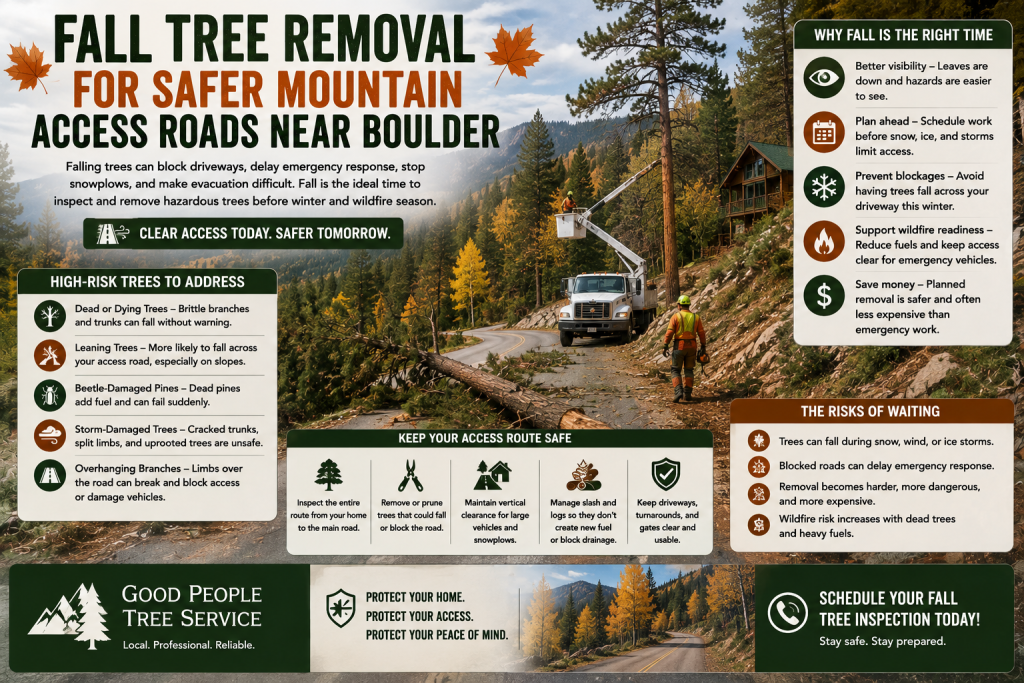
Fall tree removal for safer mountain access roads near Boulder is not just about cleaning up a property before winter. It is about keeping driveways, private roads, evacuation routes, snowplow paths, and emergency access open before wind, snow, ice, and wildfire conditions make tree problems more serious.
Mountain properties near Boulder often depend on narrow roads, steep driveways, tight turns, forested slopes, and limited access points. A tree that falls across one of those routes can trap homeowners, block emergency responders, stop snow removal, delay propane delivery, damage vehicles, or make evacuation harder during a wildfire warning. In that setting, a dead or unstable tree along an access road can create risk even if it cannot hit the house.
Fall gives homeowners a practical window to inspect and remove high-risk trees before winter weather arrives. Leaves drop from deciduous trees. Dead branches become easier to see. Beetle-killed pines often stand out. Driveways remain visible before snow covers slopes, roots, drainage issues, and road edges. Tree crews may also have better access before ice, snow, and freeze-thaw conditions make mountain work more difficult.
Learning why fall tree removal for safer mountain access roads near Boulder matters helps homeowners prioritize the right trees. The goal is not to remove every tree near a driveway. The goal is to remove trees that could block access, fall toward structures, add wildfire fuel, or become harder to manage later.
If you have dead, leaning, beetle-damaged, storm-damaged, or crowded trees along a mountain driveway or private road, Good People Tree Service can inspect the area and help determine whether removal, pruning, spacing, or monitoring makes sense.
Fall tree removal for safer mountain access roads near Boulder
Fall tree removal for safer mountain access roads near Boulder starts with one question: could this tree block the way in or out?
A tree does not need to fall on a home to become dangerous. If it falls across a steep driveway, narrow private road, gate, bridge, turnaround, or access lane, it can create an immediate problem. Homeowners may not be able to leave. Emergency crews may not be able to enter. Snowplows may not reach the house. Fire crews may lose time during a fast-moving situation.
This is especially important near Nederland, Jamestown, Boulder Canyon, Sunshine Canyon, Fourmile Canyon, Coal Creek Canyon, and other foothills or mountain areas where homes often rely on long access routes.
A safer property plan should inspect the whole route from the home to the main road, not only the trees around the house.
Fall is a smart inspection window
Fall offers better timing than many homeowners realize. By fall, summer storms, drought stress, beetle activity, and branch dieback have often become visible. A tree that looked healthy in June may show red needles, thinning canopy, dead tops, or cracked limbs by September or October.
Deciduous trees also reveal more structure after leaf drop. Homeowners can see leaning trunks, broken tops, weak unions, dead limbs, and hanging branches more easily. Conifers keep needles, but fall still helps homeowners notice brown crowns, pitch, boring dust, woodpecker activity, and dead tops before snow hides important clues.
Fall also gives homeowners time. Waiting until winter can turn planned tree removal into emergency work. Snow can cover root movement, make slopes slippery, limit equipment access, and hide drainage or erosion problems along the road edge.
A fall inspection gives homeowners a chance to act before the access route becomes harder to manage.
Access roads matter for emergency response
Mountain access roads near Boulder serve more than daily traffic. They also serve emergency responders, firefighters, utility crews, snow removal equipment, contractors, and delivery vehicles.
A blocked driveway during a winter storm is already a serious problem. A blocked driveway during a wildfire warning can become dangerous very quickly. If a dead pine, leaning aspen, cracked limb, or beetle-killed tree falls across the road, the timing may be terrible.
Homeowners should think about vertical clearance, road width, turnarounds, steep sections, and trees that could fall across the path. A tree standing uphill from a driveway may create more risk than one standing beside a flat lawn because gravity and slope can send it directly across the access road.
This is why tree removal near mountain access routes should prioritize function. Safe access is part of home safety.
Dead trees near roads deserve priority
Dead trees lose strength over time. Branches dry out. Tops can snap. Bark loosens. Decay can move into the trunk and roots. The tree may stand for a while, but standing does not mean safe.
A dead tree along a mountain access road should move higher on the priority list because it can block the route when it fails. It can also drop branches onto vehicles, damage fences, bring down utility lines, or create cleanup problems during snow or wind.
Dead trees far from structures and access routes may sometimes remain for wildlife habitat when they do not create immediate risk. Dead trees near driveways, roads, gates, or turnarounds deserve a different decision.
Fall is a good time to identify these trees before winter storms load branches and before snow makes access more difficult.
Beetle-killed pines can block access and add fuel
Bark beetles are a major concern in many Front Range pine forests. Mountain pine beetle, Ips beetles, and other bark beetles can attack stressed pines, especially when drought, heat, dense stands, or fresh slash create favorable conditions.
Beetle-killed pines may show boring dust, pitch tubes, small bark holes, red or brown needles, loose bark, woodpecker activity, or dead tops. Once a pine has died, it can become brittle over time.
Near a mountain access road, beetle-killed pines create several problems at once. They can fall across the driveway. They can add dry fuel. They can become harder to remove if homeowners wait. They can also signal stress in nearby trees.
Fresh beetle attacks may need faster attention when the tree could still contribute to local beetle spread. Older beetle-killed pines far from targets may be lower priority. But a beetle-killed pine near a driveway or access road still deserves inspection because of access and safety risk.
Leaning trees over roads need careful evaluation
Not every leaning tree needs removal. Some trees grow with a natural lean and remain stable for years. But a leaning tree over a mountain access road deserves careful evaluation, especially in fall.
A lean becomes more concerning when it is new, worsening, pointed downhill, aimed at the driveway, or paired with root movement, cracked soil, exposed roots, trunk cracks, decay, or dead canopy.
Slope matters. A tree above a road may fall downhill. A tree rooted in shallow rocky soil may have limited anchoring. Heavy rain, snowmelt, erosion, or driveway construction can change root support.
Homeowners should not try to pull or cable a large leaning tree themselves. A tree service can evaluate whether monitoring, pruning, cabling, or removal is the safer choice.
Snow can turn a weak tree into a blocked road
Colorado mountain weather can shift quickly in fall and winter. Heavy wet snow can break branches, snap dead tops, and push leaning trees farther toward failure.
Conifers can hold snow on branches and needles. Dead pines may not flex well under that load. Deciduous trees can also break during early snow if leaves remain on branches.
A tree that barely clears the driveway in October may hang lower after snow. A cracked branch may break. A dead top may land in the road. A leaning tree may shift when snow adds weight to one side.
Fall removal of high-risk trees can prevent winter access problems. It also reduces the chance that homeowners need emergency tree work on icy slopes during a storm.
Wind exposure increases access-route risk
Foothills and mountain properties near Boulder often experience strong wind. Wind can push trees repeatedly, widen cracks, break dead limbs, and loosen root plates.
Wind also affects trees differently along driveways. Road cuts, ridges, open slopes, and forest edges can create exposure. Trees that once grew sheltered may become more exposed after nearby trees die or get removed.
A dead or weakened tree along a road edge may fail during wind and land across the access route. A live tree with root damage may lean farther after repeated storms.
Fall inspections should look for wind exposure, dead tops, cracking trunks, and trees that sway or lean differently from nearby trees.
Wildfire readiness includes access routes
Wildfire mitigation often starts around the home, but access routes also matter. Emergency crews need room to enter. Residents need routes to leave. Driveways and private roads should not be lined with dead, unstable, or fuel-heavy vegetation that can fall, burn, or block movement.
Tree removal may support defensible space when dead trees, dense conifers, ladder fuels, or beetle-killed pines grow close to the driveway. Pruning lower branches and clearing slash can also help reduce fuel continuity along the route.
The goal is not to make a mountain road look bare. The goal is to keep the access corridor safer, clearer, and more usable during emergencies.
Healthy, well-spaced trees can remain. Dead, leaning, crowded, or hazardous trees should receive priority.
Slash and logs should not create a new problem
Tree removal creates branches, needles, chips, rounds, and logs. On mountain properties, cleanup matters.
Leaving slash beside the driveway can create fuel. Piling branches near a home, deck, or propane tank can increase risk. Stacking firewood too close to structures can work against defensible space goals. Fresh pine slash may also attract some bark beetles if handled poorly during active periods.
Before removing trees, homeowners should plan what happens to the material. It may need chipping, hauling, cutting, stacking in a safer location, or disposal through an appropriate local program when available.
Good access-road tree removal should leave the route safer than it was before the work began.
Which trees should homeowners inspect first?
Start with trees that could fall across the driveway or private road. Then inspect trees that could block gates, bridges, sharp turns, parking areas, turnarounds, propane access, or emergency vehicle access.
Look for dead trees, leaning trunks, beetle-killed pines, red needles, broken tops, large dead limbs, root movement, erosion near the base, trunks cracked by past storms, and trees growing uphill from the road.
Also inspect trees near utility lines. Do not approach or work on trees touching or leaning toward power lines. Utility-related tree work requires extra caution and may need utility coordination.
After inspecting the access route, move outward to the broader defensible space and forest-health concerns.
A tree beside the road may be lower risk than a tree above the road
Fall path matters. A tree beside a flat driveway may drop branches onto the road, but a tree above a steep road cut may have a more direct failure path.
Trees above mountain roads deserve special attention because gravity can send trunks, branches, and logs downhill. Even smaller trees can block a narrow driveway when they fall from above.
Look at the slope, lean direction, soil cracks, exposed roots, and road edge. A tree on a slope with roots exposed by erosion may become more risky before winter.
This is one reason mountain access road tree removal requires site-specific judgment. Tree size alone does not tell the whole story.
Fall removal can reduce emergency costs
Emergency tree removal often costs more than planned work because timing, weather, and access make the job harder. A tree across a snowy driveway may require urgent response, difficult cutting, and extra safety precautions. A dead tree that deteriorates further may require different equipment or more controlled rigging.
Planned fall removal gives homeowners more control. They can choose timing, prepare access, manage slash, and address multiple trees in one visit if needed.
Not every tree must come down immediately, but high-risk trees near access routes should not be ignored until they fall.
The safer strategy is to inspect in fall, prioritize risk, and remove trees that could create serious winter or emergency access problems.
Pruning may solve some access problems
Tree removal is not always necessary. Some access-road issues can be solved with pruning.
Dead branches over the driveway may need removal. Low limbs may need clearance. Branches rubbing utility areas, signs, gates, or snowplow paths may need selective pruning. Young trees crowding the road edge may need structural correction.
Pruning works best when the tree is healthy, structurally sound, and not leaning or dead. Removal makes more sense when the tree has major defects, is dead, is beetle-killed, or could fall across the road.
A professional inspection can help homeowners avoid removing trees that only need targeted pruning.
Removal may be safer for dead, unstable, or beetle-killed trees
Removal usually makes sense when a tree is dead, severely leaning, beetle-killed, cracked, unstable at the roots, or standing in a location where it could block access.
A dead pine above a driveway, a leaning aspen near a turn, a cracked trunk near a gate, or a beetle-killed tree beside a private road can all become high-priority removals.
The decision should consider tree condition, fall path, road importance, slope, weather exposure, and cleanup needs.
For mountain properties, a tree that blocks access can become as serious as a tree that hits a structure.
Case example: dead pine above a Boulder Foothills driveway
A homeowner in the Boulder Foothills notices a pine turning red above a steep driveway. Boring dust sits in bark crevices, and woodpeckers have chipped bark from the trunk.
The tree may be beetle-killed. It stands above the access route. If it falls in winter, it can block the driveway and create emergency access problems.
Fall removal may be the best option. Waiting could make the tree more brittle and the site harder to access after snow.
Case example: leaning aspen along a private road
A mountain homeowner has an aspen leaning toward a private road. The lean seems worse after a wet summer storm. Soil near the base has lifted, and several dead branches hang over the road.
This tree needs inspection. Root movement and worsening lean are warning signs. Pruning may not solve the problem if roots or trunk structure have failed.
If the tree could block the only road, removal may be safer before winter snow arrives.
Case example: low branches over a driveway
A healthy conifer has lower branches extending into a mountain driveway. The tree is not dead or leaning, but branches reduce clearance for snowplows and delivery trucks.
This may not require removal. Selective pruning may improve clearance while preserving the tree.
This example shows why the goal is safer access, not unnecessary clearing.
What homeowners should not do
Do not wait for a dead tree to fall across the driveway before acting. Do not cut large trees on slopes without proper equipment. Do not work near power lines. Do not stack slash near the home or along the road after removal.
Do not remove trees randomly either. Unplanned clearing can damage privacy, soil stability, shade, and forest health. The right plan removes high-risk trees and preserves healthy trees that do not threaten access.
Do not assume summer storm damage is harmless because the tree stayed standing. Fall is the time to look again.
When to call a tree service
Call a tree service if trees along your mountain driveway or private road are dead, leaning, beetle-damaged, cracked, storm-damaged, touching utility areas, or growing above steep road cuts.
Also call if branches hang over access routes, if a tree could block the only driveway, or if wildfire mitigation work needs selective removal and slash cleanup.
Good People Tree Service can inspect the access route, identify visible hazards, remove high-risk trees, and help preserve healthy trees that belong on the property.
Frequently asked questions
Why is fall a good time for mountain access road tree removal?
Fall gives homeowners time to inspect and remove high-risk trees before snow, wind, ice, and winter access problems arrive. It also makes dead branches and structural defects easier to see.
Which trees near mountain roads should be removed first?
Start with dead, leaning, beetle-damaged, cracked, or unstable trees that could fall across driveways, private roads, gates, turnarounds, utility areas, or emergency access routes.
Does every tree near a driveway need removal?
No. Healthy, well-spaced trees can often stay. Some trees only need pruning for clearance. Removal should focus on trees that threaten access, safety, structures, or wildfire readiness.
Can a fallen tree block emergency response?
Yes. On mountain properties with narrow or single-access driveways, a fallen tree can delay emergency vehicles, snowplows, fire crews, utility crews, and evacuation.
Should slash be removed after access-road tree work?
Yes, slash should be managed properly. Branches, logs, and needles left near roads, homes, or structures can create fuel, pest, or access problems.
Final thoughts
Fall tree removal for safer mountain access roads near Boulder is about prevention. A dead or unstable tree may not threaten the house directly, but it can still block the only driveway, delay emergency responders, stop snowplows, damage vehicles, or add wildfire fuel along an important route.
Fall gives homeowners a chance to inspect trees before winter. Dead pines, leaning aspens, beetle-damaged conifers, cracked trunks, root movement, and low branches over access routes should not be ignored.
The best approach is selective. Remove high-risk trees that threaten access. Prune healthy trees when clearance is the main issue. Manage slash properly. Preserve strong trees that add beauty, privacy, and forest health.
Good People Tree Service helps homeowners near Boulder, Nederland, and the foothills inspect mountain access roads, remove hazardous trees, and plan safer properties before snow, wind, or fire season turns a tree problem into an emergency.
If trees along your mountain driveway look dead, leaning, cracked, or beetle-damaged, schedule an inspection this fall before access becomes harder.