
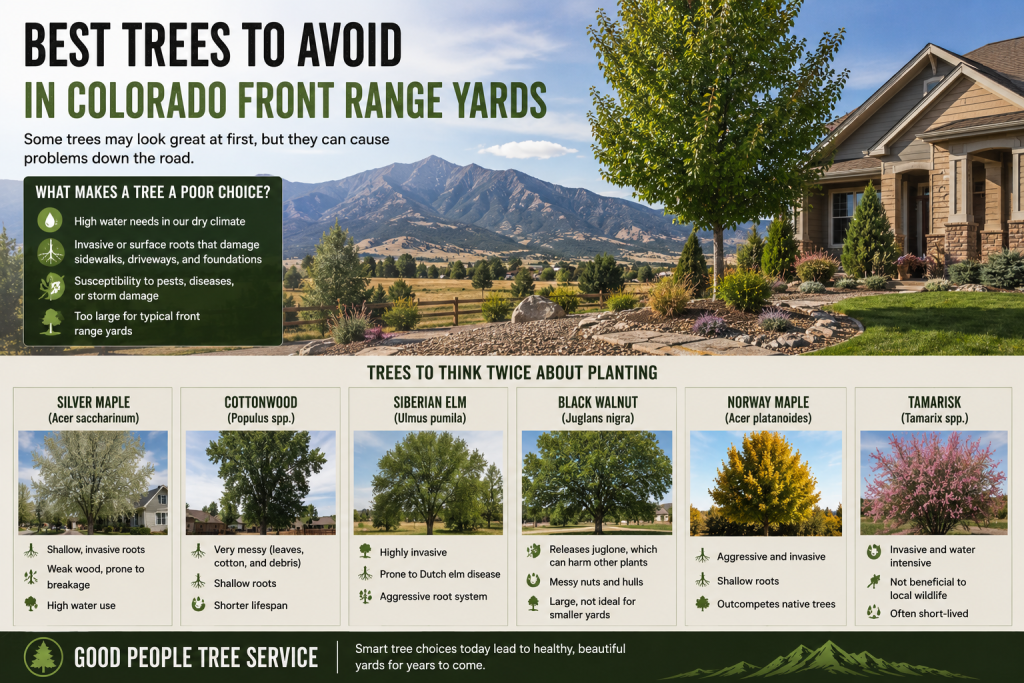
Best trees for Colorado Front Range yards and which ones to avoid is a practical question for homeowners because the wrong tree can create years of problems. A tree may look perfect at the nursery, but once it is planted in a hot, windy, compacted, or clay-heavy yard, the weaknesses become obvious.
The Colorado Front Range is not an easy place for trees. Homeowners deal with dry air, high elevation sun, alkaline soils, clay, drought cycles, heavy spring snow, sudden temperature swings, and urban heat from streets, roofs, sidewalks, and driveways. A tree that performs well in another state may struggle here.
The best tree is not always the fastest-growing tree or the one with the prettiest spring flowers. It is the tree that fits the site, has enough space to mature, can tolerate local soil and weather, and does not create avoidable maintenance problems later.
Understanding the best trees for Colorado Front Range yards and which ones to avoid helps homeowners make smarter planting decisions, reduce future removal costs, and build a healthier landscape.
If you are choosing a new tree or replacing a problem tree, Good People Tree Service can help evaluate the site and explain what tree health risks to consider before planting.
Best trees for Colorado Front Range yards and which ones to avoid
Best trees for Colorado Front Range yards and which ones to avoid depends on site conditions more than personal preference. A good tree for one yard may be a poor choice for another.
Before choosing a species, look at mature height and width, soil drainage, rooting space, sun exposure, wind exposure, distance from the house, distance from sidewalks and driveways, water availability, nearby utility lines, and long-term maintenance needs.
The goal is not to find one perfect tree. The goal is to match the right tree to the right place.
What makes a tree good for the Front Range?
A good Front Range tree usually handles more than one stress factor. It should tolerate dry air, occasional drought, alkaline soil, winter cold, spring snow, and hot summer sun.
The best choices also have strong structure. Colorado storms can load branches with wet snow or push trees with strong winds. Trees with weak branch unions, brittle wood, or poor attachment patterns often become more expensive over time.
A good tree should also fit the landscape. Planting a large tree in a narrow strip between a sidewalk and street often creates future root conflicts. Installing a thirsty species in a hot, dry yard can lead to stress, decline, or high water demand.
Hackberry: one of the toughest shade-tree options
Hackberry is often a strong choice for Colorado Front Range yards because it tolerates difficult urban conditions better than many ornamental trees. It can handle wind, drought once established, alkaline soils, and less-than-perfect sites.
It is not always the most dramatic tree in a nursery row. The bark can look rough, and some leaves may develop harmless galls. Still, hackberry earns attention because it is adaptable and durable.
Hackberry can work well as a shade tree when there is enough space. It is often a better long-term choice than trees that grow fast but develop weak wood or major pest issues.
Homeowners should still plant it correctly, water it during establishment, and give it room.
Bur oak and oak hybrids for long-term strength
Bur oak and some oak hybrids can be excellent choices for homeowners who want a long-lived shade tree. Oaks are not instant gratification trees. Many grow slower than fast shade trees, but that can be a benefit.
A slower tree with stronger wood and better drought tolerance may be more valuable than a fast tree that breaks apart or declines early.
Bur oak has thick bark, strong structure, and good toughness once established. Some oak hybrids may also perform well when matched to the site.
The main caution is soil compatibility. Some oaks can struggle with iron chlorosis in alkaline Colorado soils, especially species that are not well adapted. Choosing the right oak matters.
Kentucky coffeetree: durable but underused
Kentucky coffeetree is a strong option for many Front Range landscapes. It has a bold winter form, good tolerance of urban conditions, and relatively open shade.
Its appearance is different from more common shade trees. The branches can look coarse when young, and the tree may take time to develop its mature shape. For patient homeowners, that can be worth it.
Kentucky coffeetree can be a good choice where a large tree has room to grow and where diversity matters. Many neighborhoods have too many of the same few species. Adding durable but less overused trees helps reduce pest and disease risk at the community level.
Male cultivars are often preferred in residential yards because they avoid seedpod issues.
Honeylocust: useful, but do not overplant it
Honeylocust is popular for a reason. It provides filtered shade, tolerates many urban conditions, and can work in lawns where dense shade would be a problem. Thornless and seedless cultivars are commonly used in landscapes.
However, popularity creates risk. When one species becomes too common, pest and disease problems can become more noticeable. The Front Range has already seen this pattern with other overplanted trees.
Honeylocust can still be a good choice, but it should not be the automatic answer for every yard. If your street already has many honeylocust trees, consider another suitable species to improve diversity.
Linden trees for shade and structure
Lindens can be attractive shade trees for Colorado yards when planted in suitable sites. They offer a strong canopy shape, dense foliage, and good urban landscape value.
They do need attention during establishment. Young lindens may benefit from protection against sunscald or frost cracks in some settings because thin bark can be vulnerable. Watering during dry periods is also important.
A linden planted in a hot, dry, compacted strip may struggle. In a yard with reasonable soil volume and care, it can become a beautiful long-term tree.
Catalpa can also work well as a shade tree in many Colorado Front Range yards. It grows relatively fast, creates broad summer shade, and can tolerate local conditions when planted with enough space. Homeowners should give it room because mature catalpa trees can become large and may drop seed pods.
Ohio buckeye and horse chestnut can also be considered for shade or ornamental value in the right site. These trees offer strong seasonal interest, but homeowners should still match them carefully to soil, space, and water conditions before planting.
Smaller trees for tighter yards
Not every yard needs a large shade tree. Many Colorado homes have small front yards, narrow side yards, overhead lines, patios, and hardscape. In these areas, smaller trees may be smarter.
Good small-tree options may include serviceberry, hawthorn, Gambel oak, some crabapples, pinyon pine, bristlecone pine, and other locally appropriate ornamentals.
Small trees can reduce conflicts with roofs, foundations, sidewalks, and utility lines.
The mistake is planting a large tree where a small tree belongs. A tree that is “cute” when planted may become too big for the space in 15 years.
Good small-tree options may include serviceberry, hawthorn, redbud, Gambel oak, some crabapples, pinyon pine, bristlecone pine, and other locally appropriate ornamentals.
Hawthorns are especially useful in smaller Front Range yards because many stay compact, offer seasonal interest, and can fit better near homes than large shade trees. Redbuds can also be a strong ornamental option when planted in a protected site with the right soil and moisture conditions.
Evergreens for screening and winter interest
Evergreens can be valuable in Front Range yards because they provide year-round structure, privacy, wind protection, and winter color.
Good screening choices may include pinyon pine, bristlecone pine, white fir, columnar white pine, and carefully selected columnar ornamental pears where site conditions allow.
Columnar trees can work well when homeowners need privacy or vertical structure without planting a tree that spreads too wide. They are especially useful near fence lines, side yards, or narrow landscape areas. Even narrow trees still need enough root space, water, and clearance from homes, sidewalks, and utilities. The right choice depends on space, drainage, sun exposure, and water availability.
Evergreens should not be planted too close to the house, driveway, or fence. They need room for mature spread. Dense evergreen plantings can also trap snow, block light, or create fire-management concerns in some settings.
Watering matters too. Evergreens lose moisture during winter, especially in dry, sunny, windy weather. A neglected evergreen may look fine in fall and brown out by spring.
Trees to avoid: ash on the Front Range
Ash trees were widely planted in Colorado for decades. They grow quickly, tolerate urban conditions, and provide good shade. The problem is emerald ash borer.
Because emerald ash borer has become a major threat to Colorado ash trees, new ash planting is generally not recommended along the Front Range. Homeowners with existing ash trees should identify them, monitor for symptoms, and decide whether treatment or removal makes sense.
Planting new ash trees today can create a future maintenance burden. Even if the tree grows well at first, it may eventually require costly insect management or removal.
For replacement planting, choose a different genus. Diversity is the better strategy.
Trees to avoid: Tree-of-Heaven and Russian olive
Tree-of-Heaven and Russian olive should not be planted as normal residential landscape trees.
Tree-of-Heaven is invasive, highly adaptable, and troublesome in urban landscapes. It can grow under harsh conditions, spread aggressively, and become difficult to manage.
Russian olive is also a problem species in Colorado. It can reproduce by seed and root suckers, spread into natural areas, and create long-term management issues.
These trees may survive tough conditions, but survival alone does not make a tree a good choice. A good landscape tree should support the property without creating invasive or management problems.
Be cautious with silver maple
Silver maple grows fast, which is why many homeowners like it. Fast shade feels rewarding in a new yard.
The tradeoff is structural weakness.
Silver maples can have soft wood, storm breakage, decay issues as they age, and aggressive surface roots. In tight Front Range yards, they may lift hardscape, drop branches, or become difficult to manage near homes and driveways.
That does not mean every existing silver maple must be removed. Many mature silver maples provide valuable shade. But planting a new one in a small yard is often not the best long-term decision.
Be cautious with aspen in low-elevation yards
Aspen is one of Colorado’s most beloved trees, but it is often a poor fit for irrigated Front Range yards.
Aspen is native to mountain environments, not the hot urban plains. In lower-elevation landscapes, it can struggle with heat, pests, disease, and short lifespan. It may also sucker and spread in ways homeowners do not expect.
Aspen can be beautiful in the right place. In many Denver, Boulder, Arvada, Broomfield, Golden, Lafayette, Erie, and suburban Front Range yards, it often becomes high-maintenance.
If a homeowner wants the aspen look, it is worth discussing alternatives before planting.
Be cautious with cottonwood and willow near structures
Cottonwoods and willows can be valuable trees in the right environment, especially near waterways or large open spaces. They are not automatically bad trees.
The problem is placement.
Both can become very large and may have high water needs. Their roots can conflict with hardscape, drainage, and utilities when planted too close to homes, sidewalks, driveways, or irrigation lines. Cottonwoods can also drop branches as they mature.
For large rural properties, they may have a place. For small residential yards, they often create more risk than benefit.
Maples can be tricky in alkaline soils
Maples are popular because of their shape and fall color. Some can perform well in Colorado, but many are prone to chlorosis in alkaline soils.
Iron chlorosis often appears as yellow leaves with green veins. Over time, it can weaken the tree if not managed. Red maple, silver maple, Amur maple, and certain hybrids can be more vulnerable in local soils.
This does not mean all maples should be avoided. It means homeowners should choose carefully and understand the soil before planting.
A tree chosen for fall color alone may become a long-term treatment project.
Case example: replacing a problem ash tree
A homeowner removes a declining ash tree near the driveway. The first instinct is to replace it with another fast-growing shade tree.
A better approach is to look at the site first. Is the driveway close? Is the soil compacted? Are there overhead wires? Does the yard need filtered shade or dense shade? Are there already many honeylocusts on the street?
After that review, the homeowner might choose hackberry, Kentucky coffeetree, bur oak, a linden, or another locally suitable tree. The decision is based on long-term fit, not just fast growth.
That is how good tree selection prevents repeat problems.
Case example: the small yard with big-tree ambitions
A homeowner wants a large shade tree in a narrow front yard between the house and sidewalk. A fast-growing tree sounds appealing because the yard gets hot in summer.
The problem is space. A large tree may eventually crowd the roof, lift the sidewalk, interfere with utilities, or require heavy pruning.
A smaller ornamental tree may be the better choice. It may not shade the entire house, but it will fit the site and cause fewer conflicts.
The right tree is the one that can mature without becoming a problem.
How to choose the right tree before planting
Before planting, homeowners should ask:
- How large will this tree become?
- How much water will it need?
- Is it suited to alkaline soil?
- Will roots conflict with hardscape?
- Is it vulnerable to known pests?
- Does the neighborhood already overuse this species?
- Will it be too close to the house?
- Can it handle wind, snow, and drought?
- Is it appropriate for the site, not just the region?
Local tree selection is not about picking from a national “best trees” list. It is about choosing for Colorado’s climate and your exact yard.
Planting and care matter as much as species
Even the best tree can fail if planted poorly.
The root flare should be visible. The planting hole should be wide enough. Circling roots should be corrected when possible. Mulch should be spread in a wide, flat ring, not piled against the trunk.
Watering is especially important during establishment. A young tree needs consistent moisture in the root ball and surrounding soil. Once established, most trees still need supplemental water during dry periods in Colorado.
Tree selection starts at the nursery, but success is decided in the yard.
Frequently asked questions
What are some of the best trees for Colorado Front Range yards?
Hackberry, bur oak, Kentucky coffeetree, honeylocust, linden, serviceberry, hawthorn, Gambel oak, pinyon pine, bristlecone pine, and some firs or spruce can work well when matched to the site.
Should I plant an ash tree in Colorado?
New ash planting is generally not recommended along the Front Range because of emerald ash borer risk.
Is aspen good for Front Range yards?
Aspen is beautiful but often struggles in irrigated, low-elevation Front Range landscapes. It may have pest, disease, heat, and suckering problems.
What tree should I avoid near sidewalks or driveways?
Avoid large, fast-growing trees with aggressive surface roots in tight spaces. Silver maple, cottonwood, willow, and similar large trees can create hardscape conflicts when planted too close.
What is the most important factor when choosing a tree?
Site fit. Mature size, soil, water, sun, wind, hardscape distance, and long-term maintenance matter more than appearance on planting day.
Final thoughts
Best trees for Colorado Front Range yards and which ones to avoid depends on matching the tree to the site. A durable tree in the right place can provide shade, beauty, wildlife value, and long-term property benefits. The wrong tree can lead to root conflicts, branch failure, pest problems, drought stress, and early removal.
Hackberry, bur oak, Kentucky coffeetree, honeylocust, linden, catalpa, Ohio buckeye, serviceberry, hawthorn, redbud, Gambel oak, pinyon pine, bristlecone pine, white fir, and columnar screening trees can all be good options when matched to the right site.
Good People Tree Service helps homeowners evaluate tree health, root conflicts, site limitations, and removal needs before new tree problems begin.
If you are replacing a tree or choosing what to plant next, start with the site. The best tree is the one that can grow well in your Colorado yard for decades.