
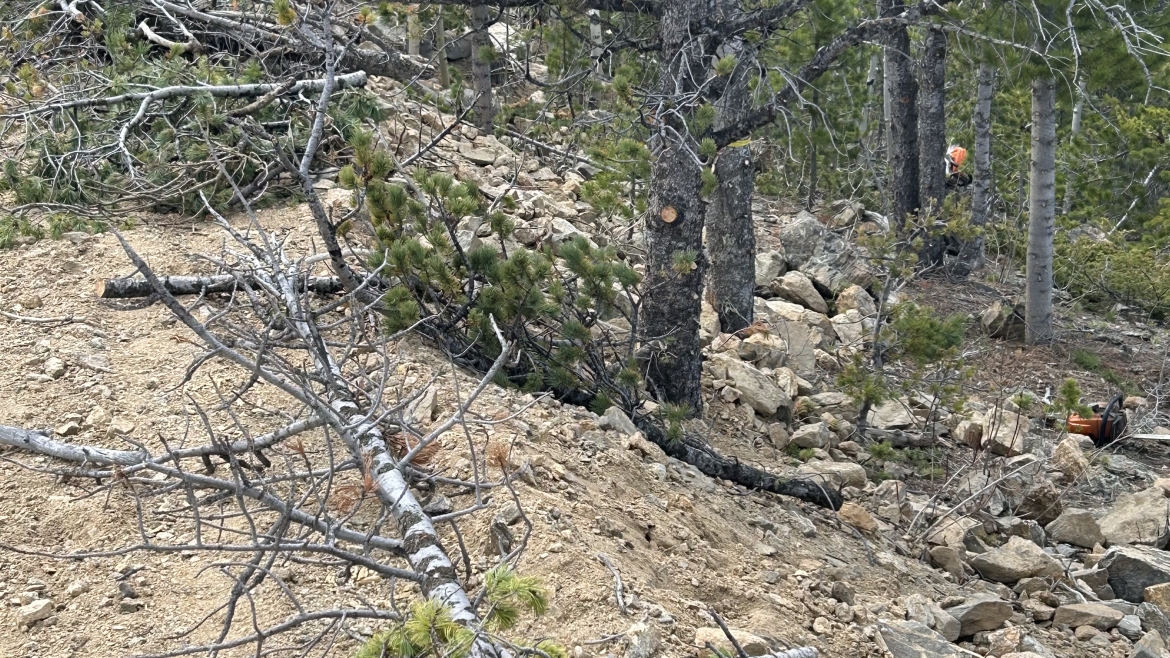
The science behind tree failure helps explain why trees can fall even when they look healthy from the outside. A tree may have green leaves, a full canopy, and a strong-looking trunk. Then one storm arrives, and a large limb breaks or the entire tree comes down.
To a homeowner, the failure may seem sudden. In reality, most tree failures begin long before the final break. Root damage, internal decay, weak branch unions, drought stress, soil compaction, and storm history can all weaken a tree over time.
For Colorado homeowners, this topic matters even more. Trees along the Front Range deal with strong winds, heavy spring snow, dry soils, drought stress, construction pressure, and fast temperature changes. These conditions can expose hidden defects quickly.
Understanding the science behind tree failure can help homeowners recognize warning signs earlier. It can also help them decide when pruning, inspection, or removal may be needed.
If a tree near your home, driveway, sidewalk, or fence has started leaning, dropping limbs, or showing signs of decline, Good People Tree Service can evaluate it before the next storm turns a hidden defect into an emergency.
Tree Failure Is Usually Not Random
When a tree falls, people often blame the weather. That makes sense. Storms are visible. Wind is obvious. Heavy snow is easy to understand.
But weather is often the trigger, not the original cause.
A healthy tree is designed to move. Branches flex. Trunks sway. Roots hold the tree in place while allowing some movement. When all parts of the tree are functioning well, the tree can handle normal weather stress.
Failure often happens when a tree already has a weakness.
That weakness may involve:
- Damaged roots
- Internal decay
- Weak branch unions
- Cracks in the trunk
- Dead or brittle limbs
- Poor past pruning
- Drought stress
- Soil compaction
- Construction damage
- Disease or insect pressure
The science behind tree failure is about understanding how those problems work together. One issue weakens the tree. Another adds stress. A storm supplies the final force.
That is why a tree can look fine for years and then fail suddenly.
Why the Science Behind Tree Failure Matters for Colorado Homeowners
The science behind tree failure starts with how trees handle force. A tree must support its own weight while resisting wind, snow, gravity, and soil movement.
Researchers often separate tree failures into three main categories:
- Branch failure
- Stem or trunk failure
- Root failure
Each type has different causes.
Branch failure happens when a limb breaks. This may be caused by weak attachment, decay, snow load, wind, deadwood, or overextension.
Stem failure happens when the main trunk cracks, splits, or breaks. This may be linked to decay, old wounds, included bark, cavities, or excessive trunk stress.
Root failure happens when the tree uproots or shifts. This may involve root decay, saturated soil, drought damage, construction injury, or poor anchoring.
A systematic review and meta-analysis on tree failure found that height and stem weight relate positively to stem failure. The same research also found that stem weight and total tree weight relate positively to root failure.
In simple terms, bigger trees often carry greater mechanical loads. That does not mean large trees are automatically unsafe. It means defects in large trees can have more serious consequences.
Wind: The Most Visible Trigger
Wind is one of the most common triggers for tree failure in Colorado.
The Front Range can experience strong downslope winds, Chinook winds, thunderstorm outflows, and fast-moving weather systems. These winds can twist canopies, bend trunks, and place heavy pressure on roots.
The National Weather Service reported that during the December 30, 2021 Front Range wind event, gusts near the base of the foothills reached 70 to 100 mph in areas including Boulder and the Highway 93 corridor toward Golden.
Extreme winds can damage even healthy trees. But trees with hidden defects are at much higher risk.
Wind can expose:
- Weak branch attachments
- Root instability
- Internal decay
- Trunk cracks
- Overextended limbs
- Canopy imbalance
The science behind tree failure shows that wind is often the final test. A tree may already be weakened by decay, drought, or root damage. Wind simply reveals the problem.
A tree does not have to fall completely to suffer wind damage. Cracked limbs, split unions, and hanging branches may remain in the canopy after the storm. These can fail later.
After a major wind event, inspect trees from a safe distance. Look for new leaning, broken limbs, hanging branches, cracks, or soil movement near the base.
Snow Load: When Weight Breaks What Wind Does Not
Colorado snow creates a different kind of force.
Wind pushes and twists. Snow adds weight.
Wet spring snow can cling to branches and overload the canopy. This is especially risky when trees already have leaves or when the canopy is dense.
Snow-related failure often happens when:
- Limbs are long and horizontal
- Branch unions are narrow
- Deadwood is present
- The canopy is too dense
- The tree has old storm damage
- Previous pruning created weak structure
A tree that looks strong in summer may struggle during a wet spring storm. The added weight can split trunks, break branches, or expose weak unions.
The science behind tree failure explains why snow damage is not only about the amount of snow. It is also about structure. A tree with better branch spacing and less deadwood usually handles snow more effectively than a tree with dense, weak, or unbalanced growth.
Preventative pruning can reduce some of this risk. Removing deadwood and improving branch spacing allows the tree to carry snow more safely.
The Science Behind Tree Failure and Root Damage
Root failure is one of the most dangerous forms of tree failure because the whole tree may come down.
Roots anchor the tree. They also absorb water and nutrients. When roots are damaged, the tree loses both stability and health.
Root failure may be caused by:
- Root decay
- Soil compaction
- Construction damage
- Trenching
- Drought stress
- Saturated soil
- Poor drainage
- Grade changes
- Root cutting near hardscaping
Colorado State University Extension explains that soil compaction reduces a tree’s tolerance to stress factors including drought, heat, wind, aphids, mites, and other insects. Compaction and hardscape features can also limit root spread and show up as reduced growth or leaf scorch.
This matters because root damage is rarely obvious right away.
A driveway project, fence installation, utility trench, or patio build may cut or compact roots. The tree may still look fine for a few years. Then wind or wet soil may reveal the problem.
The science behind tree failure is especially useful here because homeowners usually look up, not down. They notice branches and leaves. But root health often determines whether the tree can stay upright.
Warning signs of possible root instability include:
- New leaning
- Soil lifting near the base
- Exposed roots
- Cracked ground
- Mushrooms near the root flare
- Sudden canopy thinning
- Decline after construction
A tree with root problems near a home or driveway should be evaluated before severe weather arrives.
What the Science Behind Tree Failure Reveals About Hidden Decay
Internal decay is another major cause of tree failure.
A tree can look alive while the inside is losing strength. This happens because the living tissue that moves water and nutrients is near the outer part of the trunk. The center of the tree may decay while the canopy still produces leaves.
Decay often begins after injury.
Common entry points include:
- Broken branches
- Large pruning wounds
- Storm cracks
- Trunk injuries
- Root damage
- Animal damage
- Old cavities
Once fungi enter the wood, decay can spread slowly. The tree may respond by forming barriers, but it may not fully stop the process.
Visible warning signs may include:
- Fungal growth
- Cavities
- Soft wood
- Cracks
- Hollow sounds
- Old wounds
- Bark loss
- Large dead limbs above the damaged area
The difficult part is that decay is not always visible. A tree may fail before homeowners notice the structural loss.
The science behind tree failure helps explain why green leaves are not enough proof of safety. A tree can still move water while losing the internal strength needed to withstand storms.
This is why mature trees with old wounds, cavities, or large dead limbs should be inspected regularly.
Branch Failure: Why Large Limbs Break
Branch failure is one of the most common tree problems homeowners notice.
A large branch may break because of wind, snow, decay, or poor structure. Sometimes it falls immediately. Other times it cracks and remains hanging in the canopy.
A hanging branch can be very dangerous. It may fall later without warning.
Branch failure is more likely when a tree has:
- Deadwood
- Overextended limbs
- Narrow branch angles
- Included bark
- Heavy limbs over structures
- Dense canopy growth
- Old storm damage
- Improper pruning cuts
Included bark is especially concerning. This happens when bark becomes trapped between two stems or branches. Instead of forming a strong wood connection, the union becomes weaker.
In calm weather, this may not be noticeable. Under wind or snow load, the union can split.
The science behind tree failure shows why structure matters as much as health. A tree may be alive and growing, but still have weak branch connections that can fail under pressure.
Good pruning can reduce branch failure risk. The goal is not to remove excessive canopy. The goal is to improve structure and remove defects before they fail.
Drought Stress Makes Failure More Likely Later
Drought does not always kill trees quickly. It often weakens them over time.
Colorado State University Extension notes that prolonged drought stress may cause wilting, early leaf drop, smaller-than-normal leaves, early fall color, leaf scorch, and increased disease or insect pressure.
Drought affects tree failure in several ways.
First, dry conditions can damage fine absorbing roots. That limits water uptake.
Second, drought reduces energy reserves. A tree with less energy has less ability to defend itself.
Third, drought-stressed trees become more vulnerable to insects and disease.
Fourth, dead branches may develop in the canopy. These can break during wind or snow.
This is why a tree may fail years after a dry season. The storm may be the immediate trigger, but drought may have weakened the tree long before.
The science behind tree failure makes this delayed pattern easier to understand. Tree decline often starts quietly. The visible failure may come much later.
Deep watering during dry periods can help reduce stress, especially for mature trees that rely on soil moisture beyond regular lawn irrigation.
If your tree has looked thinner since a dry year, Good People Tree Service can inspect it and help determine whether it can recover or needs risk reduction work.
Soil Compaction and Urban Stress
Many residential trees fail because of conditions created around them.
Urban and suburban trees often grow in difficult sites. They may be surrounded by lawns, sidewalks, driveways, patios, fences, and compacted soil.
Soil compaction is especially common.
Compacted soil has less pore space. That means less oxygen and poorer water movement. Roots struggle to grow and function.
This can lead to:
- Reduced vigor
- Shallow roots
- Poor drought tolerance
- Leaf scorch
- Canopy thinning
- Increased pest pressure
- Reduced wind resistance
Compaction often happens during construction. It can also happen when vehicles park under trees, equipment crosses the root zone, or foot traffic is repeated over time.
The damage may not show up immediately. Like many tree problems, it can develop slowly.
Tree Size, Age, and Mechanical Load
Large mature trees are valuable. They provide shade, cooling, beauty, privacy, and habitat. But they also carry more mechanical load than young trees.
A large tree has more weight in the trunk and canopy. Its limbs are heavier. Its roots must resist greater forces. If structural defects exist, the consequences can be more serious.
This is why mature trees should be inspected regularly.
Size alone does not make a tree hazardous. A large healthy tree with good structure may be very stable. But a large tree with decay, root damage, or poor branch attachments deserves attention.
The bigger the tree, the more important it is to understand its structure.
Construction Damage Can Cause Delayed Failure
Construction-related tree damage is one of the most overlooked causes of tree failure.
A tree can be harmed even when the trunk is never touched.
Root systems may be damaged by:
- Excavation
- Utility trenching
- Driveway work
- Soil grading
- Patio installation
- Fence posts
- Heavy equipment
- Soil fill
- Drainage changes
The tree may not fail right away. Symptoms can take months or years.
This delay makes construction damage easy to miss. A homeowner may not connect a tree’s decline with a project completed several seasons earlier.
When roots are cut or compacted, the tree may become less stable. It may also absorb less water. Over time, canopy thinning and branch dieback may appear.
Protecting the root zone during construction is one of the best ways to prevent long-term tree failure.
Disease and Insects Are Often Secondary Problems
Insects and diseases can contribute to tree failure. But they often attack trees that were already stressed.
Drought, root damage, soil compaction, and poor pruning can weaken a tree’s natural defenses. Once the tree is stressed, pests and pathogens may become more successful.
For example, borers often target stressed trees. Fungal diseases may enter through wounds. Cankers may develop on weakened branches.
The visible insect or disease problem may not be the first cause. It may be part of a larger decline pattern.
Homeowners should watch for:
- Boring holes
- Sawdust-like material
- Peeling bark
- Fungal growth
- Sudden branch dieback
- Leaf discoloration
- Thin canopy
- Dead upper branches
These signs should be evaluated with the whole tree in mind, not as isolated symptoms.
Why Some Trees Fail Without Warning
Sometimes trees fail with very few visible warning signs.
This can happen when defects are hidden underground or inside the tree. It can also happen when a severe weather event exceeds what the tree can handle.
However, many “sudden” failures do have subtle clues.
The warning signs may have been:
- Slight canopy thinning
- Small dead branches
- Mushrooms near the base
- A slow increase in lean
- Old cracks
- Weak branch unions
- Root zone changes
- Soil compaction
- Prior storm wounds
These signs are easy to miss because they do not always look urgent.
The science behind tree failure shows why regular inspections matter. A trained tree professional may notice patterns before they become obvious hazards.
How Professionals Evaluate Tree Failure Risk
A professional tree evaluation looks at both the tree and the site.
The tree itself matters. So does what is around it.
A tree with a defect in an open field may be lower risk than the same tree leaning over a house. Risk depends on both likelihood of failure and potential consequences.
A professional may evaluate:
- Tree species
- Size and age
- Canopy condition
- Deadwood
- Trunk defects
- Branch unions
- Root flare
- Soil conditions
- Fungal growth
- Lean
- Recent storm damage
- Nearby structures
- Utility lines
- Pedestrian or vehicle areas
The goal is not to remove every imperfect tree. Many trees with defects can be managed through pruning, monitoring, watering, or other care.
But when a tree cannot be made reasonably safe, removal may be the best option.
Can Tree Failure Be Prevented?
Not all tree failure can be prevented. Severe weather can damage even well-maintained trees.
But many failures can be reduced through proactive care.
Helpful steps include:
- Inspect mature trees regularly
- Remove deadwood
- Prune young trees for structure
- Avoid topping
- Protect roots during construction
- Avoid parking on root zones
- Water deeply during dry periods
- Watch for mushrooms or cavities
- Inspect trees after storms
- Address leaning early
- Remove hazardous trees before they fail
Prevention is almost always easier than emergency response.
A planned pruning or removal gives homeowners more control. Emergency work often happens when the tree has already damaged something or become unstable.
When Removal Becomes the Safer Choice
A tree does not need to be removed just because it has a defect. But some defects are too serious to ignore.
Removal may be recommended when:
- Root failure is likely
- The trunk has severe decay
- Large cracks are present
- The tree leans toward a structure
- Major limbs keep failing
- The canopy is mostly dead
- Construction damage has compromised stability
- The tree is dead or rapidly declining
- Pruning cannot reduce risk enough
The decision should be based on condition, location, and risk.
A hazardous tree near a home, driveway, sidewalk, or fence deserves prompt attention.
Good People Tree Service can evaluate the tree and explain whether pruning, monitoring, or removal is the safest option.
Final Thoughts
The science behind tree failure shows that trees rarely fall for just one reason. Wind, snow, drought, decay, root damage, weak branch unions, and soil conditions often work together.
The final failure may happen in seconds. But the process often begins years earlier.
For Colorado homeowners, this makes regular tree care especially important. Front Range trees face strong winds, heavy snow, dry soils, drought stress, and construction pressure. These conditions can expose hidden defects quickly.
A tree with green leaves is not always structurally safe. A tree that has stood for years is not always stable. The safest approach is to watch for changes, inspect trees after storms, protect roots, and get professional help when warning signs appear.
Good People Tree Service helps homeowners identify hidden tree risks, reduce storm damage, and safely remove hazardous trees when needed.
If you are concerned about a tree on your property, schedule a professional evaluation before the next major weather event tests it.