
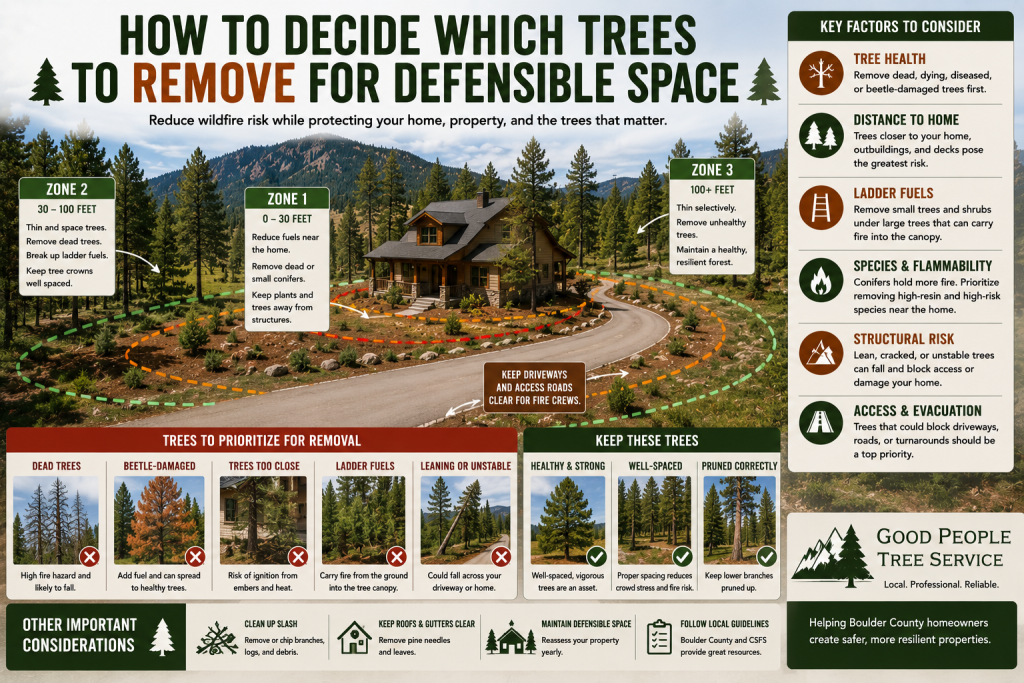
How to decide which trees to remove for defensible space starts with one important idea: defensible space is not the same as removing every tree. The goal is to reduce wildfire risk around the home while preserving healthy, well-spaced trees that still add shade, privacy, beauty, soil stability, and forest value.
For homeowners near Nederland, Boulder County, and the Colorado foothills, tree removal decisions can feel difficult. Many mountain properties are beautiful because of their trees. Pines, spruce, firs, aspens, and mixed forest make the property feel private and natural. But those same trees can create risk when they are dead, beetle-damaged, crowded, leaning, too close to structures, or connected to ladder fuels.
Defensible space helps reduce the chance that fire moves easily from vegetation to the home. It also helps firefighters, improves access, and gives the property a better chance during wildfire conditions. Tree removal is one tool in that process. Pruning, spacing, cleanup, mowing, slash management, and home hardening also matter.
Learning which trees to remove for defensible space helps homeowners avoid two mistakes. One mistake is removing too many trees without a plan. The other is keeping dangerous trees too long because they still look natural or provide privacy.
If your property has dead trees, dense conifers, beetle-damaged pines, low branches, or trees close to your home, Good People Tree Service can inspect the site and help you decide which trees should be removed, pruned, or monitored.
How to decide which trees to remove for defensible space
How to decide which trees to remove for defensible space starts by looking at the property in zones. The closer a tree is to the home, deck, garage, shed, propane tank, fence, or driveway, the more carefully it should be evaluated.
A dead tree far from the home may be lower priority if it cannot hit a structure, block access, or add fuel near important areas. A dead tree beside a wooden deck should move to the top of the list. Location changes the decision.
Homeowners should evaluate trees based on:
- distance from the home
- tree health
- tree species
- crown spacing
- ladder fuels below the tree
- branches touching or overhanging structures
- slope and fall direction
- driveway and emergency access
- beetle or pest damage
- dead limbs or broken tops
- lean, root movement, or decay
- slash and cleanup needs after removal
The best defensible space plan removes the highest-risk trees first and keeps the healthiest, best-positioned trees whenever possible.
Start closest to the home
The area closest to the house matters most. Embers, radiant heat, and nearby fuels can all affect whether a structure ignites during wildfire conditions.
Trees that grow directly against the home, over the roof, beside wooden decks, near windows, or close to vents deserve immediate attention. Even if the tree is alive, it may create risk if branches touch the structure or drop needles and leaves into gutters and roof valleys.
In this closest zone, homeowners should focus on reducing combustible material. That may mean removing small conifers, shrubs, dead plants, branches over roofs, or trees growing too close to the house.
The first question should be simple: if this tree or its branches burned, would it expose the home directly?
Remove dead trees first
Dead trees are usually the clearest removal candidates for defensible space. They add dry fuel, drop limbs, attract insects, and may fall during wind, snow, or fire conditions.
A dead pine beside the home, driveway, deck, or propane tank should be treated as a higher priority than a healthy tree in the same area. Dead branches, dead tops, and dead standing trees can all contribute to wildfire and safety risk.
Dead trees farther from the home may not always need immediate removal. Some may provide wildlife habitat if they are far from structures, roads, trails, and defensible space zones. But dead trees close to targets should not be ignored.
When homeowners feel unsure, they should prioritize dead trees near the home ignition zone, access roads, and places people use often.
Remove beetle-damaged or dying trees near structures
Beetle-damaged pines and dying conifers are common concerns near Nederland and the Boulder Foothills. Bark beetles often attack stressed trees, especially after drought, heat, dense competition, or root damage.
A beetle-damaged pine may show boring dust, pitch tubes, bark holes, red or brown needles, fading crown color, loose bark, or woodpecker activity. Once a pine dies, it can become more brittle over time.
Fresh beetle attacks may also require faster attention when the tree could still contribute to beetle spread in nearby susceptible pines. Older beetle-killed trees far from targets may be lower priority, but older dead pines near homes or driveways still create safety and fuel concerns.
For defensible space, dying and beetle-damaged trees near structures should usually rank high on the removal list.
Look for ladder fuels
Ladder fuels help fire climb from the ground into tree crowns. They can include small conifers, shrubs, low branches, tall grasses, brush piles, stacked limbs, and dense vegetation under larger trees.
A mature pine may not need removal if it is healthy and well placed. But small trees and shrubs growing beneath it may create a ladder that allows fire to move upward.
This is where selective removal matters. The right decision may be to remove small trees under larger trees, prune lower limbs, and clean dead branches instead of removing the mature tree.
When deciding which trees to remove for defensible space, homeowners should look vertically. If vegetation connects ground fuels to branches, that connection should be broken.
Remove trees that touch or overhang structures
Trees touching the home create direct risk. Branches can drop needles onto roofs, rub siding, touch gutters, scrape windows, or create a fuel bridge toward the structure.
Overhanging branches also create maintenance problems. Leaves, needles, cones, and twigs collect in gutters and roof valleys. Dry debris on or near the home can become vulnerable to embers.
In many cases, pruning may solve the issue. If the tree is healthy and far enough away, removing branches over the roof may reduce risk while preserving the tree. But if the tree grows too close, leans toward the home, or has poor structure, removal may make more sense.
Trees near wooden decks, fences, sheds, and stairs also need careful evaluation because these features can connect outdoor fuels to the home.
Thin crowded conifers
Crowded conifers can increase wildfire risk and tree stress. When tree crowns touch or overlap, fire may move more easily through the canopy. Dense trees also compete for limited moisture, which can weaken them during drought.
Selective thinning can improve crown spacing and reduce competition. The best candidates for removal are often small, weak, suppressed, damaged, leaning, crowded, or poorly placed trees.
Do not remove the strongest trees first just because they are large. In many cases, the healthiest, best-spaced trees should remain. Remove trees that crowd them, create ladder fuels, or sit too close to structures.
The goal is not a bare hillside. The goal is healthier spacing and reduced fuel continuity.
Preserve healthy, well-spaced trees
Defensible space should protect homes without destroying the landscape. Healthy trees add value. They provide shade, privacy, wildlife habitat, erosion control, and natural beauty.
A well-spaced, healthy tree with pruned lower branches may be worth keeping, especially if it does not touch structures, block access, or create ladder fuels. Some trees may only need pruning, not removal.
This point matters because homeowners sometimes overcorrect. They remove too many trees and lose shade, privacy, and soil protection. A thoughtful plan keeps the trees that can remain safely.
The best defensible space work removes risk while preserving the strongest parts of the landscape.
Consider tree species and flammability
Different trees behave differently in wildfire conditions. Conifers often create more concern near homes because they contain resin, hold needles, and can carry fire into crowns when ladder fuels exist. Pines, spruce, fir, and juniper-like evergreen vegetation often need close evaluation near structures.
Deciduous trees such as aspen, cottonwood, maple, or fruit trees may still burn under extreme conditions, especially if dead, dry, or surrounded by fuel. But healthy deciduous trees can sometimes be lower priority than dense conifers when spacing and moisture are better.
Species alone should not decide removal. Health, location, spacing, and surrounding fuels matter more. A dead aspen near a deck may be higher priority than a healthy, well-spaced pine farther away.
Look at driveway and emergency access
Defensible space is not only about the house. Access matters. Firefighters need a safe route in. Homeowners need a safe route out. Snowplows, utility crews, propane delivery, and emergency vehicles also depend on clear access.
Trees along driveways and private roads should be evaluated for fall risk, dead limbs, low clearance, dense fuels, and slope position. A dead pine above a driveway may not hit the home, but it can block evacuation or emergency response.
Trees that lean over roads, grow too close to narrow access routes, or create low clearance for large vehicles may need pruning or removal.
When deciding which trees to remove for defensible space, walk the entire access route from the home to the main road.
Slopes change the decision
Mountain and foothills properties often sit on slopes. Slope affects fire behavior, tree stability, and fall direction.
Trees uphill from a home or driveway may deserve closer attention because fire can move upslope and because falling trees may move downhill. Shallow soils, erosion, rock outcrops, and drainage channels can also affect root stability.
A tree on a slope with exposed roots, soil cracks, root movement, or a worsening lean should be inspected. Even if it is still alive, it may create structural risk.
Slope does not mean every tree should be removed. It means the fall path and fuel path should be part of the decision.
Remove trees with structural defects near targets
A tree can be alive and still be a removal candidate. Structural defects matter.
Warning signs include trunk cracks, split stems, weak branch unions, large cavities, mushrooms near the base, root plate movement, broken tops, major dead limbs, and severe lean. These defects become more serious when the tree stands near a home, driveway, deck, road, or utility line.
Pruning may help when defects are limited to branches. Removal may be safer when the trunk, roots, or main structure have failed.
For defensible space, structural risk and fire risk often overlap. A cracked, dying tree near the home may threaten both property safety and wildfire readiness.
Remove small trees under larger trees when needed
Small trees can be valuable in the right place, but they often create ladder fuel when they grow under mature conifers.
A group of young pines or spruce under larger trees may help fire climb from ground fuels into the canopy. Removing some of those small trees can reduce vertical fuel continuity without removing the mature overstory.
This is often one of the most effective selective removal decisions. It keeps the larger, healthier trees while removing the connection that makes fire spread upward more easily.
Homeowners should look for trees that fill the space between ground vegetation and low branches. Those are often better removal candidates than healthy mature trees.
Do not forget shrubs and brush
Tree removal alone will not create defensible space if shrubs, brush, grasses, and slash still connect fuels across the property.
Shrubs under trees can act like ladder fuels. Tall grasses can carry fire to shrubs. Brush piles can burn intensely. Pine needles under decks can create ember risk. Firewood stacked against the house can create a direct hazard.
When deciding which trees to remove, homeowners should also decide which non-tree fuels need cleanup. Sometimes the right answer is less tree removal and more brush clearing. Other times, trees and brush both need work.
Defensible space works best when all fuels are considered together.
Manage slash after removal
Tree removal creates slash, logs, branches, needles, and chips. If that material is left near the home, the property may still have a fuel problem.
Slash should be hauled, chipped, cut, moved, or disposed of properly. Firewood should be stored away from structures and not under decks. Beetle-infested pine wood may require special handling. Fresh pine slash should not sit near healthy susceptible trees for long periods during active beetle seasons.
Cleanup is part of the defensible space decision. Removing the right tree but leaving the debris in the wrong place does not solve the problem.
A good tree removal plan includes a debris plan before cutting begins.
Prioritize by risk, not emotion
Tree removal can feel personal. Homeowners may have favorite trees. They may also dislike certain trees and want them gone even if they are not the highest risk.
Defensible space should be driven by risk. Start with trees that are dead, dying, beetle-damaged, too close to structures, touching the home, creating ladder fuels, leaning toward targets, blocking access, or crowding healthier trees.
Lower-priority trees can wait. Healthy trees that fit the plan can stay.
This approach helps homeowners make clear decisions and avoid unnecessary clearing.
Case example: dead pine beside a deck
A dead pine stands beside a wooden deck near a Nederland-area home. It has red needles, loose bark, and branches over the railing.
This tree should rank high for removal. It is dead, close to a combustible structure, and likely to drop limbs. It also adds dry fuel near the home.
Removing it supports both safety and defensible space.
Case example: healthy pine with small trees beneath it
A healthy mature pine stands 40 feet from the home. It has strong structure and good spacing from nearby crowns. Several small conifers and shrubs grow beneath it.
This tree may not need removal. The small trees and shrubs may be the bigger problem because they create ladder fuels. Removing those smaller fuels and pruning lower branches may preserve the mature tree while reducing risk.
This is a good example of selective defensible space work.
Case example: leaning tree over the driveway
A conifer leans over the only driveway. It has dead branches and root exposure on the uphill side. It cannot hit the home, but it can block emergency access.
This tree may need removal because access is part of wildfire readiness. A blocked driveway can delay evacuation, firefighting, snow removal, or medical response.
Defensible space decisions should include access routes, not only the area around the house.
When pruning may be enough
Pruning may be enough when a tree is healthy but has low branches, dead limbs, branches over the roof, or minor clearance issues.
Good pruning can reduce ladder fuels, improve clearance, and preserve healthy trees. It can also help maintain spacing without removing every tree.
Removal becomes more appropriate when the tree is dead, structurally unsound, heavily beetle-damaged, too close to the home, or part of a dense fuel path that pruning cannot fix.
A professional inspection can help decide which option makes sense.
When removal is the better choice
Removal is often the better choice when the tree is dead, dying, beetle-killed, leaning toward a target, growing too close to the home, touching structures, blocking access, or creating unavoidable ladder fuel.
Removal may also make sense when a tree has major trunk defects, root instability, large dead sections, or poor location that cannot be corrected through pruning.
The best removals are selective. They reduce risk while leaving the landscape stronger, safer, and easier to maintain.
What homeowners should not do
Do not remove trees randomly without a plan. Do not assume every conifer must go. Do not leave slash piled near structures. Do not stack firewood against the home. Do not ignore dead trees because they still stand. Do not remove healthy, valuable trees when ladder fuels below them are the real issue.
Do not do large tree removal near power lines, steep slopes, or structures by yourself.
Defensible space is a strategy. It should be planned, inspected, and maintained over time.
When to call a tree service
Call a tree service when you are unsure which trees to remove for defensible space, especially if the property has dead pines, dense conifers, leaning trees, beetle damage, slopes, driveway hazards, or trees close to the home.
Good People Tree Service can inspect the site, identify visible risk factors, remove high-priority trees, prune where appropriate, and help preserve healthy trees that should remain.
Frequently asked questions
Which trees should I remove first for defensible space?
Start with dead, dying, beetle-damaged, structurally weak, leaning, crowded, or poorly located trees near the home, driveway, deck, propane tank, or access route.
Does defensible space mean removing all trees?
No. Defensible space means reducing fuels and improving spacing around the home. Healthy, well-spaced trees can often stay when they do not create ladder fuels or structure risk.
Are small trees more important to remove than large trees?
Sometimes. Small trees under larger trees can create ladder fuels. Removing them may reduce fire risk while preserving healthy mature trees.
Should beetle-killed trees be removed?
Yes, beetle-killed trees near homes, driveways, roads, or defensible space zones often deserve removal. Older dead trees far from targets may be lower priority.
Can pruning replace tree removal?
Sometimes. Pruning lower branches, removing deadwood, and creating clearance can reduce risk. Removal is better when the tree is dead, unstable, too close to structures, or heavily damaged.
Final thoughts
How to decide which trees to remove for defensible space comes down to risk, location, and tree condition. Start near the home. Remove dead and dying trees. Break ladder fuels. Improve spacing. Keep access routes clear. Manage slash properly. Preserve healthy trees that do not increase risk.
For mountain and foothills homeowners, the best defensible space work is selective. It does not remove trees just to remove trees. It removes the trees that make wildfire, access, or structural risk worse.
Good People Tree Service helps homeowners near Boulder, Nederland, and the surrounding foothills evaluate trees for defensible space, wildfire readiness, and property safety.
If your property has dense trees, dead pines, beetle damage, ladder fuels, or trees close to your home, schedule an inspection before wildfire season or winter weather makes the work more urgent.