
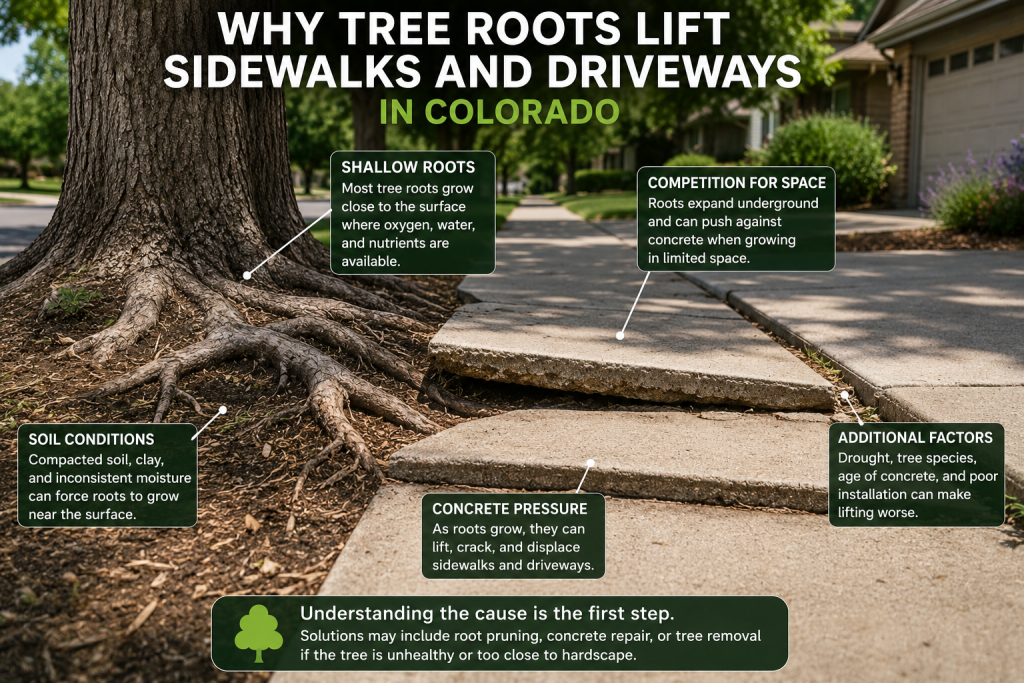
The reason tree roots lift sidewalks and driveways in Colorado usually comes down to a mix of shallow root growth, compacted soil, limited planting space, moisture patterns, and aging hardscape. Homeowners often notice the problem slowly. A small crack appears in the sidewalk. A driveway panel becomes uneven. A root starts showing above the lawn. Over time, the concrete lifts enough to create a trip hazard or drainage problem.
Tree roots do not usually “attack” concrete on purpose. They grow where conditions support them. In many Colorado yards, roots stay close to the surface because that is where oxygen, moisture, and usable soil are available. When concrete is installed near a tree, the roots and hardscape may compete for the same shallow space.
This problem is common in older neighborhoods, tight front yards, mature landscapes, and properties where large trees were planted too close to sidewalks or driveways. It can also happen after soil compaction, drought, overwatering, or construction disturbance.
Understanding why tree roots lift sidewalks and driveways in Colorado helps homeowners make better decisions. Sometimes the concrete can be repaired while preserving the tree. In other cases, cutting roots may create a safety issue for the tree. When root damage, trunk decay, or instability is involved, removal may become the safer option.
If tree roots are lifting concrete near your home, Good People Tree Service can inspect the tree, evaluate root-related risks, and help determine whether pruning, monitoring, or removal should be considered.
Why tree roots lift sidewalks and driveways in Colorado landscapes
Tree roots lift sidewalks and driveways in Colorado because most tree roots grow much closer to the surface than many homeowners expect. People often imagine tree roots growing deep like a mirror image of the canopy. In reality, many important roots spread outward through the upper soil.
These roots need oxygen. They also need moisture and room to expand. When the best growing conditions are near the surface, roots naturally grow there.
Colorado landscapes can make this pattern stronger.
Many yards have compacted soil, heavy clay, dry conditions, limited irrigation zones, and hardscape close to trees. Roots may follow narrow areas where water collects, oxygen is available, or soil is easier to penetrate.
That means the problem is not always the tree alone. The site often plays a major role.
Sidewalks and driveways become vulnerable when:
- A large tree is planted too close to concrete
- Roots grow in shallow or compacted soil
- Soil moisture collects near pavement edges
- Concrete panels are already aging or thin
- The tree species has large surface roots
- Construction changed the root zone
- Irrigation encourages roots near hardscape
- Soil under the concrete settles or shifts
The result is pressure from below and uneven support around the slab. Cracks, lifting, tilting, and gaps may follow.
Roots are shallower than most homeowners think
One of the biggest reasons tree roots lift sidewalks and driveways in Colorado is that roots are not as deep as people assume.
Most absorbing roots are located near the surface because they need oxygen. The upper soil layer usually has more oxygen than deeper soil. It also receives irrigation, rainfall, and organic matter from leaves or mulch.
Roots also spread far beyond the trunk.
That matters because a sidewalk several feet away from a tree may still be inside the active root zone. A driveway edge may seem far enough from the trunk but still be close to large structural roots.
This is why cutting roots near concrete can be risky. A root may look like an inconvenience, but it may also help support the tree or move water through the root system.
The larger the tree, the more carefully root conflicts should be handled.
Soil compaction pushes roots toward the surface
Soil compaction is one of the most important hidden causes of root and hardscape conflicts.
Compacted soil has less pore space. That means less room for oxygen and water movement. Roots struggle to grow through it. When deeper soil becomes difficult to use, roots may stay closer to the surface.
This can happen in many residential settings.
Common causes include:
- Construction equipment
- Parked vehicles
- Repeated foot traffic
- Heavy lawn use
- Patio or driveway installation
- Stored materials
- Soil grading
- Lawn renovation
- Hardscape work
Once soil is compacted, trees may show several stress symptoms. The canopy may thin. Leaves may scorch. Growth may slow. Surface roots may become more obvious.
Concrete problems can follow because those surface roots continue expanding over time.
This is one reason tree roots lift sidewalks and driveways in Colorado neighborhoods with older mature trees and heavily used yards.
Colorado drought can make root problems worse
Drought does not directly make roots “attack” concrete. But it can change how trees use the soil.
During dry periods, roots search through available soil for moisture. In irrigated landscapes, moisture may be concentrated near lawns, driveway edges, sidewalk strips, downspouts, or low spots.
A tree may develop more roots where water is available. If that water is near concrete, conflicts may become more noticeable over time.
Drought also stresses trees. A stressed tree may become more vulnerable to insects, disease, branch dieback, and root decline. If homeowners respond with shallow frequent watering, roots may stay close to the surface instead of being encouraged deeper into the soil profile.
Deep watering is usually better for mature trees than quick shallow watering.
In Colorado, dry summers and winter drought can both affect tree health. Healthy root systems are especially important because they help trees survive weather extremes.
Heavy clay soil and drainage issues matter
Some Colorado properties have heavy clay soils. Clay can hold water but may drain slowly. When compacted, it can also limit oxygen.
Poor drainage creates another problem. Roots need water, but they also need air. Soil that stays too wet can reduce root health and encourage shallow rooting patterns.
In low-oxygen soil, surface roots may become more common.
That can lead to root pressure near sidewalks, driveways, patios, and walkways.
Homeowners sometimes think the solution is simply to cut the visible roots. That approach can create bigger problems if the roots are large or close to the trunk.
A better first step is understanding why the roots are surfacing. Soil, drainage, tree species, and hardscape design all need to be considered.
The tree species can influence the risk
Some tree species are more likely to create surface root conflicts than others.
Fast-growing trees, large shade trees, and species with aggressive surface roots can be more likely to lift sidewalks or driveways when planted in tight spaces.
The issue is not always that the tree is “bad.” Often, it was planted in the wrong location for its mature size.
A small young tree may look perfect near a driveway. Twenty years later, the trunk, canopy, and root system may be much larger than expected.
In Colorado neighborhoods, root conflicts often happen when large trees grow in narrow lawn strips, small front yards, or areas surrounded by concrete.
Planning matters. The mature size of the tree should match the available soil space.
Concrete age and installation quality also play a role
Roots are not always the only cause of lifted concrete.
A sidewalk or driveway may crack because of age, poor base preparation, freeze-thaw cycles, settling soil, drainage problems, or heavy loads. Tree roots may then make an existing weakness worse.
Colorado freeze-thaw cycles can be hard on concrete. Water can enter cracks, freeze, expand, and widen the damage. If roots are already near the surface, the lifted area may become more noticeable.
Sometimes homeowners blame the tree when the concrete was already vulnerable.
Other times, the tree root is clearly the main cause.
Usually, both the tree and the hardscape should be evaluated before choosing a repair.
Why cutting roots can be dangerous
When tree roots lift sidewalks and driveways in Colorado, many homeowners want to cut the roots and replace the concrete. That may seem simple, but it can be risky.
Large root cuts can harm the tree. They can reduce water uptake, create decay entry points, weaken stability, and increase stress. In some cases, cutting major roots can make a tree more likely to lean or fail during wind.
The risk depends on:
- Root size
- Distance from the trunk
- Number of roots affected
- Tree species
- Tree health
- Soil condition
- Lean direction
- Nearby structures
- Existing decay or stress
A small root far from the trunk is different from a large structural root close to the base.
Cutting roots without understanding their role can turn a concrete repair into a tree safety problem.
Can the sidewalk or driveway be repaired without removing the tree?
Sometimes, yes.
The right solution depends on how severe the lifting is, how large the roots are, and how important the tree is to the property.
Possible hardscape solutions may include:
- Raising or ramping sidewalk panels
- Replacing concrete with a flexible material
- Redirecting the walkway
- Bridging over roots
- Using pavers in selected areas
- Adjusting grade carefully
- Improving drainage
- Creating more root-friendly space
- Installing root barriers in new designs
Not every option works for every site. Some solutions are more useful before a problem becomes severe. Others are better for preserving mature trees where removal is not necessary.
If the tree is healthy and valuable, a repair strategy may focus on preserving roots while reducing the trip hazard.
If the tree is declining, unstable, or too close to structures, removal may be more practical.
When root lifting means the tree should be inspected
Root-lifted concrete does not automatically mean the tree is dangerous. Many healthy trees create surface roots.
However, some signs should trigger a closer inspection.
Call for an evaluation if you notice:
- Large roots lifting concrete near the trunk
- A tree leaning toward a house or driveway
- Soil lifting on one side of the tree
- Cracks near the root flare
- Mushrooms near the base
- Crown thinning
- Dead branches
- Leaf scorch
- Early leaf drop
- Recent construction near the roots
- Large roots that were already cut
- Concrete lifting close to the trunk
- Multiple roots exposed and damaged
The tree’s condition matters as much as the concrete.
A healthy tree with manageable surface roots may be preserved. A declining tree with root damage and hardscape conflict may need a different plan.
Good People Tree Service can inspect the tree and help determine whether the root issue is mostly cosmetic, structural, or connected to tree decline.
Why roots near driveways can be different from roots near sidewalks
Sidewalk conflicts are often about trip hazards and accessibility. Driveway conflicts can also involve vehicle loads, drainage, and repeated pressure near the root zone.
Driveways may compact nearby soil more severely than pedestrian areas. Vehicles add weight. Edges may crack. Water may run along the driveway and collect near certain roots.
A tree near a driveway can be stressed by:
- Soil compaction from vehicles
- Limited rooting space
- Heat reflected from pavement
- Poor drainage
- Root cutting during repairs
- Deicing salts in some locations
- Construction disturbance
- Reduced soil oxygen
These stresses can affect both the tree and the driveway surface.
When tree roots lift sidewalks and driveways in Colorado, the driveway situation may require extra caution because roots may already be growing in a compacted, restricted space.
Should homeowners remove surface roots?
In most cases, homeowners should not remove large surface roots on their own.
Small nuisance roots in lawn areas may look tempting to cut, but large surface roots can be important. They may support the tree. Removing them can also create wounds that decay organisms enter.
Covering roots with deep soil is usually not a good solution either. Adding too much soil over roots can reduce oxygen and increase stress.
Better options may include:
- Mulching around exposed roots
- Expanding the mulch ring
- Reducing mowing near roots
- Avoiding root damage
- Adjusting irrigation
- Rerouting foot traffic
- Consulting a professional before cutting
A wide mulch area can make exposed roots less of a lawn problem while protecting them from mowers and foot traffic.
Can root barriers solve the problem?
Root barriers can help in some situations, especially when installed during new planting or new hardscape construction. They are less simple around mature trees.
A barrier may redirect roots, but poor installation can damage roots or create future problems. Barriers also need enough soil volume on the tree side. A tree still needs space to grow.
For existing mature trees, root barriers should be considered carefully.
They may be useful in selected cases, but they are not a universal fix.
A root barrier does not solve poor planting location, compacted soil, or a tree that has outgrown the space.
How to prevent root damage to sidewalks and driveways
Prevention is easier than repair.
The best way to reduce future conflicts is to plant the right tree in the right place.
Helpful steps include:
- Choose tree species based on mature size
- Avoid planting large trees in narrow strips
- Leave enough space from driveways and sidewalks
- Improve soil before planting
- Use mulch instead of turf near young trees
- Water deeply and consistently
- Avoid compacting the root zone
- Protect roots during construction
- Plan hardscape around existing mature trees
- Inspect older trees before major concrete work
Tree placement is especially important in Colorado because dry weather, compacted soils, and limited irrigation can increase stress over time.
A tree planted too close to concrete may not create issues for years. Once it matures, the conflict can become expensive.
When tree removal becomes the practical option
Tree preservation is ideal when the tree is healthy, well-placed, and manageable. Removal may become more practical when the tree is causing repeated damage or showing serious decline.
Removal may be considered when:
- Roots are severely lifting major hardscape
- The tree is too close to the house
- Large roots must be cut for repair
- The tree is leaning or unstable
- The canopy is declining
- The trunk has decay
- The tree has outgrown the available space
- Repeated repairs have failed
- The tree threatens utilities or structures
A tree does not need to be removed just because a root is visible. But if the hardscape issue is severe and root cutting would make the tree unsafe, removal may be the safer long-term choice.
Stump grinding may also be useful after removal if the area needs to be restored or prepared for new landscaping.
Final Thoughts
Why tree roots lift sidewalks and driveways in Colorado comes down to how roots grow, how soil behaves, and how much space trees have near hardscape. Roots are often shallow because they need oxygen and moisture. Compacted soil, drought, poor drainage, clay soil, and limited planting space can make conflicts worse.
The tree is not always the only problem. Concrete age, freeze-thaw cycles, settling soil, and installation quality can also contribute.
For homeowners, the biggest mistake is cutting large roots without understanding the tree’s stability and health. A root problem near concrete can become a safety issue if major support roots are removed.
Good People Tree Service helps Colorado homeowners evaluate trees with root conflicts, surface roots, hardscape damage, and signs of decline.
If tree roots are lifting your sidewalk or driveway, schedule an evaluation before cutting roots or replacing concrete around the tree.