
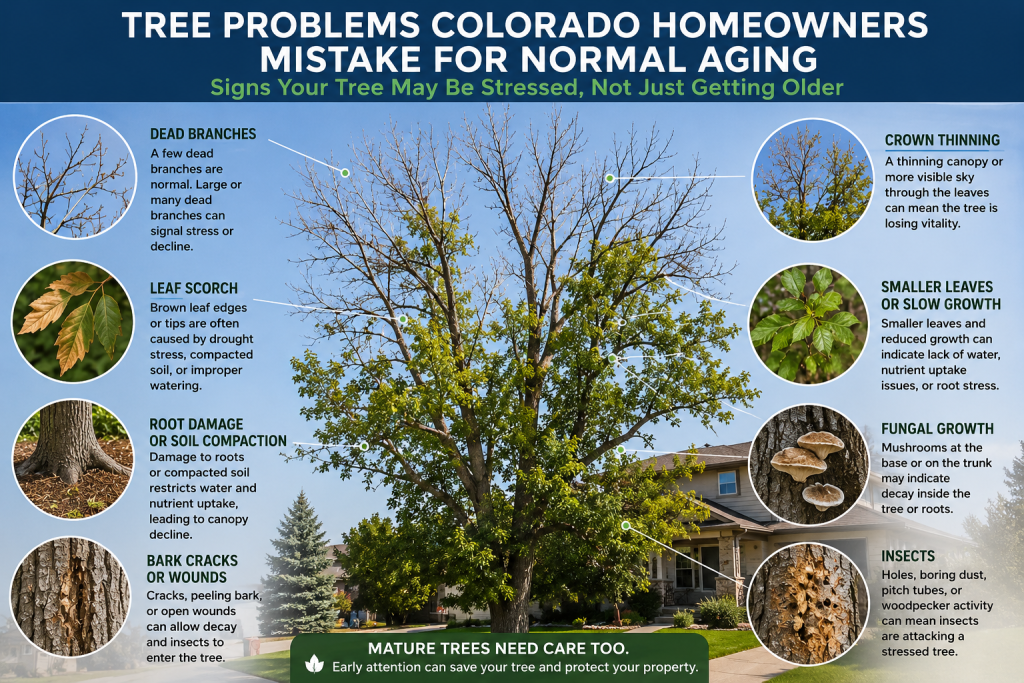
Some tree problems Colorado homeowners mistake for normal aging can be easy to overlook because they develop slowly. A tree may lose a few branches. Leaves may look smaller than usual. The canopy may thin. Bark may crack. Growth may slow down. At first, these changes can seem like a tree is simply getting older.
Sometimes that is partly true. Mature trees do change over time. They may grow more slowly, develop deadwood, and need more maintenance than young trees. But not every sign of decline is normal aging.
In Colorado, this difference matters. Trees along the Front Range face drought stress, dry winter weather, heavy clay soils, root damage, construction disturbance, strong winds, pests, and disease pressure. These problems can look like ordinary age-related decline at first. But if they are ignored, they may lead to branch failure, tree death, or emergency removal.
A healthy mature tree can often be maintained for years with proper care. A declining tree with hidden stress needs attention sooner.
If a mature tree on your property is thinning, dropping branches, showing leaf scorch, or declining faster than expected, Good People Tree Service can inspect it and help determine whether the issue is normal aging, treatable stress, or a safety concern.
Why Colorado Homeowners Often Mistake Tree Problems for Normal Aging
Tree problems Colorado homeowners mistake for normal aging are common because trees do not always show stress quickly. Many problems begin underground or inside the tree before homeowners notice anything obvious.
A root problem may take months or years to show up in the canopy. A drought-stressed tree may look fine during one dry season and decline later. A construction injury may not cause visible dieback until long after the project is complete.
This delay makes diagnosis difficult.
Homeowners may think, “The tree is old.” But the real issue may be drought, root damage, soil compaction, insects, disease, or internal decay.
The most commonly overlooked problems include:
- Crown thinning
- Top dieback
- Deadwood
- Leaf scorch
- Smaller leaves
- Early leaf drop
- Bark cracking
- Fungal growth
- Root flare issues
- Soil compaction
- Repeated branch drop
- Slow decline after construction
- Insect activity
- Poor watering symptoms
Some of these symptoms can happen naturally in older trees. But when several appear together, the tree may be under stress.
Normal Aging vs. Tree Decline
Aging is not the same as decline.
A mature tree may naturally grow more slowly than a young tree. It may produce some dead twigs inside the canopy, or it may need occasional pruning to remove dead, damaged, or rubbing branches. It may also need more monitoring after storms.
That can be normal.
Decline is different.
Decline means the tree is losing health, structure, or stability. It may be unable to move water properly, or be losing roots, or even attacked by insects.
The difference is pattern and severity.
A few small dead twigs may be routine. Large dead limbs high in the canopy are more serious. Slight seasonal leaf stress may not be alarming. Repeated scorch, thinning, and early leaf drop suggest a larger issue.
That is why tree problems Colorado homeowners mistake for normal aging should be evaluated by looking at the whole tree, not just one symptom.
Crown Thinning Is Often Misread as Age
Crown thinning is one of the most common issues homeowners dismiss.
A tree’s crown is the upper branch and leaf structure. When it starts thinning, more sunlight passes through. Branches look more exposed. Leaves may be smaller. The tree may look less full than it did a few years earlier.
Some thinning can happen as a tree matures. But noticeable crown thinning can also signal stress.
Common causes include:
- Drought
- Root damage
- Soil compaction
- Poor watering
- Disease
- Insects
- Trunk damage
- Construction disturbance
- Winter moisture stress
In Colorado, drought is a major concern. Prolonged drought stress can cause smaller leaves, early leaf drop, leaf scorch, browning tissue, and increased insect or disease pressure.
Crown thinning is not something to ignore if it appears suddenly or keeps getting worse.
Dead Branches Are Not Always “Just Old Age”
Older trees often produce some deadwood. That does not always mean the tree is dying.
However, the size, location, and amount of deadwood matter.
Small interior twigs may die because they no longer receive enough sunlight. This can be normal in mature trees.
Large dead branches are different.
Large dead limbs may indicate drought stress, root decline, disease, decay, or storm damage. They may also become a safety risk if they are high in the canopy or located over a roof, driveway, sidewalk, patio, or play area.
Colorado State University Extension lists removal of dead or diseased wood as a common acceptable reason to prune mature trees. That is because deadwood can affect both tree health and safety.
Tree problems Colorado homeowners mistake for normal aging often include dead branches that should have been addressed earlier.
If a tree is dropping large dead limbs or producing new deadwood every year, the issue deserves a closer look.
Leaf Scorch Is a Stress Signal
Leaf scorch often looks like dry, brown edges or burnt leaf tips. Many homeowners assume it is simply part of a hot summer.
Sometimes heat is involved. But leaf scorch usually means the tree is losing more water through its leaves than the roots can replace.
That can happen because of:
- Drought
- Improper watering
- Root damage
- Soil compaction
- Hot wind
- Poor drainage
- Construction injury
- Limited root space
Leaf scorch is especially common after hot, dry weather. But if it repeats year after year, the tree may have a deeper problem.
This is one of the tree problems Colorado homeowners mistake for normal aging because it can look seasonal. A homeowner may say, “It just does that every summer.” But repeated scorch means the tree is struggling to meet water demand.
Over time, repeated water stress can lead to branch dieback and increased pest pressure.
Smaller Leaves Can Mean Root Stress
Smaller-than-normal leaves are easy to miss.
A tree may still leaf out in spring. From a distance, it may look alive. But closer inspection may show that leaves are smaller, thinner, or less dense than usual.
This can be a sign that the tree has reduced energy or limited water uptake.
Possible causes include:
- Drought stress
- Root loss
- Soil compaction
- Construction damage
- Poor soil conditions
- Disease
- Declining vigor
Mature trees can tolerate some stress. But smaller leaves combined with crown thinning, dieback, or leaf scorch suggest the tree is not functioning well.
A tree does not have to be leafless to be in decline.
Top Dieback Is More Than a Cosmetic Issue
When the top branches of a tree begin dying, the problem is often serious.
The upper canopy is farthest from the roots. If the tree cannot move enough water, the top may show symptoms first. This is common during drought stress, root damage, and vascular problems.
Top dieback may appear as:
- Bare upper branches
- Dead branch tips
- Browning needles at the top
- Smaller leaves in the upper canopy
- Thinning crown
- Dead limbs spreading downward
Homeowners may think the top of the tree is aging naturally. But top dieback often points to a water movement problem.
This is another example of tree problems Colorado homeowners mistake for normal aging. The tree may be showing stress from below, even though the visible symptom is above.
Root Damage Can Look Like Aging Above Ground
Root damage is one of the most overlooked causes of tree decline.
A tree can lose roots during construction, trenching, driveway replacement, fence installation, patio work, grading, or soil compaction. The tree may not decline immediately. Symptoms may appear later in the canopy.
This delay creates confusion.
A homeowner may not connect branch dieback with a project completed two years earlier. They may assume the tree is simply old.
Root damage can cause:
- Crown thinning
- Leaf scorch
- Smaller leaves
- Branch dieback
- Early leaf drop
- Reduced growth
- Leaning
- Increased pest pressure
Colorado State University Extension explains that soil compaction reduces tree tolerance to stress factors such as drought, heat, wind, aphids, mites, and other insects. It also notes that compaction and hardscape features can limit root spread and show up as reduced growth and leaf scorch.
That is why the root zone matters so much.
A tree’s problem may begin under a driveway, patio, compacted lawn, or construction area.
Soil Compaction Slowly Weakens Trees
Soil compaction is a quiet tree stressor.
It does not look dramatic at first. There may be no broken branch, no large wound, and no obvious insect activity. But compacted soil limits oxygen and water movement. Roots struggle to grow and absorb moisture.
In Colorado yards, soil compaction can happen from:
- Construction equipment
- Parked vehicles
- Heavy foot traffic
- Stored materials
- Patio work
- Lawn installation
- Repeated mowing patterns
- Hardscape installation
The symptoms may look like aging:
- Slower growth
- Thinner canopy
- Leaf scorch
- Dead branches
- Stress during hot weather
- Increased insect issues
This is why tree problems Colorado homeowners mistake for normal aging often start in the soil. The tree may not be old enough to decline naturally. It may simply be growing in a damaged root environment.
Bark Cracks and Wounds Should Not Be Ignored
Mature trees often develop rough bark. That can be normal.
But cracks, open wounds, cavities, and peeling bark can also indicate serious problems.
Warning signs include:
- Deep vertical cracks
- Open wounds that do not close
- Soft or crumbling wood
- Cavities
- Bark falling off in large sections
- Fungal growth
- Sap or pitch around wounds
- Insect holes
- Woodpecker activity
A small surface crack is not always an emergency. But cracks combined with decay, lean, dieback, or dead limbs are more concerning.
Bark and trunk symptoms should be evaluated carefully because they may affect structure, not just appearance.
Mushrooms Near the Base Are Not Normal Aging
Mushrooms or fungal growth near the base of a tree can be a warning sign.
Some fungi grow on decaying organic matter in the soil and may not be connected to the tree. Others may indicate root or trunk decay.
A mature tree with mushrooms near the root flare, trunk base, or major roots should be inspected.
Possible concerns include:
- Root decay
- Trunk decay
- Reduced anchoring strength
- Internal wood breakdown
- Higher failure risk during wind or snow
This is especially important if the tree is near a house, driveway, sidewalk, or outdoor living area.
Fungal growth is one of the tree problems Colorado homeowners mistake for normal aging because it can seem harmless or seasonal. But in the wrong location, it may signal structural decline.
Insect Activity May Be Secondary to Stress
Many insects prefer stressed trees.
A homeowner may notice small holes, boring dust, pitch tubes, sticky sap, or woodpecker activity and assume insects suddenly caused the entire problem. Sometimes insects are the main issue. Other times, they are part of a larger decline pattern.
Drought, root damage, bark wounds, and soil compaction can weaken a tree’s defenses. Once the tree is stressed, insects may become more successful.
In Colorado, pest pressure can be especially important for stressed conifers, ash trees, and other vulnerable species.
Signs to watch for include:
- Boring dust
- Exit holes
- Pitch tubes
- Bark flaking
- Woodpecker damage
- Sudden branch dieback
- Crown fading
- Thinning needles or leaves
Insects should not be ignored. But the larger question is why the tree became vulnerable.
Early Leaf Drop Is Often a Warning
Some leaf drop is normal. Trees shed leaves in fall. They may also shed some leaves during short-term stress.
But early leaf drop during summer can be a warning sign.
It may be caused by:
- Drought stress
- Overwatering
- Root damage
- Leaf disease
- Insect feeding
- Heat stress
- Soil problems
If a tree drops leaves early once and recovers, it may have responded to temporary stress. If it happens repeatedly, the tree may be declining.
Early leaf drop is one of the tree problems Colorado homeowners mistake for normal aging because it can seem like the tree is simply “changing early.” But repeated early leaf drop means the tree is not holding its canopy normally.
Slow Growth Can Be a Sign of Stress
Mature trees naturally grow more slowly than young trees. That part can be normal.
But very limited growth, smaller leaves, sparse canopy, and repeated dieback may point to poor tree health.
Growth slows when the tree does not have enough resources.
Possible causes include:
- Drought
- Poor soil
- Root loss
- Compaction
- Disease
- Insect pressure
- Poor planting conditions
- Competition from grass
- Limited rooting space
The key is comparison. Has the tree changed noticeably? Is the canopy thinner than five years ago? Are branches dying each season? Are leaves smaller than normal?
Slow growth by itself may not be alarming. Slow growth with visible decline should be checked.
When Colorado Weather Makes Aging Look Worse
Colorado weather can make normal tree stress look more serious. It can also expose hidden problems.
Trees may be weakened by:
- Dry summers
- Windy springs
- Wet snow
- Freeze-thaw cycles
- Winter drought
- Hail
- Sudden temperature swings
- Long dry periods
A tree that is already declining may fail during a storm. A tree with root damage may lean after wet snow. A drought-stressed tree may become more vulnerable to insects.
This is why homeowners should inspect mature trees after major weather events.
The weather may not be the original cause. It may simply reveal the weakness.
When “Normal Aging” Needs a Professional Inspection
A mature tree should be inspected when symptoms are spreading, repeated, or connected to safety risks.
Call for an evaluation if you notice:
- Large dead limbs
- Top dieback
- Crown thinning
- Repeated leaf scorch
- Early leaf drop
- Mushrooms near the base
- New leaning
- Cracks in the trunk
- Branches dropping randomly
- Bark peeling in large sections
- Boring dust or pitch tubes
- Construction damage near roots
- Dead limbs over structures
- Fast decline after drought or storms
One symptom may not mean the tree is unsafe. But multiple symptoms together can point to decline.
Good People Tree Service can inspect the tree, explain the likely cause, and recommend pruning, monitoring, treatment, or removal when needed.
Can an Older Tree Be Saved?
Many mature trees can be preserved with the right care.
The best option depends on the cause of decline. A tree with drought stress may benefit from deep watering and mulch, at the same time a tree with deadwood may need careful pruning. Or a tree with root-zone compaction may need soil care and protection.
It may be manageable if:
- Most of the canopy is still alive
- Deadwood is limited
- Roots appear stable
- There is no major trunk decay
- Symptoms are not spreading quickly
- The tree is not threatening structures
- Care can reduce stress
A tree may need removal if:
- The canopy is mostly dead
- Large limbs are failing
- The trunk has severe decay
- Roots are unstable
- The tree leans toward a house
- Insect or disease damage is advanced
- Pruning cannot reduce risk enough
The goal is not to remove every old tree. The goal is to understand whether the tree is aging normally or declining dangerously.
How to Reduce Problems in Mature Colorado Trees
Homeowners can reduce tree stress with consistent care.
Helpful steps include:
- Water deeply during dry periods
- Water during dry winter months when needed
- Mulch properly around the root zone
- Keep mulch away from the trunk
- Avoid parking under trees
- Protect roots during construction
- Remove deadwood safely
- Avoid topping
- Monitor for insects
- Inspect trees after storms
- Improve soil conditions when possible
- Schedule regular mature tree evaluations
Colorado trees need care that matches local conditions. Dry air, drought, compacted soils, and sudden weather changes make proactive maintenance important.
Final Thoughts
Tree problems Colorado homeowners mistake for normal aging can lead to bigger issues when they are ignored. A mature tree may naturally grow more slowly, but thinning crowns, top dieback, leaf scorch, dead branches, root damage, fungal growth, and insect activity are not always normal.
The challenge is knowing the difference.
A tree may look old when it is actually drought-stressed. It may look tired when the real problem is soil compaction. It may seem to be aging when root damage from construction is slowly affecting the canopy.
For Colorado homeowners, early inspection can protect both the tree and the property around it.
Good People Tree Service helps homeowners identify tree problems Colorado homeowners mistake for normal aging, reduce risk, and decide whether pruning, monitoring, treatment, or removal is the right step.
If a mature tree on your property is declining, schedule an evaluation before normal aging becomes a serious safety concern.