
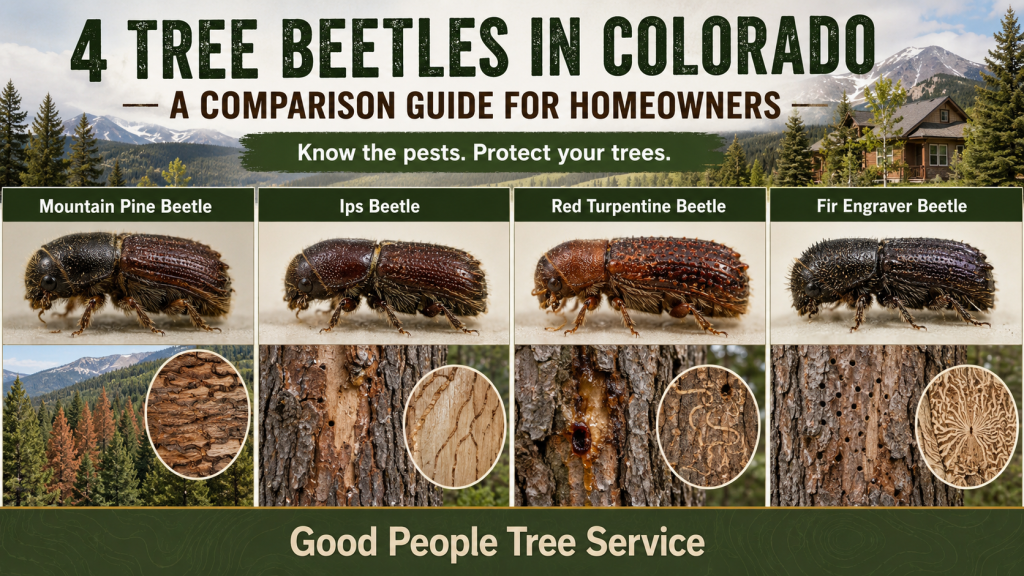
Mountain Pine Beetle vs. Ips Beetle vs. Red Turpentine Beetle vs. Fir Engraver Beetle is the kind of comparison many Colorado homeowners need but rarely find explained clearly. People notice pitch tubes, boring dust, fading needles, branch dieback, or a declining pine or fir tree. Then they start searching for answers and quickly realize that not every bark beetle affects the same trees in the same way.
That difference matters.
Some beetles are more aggressive killers., some are more likely to attack stressed or injured trees. Some target pines. Others are associated with true firs. Some leave damage higher in the trunk or canopy, while others are more often found near the lower trunk.
For homeowners in Colorado, especially along the Front Range and in foothill communities, this is more than a technical forestry topic. Bark beetle activity can affect tree health, property appearance, and long-term landscape planning. It can also influence whether a tree may still be monitored, whether stress reduction is the better step, or whether removal becomes the safer option.
If you suspect bark beetle activity in a pine or fir on your property, Good People Tree Service can inspect the tree and help determine whether the damage is active, whether the tree is declining beyond recovery, and what the next step should be.
Why the Differences Between These Beetles Matter
Homeowners often group all bark beetles together. That is understandable. The symptoms can overlap.
You may see:
- Small holes in bark
- Pitch tubes
- Boring dust
- Browning needles
- Top dieback
- Crown thinning
- Bark flaking
- Woodpecker activity
- Rapid tree decline
But the species matters because each beetle behaves differently.
The host tree matters too. A beetle affecting a ponderosa pine is not automatically the same beetle affecting a fir. A beetle attacking an injured pine near the base of the trunk may not be the same one that causes top dieback in a drought-stressed tree.
This is why a comparison post is useful. Mountain Pine Beetle vs. Ips Beetle vs. Red Turpentine Beetle vs. Fir Engraver Beetle is not just a naming exercise. It helps homeowners understand which trees are at risk, what symptoms to look for, and how urgent the problem may be.
Mountain Pine Beetle vs. Ips Beetle vs. Red Turpentine Beetle vs. Fir Engraver Beetle: The Big Picture
Before getting into each beetle, it helps to understand the basic pattern.
Mountain pine beetle is the best-known name in this group. It is associated with major tree mortality and is often seen as the most serious bark beetle problem in Colorado history.
Ips beetles are also important, but they are often more closely linked with stressed trees, slash, storm-damaged material, and drought-related decline. They can still kill trees, especially when conditions favor them.
Red turpentine beetle usually attacks stressed, injured, or weakened pines. It is often found low on the trunk. It may appear alongside other stress factors and is not always the only reason a tree declines.
Fir engraver beetle is a different category in an important way because it targets true firs rather than pines. If the host tree is a fir, this beetle becomes a more likely suspect than mountain pine beetle.
So when comparing Mountain Pine Beetle vs. Ips Beetle vs. Red Turpentine Beetle vs. Fir Engraver Beetle, the first question should always be: what kind of tree is being affected?
Mountain Pine Beetle
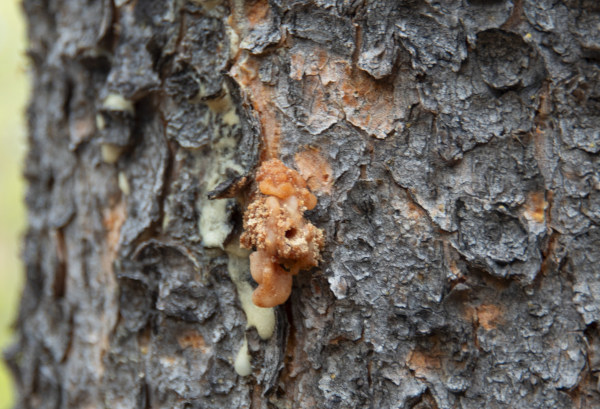
Mountain pine beetle is the best-known bark beetle in Colorado, largely because of the scale of damage it has caused in the state’s forests.
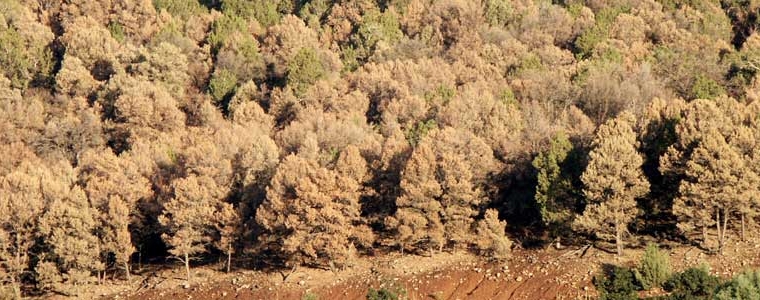
Colorado State Forest Service has reported that from the late 1990s through 2013, mountain pine beetle affected roughly 3.4 million acres of Colorado forest. In some lodgepole pine forests, mortality levels were devastating. That history is part of why homeowners are so alert when they hear the phrase “pine beetle.”
Mountain pine beetle primarily attacks pine species. In Colorado, it has been especially associated with lodgepole pine and ponderosa pine, though other pines can also be affected.
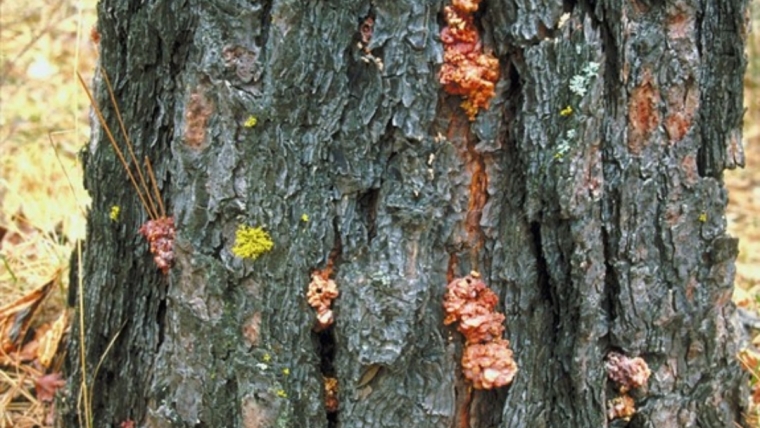
Common signs include:
- Pitch tubes on the bark
- Boring dust in bark crevices or around the base
- Blue-stain fungus in the wood
- Needles fading from green to yellow, then red
- Galleries under the bark
- Crown discoloration that may appear after the attack is well underway
One challenge with mountain pine beetle is timing. By the time the tree’s needles visibly turn red, the attack may already be well advanced or completed.
Mountain pine beetle is usually discussed as an aggressive tree-killing beetle. It is not simply a cosmetic pest.
In the Mountain Pine Beetle vs. Ips Beetle vs. Red Turpentine Beetle vs. Fir Engraver Beetle comparison, mountain pine beetle stands out for its history of large-scale mortality and its importance in pine ecosystems and residential landscapes near pine-dominated areas.
Ips Beetle
Ips beetle, sometimes called engraver beetle, is another important bark beetle in Colorado. In fact, there are multiple Ips species, and they can affect pine and some spruce hosts depending on the species and local conditions.
Ips beetles are often strongly associated with stress.
That stress may include:
- Drought
- Storm damage
- Fresh pruning slash
- Construction injury
- Root damage
- Recent disturbance
- Overcrowded or weakened trees
One reason Ips beetles confuse homeowners is that they may attack trees that already look stressed for other reasons. That means the beetle may appear as part of a larger decline pattern, not always as the first visible problem.
Common signs include:
- Top dieback or upper-crown decline
- Reddish or orange-brown boring dust
- Galleries beneath the bark
- Fading needles
- Activity in recently cut pine material or slash
- Faster decline during hot, dry periods
Ips beetle is also important because it can build in slash and freshly cut wood. That means tree care timing and cleanup can matter. Fresh storm-damaged material left on site for too long may support Ips populations.
In the Mountain Pine Beetle vs. Ips Beetle vs. Red Turpentine Beetle vs. Fir Engraver Beetle discussion, Ips beetle is often the one most closely tied to drought stress, site stress, and recently disturbed pine material.
If a pine tree is declining after a dry period or after damage, Good People Tree Service can help determine whether Ips activity may be part of the problem.
Red Turpentine Beetle
Red turpentine beetle is different from mountain pine beetle and Ips beetle in a few practical ways.
It is commonly associated with stressed, injured, or weakened pines. It is often found in the lower trunk area, especially near the base of the tree. That location can help distinguish it from other bark beetle patterns.
Homeowners may notice:
- Very large pitch tubes, often lower on the trunk
- Signs of attack near the base
- Pine stress following injury or disturbance
- Decline in already weakened trees
- Beetle activity after construction damage, root injury, or drought stress
Red turpentine beetle is often described as a secondary pest. That means it commonly attacks trees that are already under stress rather than healthy vigorous trees.
That distinction matters.
If you are comparing Mountain Pine Beetle vs. Ips Beetle vs. Red Turpentine Beetle vs. Fir Engraver Beetle, red turpentine beetle is often less about mass outbreak-style mortality and more about what happens when a pine has already been weakened.
This does not make it harmless. A tree near a house may still become unsafe if it continues declining. But it does change how the problem is interpreted.
A red turpentine beetle finding may point to a broader tree health issue, such as drought, root injury, or trunk damage, rather than being the only explanation.
Fir Engraver Beetle
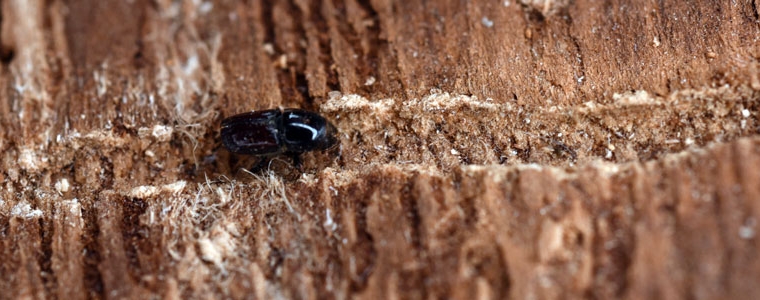
Fir engraver beetle belongs in this comparison because it is one of the key bark beetles homeowners may encounter in Colorado landscapes with true firs.
That host distinction is critical.
If the affected tree is a true fir, such as white fir or subalpine fir, fir engraver beetle becomes much more relevant than mountain pine beetle. Homeowners sometimes assume all needle browning in conifers is a “pine beetle” issue, but that is not always accurate.
Fir engraver beetle commonly affects stressed or weakened fir trees. Drought, root problems, stand stress, and other environmental pressures can increase vulnerability.
Common signs include:
- Fading crowns in fir trees
- Declining branches or crown sections
- Beetle galleries under the bark
- Bark loosening
- Tree stress before visible decline
- Multiple attacks in already weakened hosts
In the Mountain Pine Beetle vs. Ips Beetle vs. Red Turpentine Beetle vs. Fir Engraver Beetle comparison, fir engraver beetle is the one that immediately shifts the conversation from pines to true firs.
That alone makes proper identification important.
Host Tree Differences: One of the Fastest Ways to Narrow It Down
When homeowners notice beetle symptoms, one of the fastest ways to narrow the possibilities is to identify the host tree first.
Here is the practical breakdown:
- Mountain pine beetle: mostly pines
- Ips beetle: commonly pines, with some species affecting spruce
- Red turpentine beetle: pines
- Fir engraver beetle: true firs
That means if the affected tree is a fir, the conversation changes. If the affected tree is a pine, you then look more closely at where attacks are located, how the crown is declining, whether the tree was already stressed, and what kind of resin or boring dust is visible.
This is one reason Mountain Pine Beetle vs. Ips Beetle vs. Red Turpentine Beetle vs. Fir Engraver Beetle is such a helpful framework. It gives homeowners a more logical way to start sorting the clues.
Symptom Differences Homeowners Can Look For
Although positive identification may still require professional inspection, there are several patterns homeowners can watch for.
Mountain pine beetle often shows:
- Pine host
- Pitch tubes along the trunk
- Needle fade that becomes more visible later
- Serious whole-tree decline
- Large-scale concern in pine areas
Ips beetle often shows:
- Pine stress or recent disturbance
- Top dieback or crown decline
- Fine boring dust
- Association with slash or drought
- Faster attacks on already weakened trees
Red turpentine beetle often shows:
- Pine host
- Lower trunk attacks
- Larger pitch tubes
- Association with injury or stress
- Attack concentrated closer to the base
Fir engraver beetle often shows:
- True fir host
- Fir crown decline
- Bark beetle evidence in a fir, not pine
- Stress-linked attack pattern
- Progressive weakening of the host
These patterns are not a substitute for diagnosis, but they can help homeowners make better observations before calling for help.
Stress Is a Common Theme Across All Four
One of the most important things to understand in Mountain Pine Beetle vs. Ips Beetle vs. Red Turpentine Beetle vs. Fir Engraver Beetle is that tree stress often plays a major role.
Colorado trees face a lot of pressure.
Common stressors include:
- Drought
- Soil compaction
- Root damage
- Construction injury
- Poor watering
- Storm breakage
- Overcrowding
- Old age
- Existing disease
- Trunk wounds
A tree under stress is often less able to defend itself with resin and other natural responses. That can make beetle attacks more successful.
This is one reason bark beetle problems are often connected with broader tree health and site conditions.
Why Homeowners Misdiagnose Bark Beetles
Many homeowners assume that any browning conifer has the same problem.
That is not usually the case.
A tree may brown because of drought alone. It may decline from root damage, or it may be affected by cankers, needle diseases, or winter injury. It may have bark beetles, but not the species the homeowner assumes.
There is also a timing issue.
By the time needles change color, the beetle attack may already be established. Visible symptoms are often delayed compared with the actual infestation process.
That is why bark inspection, pitch patterns, host identification, and the location of damage matter so much.
Which One Is the Most Serious?
Homeowners often want a simple ranking.
In practical terms, mountain pine beetle usually carries the strongest recognition as a major tree-killing bark beetle because of its history of widespread mortality.
Ips beetle can also be serious, especially in drought-stressed or recently damaged pine stands and landscapes.
Red turpentine beetle may be less famous, but it should not be dismissed. It may indicate that a tree is already compromised.
Fir engraver beetle is very serious in the right host. If a true fir is under attack, the homeowner should not assume it is a minor issue.
So in Mountain Pine Beetle vs. Ips Beetle vs. Red Turpentine Beetle vs. Fir Engraver Beetle, the “most serious” answer depends partly on host species, tree condition, extent of attack, and location near people or property.
What Homeowners Should Do If They Suspect Beetle Activity
Start with observation, not guesswork.
Look at:
- Tree species
- Where the pitch tubes appear
- Whether boring dust is present
- Whether decline starts at the top, lower trunk, or throughout the crown
- Whether the tree was recently stressed
- Whether nearby trees show similar symptoms
- Whether storm damage or drought happened recently
Avoid moving suspect infested wood around the property unless you understand the implications. Beetle issues are often worsened when infested material is stored improperly.
Also remember that not every declining tree can be saved.
Some trees may already be too far gone. Others may need removal because they are close to a home, driveway, or walkway. In other cases, the best step may be reducing stress on nearby non-infested trees.
If you suspect mountain pine beetle, Ips beetle, red turpentine beetle, or fir engraver beetle, Good People Tree Service can inspect the tree and help determine whether the issue appears active and whether the tree should be monitored, managed, or removed.